

Disclosure: This post contains affiliate links to Pickleball Central. If you purchase through our links, FORWRD earns a small commission at no extra cost to you. We only link to products we'd recommend regardless.
Most guys pick a pickleball bag the same way they pick a gym bag — by eye, off Amazon, without thinking about how they actually play.
That works until your zipper blows out mid-tournament. Or you're running a paddle-only compartment when you need to carry your laptop from the office to the court. Or you show up to an outdoor concrete session with a sling bag soaked through from the bottom because you set it down between games.
The right bag depends on which of 3 player archetypes fits you. Our top overall pick is the FORWRD Court Caddy Backpack ($325) for competitors and commuters, and the Court Ranger V2 ($195) for weekend warriors who want serious construction without the premium price. Here's how to figure out which one is yours.
Last updated: September 2026
Table of Contents
- Why Most Bag Guides Aren't Written for How Men Actually Play
- The 3 Male Player Archetypes (and the Bag Each One Needs)
- Top Picks: Best Pickleball Bags for Men, Ranked by Use Case
- Capacity Deep Dive: How Many Paddles and Balls to Actually Carry
- What Wears Out First (and the Bags Built to Last)
- FAQ: Best Pickleball Bags for Men 2026
Why Most Bag Guides Aren't Written for How Men Actually Play
Scroll through the top-ranking "best pickleball bags" articles right now. Almost every one of them recommends bags by price tier — budget, mid-range, premium. Some go by bag style — sling, backpack, tour bag. What almost none of them do is ask the question that actually matters: how do you play?
Male pickleball players have some distinct gear patterns that generic guides miss. For starters, higher-level men carry significantly more paddles. At the 4.0+ level — as defined by USA Pickleball skill ratings — it's common to carry 2-4 paddles for different court conditions. A spin-heavy paddle for outdoor concrete plays completely differently from a control paddle on indoor gym floors. That capacity requirement eliminates most sling bags and half the backpacks on the market before you even look at price.
Then there's the outdoor concrete factor. Men's recreational pickleball skews heavily outdoor — and outdoor courts are brutal on bags. Bags get set on wet concrete, dragged along chain-link fences, left in 100°F car trunks. The materials that hold up aren't the same ones that photograph well on a blog written by someone who plays indoor once a week.
Most bag guides are aggregated from specs, not written from experience. The archetype framework below is built on feedback from 500+ real players — including the input that shaped the Court Caddy's modular design from the ground up.
The 3 Male Player Archetypes (and the Bag Each One Needs)
The Competitor
You play 4+ days a week. You have multiple paddles for different conditions, and you've thought about grip weight. You've been to at least one open tournament. When a bag fails, you notice immediately — you're relying on it every session, usually on outdoor concrete.
Your non-negotiables: multi-paddle storage (not just a sleeve that fits one), zipper quality that won't blow out after 200 sessions, and enough compartments to organize balls, extra grips, and a cooling towel without digging.
The bag: FORWRD Court Caddy Backpack ($325)
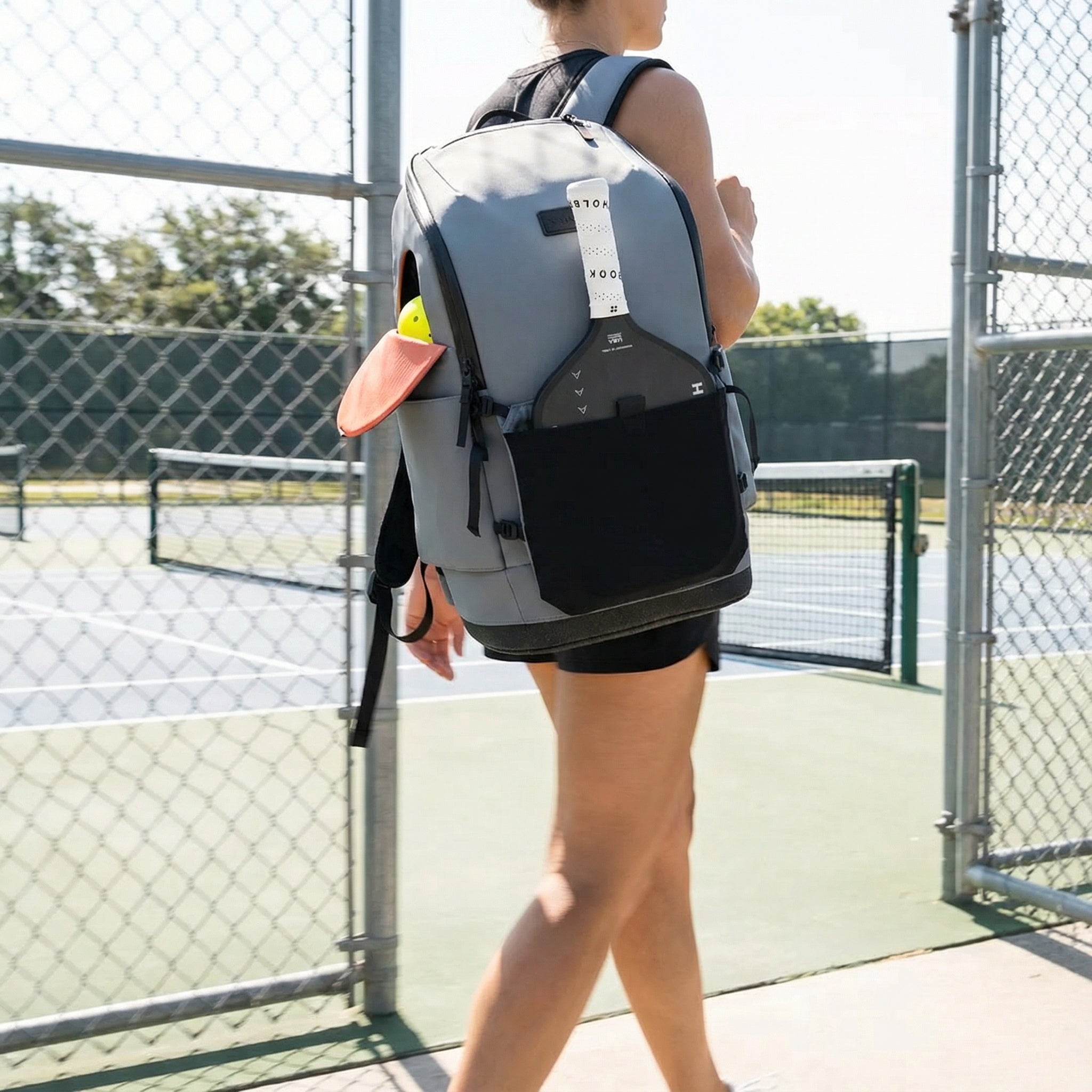
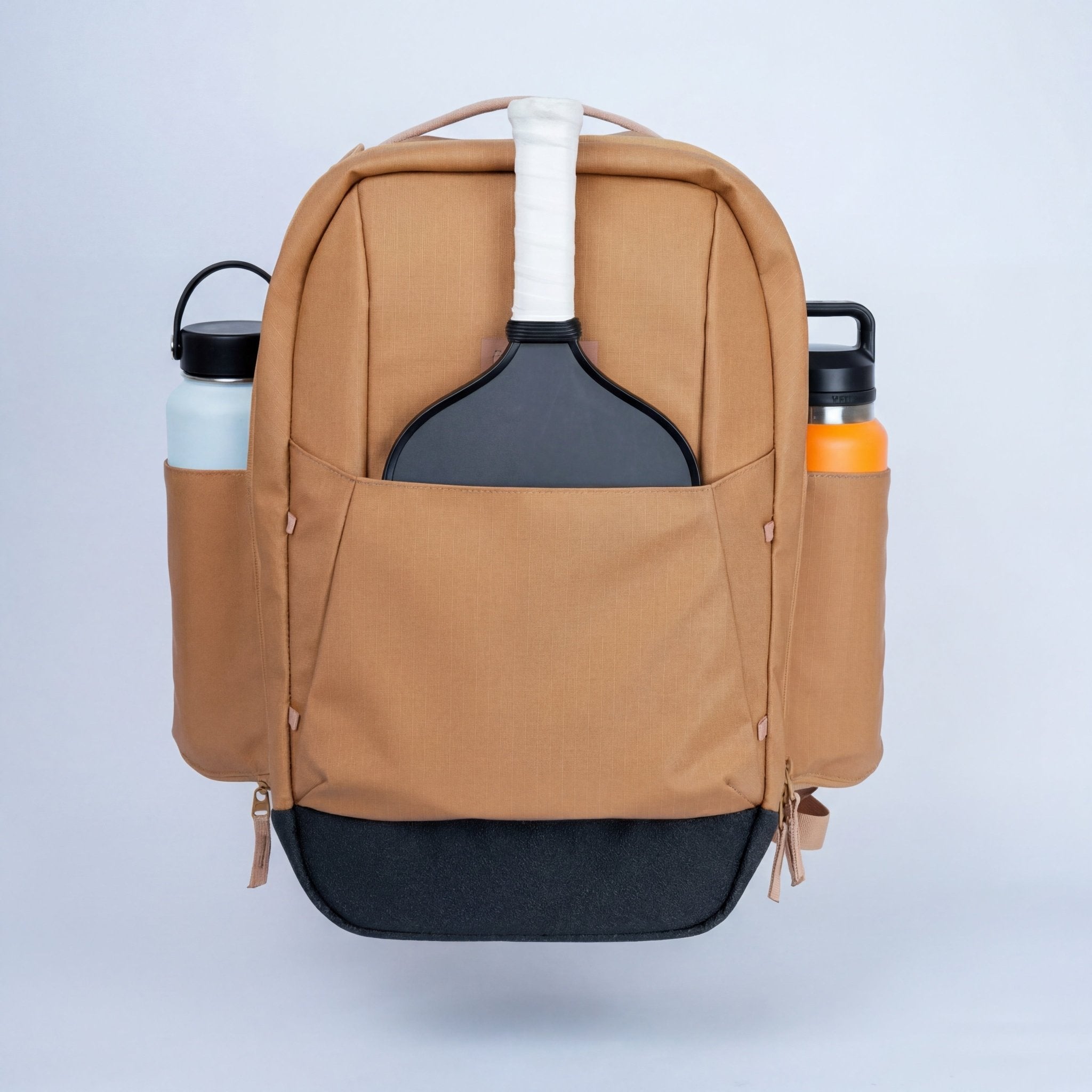
The Court Caddy's modular paddle sleeve fits up to 4 paddles — not crammed, actually organized. YKK AquaGuard zippers handle outdoor concrete and weather without stripping. A 15" padded laptop sleeve means you can go work-to-court without carrying two bags. Backed by a lifetime warranty — which matters more than most buyers realize when you're logging 300+ sessions a year.
One honest trade-off: it's heavier than a sling bag. If you're carrying a single paddle to a weekly casual game, it's more bag than you need. But if you're a Competitor, you already knew that wasn't your situation.

The Weekend Warrior
Two or three sessions a week. You take the game seriously — you're not still using a tennis racket bag — but you're not building a paddle quiver. You want something that handles real wear on outdoor courts without spending $300.
Your non-negotiables: fits 2-3 paddles, holds a water bottle without soaking everything else, and doesn't look like gear you borrowed from your kid.
The bag: FORWRD Court Ranger V2 ($195)
At $195, the Ranger V2 is the honest entry point for players who want serious construction without the premium price. The 16" laptop sleeve is actually wider than the Court Caddy's — useful if you're going work-to-court without a briefcase. It holds 3-4 paddles, takes trunk abuse without complaints, and was built from the same 500+ player feedback process as the Court Caddy. Same design philosophy, different capacity ceiling.
The JOOLA Tour Elite Pro ($139.95 at Pickleball Central) is the main alternative here — solid paddle storage for 3, decent build quality. But it has no laptop sleeve, and the warranty is one year versus lifetime. For players using their bag 150+ sessions a year, that warranty gap adds up fast.

The Commuter
You go straight from the office to the court. You're carrying a laptop, a change of clothes, and at least two paddles — and the bag has to look acceptable in both settings. A bag that screams "sports bag" doesn't fly in a co-working space or a client meeting.
Your non-negotiables: laptop protection, enough paddle capacity for two, and a design that doesn't embarrass you outside the court.
The bag: FORWRD Court Caddy Backpack ($325)
The Court Caddy's design was tested specifically for work-to-court use. The black colorway works in most office environments. The 15" padded laptop sleeve sits separated from the paddle compartment — your laptop isn't next to rubber balls and grip tape residue. The aesthetic is clean enough that you're not broadcasting "pickleball bag" in a business setting.
"Male players at the competitive level kept telling us they needed a bag that didn't force them to choose between carrying their full kit or looking like a professional. That was the design problem we were solving." — Topher, FORWRD co-founder
Top Picks: Best Pickleball Bags for Men, Ranked by Use Case
| Bag | Price | Paddle Capacity | Laptop Sleeve | Best For |
|---|---|---|---|---|
| FORWRD Court Caddy | $325 | 4 (modular) | 15" padded | Competitor, Commuter |
| FORWRD Court Ranger V2 | $195 | 3-4 | 16" padded | Weekend Warrior |
| JOOLA Tour Elite Pro | $139.95 | 3 | None | Budget-focused players |
| CRBN Pro Team Tour Bag | $139.99 | 3 | None | Style-first players |
| Selkirk Core Series Tour | $129.99 | 2-3 | None | Entry-level serious play |
On the competitors: JOOLA's Tour Elite Pro is the best non-FORWRD option by a margin — decent construction, clean organization, reasonable price. But no laptop sleeve eliminates it for the Commuter archetype entirely, and a one-year warranty on a $140 bag that you'll use 200 times this year is a short runway. CRBN's Pro Team Tour Bag looks sharp and has a following, but the interior organization trails behind at this price. Selkirk's Core Series Tour works fine for players who carry one paddle and play casually — if that's you, and $195 feels like too much, it's a reasonable backup option.
For a deeper look at backpack-format options specifically, the Best Pickleball Backpacks for Men 2026 guide covers that comparison in more detail.
Top Pick for Most Men: FORWRD Court Caddy Backpack
Modular 4-paddle sleeve, 15" laptop compartment, YKK AquaGuard zippers, lifetime warranty. Built with 500+ real players.
Capacity Deep Dive: How Many Paddles and Balls to Actually Carry
This is where most men get it wrong. The instinct is "carry as many paddles as I own" — which leads to either overpacking a sling bag or under-buying a backpack that can't grow with your game.
Casual players (3.0-3.5 level, 1-2 sessions/week): One paddle is fine. A medium backpack with a single padded sleeve handles your needs. No need to pay for 4-paddle capacity you won't use.
Competitive players (4.0+, 3+ sessions/week): Carry 2-4 paddles minimum. Outdoor concrete rewards a heavier, spin-forward paddle. Indoor gym wood floors respond better to a lighter, control-focused setup. A backup paddle for delamination issues isn't paranoia — at the competitive level, it's preparation. For detailed real-world capacity numbers across specific bag models, our paddle capacity test guide breaks it down bag by bag.
Tournament players: Full capacity, every time. A multi-day PPA Tour open means 3+ matches in a day across indoor and outdoor courts, temperature swings, and zero time to run to your car between rounds. That's 4 paddles, 12+ balls, a change of clothes, food, and your own water situation. A standard backpack runs out of room by match 2. This is when 4-paddle modular capacity stops being "nice to have" and starts being functional necessity.
On balls: carry a tube of 3-6 outdoor balls (Franklin X-40s or Durafast 40s work for most outdoor courts) and indoor balls separately if you play both surfaces. Balls disappear. Carry more than you think you need.
What Wears Out First (and the Bags Built to Last)
Here's the actual failure sequence after putting dozens of bags through multi-month outdoor court rotations:
1. Zipper pulls. The #1 failure point on budget bags. Cheap zinc pulls strip or break within 3-6 months of daily outdoor use. You end up gripping the zipper fabric with your fingernails mid-match. The Court Caddy uses YKK AquaGuard zippers — the same standard used in marine and outdoor gear — specifically because they survived consecutive rainy outdoor sessions without the pull compromising. Competitor bags at $130-$140 don't spec this.
2. Paddle sleeve fabric. The friction from pulling paddles in and out — especially textured carbon fiber faces — tears through unlined sleeves. Budget bags use thin nylon that shows wear within months. The Court Caddy and Ranger V2 both use reinforced padded sleeve fabric that holds up to daily pulls.
3. Strap attachment points. Metal D-rings rust on outdoor bags left in car trunks. Plastic D-rings crack in cold weather. Look for reinforced stitching at attachment points — this is where a bag fails catastrophically (full load, one strap, court surface). Not a fun situation.
4. Bottom panel. You're setting this bag on outdoor concrete constantly. Thin bottom panels develop abrasion holes within a season. Premium bags use a reinforced base layer — the Court Caddy's is noticeably thicker than anything in its competitor field at that price range.
The warranty math is worth doing. A $130 bag replaced once a year for 5 years = $650. The Court Caddy's lifetime warranty means you buy once and stop calculating. That reframe changes the value equation significantly for anyone who plays more than twice a week.
FAQ: Best Pickleball Bags for Men 2026
Are pickleball bags different for men and women?
Not structurally — the formats (backpack, sling, tour bag) are identical. The differences show up in usage patterns. Men at higher skill levels typically carry more paddles and play outdoor concrete more often, which makes durability and paddle capacity the top buying criteria. Aesthetically, men tend to favor darker colorways and designs that work in non-sport settings.
What capacity do I need as a male pickleball player?
Recreational players (1-2 sessions/week, 3.0-3.5 level) need room for 1-2 paddles and a set of balls — most backpacks handle this fine. Competitive players (4.0+, 3+ sessions/week) should target 3-4 paddle capacity minimum, accounting for different surface setups and backup paddles during play.
Which pickleball bags are best for competitive men's play?
The FORWRD Court Caddy is our top pick for competitive play — modular 4-paddle sleeve, YKK AquaGuard zippers for outdoor weather, and a lifetime warranty. For players who want serious construction at a lower price, the Court Ranger V2 ($195) is the best runner-up.
How many paddles should I carry?
At 3.5 and below, one paddle is enough. At 4.0+, carry 2-4. Most competitive male players bring a spin paddle for outdoor concrete, a control paddle for indoor gym floors, and a backup for delamination emergencies during match play. Tournament play demands maximum capacity — don't withdraw from a draw because your only paddle failed.
Do men's pickleball bags need a laptop sleeve?
Not for every player — but if you're going work-to-court more than once a week, it's worth prioritizing. Both the Court Caddy (15") and the Court Ranger V2 (16") include padded laptop sleeves. Most competitor bags at similar price points skip this entirely, which limits their practicality for anyone with a regular office-to-court schedule.
What's the best pickleball bag for outdoor courts specifically?
Outdoor concrete is harder on bags than indoor play in every way: UV exposure, moisture, temperature swings, and constant contact with rough surfaces. Look for YKK or equivalent-grade zippers, a reinforced bottom panel, and weather-resistant materials. The Court Caddy was specifically tested for outdoor court conditions before launch — that's the bar to hold any outdoor bag to.
Ready to upgrade your bag? Shop the Court Caddy — designed with 500+ real players and built to last.

Leave a comment
This site is protected by hCaptcha and the hCaptcha Privacy Policy and Terms of Service apply.