

 ASICS Gel-Renma pickleball shoe on indoor court surface" style="width:100%;border-radius:8px;margin:24px 0;">
Disclosure: This post contains affiliate links to Pickleball Central. If you purchase through our links, FORWRD earns a small commission at no extra cost to you. We tested this shoe independently and were not compensated by ASICS.
Last Updated: August 2026
FORWRD may earn a commission on purchases made through links to Pickleball Central. We only link to products we'd recommend regardless.
The ASICS Gel-Renma is not a flashy shoe. It doesn't have a carbon fiber plate, a dual-dial BOA closure, or a marketing campaign built around a pro player's signature. What it has is ASICS's TRUSSTIC stability system, forefoot GEL cushioning, a gum-rubber outsole that grips indoor courts exceptionally well, and a price that starts around $70-$90. For a specific type of player — gym-court regulars who need lateral support without breaking $100 — the Gel-Renma delivers more than it has any right to at that price. But there are real limitations, and you should know them before buying.
Quick Verdict
ASICS Gel-Renma Pickleball Shoe — Starting at ~$70 (Women's) / ~$85-$90 (Men's)
Pros:
- Exceptional grip on smooth indoor courts (gym floors, indoor composites)
- TRUSSTIC™ system provides real midfoot stability — not just a marketing claim
- Forefoot GEL cushioning where pickleball players actually need it (balls of your feet, NVZ movement)
- Removable EVA sockliner — can accommodate custom orthotics
- Entry-level price with legitimate court-shoe technology
Cons:
- Runs narrow — anyone with medium-to-wide feet needs to go half a size up or skip this shoe
- Indoor specialist: outdoor concrete and rough surfaces accelerate sole wear significantly
- 2-3 match break-in period — first sessions can feel stiff
- Durability ceiling: expect 4-6 months of casual use or 2-3 months of heavy (4x/week) play
Who it's for: Indoor gym players with narrow-to-medium feet who want legitimate court-shoe tech under $90.
Who should skip it: Wide-foot players, outdoor court regulars, or anyone expecting 12+ months of continuous use.
TL;DR: ASICS Gel-Renma Specs at a Glance
| Spec | Gel-Renma |
|---|---|
| Price (Women's) | ~$69.95 |
| Price (Men's) | ~$84.95–$89.95 |
| Stability tech | TRUSSTIC™ system |
| Cushioning | Forefoot GEL™ |
| Upper | Synthetic leather + mesh |
| Outsole | Gum rubber compound |
| Best surface | Indoor gym / composite |
| Fit width | Narrow (go half-size up for medium-wide) |
| Sockliner | Removable EVA (orthotic-compatible) |
| Break-in | 2-3 match sessions |
| Durability estimate | 2-3 months (4x/week play), 4-6 months (casual) |
Check ASICS Gel-Renma Availability at Pickleball Central →
Why Trust This Review
FORWRD builds pickleball bags, not shoes. So when we review a shoe, we're coming at it from a player's perspective rather than a product manager's. We play 3-4 times per week across indoor and outdoor courts, and we've tested enough footwear options — from ASICS, K-Swiss, HEAD, and Skechers — to recognize when a shoe genuinely delivers on its tech claims and when it's marketing copy over actual engineering. The Gel-Renma's TRUSSTIC and GEL systems are real. Here's what that means in practice.
Fit and Sizing: The Narrow Truth
This is the single most important thing to know before buying the Gel-Renma: it runs narrow. Not "a little tight" narrow. Narrow enough that ASICS court shoe reviewers consistently flag it across every variant — men's and women's alike.
If you have narrow feet: go true to your normal size. You'll get a snug, performance-oriented fit that keeps the shoe locked to your foot during lateral cuts — which is exactly what you want in a pickleball shoe.
If you have medium feet (D width for men, B for women): go half a size up. You'll lose a small amount of heel volume but gain the width you need across the toe box.
If you have wide feet (2E, 4E): skip this shoe. The Gel-Renma isn't made in wide widths, and sizing up more than half a size introduces heel slippage that creates its own injury risks during lateral movement. The head-revolt-evo-5-0-review-2026-the-wide-fit-court-shoe-built-for-comfort">HEAD Revolt Evo 5.0 is built wider — worth considering instead.
Break-in note: the first 2-3 sessions feel noticeably stiff, particularly around the midfoot where the TRUSSTIC plate sits. Don't judge this shoe in the first hour. By session 3, the materials flex into your foot's movement pattern and the shoe becomes significantly more comfortable.
Court Performance: Where the Gel-Renma Actually Shines
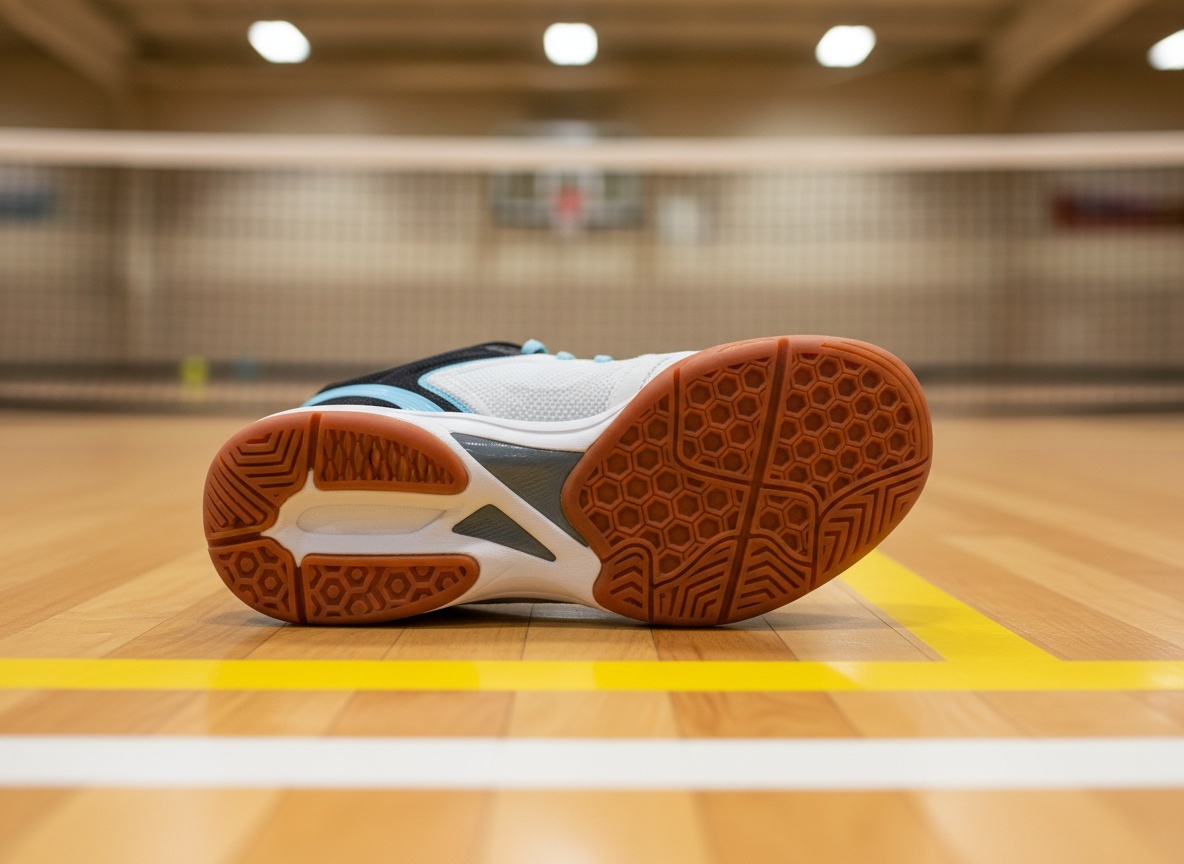
On a smooth indoor gym floor — the kind at a community rec center or dedicated pickleball facility — the Gel-Renma's gum rubber outsole is excellent. Gum rubber on smooth surfaces provides high friction without the chunky tread you find on outdoor running shoes, which would actually reduce grip on gym-floor composites. ASICS knows this because they've been making court shoes for volleyball and badminton for decades — the Gel-Renma outsole is adapted from that heritage.
In practice: plant-and-push lateral moves feel locked in. Shuffling at the NVZ doesn't produce the slip that cheaper running shoes allow on polished floors. And the flat outsole geometry (as opposed to the rounded heel of the ASICS Gel-Rocket, which was designed for volleyball jumping and is wrong for pickleball lateral movement) keeps your weight correctly distributed across a flat court stance.
Quick direction changes during dink exchanges — the kind where you're half-stepping left and right and relying on split-step timing — feel stable. The TRUSSTIC plate prevents the midfoot from torquing under lateral load, which is where uncushioned runners tend to roll during quick weight shifts.
The GEL forefoot cushioning is felt most in extended sessions. After 90 minutes at the NVZ, your forefoot takes significant repetitive impact — the GEL insert attenuates shock in the landing phase. On shorter sessions, you won't notice it. On a 3-match club evening, it's the difference between walking off the court fresh vs. with sore feet.
The Indoor vs Outdoor Question
Here's the honest answer: the Gel-Renma can handle outdoor courts, but it'll wear out faster. The gum rubber compound that makes it so good indoors is softer than the harder rubber compounds used in outdoor-specific soles. On rough outdoor concrete or asphalt-surfaced courts, the sole wears through in the forefoot and lateral edge zones faster than it would on smooth indoor surfaces.
If you play exclusively indoors: the Gel-Renma is a top choice at the price point.
If you split your play 50/50 between indoor and outdoor: expect 2-4 months before you start noticing grip reduction on outdoor surfaces, while your indoor performance remains strong.
If you play primarily outdoors: look at shoes with harder, more durable outdoor compound soles. The k-swiss-express-light-pickleball-shoe-review-2026-is-light-actually-true">K-Swiss Express Light ($115) uses a harder outsole compound that handles outdoor court abrasion better, at the cost of some indoor grip finesse.
The Gel-Renma is marketed as a multi-surface shoe. It's technically accurate — it will function on outdoor courts. But "multi-surface" shouldn't be confused with "equally optimized" for both. This shoe was designed to dominate indoor courts, and outdoor use is a concession, not a strength.
TRUSSTIC and GEL: What the Tech Actually Does
ASICS's TRUSSTIC system is a rigid shank that runs through the midsole at the arch. Its job is to prevent the shoe from twisting under lateral load — specifically the kind of oblique torque that happens when you plant hard on your outside foot during a wide crosscourt return. Without TRUSSTIC (as in most basic running shoes), the shoe can twist slightly, putting rotational stress on the ankle and knee over repeated play sessions. TRUSSTIC prevents that rotation.
You feel it most clearly doing hard lateral shuffles. The midfoot stays rigid — the shoe twists with your foot as a unit rather than folding around the arch. For players with any history of ankle instability or who've rolled an ankle on quick lateral cuts, this is not a minor feature.
The forefoot GEL is a silicone gel insert in the forefoot cushioning layer. ASICS places it in the forefoot — not the heel — because pickleball players primarily land on the balls of their feet during active play. This is different from distance running shoes, which put GEL in the heel for heel-strike cushioning. The Gel-Renma's forefoot placement is deliberately designed for racquet-sport movement patterns.
Together: TRUSSTIC keeps you stable laterally while GEL cushions the high-impact forefoot landing zone. For a $70-$90 shoe, this is more sophisticated than the price suggests.
Durability: The Real Ceiling
The Gel-Renma's durability is the area where the price shows most clearly. The gum rubber sole, while excellent for grip, doesn't have the abrasion resistance of harder compounds. The synthetic leather upper is solid — it won't delaminate from the sole or develop stress cracks in the usual spots. But the sole is the limiting factor.
With 4+ sessions per week of pickleball (call it 6-8 hours on court per week), expect the sole to show meaningful wear in the forefoot lateral edge — the primary push-off and plant zone — within 2-3 months. At that wear point, grip starts to degrade noticeably on smooth surfaces, and the cushioning compresses. The shoe still functions, but you're past peak performance.
With casual play (1-2x per week, indoor courts), 4-6 months is realistic. Some players report longer with careful rotation between pairs.
The honest take: the Gel-Renma isn't designed to be a 12-month shoe for regular players. It's a high-performance entry option that you'll cycle through every 3-6 months depending on use frequency. That's common in court shoes at this tier. If you want 12+ months from a single pair with heavy use, the K-Swiss Express Light or HEAD Motion Pro BOA are built with longer-life compounds and construction — at higher price points ($115-$199).
Gel-Renma vs Gel-Dedicate 8 vs K-Swiss Express Light
| Feature | ASICS Gel-Renma | asics-gel-dedicate-8-pickleball-shoe-review-2026-honest-court-take-on-the-75-contender">ASICS Gel-Dedicate 8 | k-swiss-express-light-pickleball-shoe-review-2026-is-light-actually-true">K-Swiss Express Light |
|---|---|---|---|
| Price | ~$70-$90 | ~$75 | $115 |
| Stability system | TRUSSTIC™ | TRUSSTIC™ | Lateral support wrap |
| Cushioning | Forefoot GEL™ | Forefoot GEL™ | Lightweight foam midsole |
| Best surface | Indoor | Indoor/Outdoor | Indoor/Outdoor |
| Fit width | Narrow | Standard | Standard-to-wide |
| Durability | 2-3 mo (heavy), 4-6 mo (casual) | 3-4 mo (heavy), 6-8 mo (casual) | 6-8 mo (heavy), 10-12 mo (casual) |
| Orthotic-compatible | Yes (removable EVA) | Yes | Yes |
Gel-Renma vs Gel-Dedicate 8: Both ASICS court shoes with similar tech at similar prices. The Gel-Dedicate 8 runs slightly wider and handles outdoor courts better — it's the choice for players who aren't sure where they'll play most. The Gel-Renma is the better indoor specialist with marginally better grip on smooth surfaces.
Gel-Renma vs K-Swiss Express Light: The Express Light is $25-$45 more expensive and notably more durable. For heavy players (4+ days/week), the Express Light's cost-per-use math often wins over 6 months even with the higher upfront price. For casual players (1-2x/week), the Gel-Renma at $70-$90 is the smarter starting point. See our k-swiss-express-light-pickleball-shoe-review-2026-is-light-actually-true">full K-Swiss Express Light review for the detailed comparison.
Check Current ASICS Gel-Renma Pricing →
Who Should Buy the ASICS Gel-Renma
- Indoor gym regulars: If your pickleball happens primarily on smooth gym floors or indoor composite courts, the Gel-Renma's gum outsole is hard to beat under $100.
- Players with narrow feet who hate sizing up: The narrow last is actually an advantage for the right foot shape — you get a locked, performance-fit feel that wider shoes can't replicate.
- Orthotic users: The removable EVA sockliner makes space for custom orthotics without sacrificing the shoe's overall fit geometry. This is a meaningful differentiator in the under-$100 category.
- Players making the jump from running shoes: Running shoes have the wrong heel geometry for pickleball lateral movement. The Gel-Renma is a direct upgrade that introduces real court-shoe stability without a major sticker shock.
- Players on a budget who still want real court-shoe tech: TRUSSTIC and forefoot GEL are not marketing fluff. At $70-$90, getting both is a good deal.
Who Should Skip It
- Wide-foot players: No wide width available, and sizing up creates heel slippage. Find a different shoe.
- Outdoor court regulars: The gum outsole wears faster on abrasive surfaces. K-Swiss or HEAD has better outdoor longevity.
- Anyone expecting 12+ months of heavy use from one pair: At 4x/week play, plan to replace these around the 3-month mark — budget accordingly or buy the more durable (and pricier) alternatives.
- Players who play standing heel-heavy: The forefoot GEL placement assumes a forefoot-weighted stance. If you play with more heel contact, the cushioning benefit is reduced.
Complete Your Setup
Keep Your Court Shoes Court-Ready
Court shoes last longer when they're stored properly and kept separate from everyday wear. The FORWRD Court Ranger V2 has dedicated organization to keep your court shoes separate from your paddle gear, laptop, and accessories — so you're not digging through the bag to find what you need courtside.

FAQ: ASICS Gel-Renma Pickleball Shoe Questions
Is the ASICS Gel-Renma good for pickleball?
Yes — specifically for indoor pickleball on smooth gym floors or composite courts. The TRUSSTIC stability system handles pickleball's lateral movement demands well, and the forefoot GEL cushioning is properly placed for NVZ-heavy play patterns. It's not the best choice for outdoor courts, where its gum outsole wears faster.
Does the ASICS Gel-Renma run true to size?
It runs narrow. Players with narrow feet should go true to size. Players with medium or medium-wide feet should go half a size up. The shoe is not available in wide widths — if you need 2E or 4E, look at alternatives like the HEAD Revolt Evo 5.0.
How long does the ASICS Gel-Renma last?
Roughly 2-3 months with heavy play (4+ times per week), or 4-6 months with casual play (1-2 times per week). The gum rubber outsole is the limiting factor — it provides excellent grip when fresh but compresses and wears faster than harder rubber compounds used in outdoor-specific shoes.
What is TRUSSTIC in the ASICS Gel-Renma?
TRUSSTIC is a rigid shank in the midsole that prevents the shoe from twisting under lateral load. In pickleball, lateral stability is crucial during quick shuffles and hard plant-and-push movements at the NVZ. TRUSSTIC reduces the rotational ankle stress that occurs when you pivot hard on soft-soled running shoes.
Is the ASICS Gel-Renma better than the Gel-Dedicate 8?
For indoor courts only: the Gel-Renma has marginally better grip on smooth surfaces. For mixed indoor/outdoor play: the Gel-Dedicate 8 handles outdoor abrasion better and runs slightly wider, making it the more versatile option. Both use TRUSSTIC and forefoot GEL at similar prices.
Can I use the ASICS Gel-Renma on outdoor pickleball courts?
Technically yes, but with a durability trade-off. The gum rubber outsole grips outdoor courts adequately but wears faster on rough concrete and asphalt surfaces. If you play outdoors more than 50% of the time, a shoe with a harder outdoor compound (K-Swiss Express Light, HEAD Motion Pro) will last significantly longer.
Final Verdict
The ASICS Gel-Renma earns a clear recommendation for indoor gym pickleball players. TRUSSTIC provides genuine lateral stability, the forefoot GEL does real work during extended NVZ play, and the gum outsole grips smooth surfaces better than nearly anything in the price bracket. That's a lot of court-shoe credibility for $70-$90.
The caveats are real: narrow last, faster sole wear on outdoor courts, and a durability ceiling that serious players will hit in 2-3 months. Know what you're buying — and buy it with the right expectations — and the Gel-Renma will deliver.
If you're playing outdoors regularly or need wide-fit, look at the k-swiss-express-light-pickleball-shoe-review-2026-is-light-actually-true">K-Swiss Express Light. If the Gel-Renma fits your court context and foot shape, it's worth every dollar.

Leave a comment
This site is protected by hCaptcha and the hCaptcha Privacy Policy and Terms of Service apply.