

Disclosure: This post contains affiliate links to Pickleball Central. If you purchase through our links, FORWRD earns a small commission at no extra cost to you. We only link to products we'd recommend regardless.
ASTM F803 is the certification standard that determines whether a pair of glasses can actually protect your eyes during pickleball. Standard UV sunglasses don't pass it. Most buying guides mention the acronym without explaining what the test involves — or why it's different from other eye safety standards you'll see on product pages. This one does. Last Updated: September 2026
Table of Contents
- What ASTM F803 Is and Who Sets the Standard
- What the Test Actually Involves
- ASTM F803 vs. ANSI Z87.1: The Confusion You Need to Clear Up
- What "Shatterproof" and "Impact Resistant" Mean Without Certification
- How to Verify Certification Before You Buy
- What Happens When Uncertified Lenses Take a Hit
- FAQ: ASTM F803 Pickleball Eye Protection
What ASTM F803 Is and Who Sets the Standard
ASTM International — formerly the American Society for Testing and Materials — is a global standards organization that develops technical specifications for materials, products, and systems across hundreds of industries. Steel alloys, medical devices, protective sports eyewear — they write the tests that define what "certified" actually means in any given context.
F803 is the specific standard number for eye protection for racquet sports. It was originally written for squash, racquetball, and tennis, then updated to include pickleball as the sport grew into mainstream recreational and competitive play. The current version covers several racquet sports, each with its own velocity requirements calibrated to the typical ball speeds in that sport.
ASTM doesn't manufacture anything. It defines the test methodology. Eyewear manufacturers run their products through accredited testing labs to those specifications and — if the product passes — can label it as ASTM F803-certified. The FORWRD Brioti FOCOS meets this standard. So does a $25 pair of ONIX Falcons. The standard sets the floor, not the ceiling.
USA Pickleball and most organized recreational leagues reference ASTM F803 as the minimum bar for certified protection. No federal law requires pickleball glasses — but the ball doesn't care about context when it comes off a driven paddle at 60+ mph.
What the Test Actually Involves
Most articles go vague here. "Tested to withstand high-velocity impact" says almost nothing useful. Here's what F803 actually requires:
It tests the assembly — lens and frame together, not the lens alone. A lens that passes in one frame can fail in a different frame. The standard requires the whole system to survive the impact test. This matters because cheap frames can flex inward under impact and drive the lens toward the eye even if the lens material itself doesn't crack.
The test uses a high-velocity steel ball. A 25mm steel ball is propelled at the lens at velocities set for each sport category. Steel at high velocity simulates worst-case contact — the kind of ball-to-face impact that happens at close range from a hard drive or an errant overhead.
After impact, the lens can't crack, shatter, or become displaced toward the eye. The frame can't break in a way that creates sharp edges or collapses inward. The whole assembly has to hold together. It's a pass/fail test — no partial credit.
This is meaningfully different from what UV sunglasses are tested to. Fashion and sun lenses are evaluated for UV transmission, optical clarity, and basic drop resistance — not sport-specific high-velocity projectile impact. "UV400 protection" and "polycarbonate construction" don't equal ASTM F803. Polycarbonate is the right lens material (it's impact-resistant by nature), but polycarbonate in an untested frame is not a certified assembly. The material matters; the system test matters more.
ASTM F803 vs. ANSI Z87.1: The Confusion You Need to Clear Up
Both standards appear on eyewear product pages. They're not interchangeable, and knowing which you're looking at matters.
ANSI Z87.1 is the American National Standards Institute standard for occupational and educational eye protection — safety goggles for woodworking, chemistry labs, construction sites. It's designed for workplace hazards: flying metal chips from grinding, chemical splash, optical radiation from welding. The standard involves impact testing and is rigorous in its occupational context.
But ANSI Z87.1 is not designed for high-velocity ball impact in a sport environment. The projectile specifications and frame retention requirements are calibrated for different threat profiles. A pair of Z87.1-rated safety glasses might stop a nail-gun chip but flex open under a driven pickleball — because that's not what they were built or tested for.
For pickleball, the correct certification is ASTM F803. If a product lists only Z87.1, it doesn't meet the racquet sports standard. Some products carry both — that's a stronger credential, not a redundant one. One doesn't substitute for the other.
What "Shatterproof" and "Impact Resistant" Mean Without Certification
They mean nothing enforceable.
"Shatterproof" is a marketing term with no regulatory definition. A manufacturer can print it on any lens regardless of what testing was done. Same with "impact resistant." These phrases describe a material property — polycarbonate genuinely is harder to shatter than glass or CR-39 plastic — but they say nothing about whether the full assembly passed a sport-specific projectile test.
A product marketed as having "polycarbonate shatterproof lenses" with no ASTM F803 mark has not been tested to that standard. It might perform fine. It might not. There's no third-party data behind the claim — just words on a box.
Certification cuts through the marketing language. ASTM F803 doesn't care what the packaging says; the product either passed the test or it didn't. That's the only statement worth relying on.
How to Verify Certification Before You Buy
Three places to check, in order of reliability:
1. Product packaging. Certified products must state the standard on the packaging. Look for "ASTM F803" explicitly — no asterisks, no vague qualifiers. "Meets impact standards" without specifying the standard is not a certification claim.
2. Product page specifications. Reputable brands include the certification in the technical spec section alongside lens material and frame specs. If you see "Polycarbonate lenses" but no mention of F803, the product likely isn't certified to the standard.
3. Manufacturer documentation. For products where you're uncertain, ask the manufacturer directly for their certification test report number and the lab that ran it. A legitimate F803 claim has third-party lab documentation. No documentation means no verifiable claim.
The FORWRD Brioti FOCOS carries ASTM F803 certification — the interchangeable-lens system means you get a certified frame regardless of which lens you pair with it. For players who want certified protection without the premium optics, the ONIX Falcon at Pickleball Central is a verified entry-level option that passes the standard.

Shop the FORWRD Brioti FOCOS — ASTM F803 Certified →
What Happens When Uncertified Lenses Take a Hit
Standard non-certified lenses — including most fashion sunglasses — use CR-39 plastic lenses in frames with basic retention designed for cosmetic durability, not sport impact. Under high-velocity contact, these can fail three ways:
Shatter into fragments. CR-39 plastic breaks. Those fragments enter the eye at effectively the same velocity as the original ball strike. This is the worst-case scenario and the failure mode ASTM F803 specifically guards against.
Flex inward without breaking. Even if the lens stays intact, a flexible frame not designed for sport impact can compress inward on contact, driving the lens directly into the cornea. Frame-level failure without lens breakage is still a serious injury mechanism.
Pop the lens out of the frame. Cheap frame-lens retention systems release under impact. The lens becomes a secondary projectile — loose, at close range, with nowhere to go except toward your face.
The honest risk assessment: taking a direct ball to an unprotected eye is a low-probability event in recreational play. But it happens — and the consequences are severe, sometimes permanently. ASTM F803-certified glasses exist for under $30. The barrier to protection is not the price.
For a full comparison of certified pickleball eyewear across price tiers — including budget options under $30 and premium interchangeable-lens systems — see our pickleball eyewear guide.
Keep Your Certified Glasses Protected
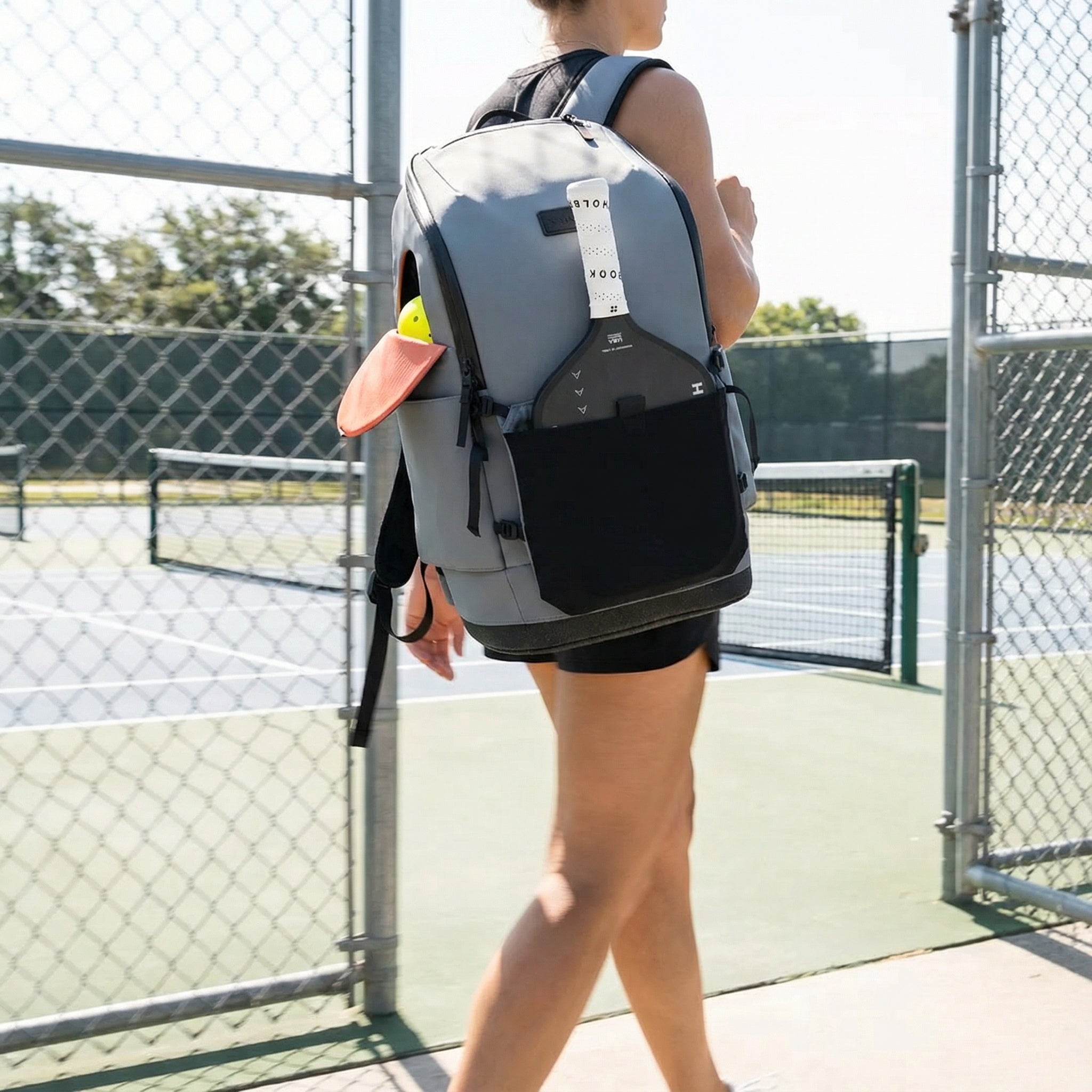
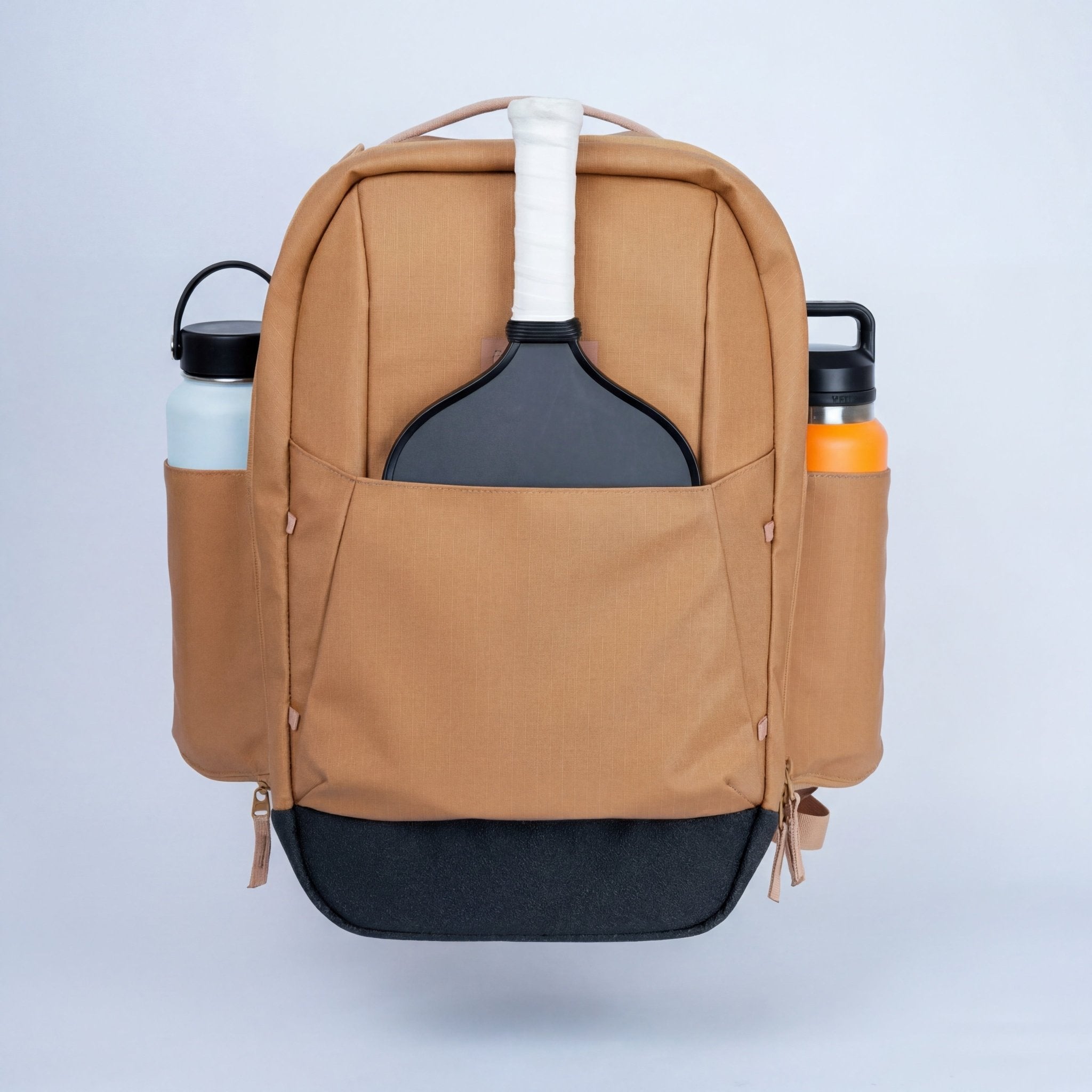
ASTM F803 certification protects your eyes. Proper storage protects your investment. The FORWRD Court Ranger V2 ($195) has an organized compartment layout that keeps eyewear separated from paddles and ball cans — no more scratched lenses from a loose bag. The 16" laptop sleeve and YKK AquaGuard zippers handle the rest. If your glasses are worth protecting with a proper certification standard, they're worth storing properly too.
FAQ: ASTM F803 Pickleball Eye Protection Standard
Do I really need ASTM F803 certified glasses for recreational pickleball?
No law requires it, but the ball speed at recreational play is still fast enough to cause serious eye injury. The standard exists because the risk doesn't scale down with your skill level. Certified options start under $30 — the protection is available, not a premium upgrade.
What's the difference between ASTM F803 and ANSI Z87.1 for pickleball?
ASTM F803 is the racquet sports eye protection standard, calibrated for high-velocity ball impact. ANSI Z87.1 is the occupational safety standard for workplace hazards like flying debris and chemical splash. Both involve impact testing — but only ASTM F803 is designed for sport-specific projectile threats like pickleball.
Are Oakley or Ray-Ban sport sunglasses ASTM F803 certified?
Most Oakley sport sunglasses carry ANSI Z87.1, not ASTM F803. Some specific Oakley models do carry F803 — verify the exact model before buying. Price and brand name don't indicate which standard applies. Check the product spec sheet for the explicit F803 claim.
How do I find out if my current glasses are ASTM F803 certified?
Check the original packaging or the product page's spec section for an explicit "ASTM F803" label. If it's not listed, email the manufacturer and ask for the third-party test certification. If they can't provide documentation, the product isn't F803-certified.
What pickleball glasses are ASTM F803 certified?
Certified options exist across price points. Budget tier: ONIX Falcon (~$25), Tourna Specs (~$25), Kitchen Blockers (~$30). Premium: FORWRD Brioti FOCOS ($199) with interchangeable lenses. For a full breakdown, see our pickleball eyewear guide.

Leave a comment
This site is protected by hCaptcha and the hCaptcha Privacy Policy and Terms of Service apply.