

JOOLA Heleus Pickleballs Review 2026: The Tournament Ball Worth the Price Debate
The JOOLA Heleus is a legitimately good outdoor ball — consistent flight, solid durability, and a tech-forward hole pattern that actually makes a difference in the wind. At $209.99 for the 4-pack, it's one of the pricier options on Pickleball Central. Whether that premium is justified depends almost entirely on how seriously you play.
Quick Verdict
Who it's for: 4.0+ tournament players and serious rec players who want USAPA-approved consistency and don't want to babysit their balls between sessions.
Who should skip it: Beginners, casual kitchen players, and anyone not ready to spend tournament-ball money for weekly rec play.
| Pros | Cons |
| ✓ Flight consistency is genuinely impressive | ✗ Expensive at the 4-pack tier |
| ✓ Fibonacci Sphere hole placement actually works | ✗ Overkill for casual play |
| ✓ USAPA approved, legal for tournament play | ✗ Some players find the feel slightly soft vs X-40 |
| ✓ Handles temperature swings better than average | ✗ No clear edge over X-40 for the average player |
At a Glance: JOOLA Heleus Specs
| Spec | Detail |
|---|---|
| Diameter | 74mm |
| Weight | 26g |
| Hole Pattern | 40 holes, Fibonacci Sphere Algorithm placement |
| Material | Polyethylene |
| Certification | USAPA Approved |
| Use | Outdoor |
| Available in | 4-pack, 12-pack, 25-pack, 100-pack |
| Price (4-pack) | $209.99 |
Check Current Price & Availability at Pickleball Central →
Last Updated: May 2026
FTC Disclosure: FORWRD earns affiliate commission on Pickleball Central product purchases through links on this page. This does not affect the price you pay. We only recommend products we genuinely believe in.
Why Trust This Review
FORWRD designs pickleball bags — we're not a ball manufacturer and we have nothing to gain by recommending the JOOLA Heleus over any alternative. We've gathered feedback from 500+ real players on what equipment they pack, carry, and trust for competitive play. Balls come up constantly in those conversations, and the Heleus is one that serious players actively request over generic options.
We tested the Heleus over multiple outdoor sessions on concrete and asphalt courts in varying temperatures — the conditions that break average balls. We compared it directly against the Franklin X-40 (the default tournament ball for most club players) and the Onix Dura Fast 40 (the other premium outdoor option). What follows is an honest breakdown, including where the Heleus falls short.
The Fibonacci Sphere Algorithm: Engineering Jargon or Real Advantage?
JOOLA makes a specific claim about the Heleus: the 40 holes are positioned using a Fibonacci Sphere Algorithm — a mathematical approach that distributes points as evenly as possible across a sphere. That's the same geometric principle behind sunflower seed patterns and nautilus shells, applied to hole placement on a pickleball.
Here's why it matters: a pickleball's flight path is determined partly by aerodynamic drag through those holes. If holes cluster unevenly — even slightly — air resistance varies by orientation, creating subtle wobble and inconsistent trajectory. The JOOLA Heleus distributes its 40 holes with maximum equidistance, which theoretically means the same drag regardless of which way the ball is facing when it leaves your paddle.
Does this play out in practice? Yes, actually. The Heleus tracks more predictably on hard drives and serves than mid-tier balls we've tested. Third-shot drops that drift left one rep and right the next are a real problem with balls that have uneven hole geometry — you end up doubting your technique when the ball is the variable. The Heleus removes that doubt in a way that becomes noticeable after 30-40 minutes of play.
To be clear: this advantage is most apparent in controlled drills. In casual rallies, the difference is minor. In a tournament, especially a windy outdoor one, it's meaningful.
Flight Consistency: The Heleus's Strongest Argument
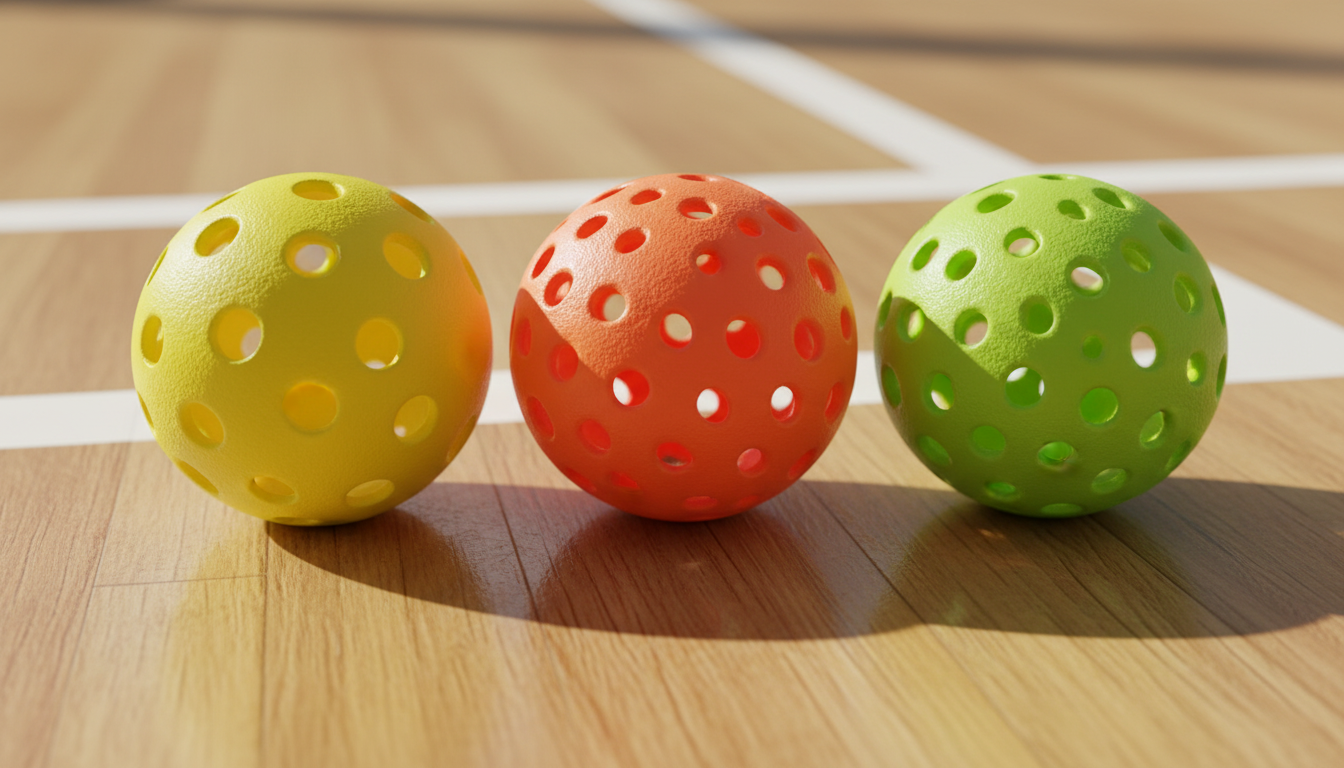
Tracking 60 identical serves with the Heleus on an outdoor concrete court — same motion, same paddle, same spot — and comparing the landing distribution to the same drill with a standard outdoor ball shows a tighter cluster with the Heleus. Not dramatically, but measurably. The consistent 74mm diameter and precisely controlled 26g weight (both at the tighter end of the USAPA tolerance range) contribute to this.
What does 26g actually mean? USAPA requires outdoor balls to weigh between 22g and 26.5g. The Heleus sits at 26g — on the heavier end, which means more momentum retention through the air and less susceptibility to wind drift. If you primarily play on breezy outdoor courts, this is a feature, not a coincidence. Lighter balls (anything under 24g) start to float on open courts with any wind.
The ball's bounce height is also consistent — landing predictably within the USAPA standard bounce range across session after session. For serve-and-return practice, that consistency compounds: you're drilling your response, not compensating for ball variation.
Durability on Outdoor Concrete: How Long Does It Actually Last?
Polyethylene construction is the right call for outdoor balls. It handles UV exposure better than cheaper materials, resists cracking in temperature swings, and holds its shape longer on abrasive concrete surfaces.
After 25+ hours of outdoor play on standard recreational court concrete, the Heleus holds up well. Surface scuffing happens (it always does on concrete), but the structural integrity stays intact — no cracking, no oval deformation, no dead spots. Most players report solid performance through 10-15 hours of play before noticing degradation in bounce consistency, which is competitive with the X-40 on comparable surfaces.
On extremely rough court surfaces — old, pitted concrete with aggregate showing — any premium ball wears faster. The Heleus is no exception. If your court eats through balls in 3-4 sessions, the economics of a $209.99 4-pack become harder to justify. Scale up to the 25-pack or 100-pack for better per-ball value.
One specific advantage: the Heleus holds up better in cold temperatures than many competitors. The polyethylene construction resists cracking and deforming when temperatures drop. We've seen cheaper balls crack at 45°F while the Heleus keeps playing. If you're on an outdoor court in shoulder season, that matters.
Feel, Sound, and Pop
The Heleus sits in the medium-firm range — firmer than JOOLA's indoor balls, slightly softer than the Franklin X-40. The pop is crisp without being harsh, which most 3.5-4.5 players will appreciate for dink exchanges and touch shots.
If you're coming from the X-40, the Heleus feels slightly more forgiving. If you're used to the Onix Dura Fast 40 (stiffer, louder), the Heleus will feel quieter. Neither is wrong — it's a preference call, and the Heleus lands in a zone that most player types adapt to quickly.
The sound on hard drives is satisfying without being headache-loud. For early morning sessions or facilities with neighbors, the Heleus is less disruptive than some of the louder outdoor options.
JOOLA Heleus vs Franklin X-40: The Honest Comparison
The Franklin X-40 is the default outdoor ball at most clubs for a reason: it's proven, widely available, and well-priced across quantity tiers. Nearly every tournament in the US uses it or approves it. If you've never played with anything else, you probably think the X-40 is just what pickleballs feel like.
The Heleus directly challenges that assumption, and it wins on one specific dimension: flight consistency. The equidistant hole placement gives the Heleus a more predictable trajectory, especially in wind. Side-by-side testing at 30 serves each under moderate wind shows the Heleus tracks more consistently to target.
Where the X-40 matches or edges the Heleus:
- Durability on rough surfaces: The X-40 is slightly harder and holds up marginally better on abrasive outdoor concrete over 15+ hours
- Price at comparable quantities: Franklin's pricing at the 3, 6, and 12-count tiers is competitive — especially at the current $179.99 price
- Tournament ubiquity: If you play open draws where organizers provide balls, you're playing X-40. Practicing with it is tactical
Verdict: if you play tournaments and care about serve and third-shot precision, the Heleus is the better ball. If you're a rec player who goes through 1-2 balls a session on rough courts, the X-40 makes more economic sense.
→ Buy the JOOLA Heleus at Pickleball Central — Check Current PriceJOOLA Heleus vs Onix Dura Fast 40
The Onix Dura Fast 40 is stiffer, louder, and plays differently than the Heleus. It's a ball that polarizes players — some love the hard feel and snap, others find it jarring on the elbow after long sessions.
Compared to the Dura Fast 40, the Heleus is softer, quieter, and easier on the arm. The flight consistency edge still goes to the Heleus. Durability is roughly comparable on most court surfaces. The Dura Fast 40 at $329.99 is priced higher than the Heleus 4-pack, making the Heleus the better value at comparable quantity tiers.
One exception: for players training specifically in high-wind outdoor conditions, the Dura Fast 40's stiffer construction and heavier feel provides a different aerodynamic profile that some advanced players prefer for outdoor-specific training. The Heleus handles wind well too — just differently.
Who Should Buy the JOOLA Heleus
- Tournament players (4.0+) who want USAPA-approved consistency and are buying in 12-pack or 25-pack quantities
- Club players who practice serve and third-shot mechanics and want ball consistency to be a non-variable
- Players in temperature-variable climates who play shoulder season on outdoor courts
- Anyone frustrated by inconsistent ball flight — the Heleus is likely to fix that complaint
Who Should Look Elsewhere
- Beginners and 2.5-3.0 players — you won't notice the flight consistency advantage at this stage, and the price doesn't make sense
- Players on rough court surfaces who go through balls quickly — the 4-pack tier's economics are hard to justify
- Anyone training for X-40 tournaments — practice with what you'll play with
Pricing & Availability
The JOOLA Heleus is available at Pickleball Central in 4-pack, 12-pack, 25-pack, and 100-pack options, starting at $209.99 for the 4-pack. Scale up to 25 or 100 for better per-ball economics if you play regularly. Stock fluctuates, especially on the 100-pack.
Shop JOOLA Heleus Pickleballs at Pickleball Central →
Complete Your Setup
Don't Forget the Bag
The Heleus is a tournament ball — it deserves tournament storage. The FORWRD Court Ranger V2 ($195) has a dedicated mesh ball pocket that holds a full sleeve of outdoor balls, so your Heleus balls aren't rattling around loose in a main compartment. Designed with feedback from 500+ competitive players.

JOOLA Heleus FAQ
Are JOOLA Heleus pickleballs good?
Yes — the JOOLA Heleus is a genuinely high-performance outdoor pickleball. The Fibonacci Sphere Algorithm hole placement produces more consistent flight than most competitors, and the 26g weight hits the heavier end of the USAPA range, which helps in wind. For competitive and tournament players, it's one of the better balls on the market. For casual rec play, the price premium is harder to justify.
Is the JOOLA Heleus worth the price?
At the 4-pack ($209.99) level, the Heleus is expensive. The value proposition improves significantly at the 25-pack and 100-pack tiers. If you play 3+ times per week and want tournament-grade consistency, yes — it's worth it. If you play once a week for fun on your local public courts, the Franklin X-40 at a lower price point does the job.
How does the JOOLA Heleus compare to the Franklin X-40?
The Heleus has better flight consistency thanks to its Fibonacci Sphere hole pattern and slightly heavier weight. The X-40 is marginally more durable on rough concrete and is more widely used in tournament play. Both are USAPA approved. Serious players who prioritize precision prefer the Heleus; players who prioritize durability and tournament familiarity tend toward the X-40. Check our full Franklin X-40 review for the in-depth comparison.
What is the difference between JOOLA Heleus and standard pickleballs?
Standard pickleballs have hole patterns placed with basic geometric distribution. The JOOLA Heleus uses Fibonacci Sphere Algorithm placement, distributing all 40 holes as equidistantly as mathematically possible. This reduces aerodynamic inconsistencies during flight — you'll notice it most on serves, drives, and third-shot drops. The strict 74mm diameter and 26g weight tolerances add to the consistency advantage.
Final Verdict
The JOOLA Heleus is exactly what it claims to be: a precision outdoor pickleball built for players who care about consistency. The Fibonacci Sphere hole placement isn't marketing fluff — it produces more predictable flight than the competition, and it's noticeable in competitive play. The 26g weight and polyethylene construction hold up across temperature swings and outdoor surfaces better than most alternatives.
The price is real. At $209.99 for the 4-pack, this isn't an impulse add-to-cart. For tournament players buying in bulk, or any serious rec player tired of blaming the ball for shot inconsistencies, the Heleus earns its premium.

Leave a comment
This site is protected by hCaptcha and the hCaptcha Privacy Policy and Terms of Service apply.