

Last updated: November 2026
The weight printed on a paddle tag doesn't tell you the full story. What actually matters is how that weight is distributed — and that's why two paddles both labeled "8.0 oz" can feel completely different in a live rally. One feels planted at the net. The other feels like it wants to rip out of your hand on a fast exchange.
After testing paddles across the full 7.0–8.5 oz spectrum — on outdoor acrylic courts in Phoenix, indoor gymnasium hardwood in Denver, and cracked-surface recreational concrete — here's what actually shifts with paddle weight, and what most guides get wrong about it.
Disclosure: This post contains affiliate links to Pickleball Central. If you purchase through our links, FORWRD earns a small commission at no extra cost to you. We only link to products we'd recommend regardless.
Table of Contents
- The Paddle Weight Spectrum: 7.0 oz to 8.5 oz Explained
- Lighter Paddles (7.0–7.4 oz): Quick Hands, More Control, Less Forgiveness
- Mid-Weight Sweet Spot (7.5–7.9 oz): Why Most Recreational Players Land Here
- Heavier Paddles (8.0+ oz): Power, Stability, and the Arm Fatigue Trade-off
- Swing Weight vs. Static Weight: The Number That Actually Determines Feel
- FAQ: Common Questions About Pickleball Paddle Weight
The Paddle Weight Spectrum: 7.0 oz to 8.5 oz Explained
Most retail paddles fall between 7.0 and 8.5 oz. That's a 1.5 oz spread — which sounds narrow until you realize 1.5 oz concentrated near the tip of a paddle creates a dramatically different swing feel than the same weight distributed closer to your hand. The number on the label is only the beginning of the story.
Here's the quick-reference chart covering the full range:
| Weight Range | Category | Best For | Key Trade-off |
|---|---|---|---|
| 7.0–7.4 oz | Light | NVZ players, arm fatigue concerns, control game | Less punch on drives; smaller sweet spot feel |
| 7.5–7.9 oz | Mid-weight | Most recreational and competitive players | Modest trade-offs on both ends — that's the point |
| 8.0–8.4 oz | Heavy | Power-first players, baseline drivers, strong arms | Slower hands at net; real arm fatigue risk over time |
| 8.5+ oz | Very heavy (custom) | Singles specialists, lead-tape experimentation | Significant fatigue risk; requires forearm conditioning |
These are static weight numbers — what a scale reads when the paddle sits flat. A different number determines how the paddle actually feels in motion. We'll cover that in the swing weight section, because it's the number most guides skip entirely.
Lighter Paddles (7.0–7.4 oz): Quick Hands, More Control, Less Forgiveness
Light paddles are the natural home for net-first players. At the non-volley zone, reaction time is everything — and a 7.2 oz paddle lets you reset, block, and redirect faster than an 8.1 oz version of the same shape. That gap narrows to nearly nothing on groundstrokes. It's very real in a fast hands battle at the kitchen.
What you gain at this weight:
- Faster hand speed on quick exchanges and speed-up volleys — measurable, not just perceived
- More precise touch on dinks and drops; lighter paddles give better feedback during contact
- Significantly less arm fatigue during three-hour tournament days or back-to-back sessions
What you give up:
- Punch on drives and roll shots from mid-court
- Stability on off-center hits — lighter paddles vibrate more on mis-hits, especially on outdoor concrete where the ball arrives harder and faster
- Some players describe light paddles as feeling "flimsy" until they adjust their mechanics to match
On outdoor surfaces, that last point matters more than you'd expect. The ball moves faster and hits with more energy outdoors — a light paddle requires you to contribute more of your own force, which is a technique adjustment, not just a preference shift.
Players with elbow issues or early signs of tennis elbow almost always do better starting at 7.3–7.5 oz rather than pushing heavier. The cumulative impact of an 8.0+ oz paddle over 300+ sessions shows up slowly and then all at once.
Shop Lightweight Paddles
Selkirk makes some of the best options in the 7.0–7.5 oz range — the SLK and Vanguard series are worth comparing if quick hands are your priority.
Mid-Weight Sweet Spot (7.5–7.9 oz): Why Most Recreational Players Land Here
If you've watched PPA or APP Tour coverage and wondered what most pros are actually using — it's this range. Not because it's the cautious pick, but because 7.5–7.9 oz genuinely balances the competing demands of soft game precision and drive power without seriously sacrificing either.
At the recreational level (3.0–4.0 skill rating), mid-weight paddles are especially forgiving of swing flaws. When your mechanics aren't dialed in, a mid-weight paddle gives you enough mass to generate power without full hip rotation, while staying light enough that you're not fighting it at the NVZ.
Three-hour sessions at 7.5–7.9 oz are sustainable for most players without significant fatigue. The same session at 8.3 oz tells a different story by game five. That's not theoretical — it's the difference between walking off court feeling tired and walking off with a hot elbow.
Who belongs here:
- Players who play multiple times per week and care about arm health long-term
- Anyone who plays doubles primarily and needs reliable performance at both the net and from the transition zone
- Beginners who want to develop their game without compensating for a paddle that's fighting them
One honest note: mid-weight isn't the best choice if you're a pure power player who hits a heavy top-spin drive as your primary weapon. For that game style, the extra mass of an 8.0+ oz paddle is genuinely useful — not just theoretical.
Shop Mid-Weight Paddles
JOOLA's Hyperion and Vision series land squarely in the 7.5–7.9 oz range and offer excellent balance of feel and power — solid picks for most recreational players.
Heavier Paddles (8.0+ oz): Power, Stability, and the Arm Fatigue Trade-off
Heavy paddles are the most misunderstood weight category in pickleball — especially for newer players who assume more weight automatically means better performance. It doesn't. It means different performance, with specific trade-offs that stack up over time.
What 8.0+ oz gives you: more mass behind drives, better stability on mis-hits (the larger moment of inertia resists twisting on off-center contact), and a more planted feel when blocking hard shots at the kitchen. Players who position at the baseline more than the kitchen line, or who play singles regularly, benefit most from this weight range.
What 8.0+ oz costs you: speed at the NVZ. It's real. There's a measurable reaction-time penalty in a fast hands exchange at 8.3 oz vs 7.5 oz. Advanced players compensate with footwork and positioning. Most recreational players — honestly — can't, and they lose points they'd otherwise win.
Arm fatigue is the other cost that takes time to surface. Heavy paddles feel fine for the first month. The micro-stress accumulates over six months of regular play. Players with existing elbow or shoulder sensitivities should approach anything over 8.0 oz with real caution, especially on outdoor concrete where vibration transfer is higher than indoor hardwood.
The Carry Load Reality: What Paddle Weight Adds Up To
Here's something no other paddle weight guide talks about: the carry load.
If you're a doubles player who brings multiple paddles to a tournament or club session — and most competitive recreational players do — paddle weight stacks before you add anything else to your bag.
Four paddles at 8.0 oz each = 32 oz = 2 full pounds of paddle weight alone.
Same four paddles at 7.3 oz each = 29.2 oz. Nearly 3 oz lighter before the first water bottle goes in.
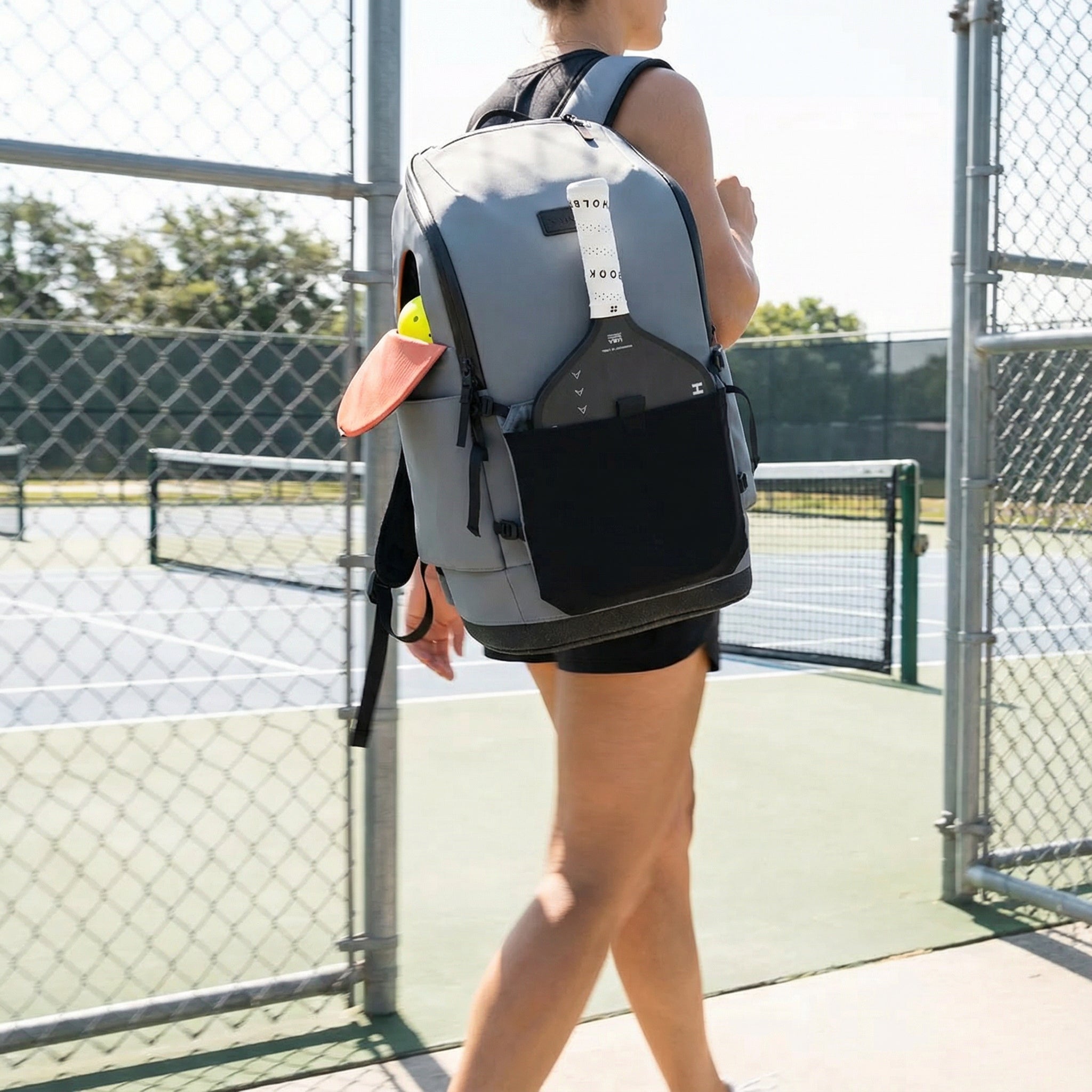
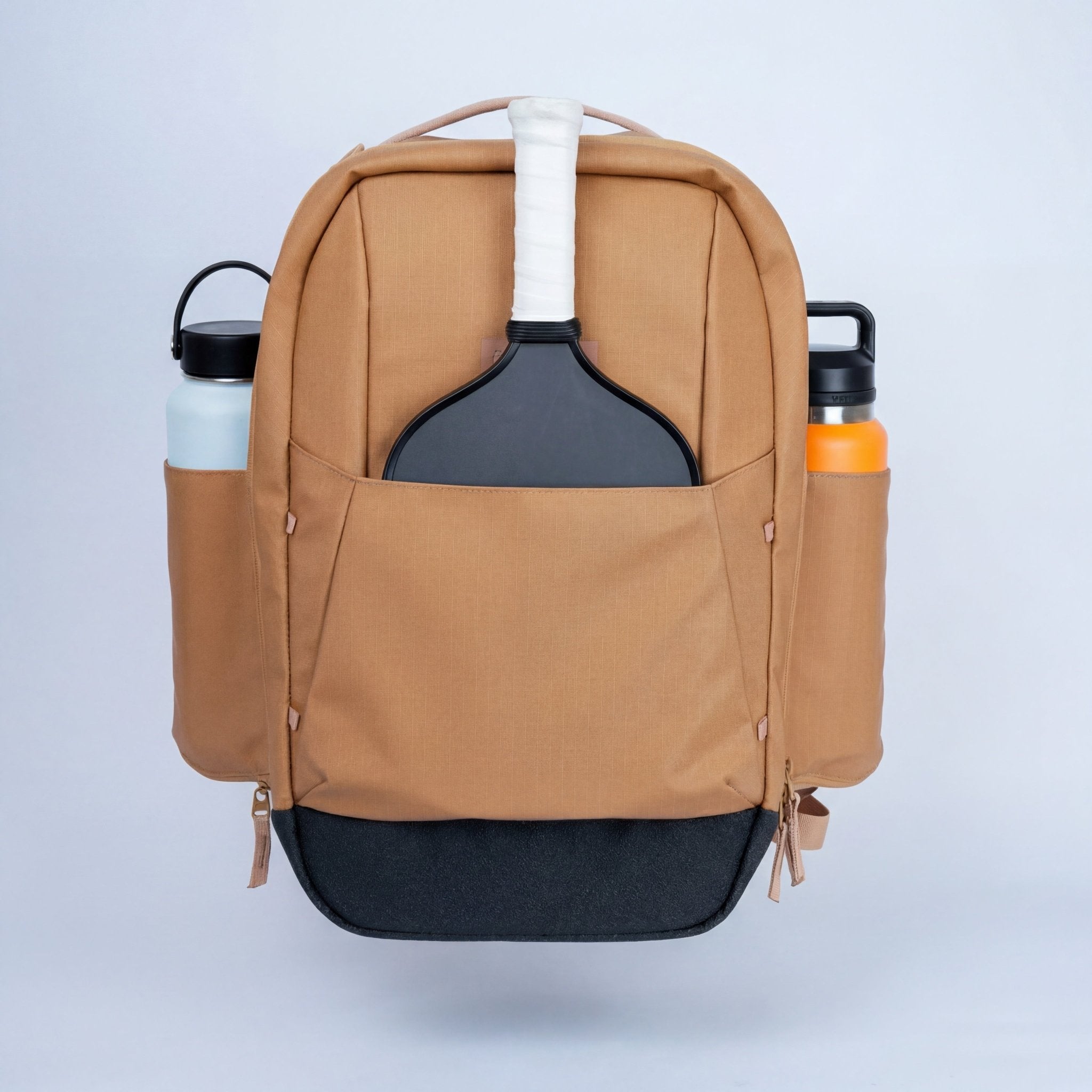
That 2.8 oz difference sounds trivial until you're carrying the bag from the parking lot to court 11 and back across a full tournament weekend. The weight compounds. It's part of why the Court Caddy's modular paddle sleeve was designed with feedback from 500+ real players — not just "can it hold paddles?" but "how does the weight distribute across the bag when you're fully loaded for a four-hour day?"

For tournament players who regularly carry 2–4 paddles, those accumulated ounces matter ergonomically — particularly over a full day with multiple court trips. The Court Caddy fits up to 4 paddles in its modular sleeve, distributing that weight across the full back panel rather than concentrating it in one side pocket. YKK AquaGuard zippers mean you're not worrying about weather either.
Swing Weight vs. Static Weight: The Number That Actually Determines Feel
"Swing weight" isn't a weight at all — it's a measure of how resistant a paddle is to rotation when you swing it. Technically, it's the moment of inertia measured about an axis 5 cm from the butt cap, in kg·cm².
What that means practically: swing weight is determined by where the mass lives on the paddle, not just how much there is total. A paddle with extra mass near the tip has a higher swing weight than a paddle with the same total ounces distributed closer to your hand. The tip-heavy version feels heavier in a live exchange — harder to accelerate, more powerful on contact — even if both paddles say "7.9 oz" on the tag.
The practical range for retail paddles runs roughly 105–130 kg·cm²:
- 105–112: Maneuverable, quick at the NVZ, easier on the arm over long sessions
- 112–118: Middle of the road — where most recreational players perform best
- 118–130: Power-oriented, stable on drives, requires more arm conditioning to sustain
Two paddles can sit 15 kg·cm² apart in swing weight while sharing the same sticker number. If you've ever picked up two paddles from a shelf — both labeled 8.0 oz — and found that one felt dramatically heavier in a live exchange, that's what you were feeling. One was tip-heavy, one was more handle-balanced. The scale lied.
"The first time a player picks up a low-swing-weight paddle after playing with a high-swing-weight one, their reaction is almost always the same: 'this feels like cheating at the net.' Then they drive it and wonder where the power went." — Grub, FORWRD co-founder, playing 4x/week at the 4.0 level
When you're comparing paddles, check swing weight data alongside static weight if the brand publishes it. If it's not listed, the static weight spec alone will mislead you about how the paddle actually plays in a real rally — especially in the quick-exchange situations where the difference matters most.
Quick rule of thumb for buyers: If two paddles have the same static weight and one is head-heavy (weight near the top), it will feel heavier to swing even though the scale says otherwise. Balance point (usually listed as distance from the butt cap) is a shorthand for this when swing weight isn't published.
Complete Your Setup
Got your paddle sorted? Now you need somewhere to carry it — especially if you're bringing a spare (or two) to your next session. The Court Caddy Backpack fits up to 4 paddles in its modular sleeve system, with YKK AquaGuard weatherproof zippers and a 15" padded laptop compartment built for real tournament days. Court Ranger V2 ($195) if you want a lighter everyday option with a 16" sleeve.
FAQ: Common Questions About Pickleball Paddle Weight
Is a heavier or lighter paddle better for pickleball?
Neither is universally better — it depends entirely on how you play. Lighter paddles (7.0–7.4 oz) favor control-oriented NVZ players and reduce arm fatigue over long sessions. Heavier paddles (8.0+) favor power-first baseline players. Most recreational players perform best in the mid-weight range (7.5–7.9 oz) where the trade-offs on both ends are manageable without serious sacrifice.
What's the best paddle weight for beginners?
7.5–7.9 oz is the safest starting range for most beginners. It's forgiving of imperfect mechanics, sustainable across long practice sessions, and doesn't lock you into a specific playing style before you've developed one. Avoid jumping straight to 8.0+ oz until your arm conditioning and swing mechanics are solid — the fatigue accumulates faster than it feels in the first few weeks.
What paddle weight do most pros use?
Most PPA and APP Tour professionals play in the 7.3–8.0 oz range, with the majority clustered around 7.5–7.8 oz. Many prioritize hand speed and NVZ dominance over raw power, which pulls them toward the lighter end of mid-weight. A handful of singles-focused pros go heavier, but it's not the norm at the elite level — the speed penalty is too real in pro-level exchanges.
Does paddle face material (carbon vs fiberglass) affect effective weight feel?
Yes — indirectly. Carbon fiber faces are stiffer, transferring vibration more efficiently through contact. At the same static weight, a carbon paddle can feel "punchier" and more responsive than a fiberglass version, particularly on indoor hardwood courts where the ball comes off softer. This affects how heavy the paddle feels in play even if the scale reads the same number — another reason static weight alone doesn't tell the whole story.
How much does a 0.5 oz difference in paddle weight actually matter?
More than you'd expect at the net, less than you'd expect on drives. A 0.5 oz difference is noticeable in extended NVZ exchanges — your hand speed measurably changes. But the power difference on drives is minor enough that most players can compensate with mechanics. Where 0.5 oz compounds is across time: a heavier paddle accumulates real fatigue faster than the initial feel suggests. Over a three-hour session on a hot outdoor court, that half-ounce starts to feel like more.

Leave a comment
This site is protected by hCaptcha and the hCaptcha Privacy Policy and Terms of Service apply.