

Disclosure: This post contains affiliate links to Pickleball Central. If you purchase through our links, FORWRD earns a small commission at no extra cost to you. We only link to products we'd recommend regardless.
Last Updated: July 2026 | By Benjamin Carper, FORWRD
Here's a thing most pickleball travel articles won't tell you: the TSA officially allows pickleball paddles in both carry-on and checked bags. No special case required. No pre-approval. Your paddle has better standing at security than your 3.4 oz moisturizer.
The real challenges of traveling for pickleball have nothing to do with TSA. They're about what to pack, how to organize it, and — for multi-day tournament players — how to manage damp gear from day 1 so it doesn't ruin your day 2 kit.
We've talked to hundreds of tournament players who travel for pickleball across the USAPA Nationals crowd to the APP regional circuit. This is what the players who get it right consistently do.
TSA and Airline Rules for Pickleball Paddles (What Actually Applies)
Paddles are allowed in carry-on and checked bags, full stop. TSA confirms this on their website. A standard pickleball paddle at 16–17 inches long is nowhere near the list of prohibited sports equipment (hockey sticks, baseball bats, golf clubs — things that function as clubs). Your paddle is fine.
The actual gray area: airline size rules. Standard domestic carry-on dimensions are 22" x 14" x 9". A paddle on its own fits easily. A full pickleball bag with paddles inside is the question. The Court Caddy fits within these dimensions when packed sensibly — and if a gate agent ever questions it, you pull out the paddles, show them the TSA page on your phone, and get on the plane. This has never not worked.
Lead tape note: If you've added lead tape to your paddle for weight distribution, it shows up as a dense mass on the X-ray scanner. Completely legal — but TSA agents sometimes pull the bag for a manual check. Keep the paddle accessible at the top of your bag and the check takes 90 seconds instead of 15.
Checked vs. carry-on: Always carry on your paddles when you can. Checked bags get thrown, stacked, and compressed. A bag with paddles inside will be fine; a bag with paddles strapped outside will not. The Court Caddy carries on as a personal item or overhead bag on most domestic routes. Check your specific airline's size policy before flying — American, Delta, and United all have slight variations.
International travel: TSA rules apply in the US. Internationally, paddles are generally allowed as carry-on in Canada, Mexico, and throughout Europe. Some international security agents treat unfamiliar sporting equipment with extra scrutiny — just be patient, be helpful, and you'll get through. Only destination where hard cases in checked bags make genuine sense: remote international locations with inconsistent security protocols.
The Pickleball Travel Bag: What to Look for and What to Avoid
A "bag you can travel with" and a "travel bag" are different things. The former is any bag you haven't lost yet. The latter was designed for this specific use case.
Here's what distinguishes a genuine pickleball travel bag:
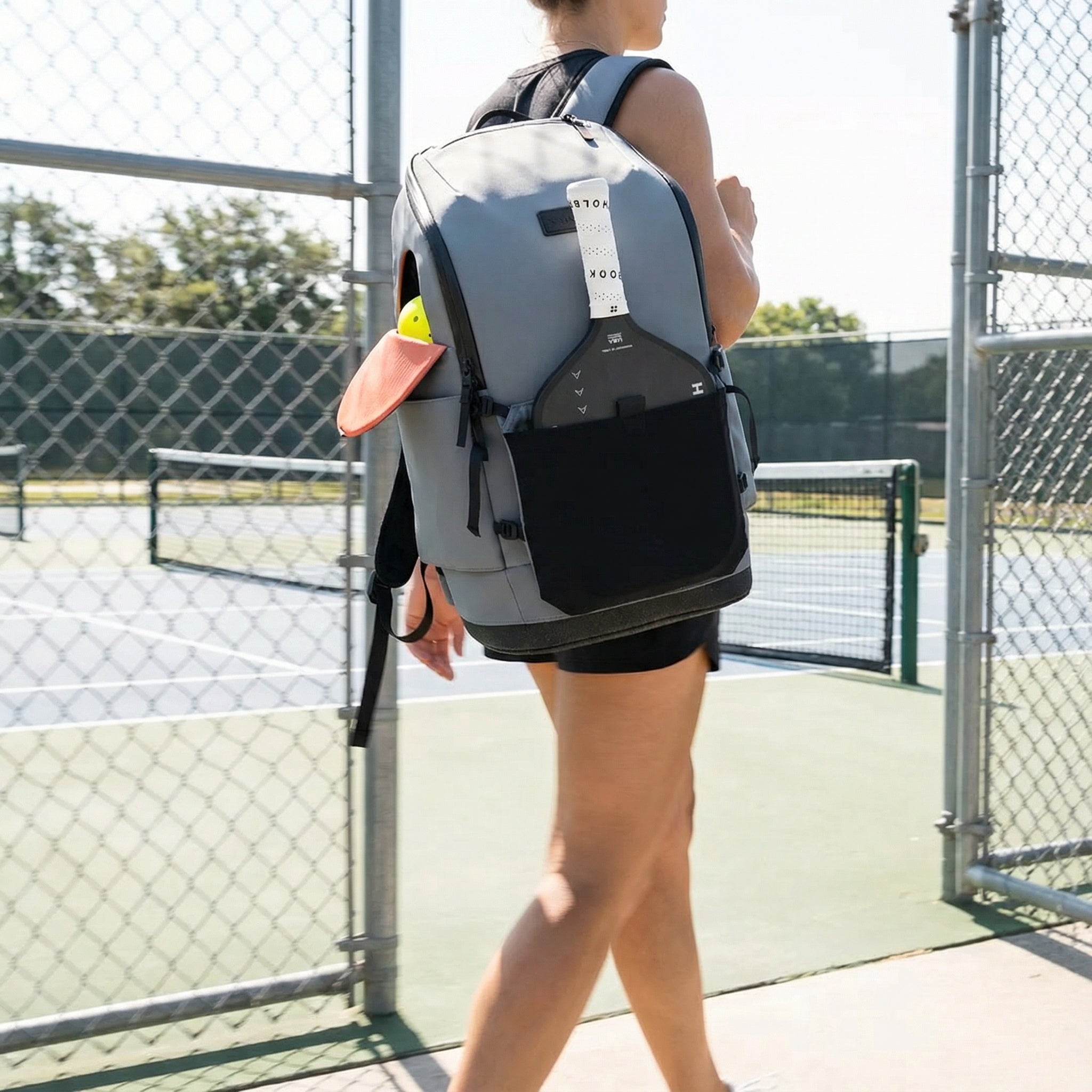
Paddle organization, not just paddle storage. Unorganized paddles bang against each other in transit. Face-to-face contact between paddle faces — especially thermoformed carbon fiber — creates micro-scratches over a 3-hour flight. You need a bag where paddles slot in individually and stay separated. The Court Caddy's modular paddle sleeve does this. A basic tennis bag with a main compartment does not.
A laptop/tablet sleeve. Tournament players stream their matches, use scoring apps, and manage brackets from a laptop or iPad. A padded laptop sleeve that isn't sharing space with sweaty gear is not optional for multi-day tournament travel. The Court Caddy has a 15" padded laptop sleeve isolated from the main compartment.
Weather resistance. Tournament venues — especially outdoor APP events in Houston or Atlanta in summer — involve rain, humidity, and sweat. YKK AquaGuard zippers keep water out of your main compartment. Standard zippers don't.
Carry-on compliant dimensions. This one is obvious but worth measuring. A bag that forces you to check your gear introduces risk — and adds cost on budget carriers.
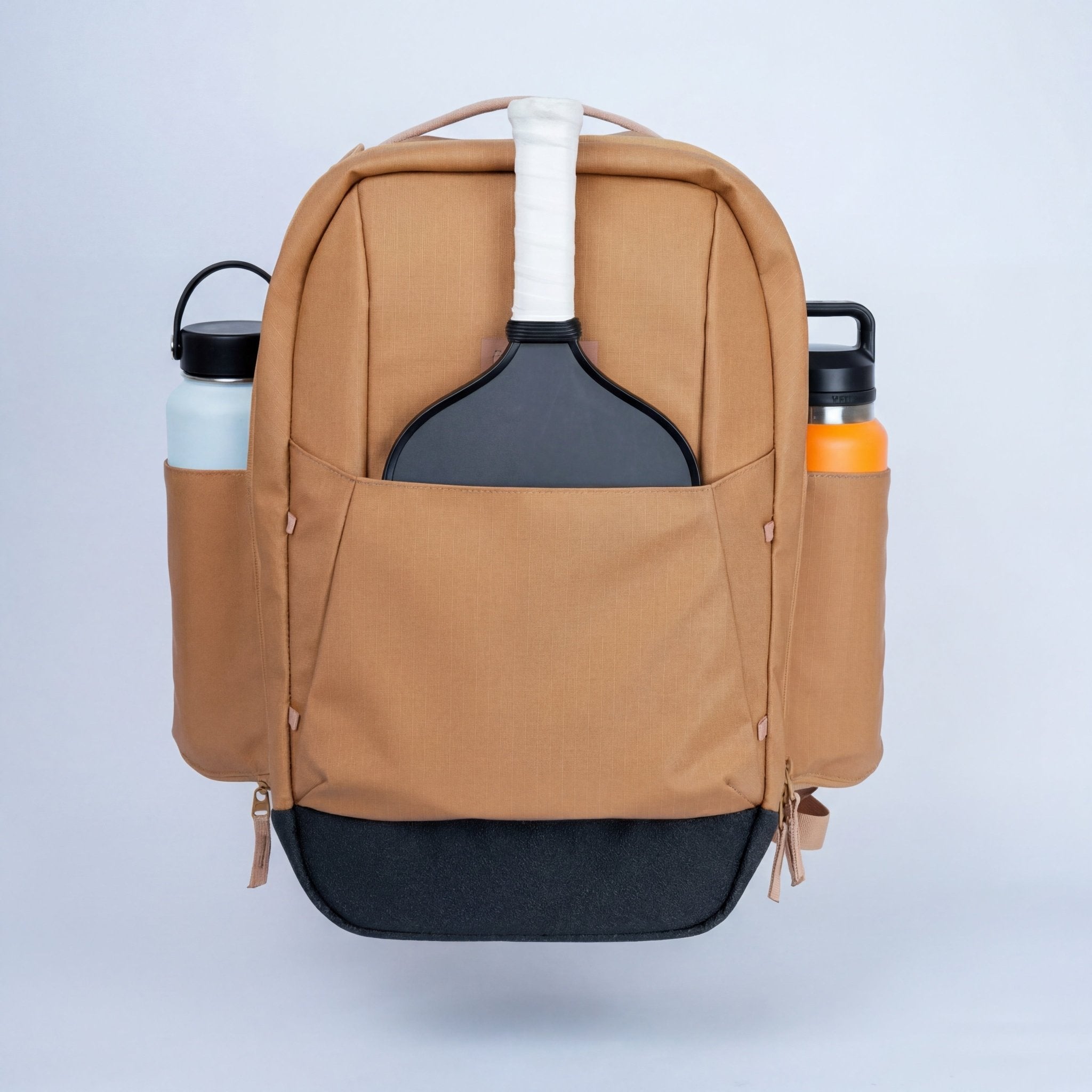
Our Pick: FORWRD Court Caddy Backpack
The only bag designed specifically with tournament-traveling players in mind — modular paddle sleeve, isolated 15" laptop compartment, YKK AquaGuard zippers. Carry-on compliant.

For day trips and weekend travel where you're not lugging a laptop: the Court Ranger V2 ($195) covers most recreational travel — 16" laptop sleeve, modular paddle sleeve, YKK AquaGuard zippers, lighter weight than the Court Caddy. It's the right call for a one-night tournament or a fly-in for open play.
What to avoid:
- Sling bags for air travel. They can't carry a full tournament kit for more than a day, and they don't fit overhead.
- Generic backpacks without paddle organization. Your paddles will rattle. The face scratches are real.
- Bags with external paddle straps. A paddle strapped to the outside of a carry-on will get gate-checked. Every time.
- Soft-case bags for checked luggage. If you must check your gear, hard-case protects paddles. Soft-case under baggage handler stress does not.
The Packing List: Everything You Actually Need
This is the printable version. Screenshot it, share it, check it off before every trip. Organized by category — no packing list in this sport has a "random stuff" section.
🏓 Paddles
- ✅ 2 match paddles (primary + backup — handle a broken paddle on day 1)
- ✅ 1 practice/warmup paddle (optional for multi-day — keeps match paddle clean)
- ✅ Paddle covers for each
🟡 Balls
- ✅ 2–3 cans of outdoor balls (tournament balls vary by venue — bring your own to warmup)
- ✅ 1 can of indoor balls if you know the venue is indoor hardwood
🎽 Apparel + Footwear
- ✅ Athletic wear: 1 outfit per day + 1 spare (you will sweat through your first outfit)
- ✅ Court shoes — pack in a shoe bag to keep outsole grit away from paddles
- ✅ Off-court shoes for travel and hotel (your court shoes don't leave the bag between sessions)
- ✅ Sun hat or visor for outdoor play
- ✅ Wristbands (3–5 pairs per day if you sweat heavily)
- ✅ Sunglasses / eye protection
⚙️ Gear + Accessories
- ✅ Overgrips (5–10 per trip; grip feel matters more under tournament pressure)
- ✅ Lead tape if you tape your paddle (pre-applied preferred; TSA note above)
- ✅ Microfiber cleaning cloth for paddle faces
- ✅ Extra shoelaces (a snapped lace on tournament morning is real)
💻 Tech + Utilities
- ✅ Laptop or iPad (tournament bracket management, streaming, scoring apps)
- ✅ Phone charger + portable battery bank (tournament venues often have limited outlets)
- ✅ Earbuds (long waits between matches)
🏥 Recovery + Safety
- ✅ KT tape / athletic tape (knee support, shoulder wrap)
- ✅ Ibuprofen or naproxen
- ✅ Blister kit (moleskin, bandages — you'll thank yourself)
- ✅ Sunscreen (minimum SPF 30; outdoor tournament days are long)
- ✅ Water bottle — the Court Caddy has two external water bottle pockets
- ✅ Snack supply (protein bars, electrolytes — tournament day schedules make meal timing unpredictable)
One thing you'll notice: the list doesn't include a separate laptop bag, gear bag, or shoe bag. With the Court Caddy's compartment system, all of this fits in one carry-on compliant bag — organized, not crammed.
Court-to-Hotel Bag Strategy (For Multi-Day Tournaments)
Single-day trips are easy. Multi-day tournaments — the APP nationals circuit, USAPA regionals, and resort tournaments — require a different approach. Most players get this wrong.
The problem: after playing 3 matches on day 1, you have sweaty court clothes, wet towels, dirty shoes, and paddle grips that need replacing. All of that is going into the same bag you're pulling out clean gear from tomorrow morning. Without a system, day 2 starts with a damp, disorganized mess.
"The players who travel the best aren't the ones with the lightest bags — they're the ones with the most organized bags. We designed the Court Caddy specifically around the overnight tournament scenario. Day 1 sweaty gear needs somewhere to live that isn't next to your clean day 2 gear and your laptop."
— Grub, FORWRD Co-founder
The Court Caddy system for overnight tournaments:
Paddle management. Match paddles go in the main modular paddle sleeve — they stay in there throughout the tournament, protected. Practice paddle goes in the front sleeve for warmup and drilling. You never have to dig through the main compartment for your match paddle on match day.
Clean/dirty separation. The 15" padded laptop compartment acts as a physical separator between your clean tech gear and whatever else is in the main compartment. Your laptop, charging cable, and scoring app device never touch sweaty gear. Main compartment gets the post-match clothes bag.
Shoes: They go back in their shoe bag the moment you step off the court. Outdoor concrete grit on your outsoles destroys whatever they touch. A dedicated shoe bag inside the main compartment handles this; FORWRD's Shoe Cube add-on (sold separately) handles it better — it attaches to the Court Caddy's exterior and keeps outsole grit completely outside the bag.
Hotel room reset (15 minutes before bed):
- Unpack everything onto the bed. Air the bag out.
- Hang sweaty court clothes to dry overnight — don't leave them packed.
- Wipe paddle faces with a dry microfiber cloth. Replace grips if they're slipping.
- Repack clean tomorrow gear in the order you'll need it. Shoes at the bottom.
- Charge your devices. Set your phone alarm 90 minutes before match time.
Players who do this consistently say it's a genuine competitive edge — not because of the gear itself, but because showing up to day 2 without the mental overhead of digging through a chaotic bag clears headspace for the actual game.
Pickleball Travel Destinations Worth the Trip (Bonus)
If you're going to pack this well, you might as well go somewhere worth the trip.
Naples, Florida is the unofficial pickleball capital of the United States. East Naples Community Park has 64 pickleball courts — the largest public pickleball complex in the world. The weather is playable year-round, the competition level is real, and you can find open play at virtually any skill level any morning of the week.
The Villages, Florida has more pickleball courts per capita than anywhere on earth. It's a retirement community, but don't let that fool you — the 4.0+ competition there is legitimately good, and the organized round-robin formats mean you play more games per session than almost anywhere else.
Palm Springs / Indian Wells, California is the West Coast version of the Florida scene — outdoor play year-round (minus 115°F summer afternoons), strong DUPR-rated play, and the BNP Paribas Open venue at Indian Wells hosts pickleball events that are worth building a trip around.
For tournament travel: The APP and PPA Tour both run regional circuits throughout 2026. Houston, Atlanta, Denver, Chicago, and Charlotte are common stops. Check theapp.global for the current tour calendar — most APP events have amateur divisions worth entering if you're traveling anyway.
FAQ: Pickleball Travel Questions
Can you bring pickleball paddles on a plane?
Yes. The TSA explicitly allows pickleball paddles in both carry-on and checked luggage. A standard 16–17 inch paddle fits well within domestic carry-on size limits (22"x14"x9"). Carry on when possible — checked bags introduce unnecessary risk for paddle damage. If you have lead tape on your paddle, keep it accessible at the top of your bag for the occasional manual security check.
What is the best pickleball bag for travel?
The best pickleball travel bag is the FORWRD Court Caddy ($325) for multi-day tournament travel — isolated 15" padded laptop sleeve, modular paddle sleeve, YKK AquaGuard weather-resistant zippers, carry-on compliant dimensions. For day trips and weekend travel without a laptop, the Court Ranger V2 ($195) covers the same features in a lighter package. Avoid sling bags for air travel — they can't carry a full tournament kit and won't fit overhead.
How do you pack pickleball gear for a trip?
Pack paddles in a dedicated paddle sleeve (never loose in a main compartment — face contact causes scratches). Put shoes in a shoe bag to keep outsole grit off paddles. Store laptop in an isolated padded sleeve. Overgrips, balls, and accessories in accessible pockets. For multi-day trips: pack clean next-day gear in a specific order so you're not digging through the bag on tournament morning.
Can you check pickleball equipment as luggage?
Yes, pickleball equipment can be checked as standard luggage — there are no special sports equipment fees for pickleball bags the way there are for golf clubs or ski equipment. However, checked bags get handled roughly. If you check your paddles, use a hard case or pack them tightly surrounded by soft gear. Carry on whenever possible. The extra cost of a carry-on seat on budget airlines is worth protecting $200–$400 worth of paddles.
How many paddles should I travel with?
For tournament travel, bring at least 2 match paddles (primary and backup) plus an optional practice paddle. Edge guards crack. Faces chip. Handles break. Having a backup paddle in the same condition as your primary prevents a tournament-ending equipment failure. For recreational trip travel, 1 paddle is fine — though 2 is always better if your travel partner forgot theirs, which happens more than you'd think.
Ready to travel right?
The Court Caddy Backpack ($325) was designed with feedback from tournament players who travel — isolated laptop sleeve, modular paddle organization, YKK AquaGuard zippers, and carry-on compliant sizing. If you're flying to tournaments, this is the bag built for exactly that.
Day trips and weekend play: Court Ranger V2 ($195) — same organizational philosophy, lighter weight, 16" laptop sleeve.

Leave a comment
This site is protected by hCaptcha and the hCaptcha Privacy Policy and Terms of Service apply.