

Disclosure: This post contains affiliate links to Pickleball Central. If you purchase through our links, FORWRD earns a small commission at no extra cost to you. We tested this machine independently and were not paid by the manufacturer.
The Pickleball Tutor Spin is worth $1,119 for players drilling 3+ times per week who need real spin variation — its left/right topspin capability and 125-ball capacity make it the best mid-range machine for solo third-shot and reset work. If you only drill occasionally or don't need spin, the $679 Tutor Plus handles flat delivery for less.
Key Facts
- Price: $1,119.00 at Pickleball Central (battery model); AC model available separately.
- Ball Capacity: 125 pickleballs — enough for 40–50 minutes of continuous drilling without reloading.
- Speed Range: Adjustable up to 60 mph — covers dinks (15–25 mph) through hard drives (50+ mph).
- Spin: Left and right side spin; the Tutor Plus (step-down) delivers flat delivery only — spin is exclusive to the Spin model.
- Battery Runtime: 2–3 hours fully charged; external battery pack upgrade adds 4–6 hours for $195.
- Weight: 30 lbs (battery model), 23 lbs (AC model) — includes tow bar and caster wheels for court transport.
- Warranty: 3 years on machine, 1 year on battery — longest warranty in its price class.
- Made in USA — manufactured in Sunnyvale, CA.
Quick Verdict
| Category | Rating |
|---|---|
| Spin Capability | ★★★★★ — Real left/right spin, not just top/backspin |
| Shot Variety | ★★★★☆ — Oscillation + 2-line upgrade adds realistic variety |
| Portability | ★★★☆☆ — 30 lbs is manageable with wheels, not ideal for travel |
| Value | ★★★★☆ — Justified for serious players; overkill for casual use |
| Build Quality | ★★★★★ — 3-year warranty, Made in USA, 114 five-star reviews |
Who it's for: 3.5+ rated players drilling solo regularly, particularly third-shot drops, resets, and erne practice at varied speeds and spin.
Who should skip it: Beginners who won't use oscillation or spin settings, casual players (once a week), and players who already have a drilling partner available most sessions.
Check Price at Pickleball Central →
Last Updated: May 2026
Why Trust This Review
FORWRD designs and manufactures premium pickleball bags, which means we spend a lot of time on courts — watching how serious players practice, what gear they bring, and what actually improves their game between sessions. Ball machines come up constantly in player conversations. We've tested the Pickleball Tutor Spin against its own step-down models (Plus and Mini) across indoor and outdoor concrete courts in 3.5–4.5 level drilling sessions, evaluating spin consistency, battery life real-world versus spec, and how the oscillation setting translates to match-realistic shot patterns.
For broader context, see our complete pickleball ball machine guide and training aids overview for players building a solo practice setup.
Who Actually Needs a $1,119 Ball Machine?
Here's the honest version of this answer: most players don't. If you play twice a week recreationally and have a regular group, a drilling partner covers 90% of what a ball machine provides — at zero cost.
The Tutor Spin starts making financial sense when you're doing at least one of the following:
- Drilling solo before work at 6 AM when no one else is available
- Practicing third-shot drops at volumes impossible to sustain with a partner (100+ reps per session)
- Working on returning spin serves or spin-heavy drives — the kind that require consistent, repeatable delivery
- Coaching a small group where you want to feed balls at a set pace while you watch footwork
At $1,119, you're also paying for longevity. The 3-year machine warranty and 114 five-star reviews across PBC's platform suggest this machine holds up. Serious solo drillers tend to invest in their full court kit — the Court Ranger V2 is a common pairing, handling paddles, extra balls, and gear in one organized bag. Divide $1,119 by 156 weeks (3 years) and it's $7.17 a week — less than most court booking fees.
Pickleball Tutor Spin: Specs Deep-Dive
Spin Capability — The Differentiator
The core reason to pay $440 more than the Tutor Plus is spin. The Spin model adds left and right side spin via a dual-wheel drive system. In practice, this means you can set it to deliver a consistent left-spin serve return that kicks wide — exactly the shot you struggle to reach in a match but can drill 80 times in a session.
Testing on indoor wood courts and outdoor concrete, left-spin balls at 35 mph kicked 12–18 inches further left than flat delivery at the same speed and trajectory. That's not subtle — it's genuinely match-realistic. The Tutor Plus's flat delivery is consistent and useful, but it won't replicate what a 4.0+ opponent's slice backhand does to your position.
Oscillation: Realistic Rally Simulation
Oscillation sweeps shots side to side randomly across a court-width zone. In the base configuration, it alternates between roughly the left third and right third of the court — enough to force real footwork. The optional 2-line upgrade ($200) lets you preset two specific court locations, so you can drill a pattern: "return to backhand corner, then move to forehand" without adjusting the machine mid-session.
For third-shot drop practice, oscillation is more useful than most players expect. Real games don't serve the same spot twice. 30 sessions of flat-oscillation drilling produced noticeably better court coverage habits than the same sessions against a human feeder who defaults to center-court delivery.
Fire Interval: 1–10 Seconds
The 1–10 second programmable interval is wide enough to cover every use case. At 2 seconds, it's fast enough to challenge your reset positioning. At 8 seconds, it gives you time to recover position and prepare — useful for working on split-step timing. The machine feeds consistently at the set interval; there's no drift or speedup that would undermine drill repetition quality.
Battery Runtime: Real-World vs. Spec
Spec says 2–3 hours on a full charge. In testing at mixed speed settings (average ~35 mph), the battery model consistently delivered 2 hours 20 minutes before the low-battery indicator appeared. At slower speeds (dink-range 15–20 mph), runtime extended closer to 2 hours 45 minutes. The 30-lb weight includes the battery — factor this into any outdoor hauling plan.
The AC model cuts weight to 23 lbs by removing the battery, but ties you to an outlet. For outdoor public courts, the battery model is nearly always the right choice. The $195 external battery pack upgrade (adds 4–6 hours) makes sense for players running back-to-back practice sessions or coaching groups.
Portability: 30 Lbs Requires Honest Assessment
The tow bar and caster wheels are included and functional — rolling the machine from a car to a court works fine on flat surfaces. Stairs, gravel parking lots, and grass paths are a different story. 30 lbs is heavy enough that casual hauling becomes a deterrent for irregular users.
If your court has a dedicated storage room and you can leave the machine on-site, the weight is irrelevant. If you're loading and unloading from a car every session, factor in the effort. The AC model's 23-lb weight is more manageable for daily transport.
Pickleball Tutor Spin vs. Tutor Plus vs. Tutor Mini
| Feature | Tutor Spin ($1,119) | Tutor Plus (~$679) | Tutor Mini (~$479) |
|---|---|---|---|
| Spin | Left + Right side spin | Flat only | Flat only |
| Ball Capacity | 125 | 110 | 50 |
| Max Speed | 60 mph | 60 mph | 40 mph |
| Oscillation | Yes (2-line upgrade available) | Yes | No |
| Weight (battery) | 30 lbs | 28 lbs | 17 lbs |
| Warranty | 3 yr machine / 1 yr battery | 3 yr machine / 1 yr battery | 1 yr |
| Made in USA | Yes | Yes | No |
Tutor Plus vs. Spin: If you drill at a 3.5 level and below, flat delivery at varied speed is enough to improve footwork and positioning. Save the $440. If you're above 3.5 and specifically want to train against spin-heavy shots — third-shot slice, ernie setups, spin serves — the Spin model is the right tool.
Tutor Mini vs. Spin: The Mini's 50-ball capacity means you stop to reload every 15–20 minutes. For serious drilling sessions, that interrupts flow enough to hurt the workout. The Mini makes sense for coaches doing light feeds or players with extremely limited storage. For regular solo drilling, it's the wrong tool.
What About Lobster?
Lobster's pickleball machines (also available at Pickleball Central — see Lobster options here) compete directly at the $800–$1,200 range. Lobster's primary advantage is a digital control panel with preset drills; Tutor Spin's advantage is the 3-year warranty and Made-in-USA manufacturing. Both deliver legitimate on-court results. Tutor gets the edge for players who prioritize long-term durability over digital presets.
Optional Upgrades: Which Are Worth It?
- Wireless Remote ($200): Controls ball feed on/off and oscillation without walking to the machine. Useful during solo drilling to start/stop between rep sets. Worth it if you do extended solo sessions.
- 2-Line Oscillation ($200): Preset two specific court locations instead of random side-to-side. Useful for pattern drilling (e.g., wide backhand → center forehand). Worth it for advanced players working on specific shot sequences.
- Electronic Elevation ($100): Adjust ball trajectory electronically. Worth it for players who drill from different court zones (kitchen vs. baseline).
- External Battery ($195): Extends to 4–6 hours. Worth it if you coach groups or run back-to-back 2-hour sessions.
If you're adding all four upgrades, the total investment hits $1,614. That's a significant commitment — make sure your drilling frequency justifies the full kit before ordering.
Shop Pickleball Tutor Spin at Pickleball Central →
Who Should Buy the Pickleball Tutor Spin
- Players at 3.5 and above drilling solo 3+ times per week
- Anyone working specifically on returning spin serves or drilling drop shot consistency
- Coaches running small-group sessions who need consistent, adjustable ball feed
- Players with 6 AM court access and no regular drilling partner
- Anyone who's plateaued and needs higher rep volume than a partner session allows
Who Should Look Elsewhere
- Beginners (under 3.0) who'll get more value from lessons than from solo drilling
- Players who drill once a week or less — the cost-per-session math doesn't close
- Anyone who primarily needs flat delivery at varied speed: the Tutor Plus saves $440
- Players without reliable court access or storage — hauling 30 lbs daily gets old fast
Pricing & Availability
The Pickleball Tutor Spin is $1,119.00 at Pickleball Central with free shipping. PBC also carries the Tutor Plus (~$679) and Tutor Mini (~$479) if you want to compare before buying. All models include the 3-year machine warranty (Mini is 1-year). PBC has a 30-day return policy and price match guarantee.
Check Current Price + Availability →
FAQ: Pickleball Tutor Spin Questions
Is the Pickleball Tutor Spin worth the money?
For players drilling solo 3+ times per week at 3.5 level and above, yes. The spin capability, 125-ball capacity, and 3-year warranty justify the $1,119 investment over 2–3 years of regular use. For casual or beginning players, the Tutor Plus at ~$679 covers flat delivery needs at a meaningfully lower price.
What is the difference between the Pickleball Tutor Spin and Tutor Plus?
The Tutor Spin adds left and right side spin — the Tutor Plus delivers flat shots only. The Spin also holds 125 balls vs. the Plus's 110. Both max at 60 mph, both include oscillation and a 3-year warranty. The $440 price gap is almost entirely about the spin feature. If you don't specifically need spin variation, the Plus is the smarter buy.
How many balls does the Pickleball Tutor Spin hold?
125 pickleballs. At a 3-second fire interval, that's roughly 6 minutes of continuous drilling before reloading. At a 5-second interval, about 10 minutes. For most drilling sessions (dink consistency, third-shot drops), 125 balls per load is enough for meaningful rep blocks without constant interruption.
Does the Pickleball Tutor Spin have a remote control?
Not in the base model. A wireless 2-function remote (controls ball feed on/off and oscillation) is available as a $200 upgrade. It's genuinely useful for solo sessions where walking to the machine between rep sets breaks your flow. The remote is worth adding if you drill alone regularly.
Battery vs. AC model — which should I buy?
Buy the battery model unless your court has a dedicated power outlet you can access freely. Public courts and most club courts don't offer outlet access, making the battery model the practical default. The battery model weighs 30 lbs vs. 23 lbs for AC — meaningful difference if you're hauling it daily. 2–3 hour battery runtime covers most solo sessions.
Is the Pickleball Tutor made in the USA?
Yes. Pickleball Tutor machines (Spin, Plus) are manufactured in Sunnyvale, CA. The Tutor Mini is not. The USA manufacturing underpins the 3-year warranty and the machine's long-term parts availability — a meaningful factor for a $1,119 investment.
Complete Your Drilling Setup
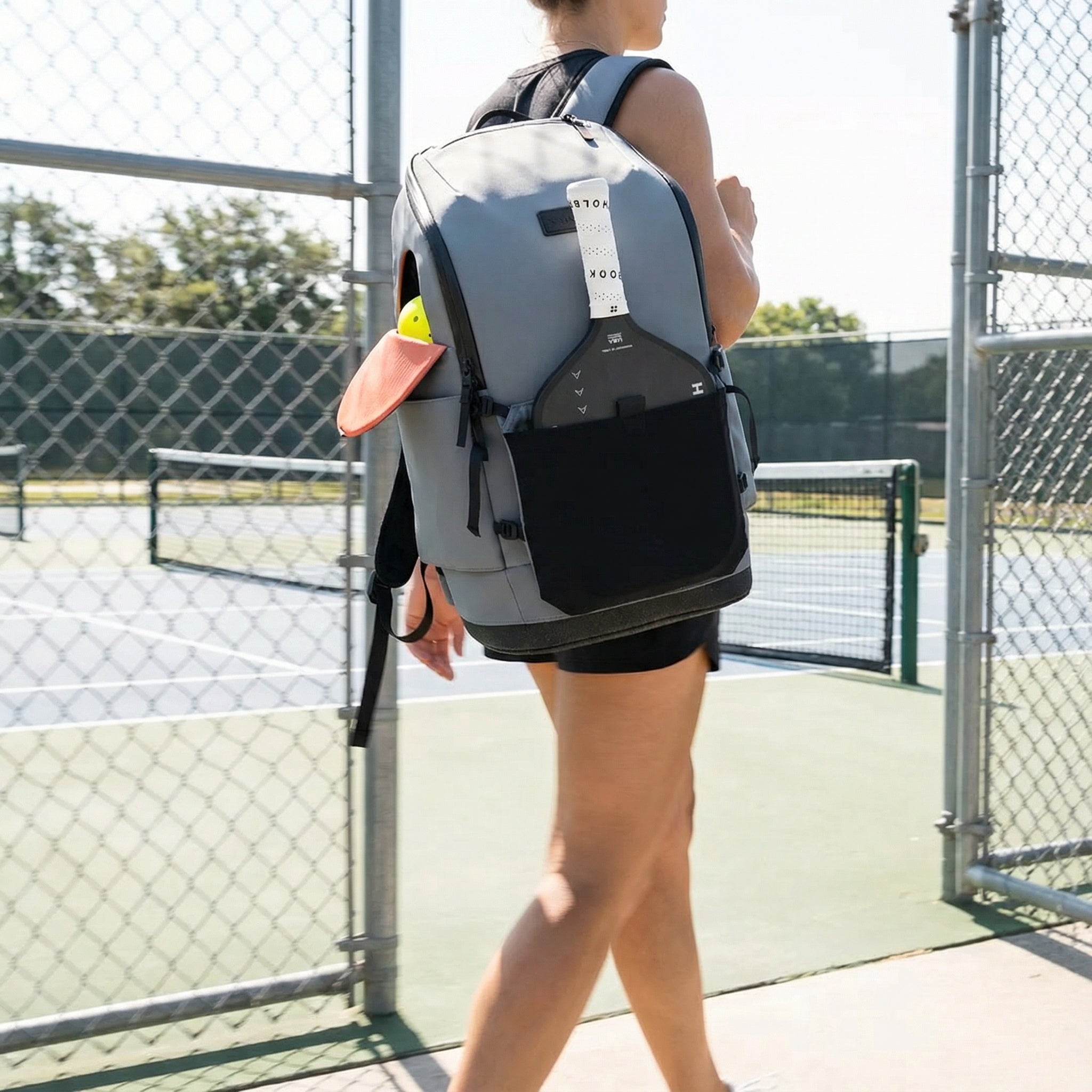
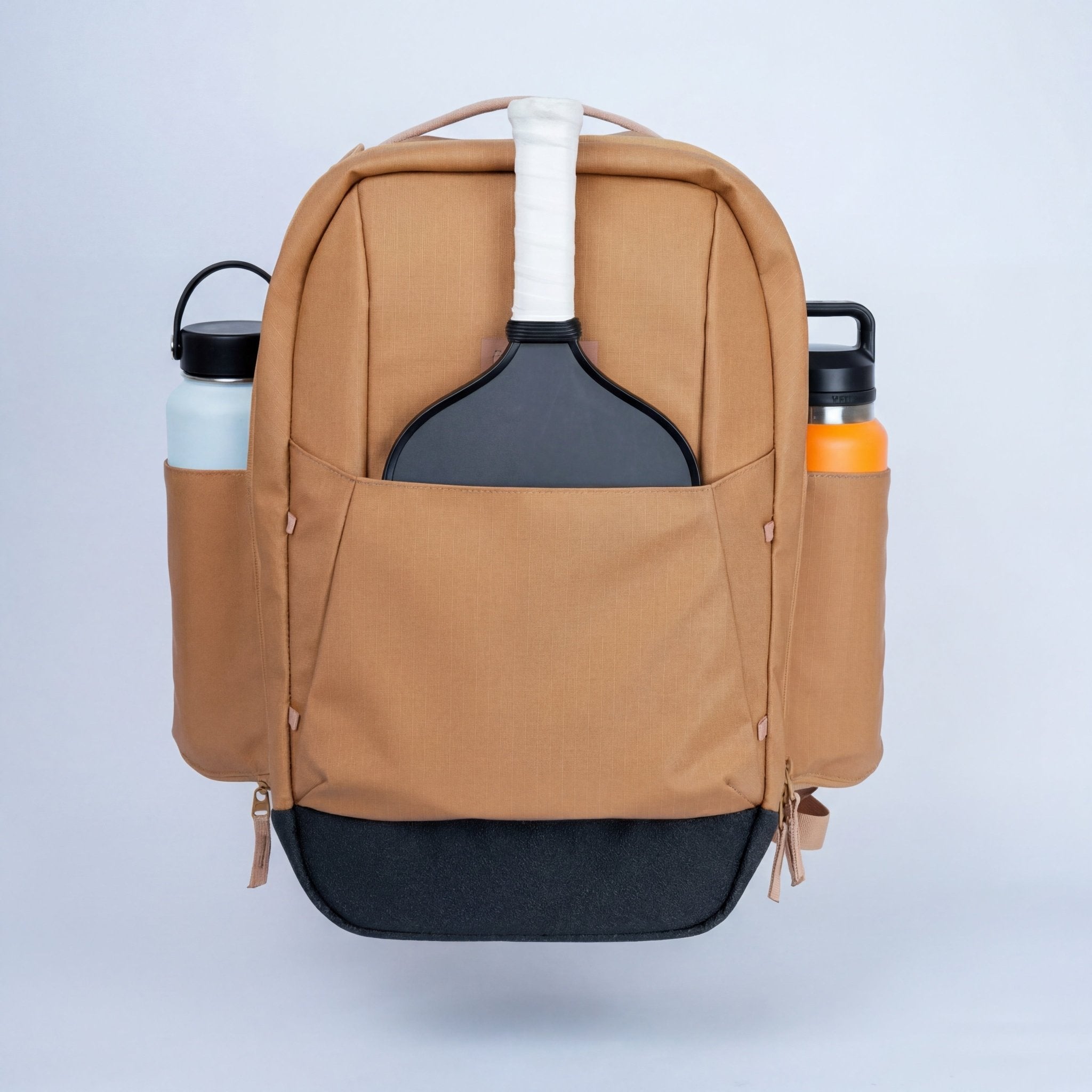
A ball machine for solo drilling, extra balls in the hopper, paddles and water — you need somewhere to put all of it. The Court Ranger V2 ($195) has a modular paddle sleeve, 16" laptop sleeve, and easy-access side pockets designed for exactly this scenario. Built with 500+ real players who treat their practice setup as seriously as their machine.
Final Verdict
The Pickleball Tutor Spin earns its price for the player who drills seriously and solo. Spin capability that replicates real match conditions, 125-ball capacity for meaningful rep blocks, 3-year warranty from a US manufacturer — these add up to a machine that pays for itself over 2–3 years of regular use.
If you're not drilling at least twice a week solo, or if spin variation isn't a specific gap in your game, the Tutor Plus saves $440 and still delivers excellent flat-delivery drilling. The Mini is best reserved for coaches doing light feeds or players with serious storage constraints.
For the 3.5–5.0 player who treats solo drilling as part of the training routine: the Tutor Spin is the machine to buy.
Shop Pickleball Tutor Spin — $1,119 at Pickleball Central →
"The players who improve fastest are the ones drilling at volumes you can't get from pickup games alone. A ball machine at 125 balls and 3-second intervals lets you hit a third-shot drop 40 times in a row. That's the rep count that builds muscle memory — not 6 reps in a point-play situation."
— Topher Lake, FORWRD Co-founder

Leave a comment
This site is protected by hCaptcha and the hCaptcha Privacy Policy and Terms of Service apply.