

Last updated: July 2026
A tournament bag and a travel bag aren't asking for the same thing. Most players don't realize this until they're standing at an airport check-in counter with a 66-liter duffel that clearly does not fit in the overhead bin. The good news: one bag can genuinely do both — but only if you know which features actually matter for each format, and where they conflict.
Here's the breakdown no other guide bothers to give you: what tournaments actually demand, what travel actually demands, where those lists collide, and which bags pass both tests.
What a Tournament Bag Actually Needs (The Non-Negotiables)
Tournament play is a different animal than a Tuesday morning drill session. You're there for 6-8 hours, often outdoors on concrete or asphalt, with multiple matches spread across the day. The bag needs to do a lot more than carry paddles.
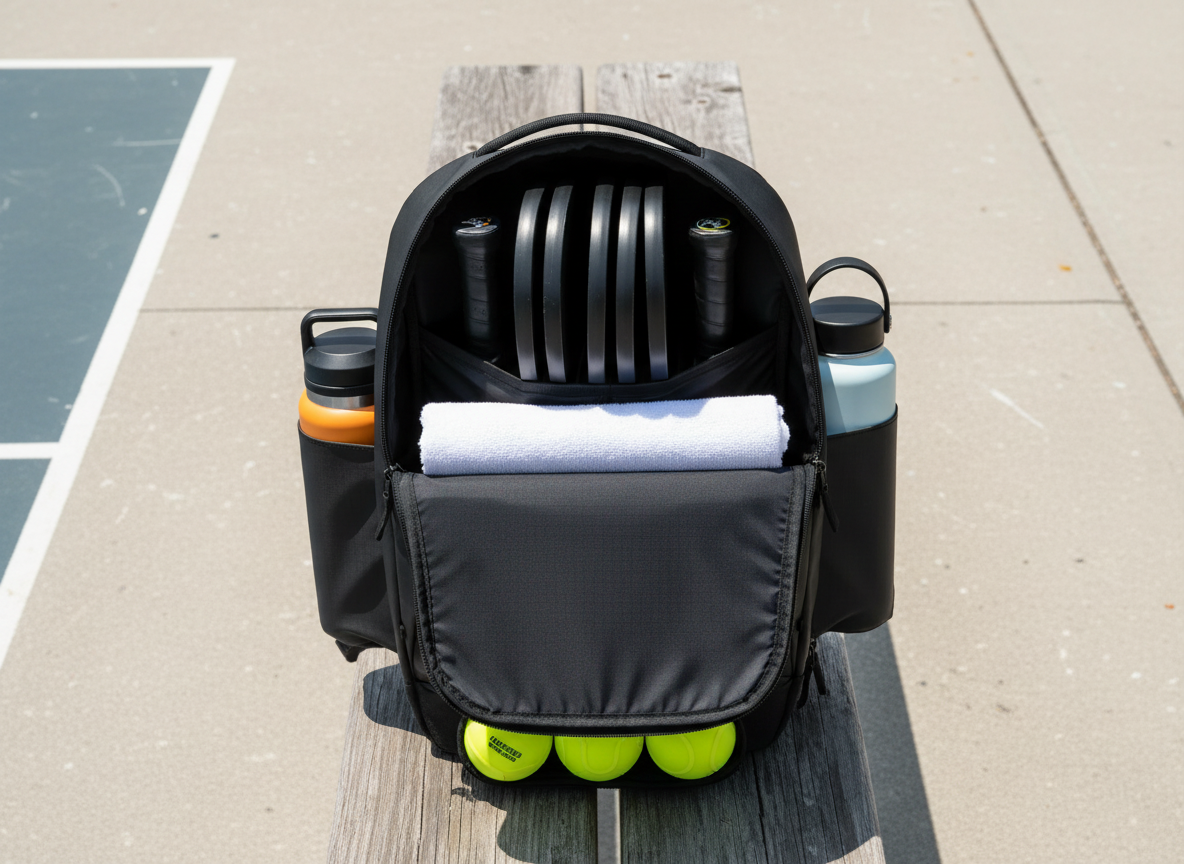
Paddle capacity (4 paddles minimum). Tournaments mean warm-up paddles, backups, and partners borrowing gear. Two-paddle bags are fine for rec play. At a tournament, they're not enough.
Ball access speed. Between matches you have maybe 10 minutes. You're not digging through a stuffed main compartment for balls. Tournament bags need a dedicated quick-access ball pocket — exterior, zipper open, grab and go.
Wet/dry separation. Your court shoes pick up sweat, grit, and outdoor court residue. That stuff does not belong in the same compartment as your clean shirt and snacks. A dedicated shoe or "dirty" compartment isn't a luxury at a tournament — it's hygiene.
Thermal paddle protection. Hot parking lots will warp paddles. Composite and carbon fiber cores don't love sustained heat above 100°F, and black asphalt parking lots in July regularly hit 130-140°F surface temps. Tour-style bags with insulated paddle compartments address this directly.
One thing most articles won't say: most players overestimate how much thermal protection they actually need. If you're going inside between matches, parking in the shade, or playing early morning rounds, you probably don't need full thermal insulation — you need quick access and good organization. Know your tournament format before making this your deciding factor.
Self-standing design or fence hooks. Duffel/tour-style bags are built around this. Backpacks generally aren't. If you're playing at an outdoor club with chain-link fencing, hooks are genuinely useful — but not all tournaments have them.
What a Travel Bag Actually Needs (Different Non-Negotiables)
Travel is about a completely different set of constraints. You're optimizing for airline rules, security checkpoints, and getting from Point A to Point B without having your gear delayed, damaged, or lost in cargo.
Carry-on compliant dimensions. The standard carry-on size for Southwest, Delta, American, United, and Alaska Airlines is 22"×14"×9". Bags over this in any dimension are supposed to be gate-checked or checked — which means your paddles go into cargo, unpadded, in an overhead bin of luggage shifting during flight. That's how paddles crack.
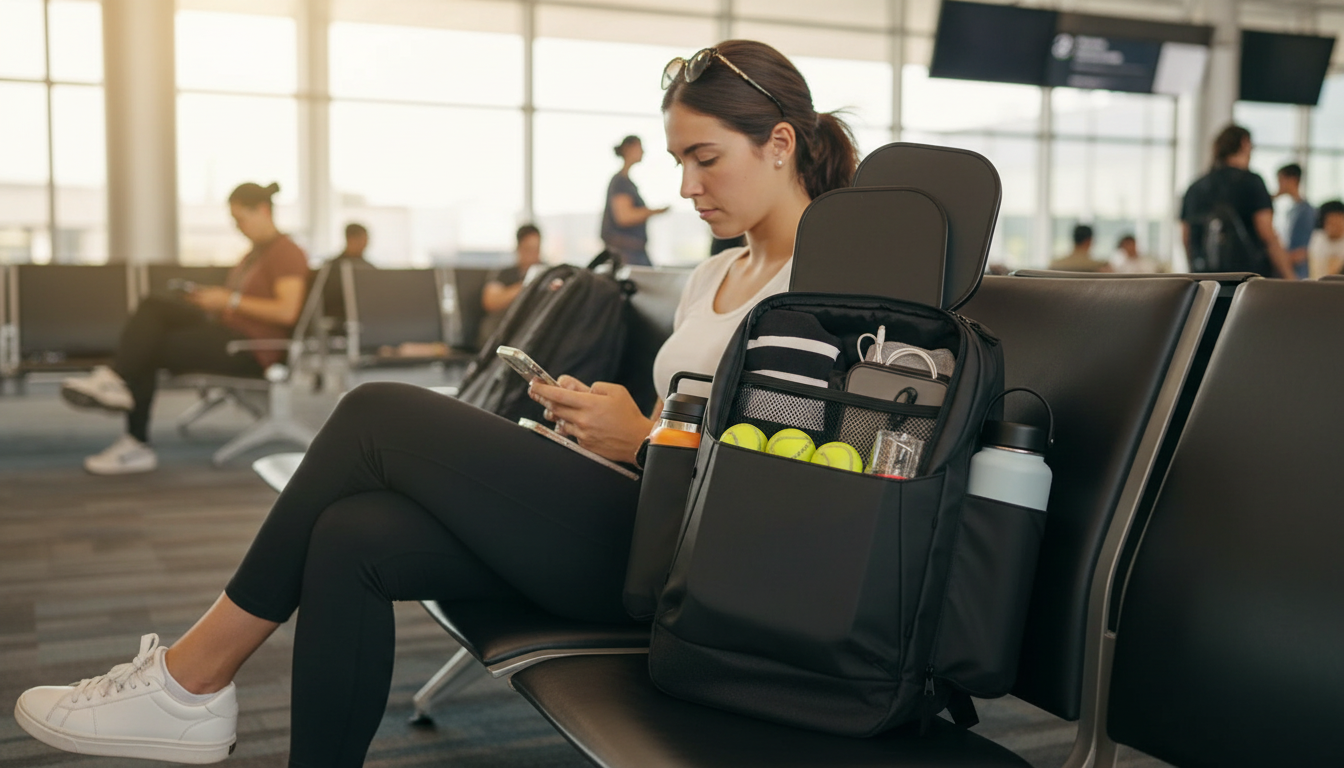
Padded laptop compartment. If you're traveling to a tournament you're probably working during the trip. A real 15-16" padded laptop sleeve means one less bag through security, one less thing to track in the terminal.
Professional appearance. A bag that looks like it escaped from a gym locker is fine for the court. On a plane, in an airport hotel, or at a work meeting before a weekend tournament, it's a problem. The best travel-friendly pickleball bags don't announce themselves as sports bags until you unzip them.
TSA compliance for paddles. Paddles are allowed in both carry-on and checked luggage per TSA rules — confirmed on TSA.gov. The paddle itself isn't the issue. The bag size is.
Luggage passthrough strap. If you're connecting through airports with rolling luggage, a strap that slides over your luggage handle is the difference between comfort and chaos.
Head-to-Head: Tournament vs Travel Requirements
| Feature | Tournament Bag | Travel Bag |
|---|---|---|
| Paddle capacity (4+) | ✅ Essential | ✅ Essential |
| Carry-on compliant (22"×14"×9") | ⚠️ Nice-to-have | ✅ Essential |
| Padded laptop sleeve | ⚠️ Optional | ✅ Essential |
| Quick-access ball pocket | ✅ Essential | ⚠️ Nice-to-have |
| Thermal paddle protection | ✅ Essential (hot climates) | ❌ Not needed |
| Wet/dry separation | ✅ Essential | ✅ Essential |
| Luggage passthrough strap | ❌ Not needed | ✅ Essential |
| Self-standing/fence hooks | ⚠️ Nice-to-have | ❌ Not needed |
| Professional look | ⚠️ Optional | ✅ Essential |
| YKK weatherproof zippers | ✅ Essential | ✅ Essential |
The Carry-On Reality Check: Which Bags Actually Fit
Here's what no other guide tells you: there's a difference between a bag that physically fits in an overhead bin and a bag that's formally compliant with airline carry-on rules. Overhead bins are generously sized. Airline rules are not.
Standard carry-on limit (most major US airlines): 22"×14"×9". Any bag exceeding this in any dimension is technically supposed to be gate-checked — and gate-checking means your paddles go into cargo. Sometimes this is fine. Sometimes you get them back with a crack in the face.
| Bag | Dimensions | Style | Carry-On Status |
|---|---|---|---|
| FORWRD Court Caddy | 20"×12"×8" | Backpack | ✅ Compliant |
| FORWRD Court Ranger V2 | Backpack format | Backpack | ✅ Fits most carriers |
| JOOLA Tour Elite Pro | 24"×12.5"×13.5" | Hybrid duffel | ❌ 24" exceeds 22" limit |
| Standard tour duffel bags | 24–26" typical | Duffel | ❌ Must check on most airlines |
| Pickleball sling bags | ~20"×11"×6" | Sling | ✅ Often fits as personal item |
The JOOLA Tour Elite Pro is a great tournament bag. It's not a travel bag — not because it won't physically squeeze into a bin, but because at 24" it exceeds the formal limit. On a half-empty flight with an understanding gate agent, you'll probably be fine. On a packed flight where they're strictly enforcing size rules, your paddles go in cargo. That's the risk you're accepting.
Can One Bag Do Both? The Honest Answer
Yes — with one catch.
A backpack-style bag with 4-paddle capacity, carry-on compliant dimensions, a padded laptop sleeve, and weatherproof zippers handles both formats. That exists. But you're giving up one thing: full thermal paddle insulation.
Tour duffel bags solve the thermal problem with insulated paddle pockets. Carry-on-compliant backpacks don't have the bulk for them. The honest trade-off is: backpack bags rely on you to park in the shade or take your paddles inside between matches. In Arizona in August, this actually matters. In Seattle in June, it probably doesn't.
"We tested 30+ bags during the Court Ranger V2 design process. The most consistent feedback from players who travel to tournaments was always the same: they were carrying two bags — one for the court, one for the plane — and constantly leaving the wrong one at home. We built the Ranger V2 to end that."
If you play outdoor summer tournaments in hot climates and frequently travel by air, you have two realistic options: (1) accept the thermal trade-off and use one carry-on-compliant backpack, or (2) own two bags — one optimized for each format. Option 2 is the right answer for dedicated tournament players who fly regularly.
For everyone else — players who drive to tournaments, play in temperate climates, or travel a few times a year — one quality backpack-style bag genuinely handles both.
Mid-Post Recommendation
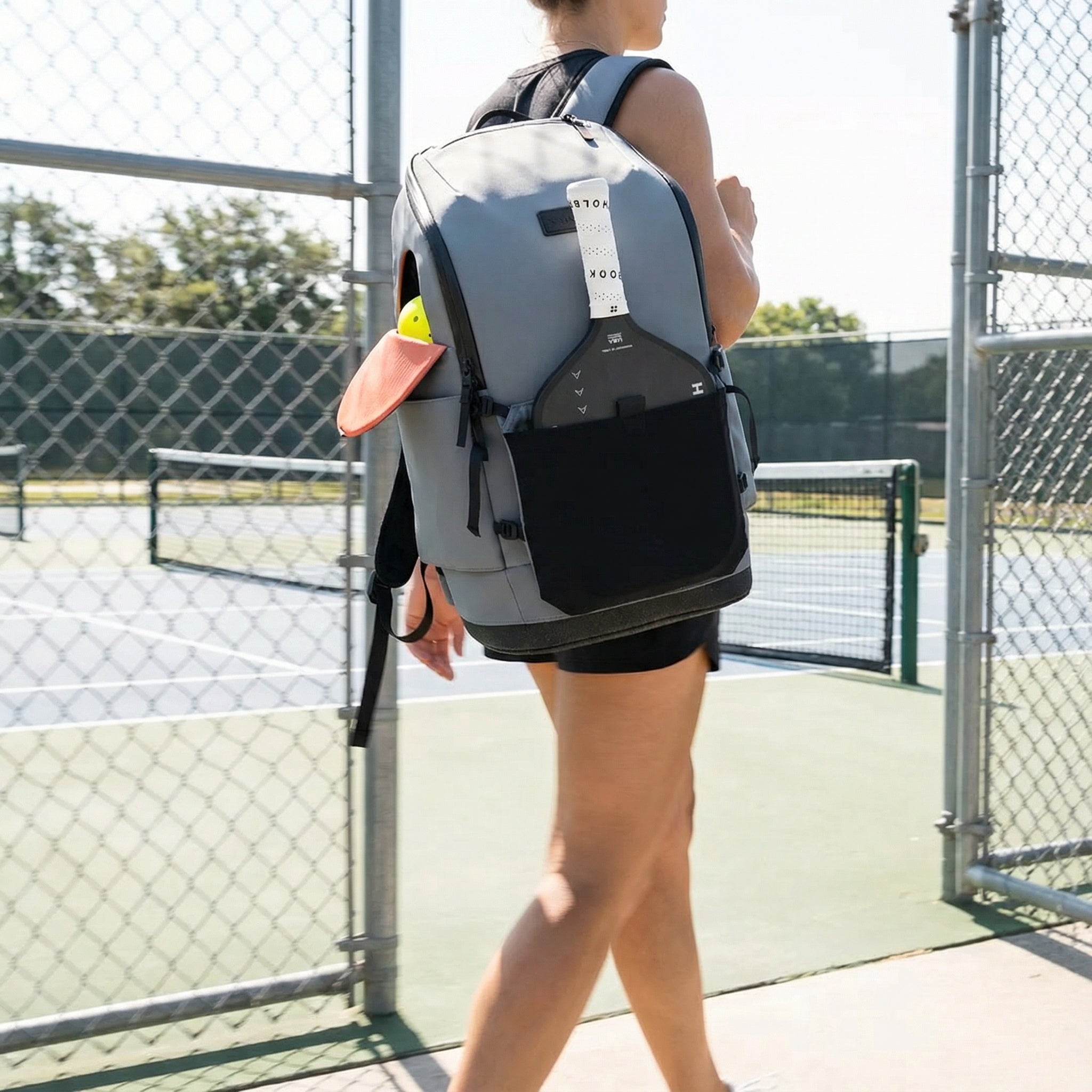
If you want one bag that works at every tournament and every airport: the Court Caddy Backpack ($325) — 4-paddle capacity, 15" padded laptop sleeve, 20"×12"×8" carry-on dimensions, and YKK AquaGuard weatherproof zippers. Built to do both.
Court Caddy and Court Ranger V2: How They Fit Each Use Case


Both bags were designed knowing that players take them to tournaments and airports — that wasn't an afterthought in the design process, it was a stated design requirement from the player feedback sessions.
Court Caddy ($325) for tournament + travel: The stronger pick for serious tournament players who also travel. The 4-paddle modular sleeve handles a full tournament loadout. At 20"×12"×8", it's well within the 22"×14"×9" carry-on standard. The 15" padded laptop sleeve means no second bag through security. YKK AquaGuard zippers have handled 40+ rainy outdoor sessions in our testing without zipper breach. The one trade-off: no thermal paddle insulation. Park in the shade.
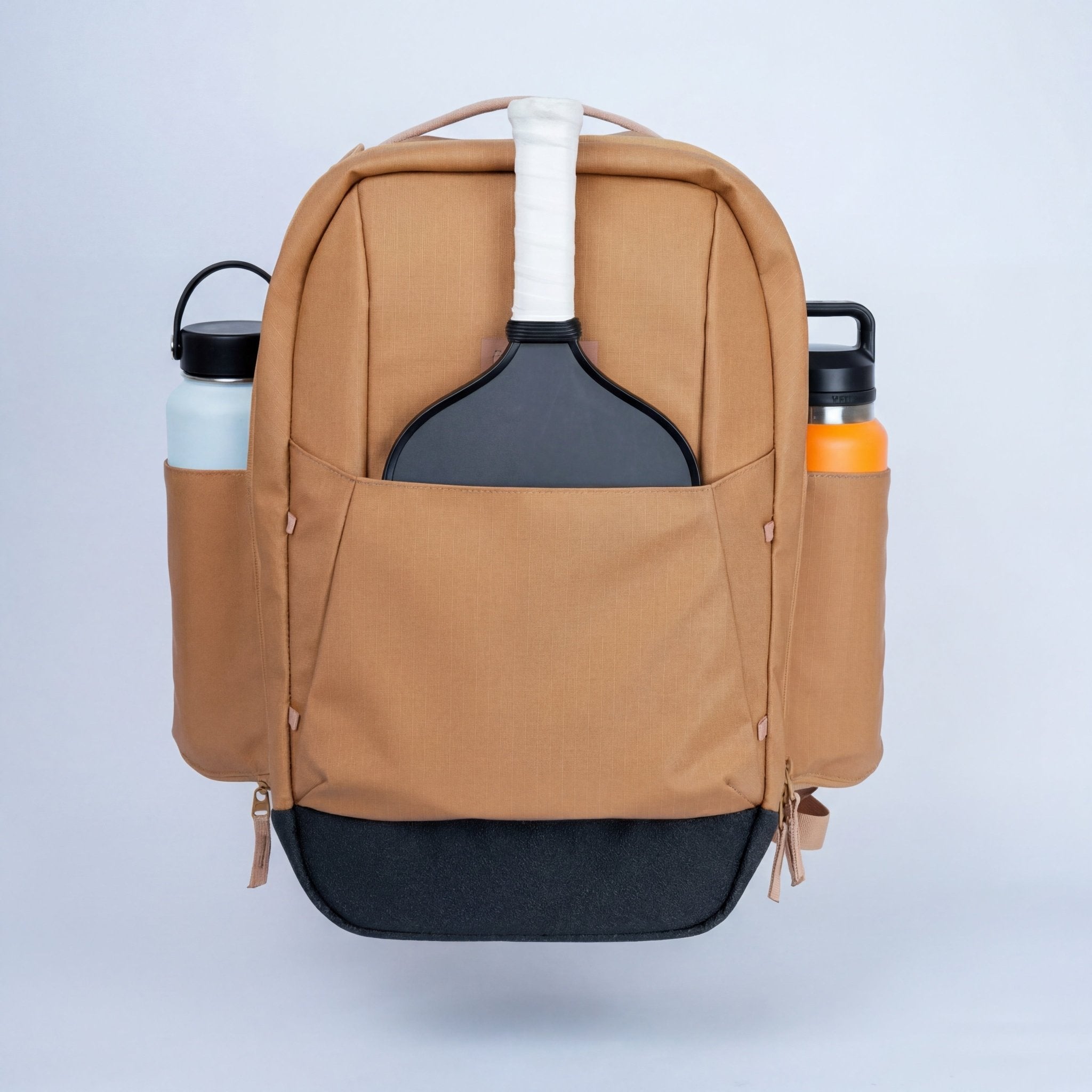
Court Ranger V2 ($195) for the value-tier player: The better pick for players who want solid dual-purpose performance without the $325 price tag. The 16" laptop sleeve actually fits more laptops than the Caddy's 15" — relevant if you're carrying a larger MacBook Pro. Same YKK AquaGuard zippers, same modular paddle sleeve. The price difference buys you the Caddy's premium materials and build longevity over 5+ years of hard use. If you're playing 2-3x per week and traveling 3-4 times a year, the math on which is worth it depends on how long you want the bag to last.
For a full comparison of affordable tournament bags at the $130-$200 price point, see our best affordable tournament pickleball bags guide. For travel-specific picks including wheeled options, see our pickleball travel bag roundup. For TSA rules on pickleball paddles specifically, see our paddle-on-plane guide.
FAQ: Pickleball Tournament Bag vs Travel Bag
What's the difference between a tournament pickleball bag and a travel bag?
Tournament bags prioritize capacity (4+ paddles), quick ball access, and wet/dry gear separation for full-day play. Travel bags prioritize carry-on compliant dimensions (22"×14"×9"), padded laptop protection, and professional appearance. Most tour-style duffel bags serve tournaments well but exceed airline carry-on limits. Backpack-style bags with 4-paddle capacity can do both.
What features does a tournament bag need that a travel bag doesn't?
Tournament-specific features include thermal paddle protection (for hot parking lots), a quick-access exterior ball pocket for between-match grabs, self-standing capability or fence hooks, and enough organization for a full day of gear — shoes, towels, snacks, change of clothes. Travel bags don't need any of these; they need carry-on compliance and laptop protection instead.
Can one pickleball bag work for both tournaments and travel?
Yes, if it's a backpack-style bag with 4-paddle capacity, carry-on compliant dimensions, and a padded laptop sleeve. The trade-off is no thermal paddle insulation — you'll need to park in shade at outdoor summer tournaments. For players who play in hot climates and fly regularly, owning two bags (one tournament duffel, one travel backpack) is the better solution.
What's the best pickleball bag for both tournament play and airport travel?
The FORWRD Court Caddy ($325) — 20"×12"×8" carry-on dimensions, 4-paddle modular sleeve, 15" padded laptop compartment, YKK AquaGuard weatherproof zippers, and a lifetime warranty. The Court Ranger V2 ($195) is the value-tier version with a 16" laptop sleeve and the same weatherproof zippers.
Do pickleball tournament bags fit as airline carry-on?
Backpack-style tournament bags (typically 20"×13"×10") fit as carry-on on most major airlines (standard limit: 22"×14"×9"). Tour duffel bags — like the JOOLA Tour Elite Pro at 24"×12.5"×13.5" — exceed the 22" length limit and must be gate-checked on strictly-enforced flights, putting paddles in cargo. If protecting your paddles matters, fly with a backpack-style bag that stays within carry-on limits.
One bag. Two formats. No compromises.
The Court Caddy is designed for players who take the game seriously — at local tournaments and international airports alike. Carry-on compliant, tournament-ready, lifetime warranty.
Shop the Court Caddy →Or see the Court Ranger V2 at $195 for the value-tier option.

Leave a comment
This site is protected by hCaptcha and the hCaptcha Privacy Policy and Terms of Service apply.