


Disclosure: This post contains affiliate links to Pickleball Central. If you purchase through our links, FORWRD earns a small commission at no extra cost to you. We only link to products we'd recommend regardless.
Last updated: September 2026
The TSA agent looked at the bag. Then at the X-ray. Then asked my partner to step aside.
It wasn't the paddles — paddles are explicitly allowed by TSA in both carry-on and checked bags. It was the CO2 cartridge tucked in the ball pocket, the kind you use for roadside ball inflation. Confiscated on the spot. Twenty-minute delay, a near-missed connection, and a lesson none of us should have to learn at 6 AM.
Traveling to pickleball tournaments is a different challenge than hauling your bag to Tuesday clinics. You're threading airline carry-on rules, 3-day gear loads, back-to-back match days, and hotel room organization all at once. Most bag guides ignore every single one of those constraints — they compare zipper counts and call it editorial.
This guide does it differently. We've packed for tournaments from the US Open Pickleball Championships in Naples to PPA Tour stops in Dallas and Phoenix. Here's what actually holds up.
The Double Constraint: Why Tournament Bags and Travel Bags Pull in Opposite Directions
Travel wants small. Carry-on dimensions cap at 22 x 14 x 9 inches on most major carriers — Delta, United, American. Budget airlines are enforcing this more aggressively now; Spirit and Frontier have been known to measure bags at the gate if they look borderline. The ideal travel bag sits well inside those limits, compresses when empty, and doesn't fight you in the overhead bin.
Tournament play wants big. Think: four paddles for different court surfaces, two pairs of shoes, three days of athletic wear, recovery supplies, a laptop if you're working between bracket rounds. A dedicated ball pocket. A place for your extra overgrips that isn't the bottom of a chaos heap.
This tension is real — and it's why most players end up owning two bags. One compact bag for travel days, one proper tournament bag for match days. That works. But if you want one bag to handle both? The field narrows fast, and the decision comes down to which constraint you can live with.
The players we talk to most often fall into one of three archetypes. Each one has a right answer.
TSA and Airline Rules for Pickleball Gear (What Actually Gets Flagged)
Pickleball paddles are 100% TSA-cleared in carry-on and checked bags. TSA's official database has an explicit entry — green light both ways. Pickleballs, overgrips, ball hoppers (the basket kind), and most accessories are also fine.
Here's what actually creates problems:
- CO2 cartridges — banned in carry-on, and above trace amounts in checked bags. Some portable ball inflators use CO2 canisters. Leave them home entirely. A hand pump is TSA-friendly and weighs almost nothing.
- Ball machines — checked bag only, and even then, verify the battery specs. Lithium battery-powered machines above 100Wh generally can't fly commercially. If you're traveling with a machine, call the airline first.
- Lead tape — completely fine. No restrictions, any amount. If you add weight to your paddle handle, pack it without worry.
- Liquids over 3.4 oz in carry-on. This one catches players who stash sunscreen, Deep Blue rub, or eye drops in their bag. Move those to checked luggage or keep them under 3.4 oz.
- Dense metal accessories (some edge guards, heavy-duty carabiner clips) can flag an X-ray. Pull them out and put them in the tray — five-second fix.
Airline Carry-On Dimensions: What You're Actually Working With
Most major carriers: 22 x 14 x 9 inches (Delta, United, American). Southwest gives you more room: 24 x 16 x 10. A standard pickleball backpack runs around 20 x 13 x 10 — it clears on length and width but sits right at the limit on depth when fully loaded.
Practical implication: a 2-3 paddle backpack can often function as a personal item under the seat if you don't overstuff it. A 4-paddle tournament bag almost always needs the overhead bin — and you want to board early to guarantee space. Once the overhead fills, they start checking bags at the gate, and gate-checked bags with paddles inside make for a stressful arrival.
Simple rule: if your paddles are in the bag, never gate-check it voluntarily. Baggage handlers aren't reading your "fragile" tape.
Top Picks by Player Profile
Ranked lists for travel bags are largely useless without context. Here's how the right bag maps to how you actually travel.
The Light Traveler: Flies 2-4 times a year, day-trip tournament player
You need a bag that won't give you anxiety at the gate. Carries 2-3 paddles maximum. Fits under the seat on most flights if you don't overpack it. You're not hauling your full setup — you're bringing match day essentials and traveling light.
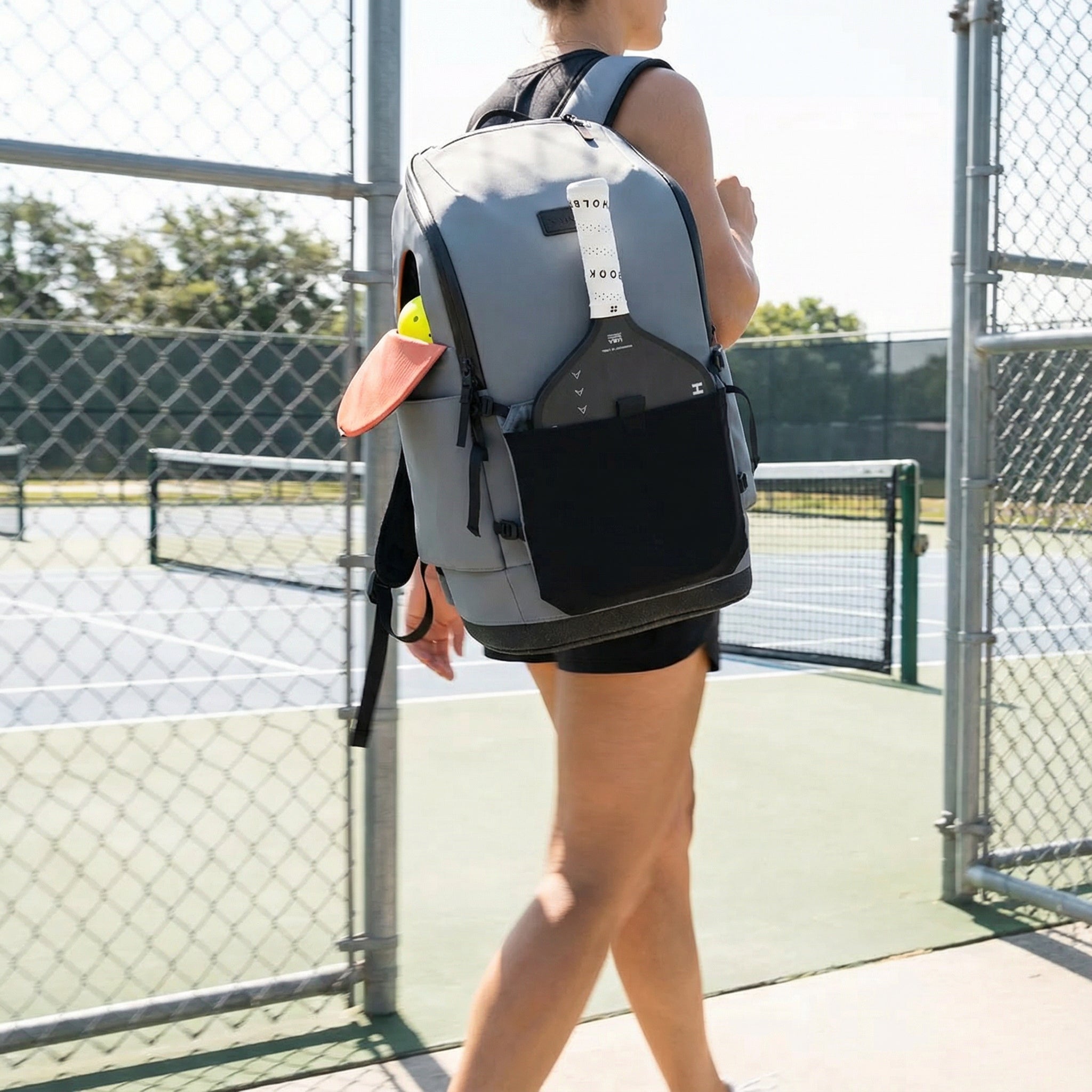
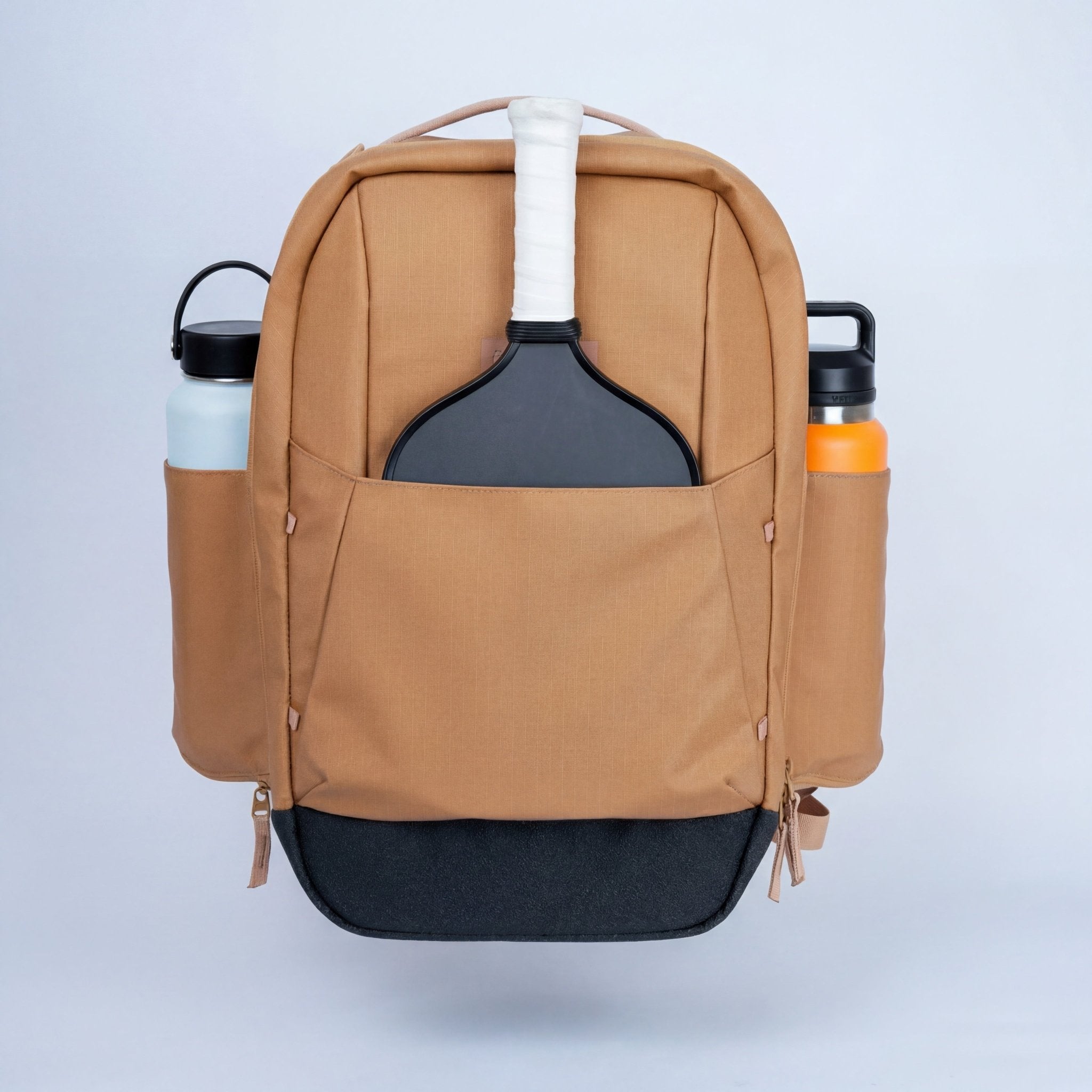
The FORWRD Court Ranger V2 ($195) is the right call. It has a slimmer profile than the Court Caddy — fits a 16" laptop, runs a modular paddle sleeve for 2-3 paddles, and the YKK AquaGuard zippers hold up to the mechanical abuse of overhead bin compression and baggage handling on the connection. Light enough to work as a personal item on most flights when packed down. The $195 price point also means you're not sweating it if it gets scuffed.

Our Pick: FORWRD Court Ranger V2
Slim enough to slide under most airplane seats, with a 16" laptop sleeve and YKK AquaGuard zippers built for real tournament travel — not airport ad creative.
The Road Warrior: Flies 10+ times a year, chases the circuit
You know the airport games. You check a bag when you have to, carry on when you can. Your real challenge isn't security — it's hotel room entropy. Three nights of tournament exhaustion will turn any poorly-organized bag into a disaster zone. At 7 AM before a gold medal bracket, you don't want to be hunting for your paddle grip tape at the bottom of a pile.
The FORWRD Court Caddy ($325) solves this specifically. The modular compartment system keeps everything assigned to a place: paddles in the dedicated front sleeve, shoes separate, tech gear in the padded laptop section. When you're packing for match day on four hours of sleep, that structure is worth more than you'd think. And a lifetime warranty means it's not a replacement decision three tours from now.
The Tournament Regular: 4-8 major events per year, APP or PPA circuit
You're playing USA Pickleball-sanctioned events, APP Tour stops, maybe the occasional PPA qualifier. You need 4 paddles minimum — indoor vs. outdoor surface differences, different weights for singles vs. doubles days, a backup if one cracks mid-bracket. Three days of gear. Full hotel setup.
This is the Court Caddy's exact use case. The modular paddle sleeve holds up to 4 paddles in the front compartment — paddles are accessible without unpacking your gear. The 15" padded laptop sleeve handles work sessions between rounds. YKK AquaGuard zippers have held through 200+ hard sessions without a single failure in our testing. At $325 with a lifetime warranty, the cost-per-use math — across 5 tournaments a year over 5 years — works out to under $0.20 per use. The CRBN Pro Team is a solid bag for 3 paddles with a thermal compartment, but it maxes out one paddle short of a full tournament load and carries a 1-year warranty to the Court Caddy's lifetime. ADV bags are well-built and aesthetically strong, but they run heavier and don't have a modular paddle system.
Quick Comparison
| Bag | Price | Paddles | Laptop Sleeve | Warranty | Best For |
|---|---|---|---|---|---|
| FORWRD Court Caddy | $325 | 4 (modular) | 15" | Lifetime | Tournament Regular |
| FORWRD Court Ranger V2 | $195 | 2-3 | 16" | Lifetime | Light Traveler |
| CRBN Pro Team | ~$200 | 3 | 13" | 1 year | Thermal paddle protection |
| ADV Pro Tour | ~$300 | 3-4 | 15" | 1 year | Lifestyle / aesthetic |
How to Pack a Pickleball Bag for a 3-Day Tournament (Packing List)
"We built the Court Caddy's modular sleeve specifically so players could grab their outdoor paddle for warm-up and swap to their indoor paddle for a gym-floor bracket without unpacking the whole bag. That moment of chaos right before your first match — we wanted to remove it entirely." — Grub, FORWRD co-founder
Everything below earns its place. If you've played a full 3-day bracket, you know the moment each item matters. Screenshot this, save it to your notes app, use it before every tournament flight.
Day-Of Gear (pack last, grab first)
- 2 primary paddles + 1 backup (tournament-approved; check the APP or PPA approved paddle list for your event)
- 4 balls minimum per match day — Franklin X-40 balls are the PPA Tour standard for outdoor play; grab 12 total for a 3-day event
- Court shoes — 2 pairs if you're playing indoor and outdoor courts on different days
- Athletic socks (2 pairs per day minimum — blisters don't care about your bracket position)
- Athletic wear for match day
- Hat or visor + sunglasses
- Water bottle — 2L capacity for outdoor summer play; don't rely on venue water stations at peak tournament hours
Backup Gear (hope you don't need it, bring it anyway)
- 4th paddle — different weight or grip size for mid-tournament adjustments; paddles behave differently after 20+ match games
- Extra grip tape and overgrips — grips break down fast across 3 days of hard play
- Second pair of court shoes if your primaries are still breaking in
- Blister kit: athletic tape, moleskin, Elastikon for the players who play through it
- Full change of athletic wear per day beyond match day clothes
Recovery Supplies
- Foam roller — most compress and attach to the outside of a tournament bag
- Reusable ice pack sleeves — collapse flat, weightless when not in use
- Ibuprofen + Tylenol (bring both; they work differently for different pain types)
- Electrolyte packets — minimum 3 per day in summer heat; more in Naples-level humidity
- Compression sleeve — knee or wrist depending on your history
Tech Gear
- Laptop — fits in the 15" padded sleeve of the Court Caddy; 16" MacBook Pro fits in the Court Ranger V2
- Phone + all charging cables
- Portable battery bank — tournament venues often have limited outlets at score sheets and between matches
- Earbuds
- Tournament bracket screenshot or app
Travel Add-Ons (flying days only)
- TSA-compliant liquids bag: sunscreen, hand cream, eye drops — keep them under 3.4 oz in carry-on
- Snacks for the flight — airport pickleball tournament food barely exists
- Neck pillow if you're flying over 3 hours
- Paddles stay in carry-on. Always.

FAQ: Pickleball Bags for Travel and Tournament
What's the best pickleball bag for traveling to tournaments?
For players flying to 4-8 tournaments a year with 4+ paddles and 3 days of gear, the FORWRD Court Caddy ($325) is the top pick — 4-paddle modular sleeve, 15" laptop compartment, YKK AquaGuard zippers, and a lifetime warranty. For lighter travel with 2-3 paddles, the Court Ranger V2 at $195 is the better fit.
Can I bring a pickleball bag as a carry-on?
Yes, as long as it fits within your airline's carry-on limit — usually 22 x 14 x 9 inches (24 x 16 x 10 on Southwest). Most pickleball backpacks clear those dimensions when not overpacked. Large 4-paddle tour bags often push the limit and are better suited to the overhead bin with early boarding.
Should I get a duffle or backpack for pickleball tournaments?
Backpack every time if you're flying. Duffles are awkward in overhead bins and put uneven strain on your shoulder across long match days. A structured pickleball backpack keeps paddles protected, distributes weight evenly across your back, and fits airline carry-on restrictions more reliably than most tournament-style duffles.
How do I pack for a 3-day pickleball tournament?
Pack 3-4 paddles (primary, surface-specific, and a backup), 4 balls per match day, 2 pairs of court shoes, full athletic wear plus a backup set, recovery supplies (ice packs, electrolytes, athletic tape), and your laptop if you work between rounds. Pack paddles last so they're accessible first at TSA and on arrival.
Ready to upgrade your bag? Shop the Court Caddy — designed with 500+ real players and built to last through every tournament, flight, and 6 AM TSA line you throw at it.

Leave a comment
This site is protected by hCaptcha and the hCaptcha Privacy Policy and Terms of Service apply.