

Disclosure: This post contains affiliate links to Pickleball Central. If you purchase through our links, FORWRD earns a small commission at no extra cost to you. We only link to products we'd recommend regardless.
Last Updated: September 2026
You've already planned vacations around golf courses, ski slopes, and surf breaks. Pickleball travel is the same idea — except your courts are easier to find, the community is friendlier, and you can play at 8 AM and be at the beach by noon. The sport crossed 19 million players in the US in 2026, and the travel infrastructure finally caught up. Purpose-built pickleball resorts. Tournament circuits that span 40+ cities. Cruise ships with dedicated courts. A global app network that maps courts in 68 countries.
This guide covers everything: the best destinations in the US and internationally, how to plan a tournament trip, what to pack and how to fly with your gear, and the framework we use to get into a competitive game anywhere — within 24 hours of landing.
Quick Navigation
- Best US Pickleball Destinations
- International Destinations Worth the Trip
- Organized Trips vs. DIY
- Tournament Travel Planning
- What to Pack for a Pickleball Trip
- The Right Travel Bag
- Flying with Pickleball Gear
- Finding Courts at Your Destination
- The 24-Hour Game Framework
- Pickleball Cruises
- Seasonal Guide: When to Go Where
- What Pickleball Travel Actually Costs
- FAQ
The Best US Pickleball Destinations in 2026
Not all pickleball destinations are equal. A city with 50 courts scattered across parks is a different experience than a destination built for the sport — with organized open play, pro clinics, and enough courts that you don't wait 45 minutes for a paddle up. Here are the ones that earn the trip.
Naples, Florida
This is the undisputed pickleball capital of the US, and it's not close. Naples has over 200 public courts across the city, with East Naples Community Park (65 courts) and the Naples Pickleball Center (64 courts) as the anchors. Open play runs morning through evening. Skill-segmented courts mean you're not stuck playing against beginners if you're a 4.0+ — or getting destroyed by 5.0 bangers if you're just getting your footing.
The Minto US Open Pickleball Championships happens here every April. If you want to see what elite tournament play actually looks like at courtside, this is your one event. It drew 55,000 spectators in 2025. Book accommodation 6+ months in advance if you're planning around the US Open — everything within a 10-mile radius fills up.
Best time to visit: November through April. Florida summers are brutal for outdoor play — heat index over 100°F by 10 AM. If you go in the summer, go early or find indoor facilities.
Indian Wells / Palm Springs, California
The BNP Paribas Tennis stadium at Indian Wells also hosts major pickleball events, including Tournament of Champions stops. The Coachella Valley has excellent court access — Desert Recreation District runs dedicated pickleball facilities, and the proliferation of resort communities (Palm Desert, Rancho Mirage, La Quinta) means court access is embedded into where you'd stay anyway.
One underrated angle: the snowbird community means there are organized skill-segmented games running every morning from October through April. Show up at a community court, announce your rating, and you're in a game within 15 minutes. The culture here is built for exactly this.
San Diego, California
San Diego's year-round weather makes it a different kind of pickleball destination — no "best time to visit" because every month is fine. Mission Bay Park, Morley Field, and the Scripps Ranch Recreation Center all have strong court access. The city's proximity to Tijuana also means day-trip options if you want to experience international play (courts are built and active in northern Baja).
It's not a purpose-built pickleball destination in the way Naples is, but the court density combined with the climate and general San Diego lifestyle makes it an easy bolt-on to any trip.
Scottsdale / Surprise, Arizona
Arizona has become a serious pickleball hub, largely because of the retirement community infrastructure that was already there before the sport exploded. Sun City Grand has its own dedicated pickleball complex. Surprise has a nationally-known training center. The PPA Tour has made multiple Arizona stops in 2026.
Optimal window: October through April. June through September is outdoor pickleball in a convection oven — surface temperatures on outdoor courts can hit 130°F in July. Some indoor facilities mitigate this, but it's a real factor.
Austin, Texas
Austin is worth flagging because it's the fastest-growing pickleball market in a fast-growing pickleball country. Dreamland (the purpose-built indoor facility in Austin) opened to national attention in 2024 and has become a model for what a dedicated club can be. If you're passing through or combining with a work trip, Dreamland and the surrounding park courts offer legitimate destination-level play.
→ For more on finding court gems in unexpected cities, read our guide: Pickleball Court Guide: Dimensions, Surfaces, and How Courts Vary Across the Country
International Pickleball Destinations
International pickleball travel is earlier in its development than domestic, but certain spots have crossed the threshold from "there are courts here" to "worth building a trip around."
Cancun / Riviera Maya, Mexico
The resort corridor south of Cancun has embraced pickleball faster than almost any other international destination. Tulum now has resort facilities with daily programming. Tres Palapas Baja (on the Pacific side) has ten dedicated courts. Several all-inclusive resorts in the Playa del Carmen area have added courts and clinics to their standard amenities. The appeal here is obvious: combine a tropical vacation with actual play time in a climate that suits it.
Tuscany / Italy
Less obvious, more surprising. Several agriturismi (farm-stay properties) in Tuscany have added pickleball courts as a draw for American guests. Organized pickleball vacation companies now run week-long Tuscany itineraries — play in the morning, tour vineyards in the afternoon. It's niche but legitimately excellent.
Caribbean Resorts
Park Hyatt St. Kitts, Half Moon Jamaica, and Sandals resorts across the Caribbean have added courts and programming. The Half Moon Jamaica setup — eight courts, daily clinics, private lessons, beachfront access — is particularly well-executed. For players who want organized resort play with a luxury backdrop, these properties outcompete domestic options on ambiance, even if the court volume is lower.
New Zealand
New Zealand's pickleball community is small but well-organized, and the country's infrastructure for outdoor sports generally makes court access predictable. Several organized tour companies now run "play and sightsee" itineraries through the North Island. It's a long-haul flight, so this is trip-within-a-trip territory rather than a dedicated pickleball destination.
Organized Pickleball Trips vs. DIY: The Honest Trade-Off
The organized pickleball travel market has grown fast — Pickleball Getaways (founded by Ben Johns), Dink Destinations, Evyssa, Pickleball in Paradise, and half a dozen others all offer group trip packages. Price range: $1,500 to $6,800 depending on duration, destination, and inclusions.
The value prop is real: you show up, you play, someone else handles court logistics, meal arrangements, and social structure. You'll meet 20-30 other players at similar skill levels. For travelers who don't know the local court scene, or who want a social experience rather than a solo expedition, organized trips deliver it.
The trade-off is flexibility and cost. $3,300 for a 7-day organized trip versus $1,200-1,800 for a DIY trip to the same region (flights, accommodation, court fees) — the gap is real. Here's when each option makes sense:
| Go organized if… | Go DIY if… |
|---|---|
| You're traveling solo or with non-playing partner | You're traveling with a group of 4+ players |
| The destination is unfamiliar (international, new city) | You know the destination or have local contacts |
| You want guaranteed skill-level matching | You're flexible on who you play with |
| Clinic time with a pro is the goal | Just playing is enough — no instruction needed |
One real advantage of organized trips that's easy to overlook: the people. Players who book a pickleball trip with strangers are self-selected for being social, reasonably serious about the game, and good at being in group situations. The social dynamic often surprises first-timers.
Tournament Travel: How to Plan Your Event Trips
Playing in a tournament away from home is a different animal than just playing recreational travel. The logistics are tighter, the stakes feel higher, and the planning needs to start earlier than most people expect.
The PPA and MLP Circuit
The Professional Pickleball Association Tour runs 30+ stops in 2026, concentrated in the spring (March-June) and fall (September-November). Major League Pickleball runs 12 stops through the summer. Both circuits are open to amateur divisions alongside the pro draws — so you can register to play AND watch the pros on the same weekend.
Registration opens 8-12 weeks before most PPA events. For high-demand events (US Open, Nationals, Life Time Grand Slam stops), early registration is legitimately important — fields fill up, and waitlists are real.
Planning Timeline
- 10-12 weeks out: Register for the event. Book accommodation — tournament weekends in smaller cities can be supply-constrained. The host venue often has a hotel block; use it.
- 6-8 weeks out: Register your partner if you're playing doubles. Confirm scheduling — most tournaments post bracket schedules 2-3 weeks out, but some early-round conflicts come up sooner.
- 2-3 weeks out: Confirm flights. Build a gear checklist specific to the event surface (indoor courts vs outdoor, concrete vs asphalt).
- 48 hours before: Review match schedule, know your court assignments, pack your bag. Full tournament packing checklist here.
At the Tournament
Something no guide tells you: arrive at least 15 minutes early to check-in, even if you've done it online. Tournament check-in lines move slower than anyone expects. Get your wristband, find your assigned courts, and walk the facility before you play. Knowing where the bathrooms, water, and ball stations are removes one category of mental friction during competition.
For a full hour-by-hour breakdown of what to expect at your first tournament, read: Your First Pickleball Tournament: What to Expect Hour by Hour
"The players who do well in tournament travel are the ones who remove variables. Same warmup routine, same bag setup, same pre-match meal. The tournament is stressful enough. Your gear situation shouldn't add to it." — Topher, FORWRD co-founder
What to Pack for a Pickleball Trip
The gear list differs depending on whether you're heading to a resort for recreational play or a tournament. Here's both.
Recreational Trip (Resort or Destination Play)
- 2 paddles minimum. Your main paddle plus one backup. String tension, grip feel, and paddle condition all change with heat and humidity. Don't find out your only paddle has gone dead at a resort with no pro shop.
- 6-8 balls. Outdoor courts chew through balls faster than indoor. Indoor balls travel poorly and crack in cold temps. Know where you're playing and pack accordingly. Franklin X-40s for outdoor; Onix Fuse for indoor.
- Court shoes — dedicated. Not running shoes, not cross-trainers. Court-specific shoes with lateral support. Playing pickleball in running shoes on a concrete court for 3 hours is the fastest route to a rolled ankle. Pickleball shoes at Pickleball Central →
- Extra grip tape. Heat makes your current grip slippery. Bring 2-3 overgrip replacements.
- Sunscreen rated 50+ SPF. Obvious. Often forgotten.
- Electrolytes. Not sports drinks — actual electrolyte packets. Playing 3 hours of outdoor pickleball in 85°F heat requires more salt replacement than Gatorade provides.
- A towel and headband. Sweat management is real at outdoor destinations.
Tournament Trip (Additional items)
- Approved tournament balls. Check the event's approved ball list. Many PPA events require Franklin X-40s. Buying at the venue is expensive and sometimes unavailable.
- Wrist brace / elbow sleeve if needed. You'll play more than you expect. Support gear you might skip at home becomes worth it during 3-day tournament weekends.
- Printed or downloaded match schedule. Cell service at large venues is sometimes strained. Have a screenshot.
- Cash. Smaller tournament venues (community parks, school gyms) often run food vendors that don't take cards.
- Full change of clothes per playing day. You will sweat through what you're wearing.
→ For the complete checklist with quantities and brand recommendations, read: Pickleball Travel Packing Guide 2026: The Complete Checklist
The Right Bag for Pickleball Travel
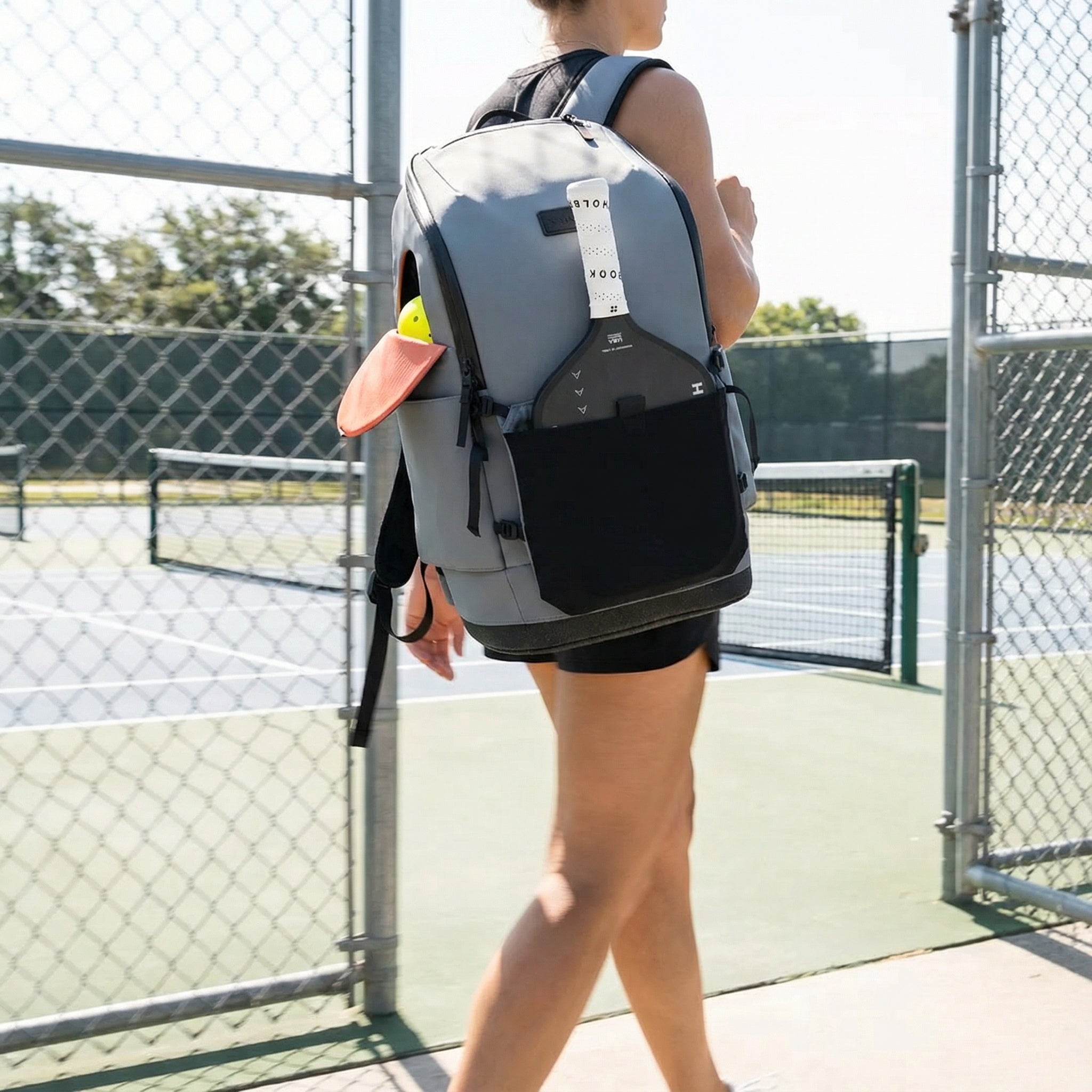
Most pickleball-specific bags are built for the daily commute to your local courts — not for three-day tournament travel with a laptop, change of clothes, and 8 balls. The bag you use every Tuesday at your community rec center is probably not the right bag for a weekend in Naples or a flight to Indian Wells.
Here's what actually matters for travel:
- Laptop sleeve. If you're combining pickleball travel with work trips — which is increasingly how people do it — you need a real laptop sleeve. Not a flimsy padded pocket, but a proper 15"+ sleeve that protects during overhead bin jostling.
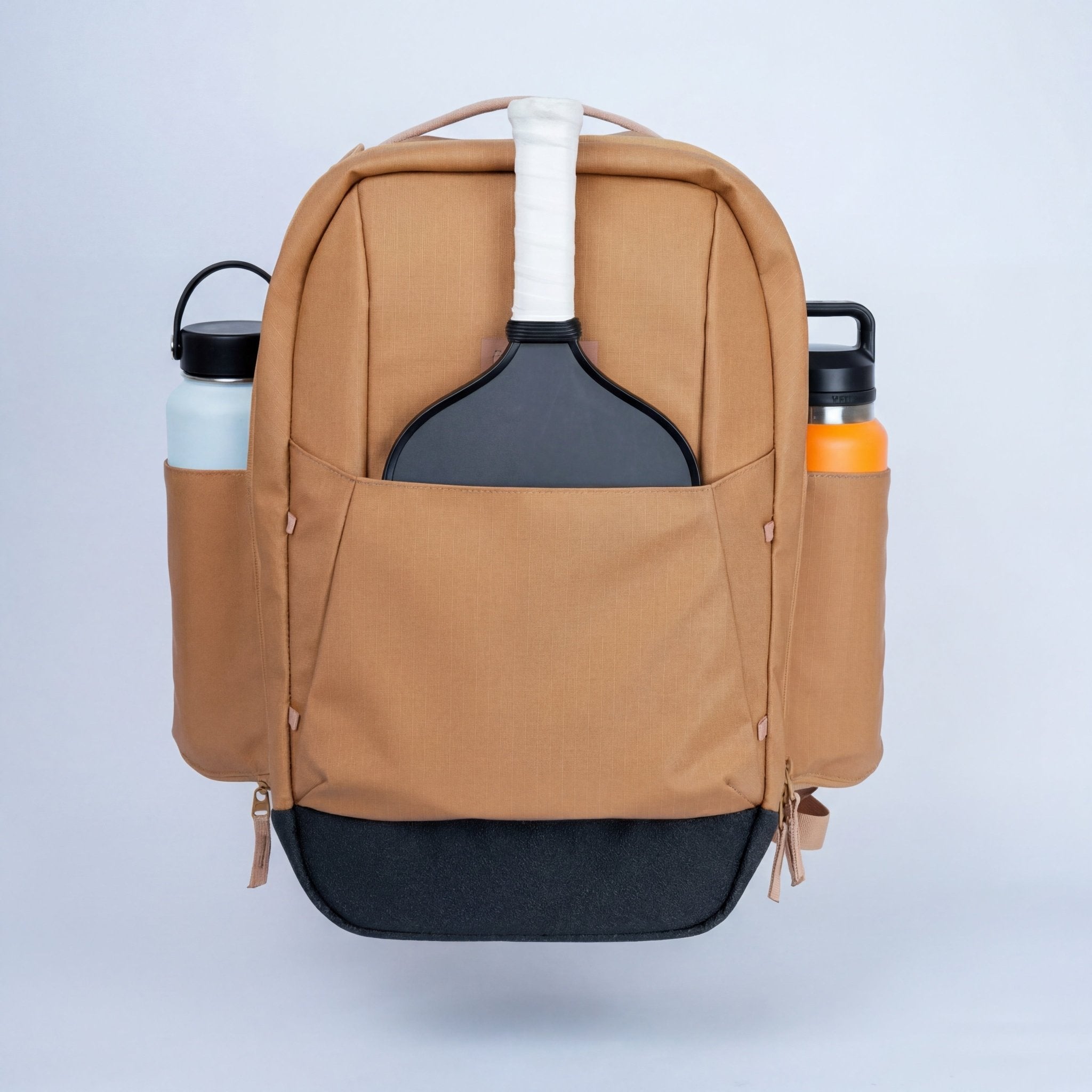
- Dedicated paddle sleeve that protects in transit. Not just a compartment where paddles bounce around. A modular sleeve that keeps paddles separated and padded.
- Enough space without being a monster. A bag you can carry on a flight is better than one you have to check. The moment your bag gets checked, you've lost 30 minutes at baggage claim every flight.
- Durability for repeated travel. YKK zippers, reinforced shoulder straps. Bags that fall apart after 10 flights defeat the purpose.
The Court Caddy is the bag we built specifically for players who travel. The 15" padded laptop sleeve means it goes from court to client meeting. The modular front paddle sleeve holds up to 4 paddles separated. YKK AquaGuard zippers survive the trunk-of-a-rental-car and overhead-bin abuse that kills cheaper bags. The design came directly from player feedback — 500+ players told us what was wrong with every other bag they'd tried. This is what we built in response.
The Travel Bag: FORWRD Court Caddy
15" padded laptop sleeve, 4-paddle modular sleeve, YKK AquaGuard zippers, lifetime warranty. Built from feedback from 500+ real players. As featured in The Dink, Pickleball Effect, and The Kitchen.

If you're not at the stage where a $325 bag makes sense — maybe you're early in the tournament travel journey — the Court Ranger V2 at $195 is the everyday travel option. Slightly more compact, 16" laptop sleeve, same YKK zippers. Good for single-day tournament travel or recreational destination trips where you want to pack light.
→ For a full breakdown of travel-specific bag options across price points: Best Pickleball Bags for Travel & Tournaments: 2026 Tested
Flying with Pickleball Gear: What TSA Actually Says
This is the section no one writes in any detail, but it comes up in every pickleball travel conversation. Here's what actually applies:
Paddles
Paddles are carry-on legal and have been without issue. TSA has no specific rule against pickleball paddles in carry-on bags. In practice, they scan as non-threatening paddles (which they are). Throw them in your carry-on. Don't check paddles if you can avoid it — baggage handlers are hard on everything, and a de-laminated edge from a rough throw into a luggage cart is a real risk.
One practical note: if you're carrying multiple paddles (4+), they may ask you to remove them for secondary screening, similar to electronics. It's not a problem, just slightly slower. Budget 5 extra minutes at security on the way there.
Pickleballs
No TSA restriction on pickleballs in carry-on or checked bags. Plastic balls, air-permeable, obviously not pressurized. They're fine. In checked luggage they may rattle (annoying for fellow passengers if the bag is fragile-stacked). In carry-on they add weight but no issues. Most players just throw a half-dozen in their bag without thinking about it, and that's fine.
Grip Tape and Overgrips
Carry-on legal. No restriction. A sealed roll of grip tape or overgrip strips won't raise any flags. Edge tape is the same.
What to Watch
The only potential friction is aerosol cans — if you're carrying spray sunscreen or sports-equipment spray, check the ounce limit (under 3.4 oz for carry-on). Beyond that, pickleball gear is one of the most travel-friendly sports kits that exists. No pressurized balls, no long-shaft equipment, no blades or springs. You'll have zero issues.
If you're flying with a wheeled bag and want to check it: pack paddles in the center, surrounded by clothing. Don't put them face-against-face without a cloth between them — carbon fiber faces scratch each other. Pack balls in a separate stuff sack so they don't rattle around loosely.
Finding Courts at Your Destination
The court-finding ecosystem has improved dramatically in the last two years. A few tools that actually work:
PicklePlay
The most actively maintained court database in the US. You can filter by indoor/outdoor, surface type, number of courts, and whether there's organized open play scheduled. The app also shows upcoming scheduled sessions at each facility, which is what you actually want — not just "there are courts here" but "there's a 3.5-4.0 open play session at this facility Tuesday at 7 AM."
Places2Play (USAPA)
The USAPA's official court finder. Slightly less current than PicklePlay on session scheduling, but more comprehensive for courts in smaller markets and internationally. Good backup when PicklePlay doesn't have granular data for a destination.
Facebook Groups
Search "[City Name] Pickleball" on Facebook. Almost every market with meaningful court activity has an active Facebook group where locals post open play schedules, court conditions (temporary closures, resurfacing), and informal games. This is the best way to find organized play that doesn't show up in the apps — early morning groups, evening sessions, weekend skill-specific games.
Local Club Websites
Many communities have local pickleball clubs that run sessions not listed in national databases. A quick Google search for "[City] Pickleball Club" usually surfaces these. Clubs often let visiting players join open sessions for a drop-in fee ($5-15). Some require advance notice; most don't.
At Resorts
Call ahead. Don't rely on the resort website — it often lags behind what's actually available. Call the pro shop or activities desk directly. Ask: "Do you have organized open play sessions, and can I join as a guest?" The answer is almost always yes, often with a small court fee or equipment rental charge.
How to Get Into a Game Anywhere: The 24-Hour Framework
You landed in a new city. You have tomorrow morning free. Here's how to get into a competitive game with zero contacts:
The night before:
- Open PicklePlay and look for facilities within 5 miles. Filter for "open play" scheduled tomorrow morning.
- If nothing shows, search "[City] Pickleball" on Facebook and scan recent posts for any mention of tomorrow's sessions.
- If you find a session: check if it requires advance signup (most don't). Show up 10 minutes early.
- If you can't find a session: message the Facebook group. Something like "I'm visiting [City] tomorrow morning, 4.0 player, looking for a game — any open sessions running?" The response rate is high. Pickleball communities are unusually welcoming of traveling players.
When you arrive:
- Announce your approximate level when you introduce yourself. "I'm a 4.0 recreational player" sets expectations without being weird about it.
- Offer to play whoever needs a fourth. Don't wait to be invited — just step up.
- Thank the organizer or whoever runs the session. This is the person who can tell you if there are other sessions worth knowing about while you're in town.
The pickleball community's reputation for friendliness toward traveling players is accurate — it's not marketing. The sport grew as a social game among adults, and the culture of including new players is deeply embedded. Show up somewhere with a paddle and a willingness to play and you'll be in a game within 20 minutes. This doesn't work with tennis. It does with pickleball.
Pickleball Cruises: Which Lines Are Actually Worth It
Cruise lines spotted the pickleball trend early and most major carriers now have some form of court access. The experience varies wildly.
Norwegian Cruise Line has dedicated courts on the Norwegian Prime and Norwegian Viva — proper 20×44 foot courts, not shrunken deck courts. They run organized sessions and mini-tournaments. This is the best cruise line option if pickleball is a priority.
Carnival installed a dedicated court on Carnival Conquest and has expanded to other ships. Court quality is decent; organization varies by sailing.
Royal Caribbean has courts on several ships but they're typically shared multi-sport courts. Playable, not ideal. Pickleball is sometimes scheduled by the hour, which limits how much you can actually play.
Regent Seven Seas has dedicated courts on three ships (Splendor, Explorer, Grandeur). Premium product, premium price. If you're in the luxury cruise market, these are worth investigating.
Honest reality check: a cruise is not the best way to maximize pickleball playing time. The court-to-passenger ratio doesn't support more than 1-2 hours of dedicated play per day even on the best ships. Go on a cruise because you want a cruise — the pickleball is a bonus, not the reason. If the goal is volume of quality play, a destination trip will deliver 4-8 hours per day versus a cruise's 1-2.
The organized cruise-specific pickleball programs (like "Pickleball at Sea" on Royal Caribbean) bundle structured play, coaching, and social events into a travel experience that's specifically about the sport. These can be excellent for exactly the right person — traveling solo, want structure, comfortable with group dynamics.
Seasonal Guide: When to Visit Each Destination
| Destination | Best season | Avoid | Notes |
|---|---|---|---|
| Naples, FL | Nov–April | June–Sept | US Open in April draws crowds; book ahead |
| Indian Wells / Palm Springs, CA | Oct–May | June–Sept | Desert heat is not outdoor-play heat in summer |
| San Diego, CA | Year-round | June (marine layer) | "June Gloom" is real but not unplayable |
| Scottsdale / Surprise, AZ | Oct–April | June–Sept | July surface temps can exceed 130°F outdoors |
| Austin, TX | March–May, Oct–Nov | July–Aug | Indoor facilities extend summer playability |
| Caribbean Resorts | Dec–April | Sept–Oct (hurricane season) | Price peaks in January-February |
| Mexico (Tulum, Baja) | Nov–May | July–Oct (heat + rain) | Baja Pacific side is dryer than Caribbean side |
| Italy (Tuscany) | May–June, Sept–Oct | July–Aug (crowded + hot) | Organized pickleball trips follow the tourist calendar |
What Pickleball Travel Actually Costs (2026 Numbers)
The honest budget breakdown, because every article promises a "budget guide" and then gives vague ranges:
Weekend Tournament Trip (regional, drive or short flight)
- Event registration: $75-140 (per player, most events)
- Hotel (2-3 nights, near venue): $120-200/night
- Flights (regional): $0-250 round-trip depending on your location
- Food: $40-60/day
- Court shoes (if you need them): $80-130
- Total: $500-1,100 for a solo player, per weekend
Destination Trip (fly-in, 5-7 days, no organized package)
- Flights: $200-600 round-trip (domestic)
- Accommodation (5 nights near courts): $800-2,000
- Court access / open play fees: $10-25/day × 5 days = $50-125
- Food: $50/day × 5 = $250
- Total: $1,300-2,975 for a solo trip
Organized Group Pickleball Trip
- Entry-level packages (Dink Destinations, domestic): $1,499-2,000
- Mid-range packages (4-7 days, international): $2,500-3,800
- Premium/luxury packages (Evyssa, Caribbean): $4,800-6,850
- Flights: $200-1,500 depending on destination
- Total: $1,700-8,350 all-in
Couples and groups dramatically change the economics. Hotel rooms split two ways cut accommodation costs in half. Group of four with car rental splits transport. The per-person cost for a group DIY trip can drop below $800 for a long weekend, making it competitive with organized packages at the low end.
One cost most players underestimate: consumables. Balls wear out faster in heat, outdoor concrete, and extended play sessions. Budget for replacing 6-8 balls per week of heavy play. At $4-8 per ball for quality options, that's $25-65 extra.
Frequently Asked Questions
What's the best pickleball destination for beginners?
Naples, Florida, for the sheer volume of courts and organized skill-segmented open play. You can find a 2.5-3.0 game without anyone side-eyeing you for being new. The culture there is built for it.
Can I rent pickleball paddles at most destinations?
Most resorts, dedicated facilities, and tournament venues have rentals. Quality varies — resort rentals are often entry-level paddles that feel nothing like your regular game. Bring your own paddles for anything competitive. Rent only if your bag was lost or you forgot equipment.
Do I need to register for open play sessions in advance?
Depends on the facility. Popular sessions at high-demand courts (Naples Community Park during peak season, Indian Wells in the spring) can fill up. Check PicklePlay or the Facebook group for the specific venue — if they have an advance signup system, it'll be listed there. Most community park open play is first-come-first-served with a paddle-up board.
How do I find players at my skill level while traveling?
Join the local Facebook group for the destination before you travel and post your DUPR rating or self-assessed level. Describe what you're looking for (competitive games, recreational play, clinics). The response will tell you everything about what's available. Skill-matched organized play usually happens at specific times — morning sessions are often more competitive than afternoon walk-ons.
Is pickleball equipment allowed on cruise ships?
Yes — no cruise line has restrictions on bringing your own paddle. Some ships prefer you use their house equipment for court rotation fairness, but bringing your own is fine for clinic sessions and reserved court time. Check whether your cruise has a pro shop that sells balls, or bring your own.
What's the difference between indoor and outdoor balls for travel?
Indoor balls have larger, fewer holes and are softer — they don't travel well and crack in lower temperatures. Outdoor balls (Franklin X-40, Onix Pure 2) have smaller, more holes and are harder. For most pickleball travel destinations (warm outdoor courts), outdoor balls are the right call. If you're heading somewhere with indoor-only facilities, bring both.
Do I need travel insurance for pickleball trips?
For domestic trips, standard travel coverage is sufficient. For international trips or expensive organized packages ($2,000+), travel insurance with "cancel for any reason" is worth it — tournament schedules change, weather happens, injuries happen. Most organized pickleball travel companies have partial-refund policies but not full ones. Read the cancellation terms before booking.
What's a realistic playing volume for a dedicated pickleball trip?
At a destination with strong court access, 3-4 hours of play in the morning is a good sustained pace for 5-7 days. More than that and most players start accumulating fatigue injuries (elbow, shoulder, Achilles) by day 3-4. Plan rest days or active recovery days (swimming, easy walks) between heavy play days.
Your Pickleball Travel Cluster: Go Deeper on Each Topic
This pillar covers the map. Each link below goes deeper on its specific topic:
- Pickleball Travel Packing Guide 2026: The Complete Checklist
- What to Pack for a Pickleball Tournament: 2026 Checklist
- How to Prepare for a Pickleball Tournament: 4-Week Countdown
- Your First Pickleball Tournament: What to Expect Hour by Hour
- Best Pickleball Bags for Travel & Tournaments: 2026 Tested
- Pickleball Tournament Bag vs Travel Bag: The 2026 Guide
- Best Pickleball Travel Bags With Wheels (2026 Honest Review)
- Best Pickleball Tournament Bag 2026: Court-Tested Picks
- Best Affordable Tournament Pickleball Bags 2026 (Tested)
- What to Bring to a Pickleball Tournament: The 2026 Checklist
- Pickleball Summer Tournament Gear 2026: Full Outdoor Checklist
Pack Smarter. Travel Better.
The Court Caddy is built for players who travel — 15" laptop sleeve, 4-paddle modular carrier, YKK AquaGuard zippers, lifetime warranty. Designed with feedback from 500+ players. Featured in The Dink, Pickleball Effect, and The Kitchen.
Shop the Court Caddy — $325 →
Leave a comment
This site is protected by hCaptcha and the hCaptcha Privacy Policy and Terms of Service apply.