

Disclosure: This post contains affiliate links to Pickleball Central. If you purchase through our links, FORWRD earns a small commission at no extra cost to you. We only link to products we'd recommend regardless.
Last Updated: July 2026
Quick Answer
A standard pickleball court is 20 feet wide by 44 feet long — the same for singles and doubles. The net stands 36 inches at the sidelines and 34 inches at the center. Each side has a 7-foot non-volley zone (the kitchen). The total recommended playing area including buffer zones is 30×60 feet.
Most players show up to their first game, find the lines confusing, and spend the first three rallies stepping on the kitchen line without realizing it's a fault. That's not dumb — pickleball's court layout is specific in ways that matter for every single point you play. The kitchen, the service boxes, the transition zone between baseline and net — understanding these isn't just court trivia. It's the foundation for every strategy tip you'll ever read.
This guide covers everything about pickleball courts: official dimensions, zone-by-zone breakdowns, how surfaces change your game, and — because it gets skipped everywhere else — how the court layout should actually change the way you play and what you pack. We'll link out to our deep-dive articles on each sub-topic so you can go as far as you want on any section.
Official Court Dimensions: Every Number That Matters
The official pickleball court is 20 feet wide and 44 feet long — total playing surface of 880 square feet. Singles and doubles use the exact same court, which is one of the quirks that separates pickleball from almost every other net sport. No expanded doubles alleys, no alternate zones. Same 880 square feet, same lines.
Here's the full measurement table, the one you want bookmarked:
| Measurement | Imperial | Metric |
|---|---|---|
| Court width | 20 ft | 6.10 m |
| Court length | 44 ft | 13.41 m |
| Non-volley zone (each side) | 7 ft from net | 2.13 m |
| Service area length | 15 ft | 4.57 m |
| Service area width (each side) | 10 ft | 3.05 m |
| Baseline to net | 22 ft | 6.71 m |
| Net height at sidelines | 36 in | 91.4 cm |
| Net height at center | 34 in | 86.4 cm |
| Line width | 2 in | 5 cm |
| Recommended total area (with buffer) | 30 × 60 ft (min) | 9.1 × 18.3 m |
| Preferred total area | 34 × 64 ft | 10.4 × 19.5 m |
All lines are exactly 2 inches wide. The kitchen line and baselines are part of the kitchen and baseline respectively — stepping on them counts as being in that zone. That detail trips up beginners constantly.
Compare this to tennis (78 × 36 feet for singles) and badminton (44 × 17 feet for singles) and pickleball lands somewhere in between — compact enough for quick reflexes and short points, big enough that speed and footwork still matter. The compact size is a big part of why players over 50 make up pickleball's largest demographic: the court is forgiving without being trivial.
→ Deep dive: Pickleball Court Dimensions and Layout Guide: Every Line Explained
The Kitchen (Non-Volley Zone): The 7 Feet That Define Pickleball
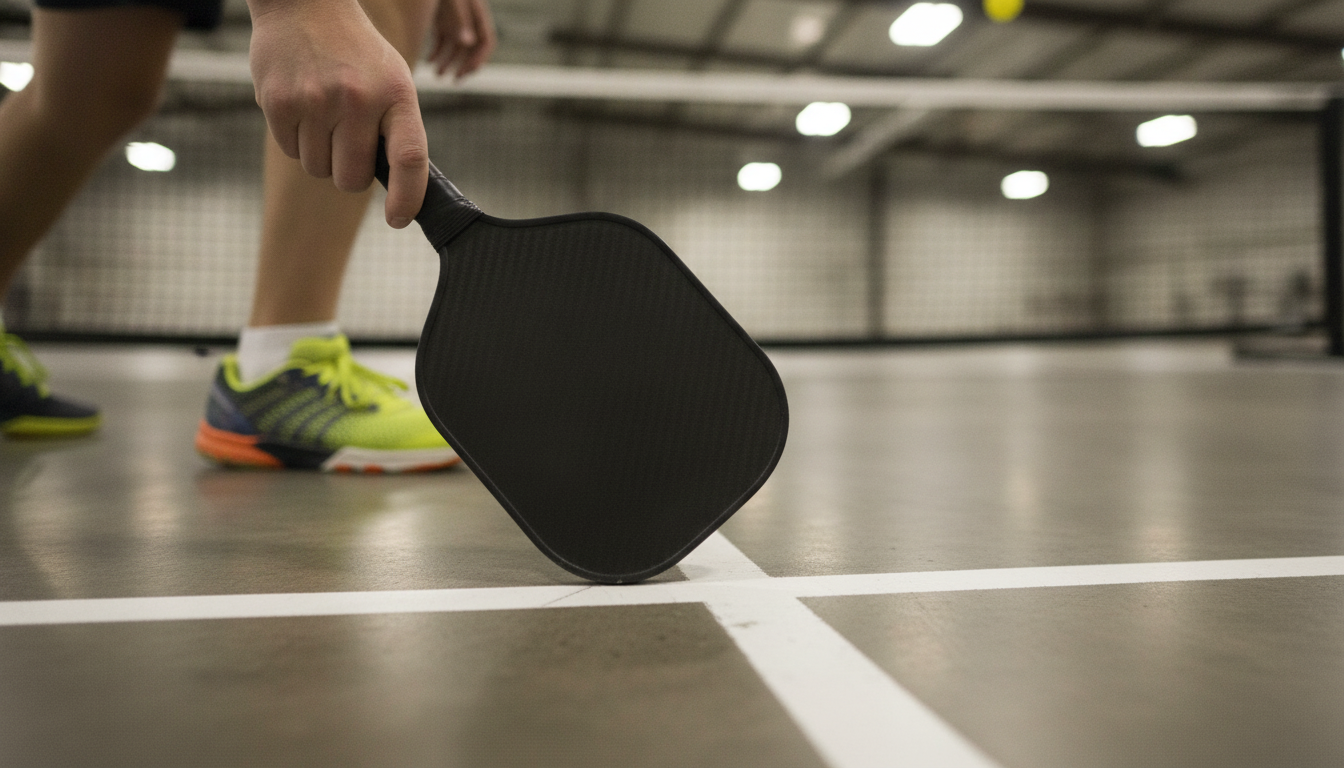
If you only learn one thing about pickleball's court layout, learn the kitchen. The non-volley zone — universally called the kitchen — is the 7-foot rectangle on each side of the net that spans the full 20-foot court width. You can stand in it whenever you want. You just can't volley from it.
A volley is any ball you hit out of the air before it bounces. Hit one while your foot touches the kitchen or the kitchen line, and it's a fault. Hit one, and your momentum carries you into the kitchen after the shot — also a fault. The rules are about where your body is during and immediately after the swing, not just at the moment of contact.
What you CAN do in the kitchen: stand there, move through it, hit a ball that has bounced inside it. Groundstrokes from the kitchen are completely legal. The restriction is specifically on volleys — those fast, reflexive shots at the net that would otherwise make the game a pure power contest decided by whoever can hit the hardest.
Here's the strategic reality of the kitchen: it's why pickleball has a soft game. Without the NVZ restriction, two good players could just rush the net and smash everything. The kitchen forces a dinking exchange — back-and-forth groundstrokes inside the kitchen or just behind it — that rewards patience, deception, and placement over raw power. It's the rule that makes the game intelligent.
"The kitchen is where pickleball separates itself from every other racquet sport. It forces you to earn the volley. You can't just rush the net and hammer — you have to wait, dink, and create an opening. That's the skill game." — Topher Morales, FORWRD co-founder and certified pickleball instructor
One 2026 rule clarification worth knowing: pre-swing kitchen contact is no longer automatically a fault. Under the updated USAPA rules, only contact during and immediately after your swing counts as a violation. So if you're standing in the kitchen waiting for a ball, that's fine — it's what happens during and after the swing that matters.
→ Deep dive: Pickleball Kitchen Rules 2026: NVZ Guide + Every Myth Debunked
Net Height: 36", 34", and Why the Sag Is Intentional
The net runs 36 inches high at both sidelines and sags to 34 inches at the center. That 2-inch dip isn't a mistake or poor equipment — it's intentional, and it creates one of the most important strategic corridors in pickleball: the down-the-middle shot.
A ball cleared over the center of the net travels through the lowest point. Two inches lower might not sound like much, but at the reflexive speeds of an NVZ exchange, it's the difference between a clearable shot and one that clips the tape. Every experienced player knows to aim for the center seam on resets and drives. The net height is why that targeting exists.
The net is 21 feet 9 inches long — 3 inches longer than the court is wide — and sits on posts set 12 inches outside each sideline. Unlike tennis nets that stand on fixed posts, most recreational pickleball nets use a portable system with a center strap that adjusts to achieve the 34" center measurement. That strap is what makes the sag precise and repeatable.
For portable and backyard setups, getting the height right matters more than players assume. A net set at 34 inches even at the sidelines changes ball dynamics enough to affect practice. If you're drilling dinks and your net is off, your muscle memory for net clearance won't transfer to tournament play. Use a tape measure before you drill, not after your shots start going wrong.
→ Deep dive: Pickleball Net Height: Official Rules and How to Set Up Correctly
Court Zones Explained: Service Areas, Baselines, Center Line
Beyond the kitchen, the rest of each half-court is divided into two service areas by a center line running from the kitchen line to the baseline. Each service area is 10 feet wide by 15 feet deep — relatively compact boxes that define where you serve to and where you stand to receive.
The baseline is the back line of the court, 22 feet from the net on each side. In recreational play, you'll spend a surprising amount of time near the baseline in doubles — especially on the serve and the return. The double-bounce rule requires the serve AND the return to bounce before anyone volleys, which means both teams spend the first two shots at or behind the baseline before the rally transitions to net play.
The transition zone — that 15-foot corridor between the kitchen line and the baseline — is where most rallies happen in intermediate play. Players who haven't fully developed their net game spend long stretches here, trying to find angles without getting pushed back to the baseline. Getting comfortable moving through the transition zone toward the NVZ is one of the biggest jumps in player development from 3.0 to 3.5 level.
The center line continues from the kitchen line to the baseline, splitting each service area. It matters only for the serve — the ball must land in the service box diagonally opposite the server. During rallies, the center line is irrelevant. Many beginners try to defend it like a sideline. Don't. Once the rally starts, the entire 20-foot width of the court is in play.
Court Surfaces: How Concrete, Asphalt, and Sport Tile Change the Game
The court dimensions are fixed. The surface underneath them is not — and that variability changes how the ball bounces, how long your knees hold up, and what shoes and balls you should bring.
Concrete (most common outdoor): Dense, consistent bounce, durable for decades. The Franklin X-40 outdoor ball bounces predictably on concrete — a mid-height, not-too-fast bounce that rewards controlled placement. Hard on joints with extended play. If you're playing outdoor concrete regularly, cushioned court shoes aren't optional.
Asphalt: Similar to concrete but typically rougher texture and slightly hotter surface temperature in summer. Ball bounce is similar to concrete but degrades faster as the surface ages and develops cracks. Balls wear faster on rough asphalt. If you're playing on older asphalt, expect to cycle through balls more quickly.
Modular sport tile (e.g., SnapSports, VersaCourt): Polypropylene tiles with engineered texture. Designed for consistent, medium-speed bounce. Gentler on joints than concrete, better drainage, and available in customizable colors. Most new recreational facilities and converted tennis courts use sport tile for exactly these reasons. More forgiving on slides and quick stops.
Wood / gym flooring (indoor): Smooth, fast surface. Ball bounce is lower and faster compared to outdoor hard courts — the indoor Franklin X-26 ball is specifically designed for gymnasium hardwood. Players switching between outdoor and indoor notice the speed difference immediately. Footwear matters here: gum-sole indoor court shoes grip gymnasium floors in ways that outdoor shoes don't.
Asphalt/concrete with cushioned coating: Premium outdoor installations add a rubberized coating over hard surfaces. It softens impact, improves grip in wet conditions, and extends the life of the surface. Many USAPA-sanctioned tournament venues use cushioned acrylic. If you're training for tournament play, finding courts with cushioned coating gives you the closest practice analog to tournament conditions.
→ Deep dive: Pickleball Court Surfaces Guide: Which Surface Is Right for Your Game?
Indoor vs. Outdoor Courts: More Different Than You Think
Most beginners assume outdoor = nicer, indoor = rainy-day backup. Experienced players know it's more complicated than that.
Outdoor courts deal with wind, sun angle, temperature variation, and surface texture. Wind at 10+ mph changes shot selection more than most beginners realize — drives that would land cleanly go long, lobs that would've worked get pushed out of bounds. Learning to read wind before a point starts (watching the flag, checking tree movement, noting which direction feels into the wind) is a legitimate tactical skill at competitive outdoor play.
Sun angle is a real issue at certain times of day and certain court orientations. North-south oriented courts catch direct late-afternoon sun for one side of the court more than the other. Many municipal courts were designed for tennis with north-south orientation as standard, and pickleball converted courts inherit whatever orientation the tennis court had. Know your court. If you're playing 5 PM outdoor, factor in which end has the sun disadvantage.
Indoor courts are faster, quieter, and consistent. No wind, no sun angle, predictable lighting. But gym floors reward different footwork and create different acoustics — the pop of a pickleball on wood gym floor is genuinely louder than outdoor concrete, and in tight gym spaces, the echo can make communication between doubles partners harder. Wear non-marking indoor shoes. Outdoor court shoes leave marks on gym floors and are often prohibited.
Ball selection: this isn't optional. The Franklin X-40 (outdoor) and X-26 (indoor) play differently. Bringing an outdoor ball to an indoor gym session isn't just a faux pas — the ball's harder plastic bounces too fast on wood floors and makes rallies feel rushed. Bring the right ball for the surface.
→ Deep dive: How to Find Pickleball Courts Near Me: 6 Best Tools (2026)
How Court Dimensions Shape Your Strategy
Here's what no other court guide bothers to tell you: the dimensions aren't just measurements. They're a strategic map. Every number on that measurement table creates a tactical constraint that good players have internalized so thoroughly they don't think about it — they just play it.
The 7-foot kitchen creates the dinking game. You already know this from the kitchen section. But here's the strategic implication that takes time to see: because both players can't volley from the kitchen, the dominant position in pickleball is both players at the kitchen line, dinking, waiting for the other side to pop a ball up. The entire game structure flows from that 7-foot restriction. If you don't understand why the NVZ exists, you don't understand why dinking is the centerpiece of high-level strategy.
The 20-foot width creates angle pressure. Twenty feet is narrow enough that a sharp cross-court dink — aimed at a wide angle to the opponent's backhand corner — lands near or just inside the sideline while covering the most court. The narrowness of the court makes wide angles harder to track than in tennis, which means angle shots carry more pressure relative to their difficulty. This is why the erne (a jump volley around the net post) is such a punishing shot — it exploits the court's narrow width to create an unreachable angle.
The 15-foot transition zone is no-man's-land. Between the kitchen line and the baseline is 15 feet of court that intermediate players spend too much time in. You can't volley from the kitchen at the net, and you're too close to the kitchen to hit effective drives from the baseline. The transition zone is where balls bounce at your feet, where angles tighten, and where mistakes happen. The goal in doubles is to spend as little time in the transition zone as possible — push forward to the kitchen line as quickly as you can after the return, and don't retreat from it without purpose.
The 22-foot baseline creates the third-shot drop window. The third shot drop — a soft shot from the baseline that arcs into the kitchen — is pickleball's signature skill shot, and the 22-foot distance to the net is the reason it works. Far enough from the net that a hard drive gives the opposing team time to reset, but close enough that a soft arc can land in the kitchen before the bouncing back. The third shot drop only exists because of that specific 22-foot distance. Change the baseline by 5 feet in either direction and the shot calculus changes completely.
"When I'm teaching players to level up, I literally make them stand on the kitchen line and visualize the court zones before we drill. The dimensions tell you where to be and why. Once you see the court as a strategic map rather than just a playing surface, everything else clicks." — Grub Williams, FORWRD co-founder and 4.5-rated competitive player
Singles dimensions create a different game. Same court, but with two players instead of four covering the same 20×44 feet, the defensive coverage is completely different. Singles pickleball rewards speed, stamina, and powerful drives far more than doubles — the soft dinking game matters less because there's no doubles partner to exploit. Understanding that the same court creates two very different games explains why top singles players and top doubles specialists can have very different playing styles despite competing on identical courts.
What Your Court Type Should Change About What You Pack
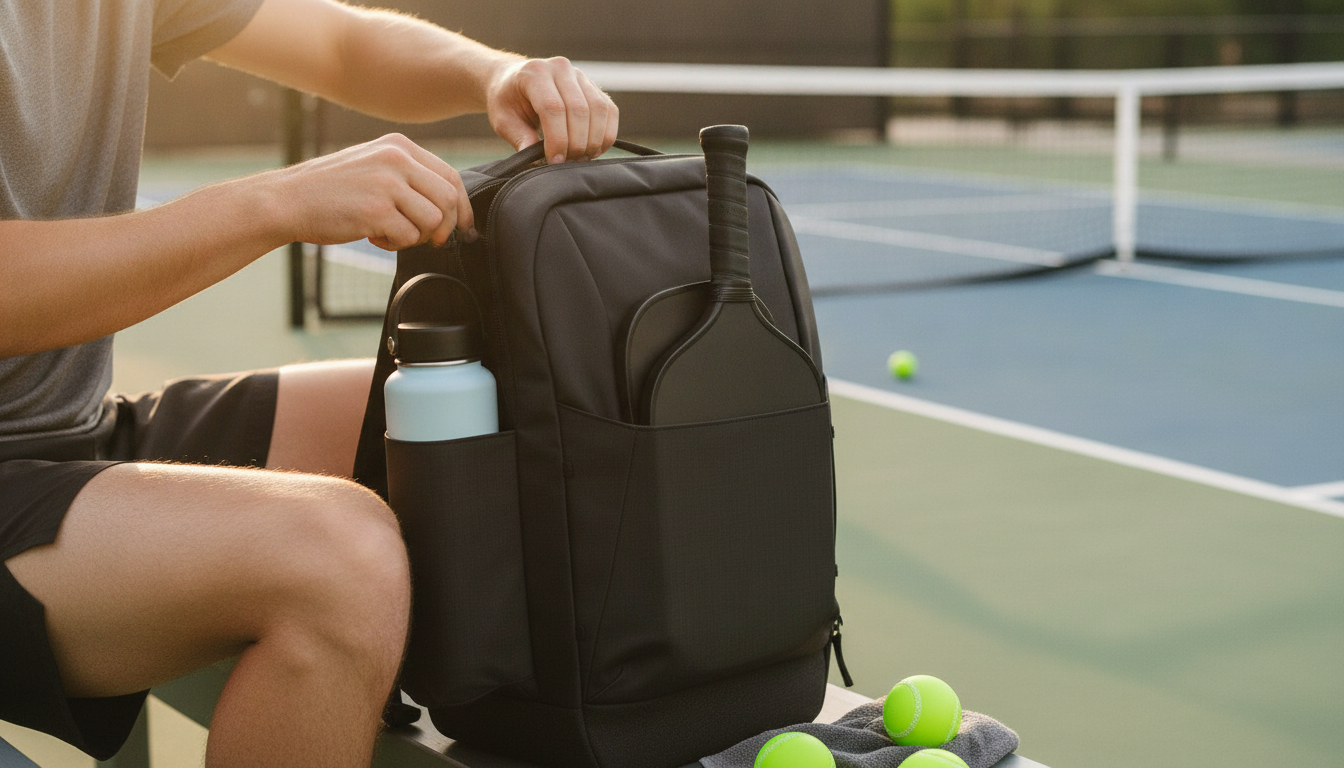
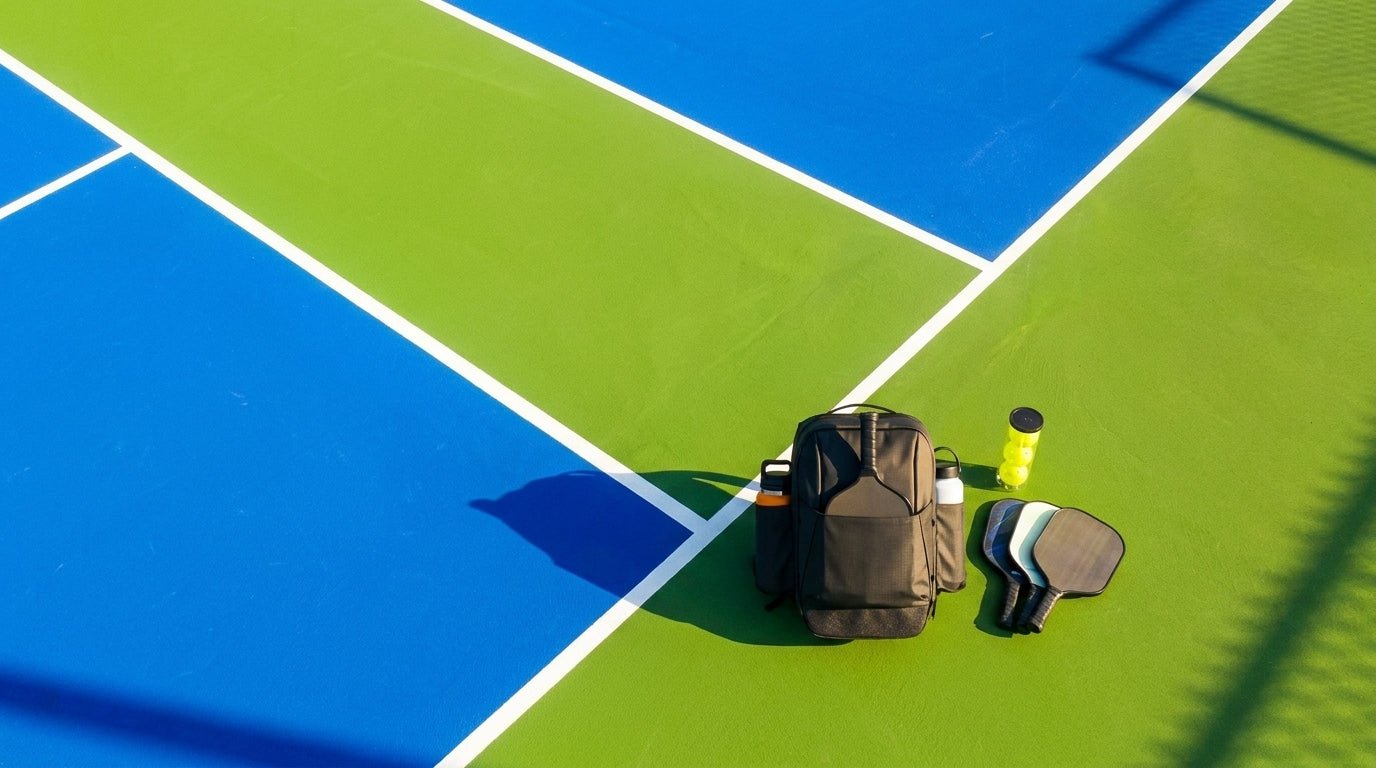
This is where the court knowledge guide most others skip entirely: your bag loadout should change based on where you're playing. Not drastically — but the players who always have the right gear for the right court type are the ones who never get caught unprepared at a tournament or an unfamiliar venue.
Outdoor concrete/asphalt courts: UV protection, extra outdoor balls (they wear faster on rough asphalt), sunscreen, and most importantly — the right shoes. Court shoes with extra lateral support and cushioning are non-optional for regular outdoor concrete play. If you're playing 2+ hours on hard courts, bring a change of socks. Humidity and heat wilt socks faster than you'd think, and fresh socks mid-session prevent the blisters that end days early.
Indoor gym courts: Non-marking gum-sole shoes (don't forget these — showing up with outdoor shoes to a gym that enforces the policy is an embarrassing start). Indoor balls instead of outdoor. A change of shirt if you run hot — gyms have worse airflow than outdoor courts.
Tournament play: Multi-surface events often move between indoor and outdoor courts. Pack for both. That means two pairs of shoes (or confirmed-versatile indoor/outdoor shoes), both ball types, extra grip tape — tournament conditions in hot venues chew through overgrips faster than casual play. A bag with dedicated compartments makes this manageable instead of chaotic.
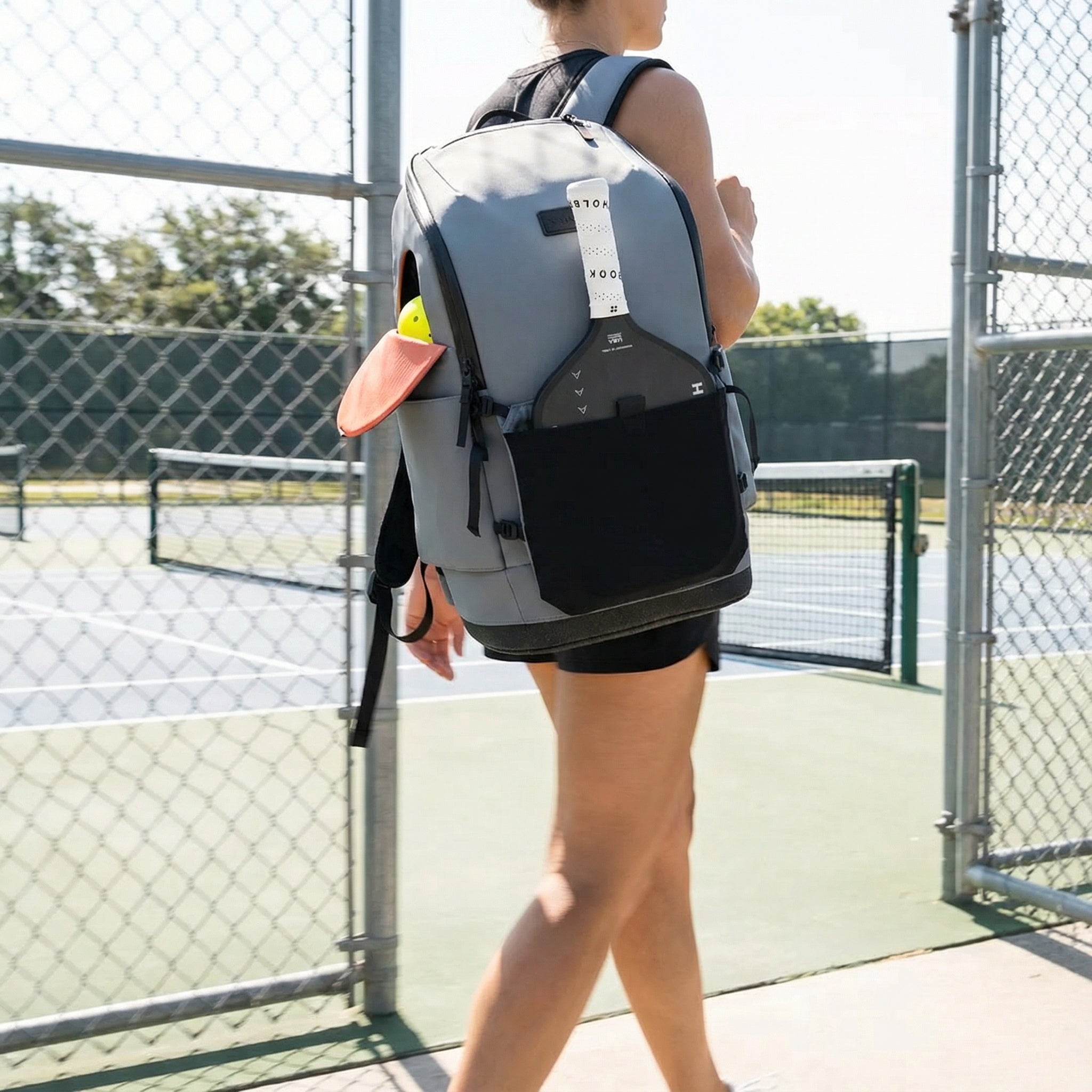
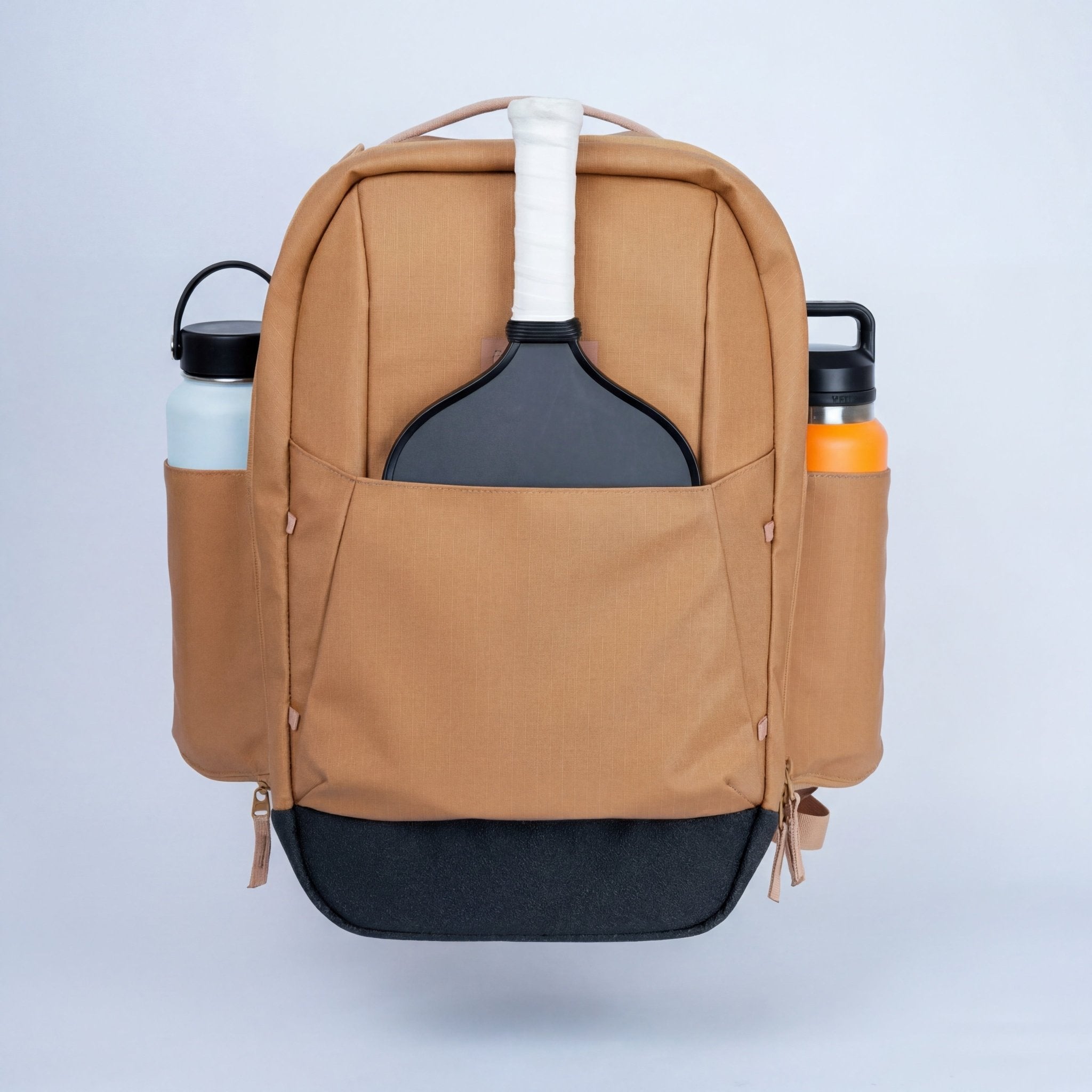
The Court Ranger V2 ($195) handles most everyday court scenarios — dedicated paddle sleeve for up to 4 paddles, 16" laptop sleeve, and enough organization pockets for two sets of shoes plus gear without becoming a duffel. It's the bag for players who take their court sessions seriously without the full tournament loadout.
For Everyday Court Sessions: Court Ranger V2
4-paddle sleeve, 16" laptop compartment, and room for indoor + outdoor footwear in one bag. Built with feedback from 500+ real players and designed for the player who plays 3-5x per week across different venues.
The Court Caddy ($325) is the upgrade for tournament players and serious club players who carry more: 4 paddles, full tournament documentation, laptop, change of clothes, and a full hydration setup. The 15" padded laptop sleeve and modular organization are designed for players treating pickleball like a sport, not a hobby. If you're playing in sanctioned tournaments, the Court Caddy handles the complexity without the chaos of an overstuffed bag.

One gear consideration that's easy to miss: if you play on both indoor and outdoor courts regularly, you almost certainly need two different pairs of shoes. Dedicated pickleball court shoes are designed for specific surfaces — a gum-sole indoor shoe grips gym floors and protects the surface; a reinforced outdoor court shoe handles the lateral stops on concrete without wearing through. Trying to do both with one pair compromises both.
→ Deep dive: Our Portable Net Buying Guide covers which nets work for backyard and temporary court setups if you're building a practice space at home.
Building and Converting Courts: Costs, Options, Backyard Reality
Pickleball's explosive growth means more players than ever are either building backyard courts or converting existing tennis courts. The math is more favorable than most people expect — but the execution has details that bite uninformed builders.
Tennis court conversion: A standard tennis court (78×36 feet) fits 2 pickleball courts side by side with buffer zones, or up to 4 pickleball courts with tighter buffers (common at multi-use facilities). The conversion itself — adding pickleball lines and net posts — runs $1,500 to $4,000 for a professional installation, depending on surface condition and whether you want temporary tape lines or permanent paint. Most municipalities and clubs go permanent paint because tape wears quickly under heavy play.
New outdoor court construction: A single dedicated pickleball court on concrete or asphalt runs $15,000 to $40,000 all-in, depending on your location, existing concrete or asphalt availability, surface type, fencing, and lighting. Add $8,000–$15,000 for a quality cushioned acrylic coating. The wide range matters: if you already have a concrete slab in the right dimensions, you might get away with $4,000 to $8,000 for paint, net posts, and surfacing. Starting from bare ground with fencing and lighting is the expensive end.
Backyard/DIY options: Portable net systems ($150–$500) combined with temporary line tape ($30–$80) create a fully playable court on any flat hard surface. Driveway pickleball is genuinely popular for this reason. The play quality is lower than a purpose-built court, but for practice and casual games, it's more than sufficient. Make sure your surface is flat — even small slope creates uneven bounce that messes with muscle memory.
If you're considering a backyard installation, the two questions that decide your budget are: (1) do you already have a suitable hard surface? and (2) do you want fencing? Fencing alone adds $2,000–$6,000 to a project but makes the court dramatically more usable for serious play.
→ Deep dive: How Much Does It Cost to Build a Pickleball Court? (2026 Complete Guide)
How to Find Courts Near You
In 2026, finding open pickleball courts is dramatically easier than it was even three years ago. The sport has grown fast enough that dedicated apps, websites, and local Facebook groups now map nearly every publicly accessible court in the country.
The best tools right now: Pickleheads (the most comprehensive map, covers parks, clubs, and private facilities), Places2Play (the USAPA's official court finder, skews toward sanctioned facilities), and local municipality parks websites for your specific city. Many YMCAs and rec centers have added permanent courts in the last two years — call before you show up, because hours and availability vary widely.
For indoor courts in colder months, Planet Fitness locations with dedicated pickleball courts are expanding. Private pickleball clubs with dedicated court space are also growing rapidly in major metro areas — expect to pay $40–$80/month for membership access to indoor courts with reliable hours and competitive open play.
If you're traveling and want to play, Pickleheads lets you search by location with a map. Most major hotels near resort or convention areas now have at least temporary pickleball setups. The Marriott and Hilton chains have both added pickleball as an amenity at select properties.
→ Deep dive: How to Find Pickleball Courts Near Me: 6 Best Tools (2026)
Court Etiquette: The Unwritten Rules That Keep You Welcome
Every public and club pickleball court has an unwritten social contract. Learn it before your first session — you'll have a much better time, and the regulars will welcome you back.
Rotation protocol: Most public courts run on a paddle-up system. When you're waiting to play, put your paddle in a designated spot (usually a rack or a spot on the fence). The next group to play picks up the earliest paddles. Cutting the queue — showing up and acting like you're next when paddles are lined up — is the fastest way to start a session badly.
Call your own faults. In recreational open play, there's no referee. Call kitchen faults on yourself. If a ball is clearly out, say so even if it benefits the other team. Pickleball culture is unusually honest about self-officiating for a competitive sport — cheating at casual play will get you a reputation that follows you to every court in your local community.
Open play vs. reserved courts: If a court is listed as "open play," that means anyone can show up and rotate in. Reserved courts are booked. Don't crowd a reserved court hoping to jump in. Conversely, if you've reserved a court, show up on time — courts with reservation systems often have waitlists and no-shows frustrate everyone.
Keep the noise reasonable. Pickleball has a legitimate HOA and residential neighbor noise issue. The pop of paddle-on-ball on hard outdoor courts is genuinely loud. Be aware of your venue's noise context, especially on early-morning or evening weekend sessions. There's a whole category of USAP Quiet Approved paddles designed for exactly this reason — if you're playing at a venue with HOA noise concerns, these are worth knowing about.
→ Deep dive: Pickleball Court Etiquette: Unwritten Rules Every Player Should Know

FAQ: Pickleball Court Knowledge
What are the official dimensions of a pickleball court?
A standard pickleball court is 20 feet wide by 44 feet long — the same size for both singles and doubles. The total recommended playing area, including buffer zones, is at least 30×60 feet. All court lines are 2 inches wide. The net stands 36 inches at the sidelines and 34 inches at the center.
What is the kitchen in pickleball?
The kitchen is the informal name for the non-volley zone (NVZ) — the 7-foot area on each side of the net, spanning the full court width. You can stand in the kitchen or move through it at any time, but you cannot volley (hit the ball out of the air without it bouncing first) while any part of your body or paddle touches the kitchen or its boundary line. Momentum faults also apply: if you volley and then step into the kitchen, it's still a fault.
Why is the net lower in the middle of a pickleball court?
The net sags to 34 inches at the center versus 36 inches at the sidelines by design. This creates a lower clearance corridor down the middle of the court, which is strategically significant — experienced players aim for the center seam on drives and resets because it offers the lowest net height. The sag is achieved via a center strap that can be adjusted to set the exact 34-inch measurement.
Is the pickleball court the same size for singles and doubles?
Yes — pickleball uses the same 20×44-foot court for both singles and doubles. This is one of pickleball's unique characteristics compared to tennis and badminton, which both use wider courts for doubles. In pickleball, two players cover the same 880 square feet as four players, which is why singles pickleball tends to favor more power and athleticism while doubles rewards soft-game positioning and net strategy.
Can you stand in the kitchen in pickleball?
Yes. You can stand in the kitchen, walk through it, and even camp out there for an entire rally. The restriction is specifically on volleys — hitting a ball out of the air without letting it bounce first. You can stand in the kitchen and hit a ball that bounces inside the kitchen; that's a legal groundstroke, not a fault. Players often step into the kitchen to take groundstrokes on low balls that land in the NVZ.
What is the transition zone in pickleball?
The transition zone (sometimes called "no-man's land") is the area between the kitchen line and the baseline — roughly a 15-foot corridor that represents the worst place to be in a rally. From the transition zone, you can't volley from the NVZ and you're too close to the net to hit clean drives from the baseline. Most balls bounce at your feet here. The goal in doubles is to move through the transition zone quickly after the return and establish position at the kitchen line. Spending extended time in the transition zone is a primary marker of 2.5–3.0 level play.
How much space do you need for a pickleball court?
The playing surface itself is 20×44 feet (880 square feet). For safe recreational play with comfortable buffer zones, USAPA recommends a minimum total area of 30×60 feet (1,800 square feet). The preferred full area with generous sideline and baseline buffers is 34×64 feet. If you're planning a backyard installation, 34×64 feet is the standard to target for quality play. Multi-court facilities typically plan for 30×60 minimum per court to allow side-by-side installation.
How much does it cost to build a pickleball court?
Costs vary widely based on surface, location, and features. Converting an existing tennis court with permanent paint and net posts runs $1,500–$4,000 professionally. A new outdoor dedicated court on concrete or asphalt runs $15,000–$40,000 all-in, including surface, fencing, and posts. Adding a cushioned acrylic coating adds $8,000–$15,000 but improves play quality significantly. DIY backyard setups using a portable net and line tape on an existing flat hard surface can cost as little as $200–$600 for a fully functional practice court.
What's the difference between indoor and outdoor pickleball balls?
Outdoor balls (like the Franklin X-40) have smaller holes and harder plastic designed to resist wind and withstand rough hard-court surfaces. They bounce with more pace on concrete. Indoor balls (like the Franklin X-26) have larger holes and softer plastic, designed for the faster, smoother gymnasium floor surface. Using an outdoor ball indoors produces a faster, harder-to-control bounce on wood floors. Using an indoor ball outdoors makes the ball susceptible to wind and accelerates wear on rough surfaces. The right ball for your surface isn't a minor preference — it's a meaningful difference in how the game plays.
What are the best pickleball courts for beginners to learn on?
For beginners, indoor courts on sport tile or smooth gymnasium flooring offer the most forgiving conditions — consistent bounce, no wind, controlled lighting, and no sun angle to deal with. Many YMCAs and recreation centers offer beginner open play on exactly these surfaces. Modular sport tile courts at outdoor recreation facilities are also beginner-friendly: medium-speed bounce, gentler on joints than concrete, and typically maintained well. Avoid starting on rough asphalt — inconsistent bounce and harder surface make learning the basics more difficult than necessary.
Related Articles in This Guide
- Pickleball Court Dimensions and Layout Guide: Every Line Explained
- Pickleball Court Surfaces Guide: Which Surface Is Right for Your Game?
- Pickleball Net Height: Official Rules and How to Set Up Correctly
- Pickleball Kitchen Rules 2026: NVZ Guide + Every Myth Debunked
- How Much Does It Cost to Build a Pickleball Court? (2026)
- How to Find Pickleball Courts Near Me: 6 Best Tools (2026)
- Pickleball Court Etiquette: Unwritten Rules Every Player Should Know
- Pickleball Court: Complete Guide to Dimensions, Construction, and Installation (2026)
- Pickleball Portable Net Buying Guide 2026

Leave a comment
This site is protected by hCaptcha and the hCaptcha Privacy Policy and Terms of Service apply.