

Disclosure: This post contains affiliate links to Pickleball Central. If you purchase through our links, FORWRD earns a small commission at no extra cost to you. We only link to products we'd recommend regardless.
Last Updated: October 2026
Pickleball's explosive growth has created a familiar problem: more people want to play than courts can handle. If you've ever shown up to your local recreation center only to find a 45-minute wait, you understand the frustration. Court shortages persist even as the sport grows 20% annually, leaving dedicated players searching for ways to keep their skills sharp between sessions.
The good news? You don't need a dedicated court or a $1,500 ball machine to improve. With some basic materials from your local hardware store, a driveway or garage, and a few hours of simple construction, you can build effective practice equipment that delivers hundreds of quality reps per session. We've built and tested every setup in this guide ourselves — including a PVC net that survived an entire Colorado winter on a concrete driveway and a garage rebounder we still use for morning warm-ups before court sessions. FORWRD is a brand run by pickleball players, and we've logged more solo drills against garage walls than we'd care to admit.
Most DIY setups run $50–200 total. The fundamentals you'll develop — dinking consistency, drop shot touch, volley reflexes — are the same ones that move you up a full rating level. When you're hauling your practice kit between home and the courts, the FORWRD Court Ranger V2 keeps everything organized; more on that at the end.
"The players who improve fastest aren't the ones with the best coaching — they're the ones who figured out how to get quality reps every day. A $60 PVC net in your driveway beats a 45-minute wait for an open court every time. Build the tools, do the reps, show up to the court sessions ready to apply it."
— Topher Lake, FORWRD Co-founder
DIY Short Practice Net for Driveway or Backyard
You don't need a regulation 44' x 20' court to practice dinking and get meaningful reps. A compact 10–14 foot wide net is enough to work on soft game shots, controlled drives, and third-shot drops. This portable setup fits most driveways and folds away when you're done.
If you don't have net material, a rope or string stretched between two points at 34" height creates a basic visual barrier for dink practice. Not ideal, but it's a free start.
Materials List
Head to any hardware store for these items:
Item |
Quantity |
Approximate Cost |
|---|---|---|
1" PVC pipe (10' lengths) |
4 |
$15–20 |
1" PVC T-joints |
4 |
$4 |
1" PVC elbow joints |
4 |
$4 |
Nylon mesh or landscaping fabric |
1 roll (cut to 34" height) |
$10–15 |
Heavy-duty zip ties |
1 pack |
$5 |
Sandbag weights or concrete-filled buckets |
2 |
$10–15 |
Rope or string (as a net alternative) |
Optional |
$3–5 |
Total cost: roughly $50–60 for a durable, reusable practice net.
Assembly Steps
Cut PVC pipes to size: two 5' sections for the horizontal top bar (or one 10' piece), two 34" uprights for net height, and four 18" base pieces for stability feet.
Connect the uprights to T-joints at the bottom, then attach base feet extending outward in a T shape.
Add elbow joints at the top of each upright, then connect the horizontal bar across.
Attach your net material using zip ties every 6–8 inches along the frame. Velcro strips work too if you want easy removal.
Place sandbags or weighted buckets on each base foot to prevent tipping.
Marking the Kitchen
Use painter's tape or sidewalk chalk to mark a 7-foot zone on each side of your net. This represents the non-volley zone — the kitchen line where you'll practice dinking without stepping in. The visual reference keeps your footwork honest.
Practice Ideas
Cross-court dinks: Stand at opposite kitchen corners and hit 20 consecutive dinks that bounce inside the taped zone.
Third-shot drops: Start at your baseline mark (about 15' back) and practice soft arcing shots that land in the kitchen.
Mini-games: First player to land 10 shots in the marked zone wins. Add variety by requiring alternating forehand and backhand.
DIY Rebound Wall and Portable Rebounder Frames
Solo practice becomes dramatically more effective when every shot comes back to you. A rebounder eliminates ball chasing and lets you focus on consistency, reflexes, and stroke mechanics. After building and using several different versions — a plywood wall rebounder, a bungee cord frame, and a PVC-stretch net — the plywood garage wall rebounder is the one we keep coming back to. It's quieter than concrete, gives realistic return angles, and costs $30 to build.
Commercial options like the OnCourt OffCourt Rebounder Deluxe deliver consistent returns and fold for storage ($150–250). Worth considering once you've confirmed daily rebounder practice fits your routine — but the DIY version is the right starting point.
Permanent Garage Wall Rebounder
A smooth plywood sheet mounted on your garage wall provides a consistent, quiet practice surface:
Purchase a 4' x 8' sanded plywood board (about $25–30 at Home Depot or Lowe's).
Mount it securely to wall studs using lag screws.
Paint a bold horizontal line at 34" from the floor to simulate net height.
Add 2–3 target squares using painter's tape or contrasting paint for accuracy drills.
The plywood surface offers roughly 70–80% energy return — similar to regulation walls — while being quieter than hitting bare concrete or metal. After 6 months of daily use on our test unit, the surface held up fine with one coat of polyurethane. Seal yours before the first session if your garage sees temperature swings.
Optimal Distances for Drills
7 feet: Practice dinking — soft, controlled shots that stay below the painted net line.
3–4 feet: Rapid-fire volleys for hand-eye coordination and quick reactions.
10–12 feet: Drive and drop shot practice, working on power control.
Portable Rebounder Frame
If you can't modify your garage or need something transportable, build a standalone frame:
Construct a 4' x 4' frame from 1" PVC pipe or lightweight aluminum tubing.
Stretch rebound netting or create a bungee cord lattice across the frame — spacing cords 3–4 inches apart.
Add an adjustable hinged support leg to change the rebound angle (steeper = faster returns).
Weight the base with sandbags for stability.
Solo Drill Ideas
No-miss dinks: Hit 50 consecutive soft shots below the net line. Start over if you miss. Develops touch.
30-second volley blitz: Count how many clean volleys you can hit in 30 seconds. Track weekly progress.
Target squares: Chalk 12" x 12" targets on your rebounder and alternate hitting each one. Builds the placement precision that separates levels.
Homemade Ball Machines and Ball-Return Hacks
Let's be clear: building a true motorized ball machine with oscillation and speed control is complex, expensive, and potentially frustrating. Commercial machines like the Pickleball Tutor deliver consistent feeds but cost $400–1,500+. Instead, focus on simple, safe, low-tech solutions that give you controlled practice reps without the engineering headache.
Gravity-Fed Ball Dropper
This simple training tool uses gravity to feed balls into your contact zone, letting you focus purely on stroke mechanics:
Materials:
3–4" diameter PVC pipe, 3 feet long
Step ladder or wall-mounting bracket
Spring clothespin or simple pull-cord release gate
Funnel or angled entry piece
Setup:
Mount the pipe vertically, angled slightly (about 10 degrees) so balls naturally roll toward the bottom.
Create a gate at the bottom using a hinged flap or spring clothespin that releases one ball when triggered.
Load 10–15 balls into the top.
Stand in your ready position, pull the release, and hit each ball as it drops.
This works especially well for serve practice — the ball drops into a consistent position so you can groove your toss and contact point. It's also excellent for third-shot drops where you want to develop feel without chasing balls across your driveway.
Elastic Tether Trainer
The ball-on-string concept mirrors commercial tether trainers at a fraction of the cost — roughly $6 total:
Materials:
36 inches of 50 lb fishing line
Size 3 swivel barrel (allows natural spin)
Paracord and cord lock
One hollow pickleball (pierce with scissors, seal edges with a lighter)
Weighted base or ground stake
Assembly: Thread the fishing line through the ball, attach the swivel, then connect to your anchor. The ball returns after each hit, allowing 100+ reps per minute without retrieval. This setup excels at building muscle memory for consistent contact points.
Safety Notes
Secure all frames and mounts before hard hitting — a loose rebounder or dropper becomes a hazard.
Position equipment away from windows, cars, and property lines.
Wear protective eyewear during close-range volley drills.
Check fishing line and bungee cords monthly for wear — they degrade and can snap unexpectedly.
DIY Targets, Spin Trainers, and Accuracy Games
Here's what separates a 3.5 player from a 4.0+: the ability to hit specific windows, not just keep the ball in play. Precision comes from deliberate practice with clear targets. Commercial target systems cost $50–100, but you can build effective alternatives for almost nothing.
Hanging Targets
Create suspended targets that swing when hit, providing instant visual feedback:
Plastic plates: Dollar store plates hung from your DIY net with string at varying heights. Aim for the satisfying "thwack."
Foam rings: Pool noodles cut into 6" sections and strung together. Hit through the center.
Old Frisbees: Hung at kitchen height for dink accuracy.
Vary target positions — some at net height, others lower in the kitchen zone, some at the sideline corners.
Floor Targets
Mark specific landing zones for drop shots and serves:
Painter's tape rectangles (2' x 2') near the kitchen line for dink placement
Yoga blocks at deep serve corners — hit the block and you've nailed the target
Cut cardboard boxes laid flat for drop shot landing zones
DIY Spin Training Ball
Understanding spin visually accelerates learning. Create your own two-tone training ball:
Take a standard outdoor pickleball
Tape or paint one half a contrasting color (bright orange on yellow works well)
Practice serves and dinks while watching the spin rotation
When you can see topspin pulling the colored half forward or backspin rotating it back, you'll understand how paddle angle affects the ball. This simple visual feedback tool costs nothing but teaches spin mechanics faster than words.
Accuracy Mini-Games
10 in a row: Hit a hanging plate 10 consecutive times. Miss and start over.
Serve corner only: 20 serves that must land in the back corner. Track your success rate.
No-net-touch dinks: Hit into a taped 2' x 2' box without the ball touching the net. Count consecutive successes.
Alternating targets: Number 4 targets and hit them in sequence. Builds court awareness and placement control.
Marking a Temporary Court in Your Driveway or Street
A regulation pickleball court measures 44 feet long by 20 feet wide — about the size of a doubles badminton court. Most driveways can't accommodate full dimensions, but you can scale down effectively for practice.
Scaling Your Space
Available Length |
Recommended Setup |
|---|---|
44+ feet |
Full court |
30–40 feet |
3/4 court (focus on kitchen and mid-court) |
20–30 feet |
Half court (kitchen to centerline) |
Under 20 feet |
Mini court (dinks and volleys only) |
Even limited space works. A 15' x 10' area is enough to practice dinking, volleys, and footwork fundamentals.
Marking Materials
Choose based on your surface:
Smooth concrete: Painter's tape (removes cleanly, lasts several sessions)
Rough asphalt: Removable field marking paint or sidewalk chalk
Any surface: Reusable rubber throw-down lines cut from old yoga mats
Step-by-Step Court Marking
Baseline: Mark the back line first. Standard width is 20', but adjust to your space.
Sidelines: Extend perpendicular lines 44' (or your scaled length) from each end of the baseline.
Centerline: Split the court down the middle from baseline to the 7' kitchen line.
Non-volley zone (kitchen): Mark a line 7 feet from the net on each side. This is the most critical line for practice — it's where dinks live.
Net placement: Center your DIY net at the halfway point.
Urban Player Tips
Playing in a cul-de-sac or quiet street? Keep these in mind:
Choose low-traffic hours (early morning, mid-afternoon)
Use chalk or removable tape that won't leave permanent marks
Keep sessions to 45–60 minutes to avoid wearing out neighbor patience
Store equipment completely off the road when finished
If tape isn't practical, use cones, water bottles, or garden stakes at corners and critical lines. You'll quickly memorize positions and can adjust drills for whatever space you have.
DIY Ball Pickup, Storage, and Transport Solutions
Chasing balls wastes time and breaks your rhythm. Efficient pickup and organization means more quality reps per session — critical when you're practicing alone.
DIY Pickup Tube
Commercial pickup tubes cost $30–40. Build your own for under $10:
Materials:
2.5–3" diameter clear acrylic or PVC pipe, 3 feet long
Rubber stopper or cap for one end
Flexible rubber flange at the open end (allows balls in, prevents them falling out)
How it works: Press the open end over a ball on the ground. The rubber flange bends inward, the ball pops inside, and the flange snaps back. Repeat until you've collected 15–17 balls without bending over once. This cuts retrieval time by roughly 70% compared to hand-picking. The dedicated PickleUpper Ball Pickup Tool is the commercial version — worth the $30 once you're running daily solo sessions.
Rolling Ball Hopper
For larger ball collections, build a mobile storage solution:
Collapsible milk crate style bin (available at hardware stores for $10–15)
Add small caster wheels to the bottom ($8 for a set of four)
Attach a telescoping handle from an old luggage bag
This setup holds 50+ balls, cones, tape, and small training tools. Roll it from your garage to your driveway court in seconds. If you'd rather buy, the OnCourt OffCourt PickleHopper holds 50 balls, collapses flat, and doubles as a seat between drills.
Home Practice Station Setup
Create a dedicated storage area in your garage:
Wall-mounted hooks for paddles (prevents warping and damage)
Labeled bins for balls (separate indoor practice balls from outdoor game balls)
Small parts container for zip ties, tape, chalk, and tools
Designated spot for your court bag
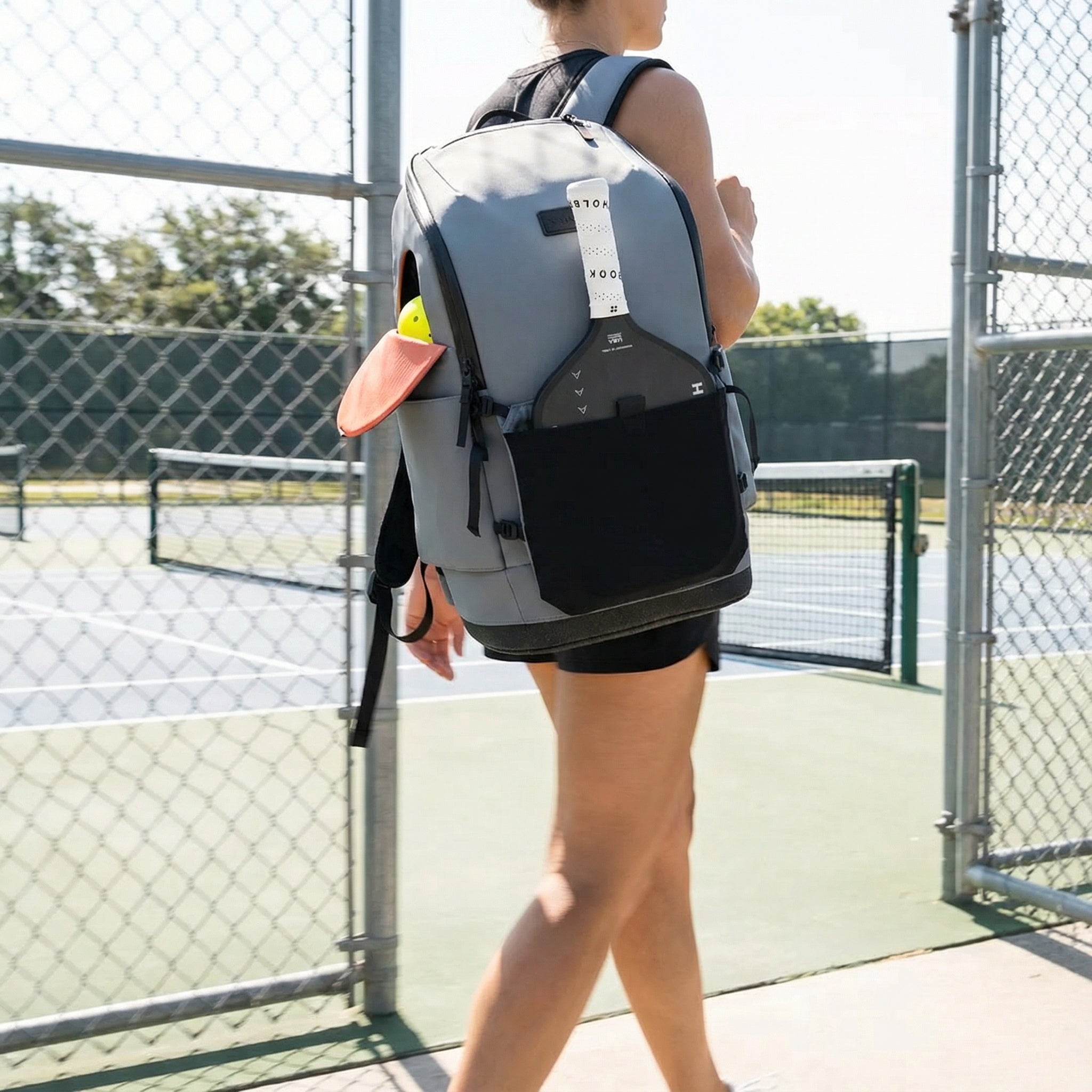
When you're moving between your home setup and dedicated courts, a purpose-built pickleball bag matters. The FORWRD Court Caddy ($325) has the compartment layout to handle a full practice kit — paddles, balls, training aids — without the contents mixing. The Court Ranger V2 ($195) is the backpack option if you're carrying everything on foot. Both use YKK AquaGuard zippers and handle garage floors and outdoor conditions without degrading.
Safety, Noise Control, and Neighbor-Friendly Practice
DIY practice should improve your game without damaging relationships or property. A few precautions go a long way.
Personal Safety
Wear protective eyewear during close-range volley drills — balls return fast and unpredictably from rebounders.
Use closed-toe court shoes, even in your driveway. Lateral movement on concrete with sandals invites ankle injuries.
Check all frames, nets, and tethers before each session. Fishing line frays (roughly 10% monthly with heavy use), bungee cords stretch, and zip ties break.
Noise Reduction
Pickleball's distinctive "pop" carries. Reduce impact on neighbors:
Use softer foam practice balls for apartment complexes or shared walls. The Quick Start 36 Foam Balls are purpose-built for this — nearly silent on impact and safe for any surface.
For indoor or low-noise sessions, Franklin X-26 Indoor Pickleballs are softer and significantly quieter than 40-hole outdoor balls.
Place rebounders on cardio mats or grass to dampen vibration.
Avoid late-night or early-morning drills in residential areas.
Add rubber grommets or felt pads where frames contact hard surfaces.
Property Protection
Hang old moving blankets behind rebound walls to protect garage doors and absorb sound.
Position all equipment away from windows, parked cars, and fence lines.
Consider the trajectory of missed shots — where will an errant ball end up?
Neighbor Etiquette
If you're using a shared area like a common parking lot or cul-de-sac:
Inform neighbors before you start, especially for regular practice schedules.
Keep sessions to predictable times — consistency builds tolerance.
Offer to include interested neighbors in a practice session. You might find a new drilling partner.
Putting It All Together: Sample DIY Practice Routines
Consistent short sessions beat occasional marathon practices. Here are three routines using only the DIY tools from this guide. Track your progress — if you hit the target 6/10 times today, aim for 7/10 next session. This kind of deliberate, measurable practice done 3–4 times weekly delivers real improvement by your next league season.
20-Minute Quick Session
Perfect for lunch breaks or before work:
Warm-up (3 min): Light jogging in place, arm circles, paddle swings
Dink series (7 min): 100 soft dinks against your rebounder, staying below the net line
Target work (5 min): Hit 10 consecutive shots at a marked target square
Volley burst (5 min): 3 rounds of 30-second rapid volleys, counting total hits
40-Minute Skill Builder
Solid weekday evening session:
Warm-up (5 min): Dynamic stretches plus 20 practice swings
Dink series (10 min): Alternating forehand/backhand dinks, 50 each side
Drop shot practice (10 min): Use your gravity dropper, focusing on soft landing in the kitchen zone
Volley and reflex (10 min): Close-range rebounder work, varying speed and angle
Target games (5 min): "10 in a row" on a hanging plate
60-Minute Complete Workout
Weekend deep practice:
Warm-up (5 min): Full dynamic warm-up plus footwork ladder (use tape lines)
Dink series (15 min): Cross-court dinks with a partner at your mini net, or solo rebounder work with placement focus
Serve practice (10 min): 30 serves targeting deep corners using floor markers
Third-shot drops (10 min): Dropper-fed balls, landing in the taped kitchen zone
Volley drills (10 min): Progressive distance work — start at 3 feet, back up to 7 feet
Conditioning (5 min): Side shuffles along your driveway court lines, 10 lengths
Cool-down and review (5 min): Light stretching, note what felt good and what needs work
Complete Your Setup: Store and Transport Your DIY Practice Gear
You've built the practice net. You've got a rebounder in the garage. You've got a ball collection growing by the week. The last piece is moving it all without losing your mind.
A solid practice routine only works if you can show up ready — paddles protected, balls organized, gear not repacked from scratch before every session.
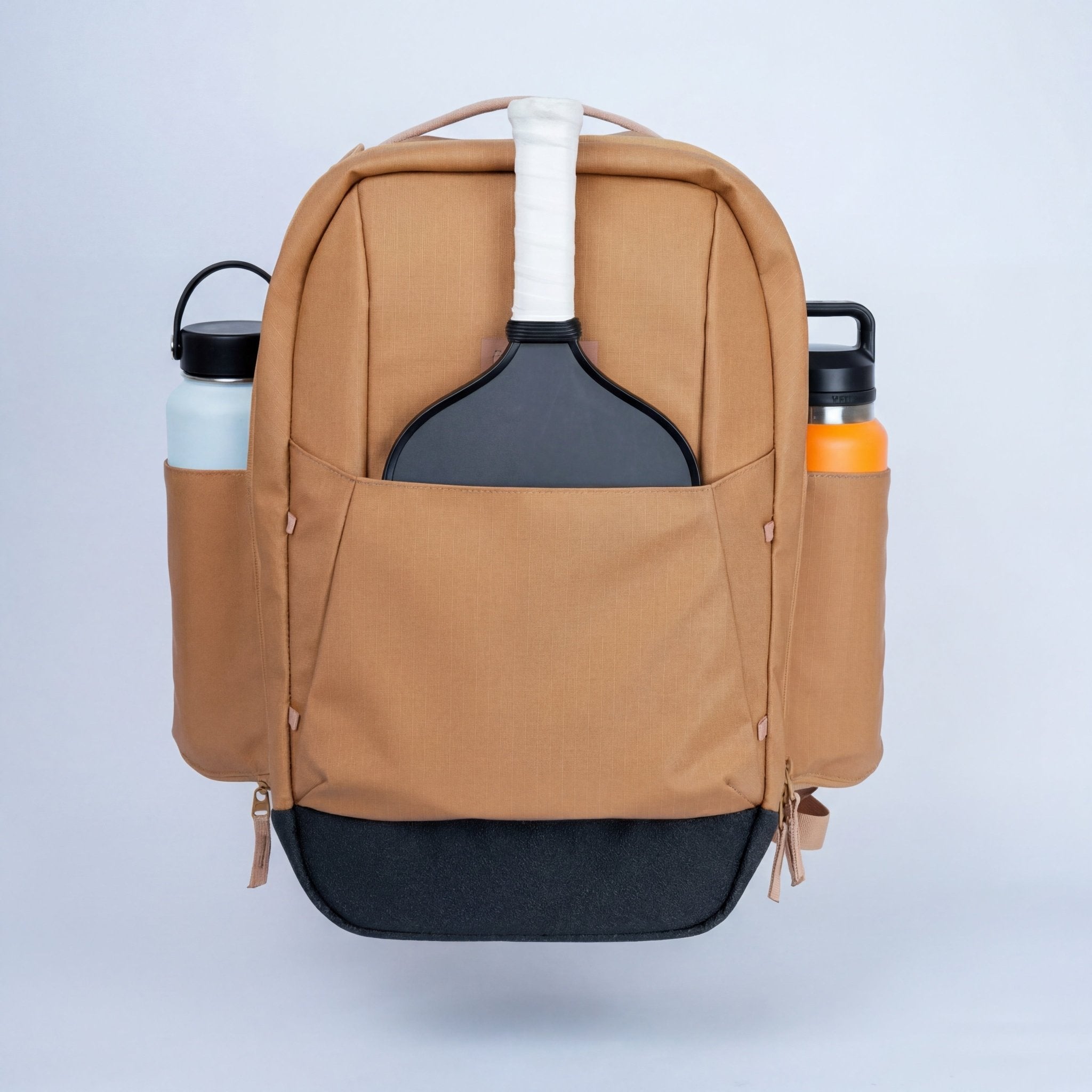
The FORWRD Court Ranger V2 ($195) fits 3-4 paddles in a modular sleeve, has a 16" laptop sleeve for remote work between sessions, and uses the same YKK AquaGuard zippers as expedition gear. For players who split time between home practice and court play, it's the bag that makes the logistics of a serious training routine actually manageable.

Ready to upgrade your practice setup? Shop the Court Ranger V2 — built with 500+ real players who take their practice seriously.
FAQ: DIY Pickleball Practice Equipment
How much does a basic DIY practice setup cost in 2026?
A functional setup with a mini net, simple rebounder, and court markings runs $75–125 in materials. The most expensive component is usually plywood for a wall rebounder ($25–30). Compare that to commercial alternatives that easily exceed $400 for similar functionality.
What's the best DIY pickleball practice setup for a small backyard?
A compact PVC net (10–14 feet wide) and a 4' x 4' plywood rebounder mounted on your garage wall cover 90% of solo practice needs. Total cost runs $75–100 for the net and $30–40 for the plywood. Add sidewalk chalk for kitchen and baseline markings. You can run dink drills, third-shot drops, and volley work without a full 44-foot court.
Can I practice pickleball alone at home without a partner?
Yes — and it's underrated for skill development. A wall rebounder lets you practice volleys, dinks, and drives at whatever pace you set. A gravity-fed ball dropper gives you serves and groundstroke reps without chasing. The solo drilling gap most players miss is footwork: set up cones or chalk targets and practice split-step and lateral movement between each shot.
How do DIY practice setups compare to commercial ball machines?
DIY setups cost $75–200 in materials and work well for dinking, volley reps, and serve consistency — the skills that move your game most. Commercial machines like the Pickleball Tutor add ball speed variation and automated feeds ($400–1,500+). Start with DIY. Upgrade when you've maxed out what solo drill reps can teach you.
What's the minimum space I need for home practice?
A 10' x 15' area — roughly the size of a parking space — is enough for dinking and volley practice against a rebounder. For a mini net setup with two players, aim for at least 15' x 20'. A full-scale driveway court requires 44' x 20', but scaled-down versions work well for most drills.
Should I use indoor or outdoor balls on my rebounder?
Outdoor balls (40-hole design) work best for most DIY rebounders — more durable and provide realistic bounce characteristics. Indoor balls (26-hole design) are softer and quieter, making them better for apartment practice or late-evening sessions where noise matters.
How do I practice the kitchen game without a court?
Mark a 7-foot zone from your portable net with chalk or painter's tape. Practice dinking with your wall rebounder from 7 feet, focusing on shots that clear the painted net line and land within the 7-foot zone. Set a no-miss target (10, 20, 50 consecutive dinks) and start over when you miss. This builds the repetition and consistency that translates directly to match play.
How should I store DIY equipment to make it last?
Store plywood rebounders flat or upright against a wall to prevent warping. Coil bungee cords and fishing line loosely to avoid kinks. Keep PVC frames assembled or store pieces together with labeled bags for hardware. A pickleball-specific bag — the Court Ranger V2 works well here — handles the smaller items like tape, targets, and tethered trainers between sessions.

Leave a comment
This site is protected by hCaptcha and the hCaptcha Privacy Policy and Terms of Service apply.