

Disclosure: This post contains affiliate links to Pickleball Central. If you purchase through our links, FORWRD earns a small commission at no extra cost to you. We only link to products we'd recommend regardless.
Last updated: June 2026
The most expensive bag mistake beginners make isn't buying the wrong bag — it's buying twice. A $130 bag you outgrow in four months, followed by the $195 bag you should have bought the first time, costs $325 total. The players who avoid this have a clear framework for what they actually need right now versus what they'll wish they had in six months. That's what this guide gives you — plus honest picks at each tier, including when the Court Caddy is the right call from day one.

What Do Beginner Pickleball Players Actually Need in a Bag?
Most beginner bag guides are written for the wrong person. They rank bags by paddle capacity, thermal insulation ratings, and tournament-day organization — features that matter when you're playing four times a week at a serious club level. If you're just getting started, your priority stack is simpler and more specific.
Here's what actually matters in your first bag:
- Room for 1–2 paddles, a water bottle, and a few balls — that's the core load for most beginner sessions. You don't need 12-paddle capacity.
- Quick-access pockets — a side or outer pocket for balls, a towel, and sunscreen that you can reach without opening the main compartment mid-changeover. This sounds minor until you've dug past a change of clothes for a ball three sessions in a row.
- Bilateral backpack carry — two shoulder straps distribute weight evenly. Sling bags concentrate load on one shoulder; duffel bags require one-hand carry. Both compound on a 10-minute walk from parking to court.
- Zippers that won't fail — this is the most underrated feature for beginners. Standard zippers on outdoor bags degrade from sunscreen and sweat exposure in a predictable pattern: stiffness first, then misalignment, then failure. If you play outdoors, zipper spec matters from day one. See our waterproof pickleball bag guide for the full breakdown.
What you don't need right now: a 12-paddle clamshell design, a built-in thermal rating measured in hours, or a $300 bag before you've found your playing rhythm. Start with what serves your actual session load. Know what you'll add later.
The beginner-specific pain points that surfaced in FORWRD's 500+ player design feedback process: slow access to balls mid-changeover, strap compression after just a few months of regular use, and zipper failure on outdoor bags within one season. These aren't premium player problems — they show up earliest for beginners who are loading and unloading unfamiliar gear frequently and haven't yet developed the muscle memory that reduces bag handling time.
Best Pickleball Bags for Beginners 2026: Our Picks
#1 — FORWRD Court Caddy (Best Overall for Players Who Play 2+ Times Per Week)
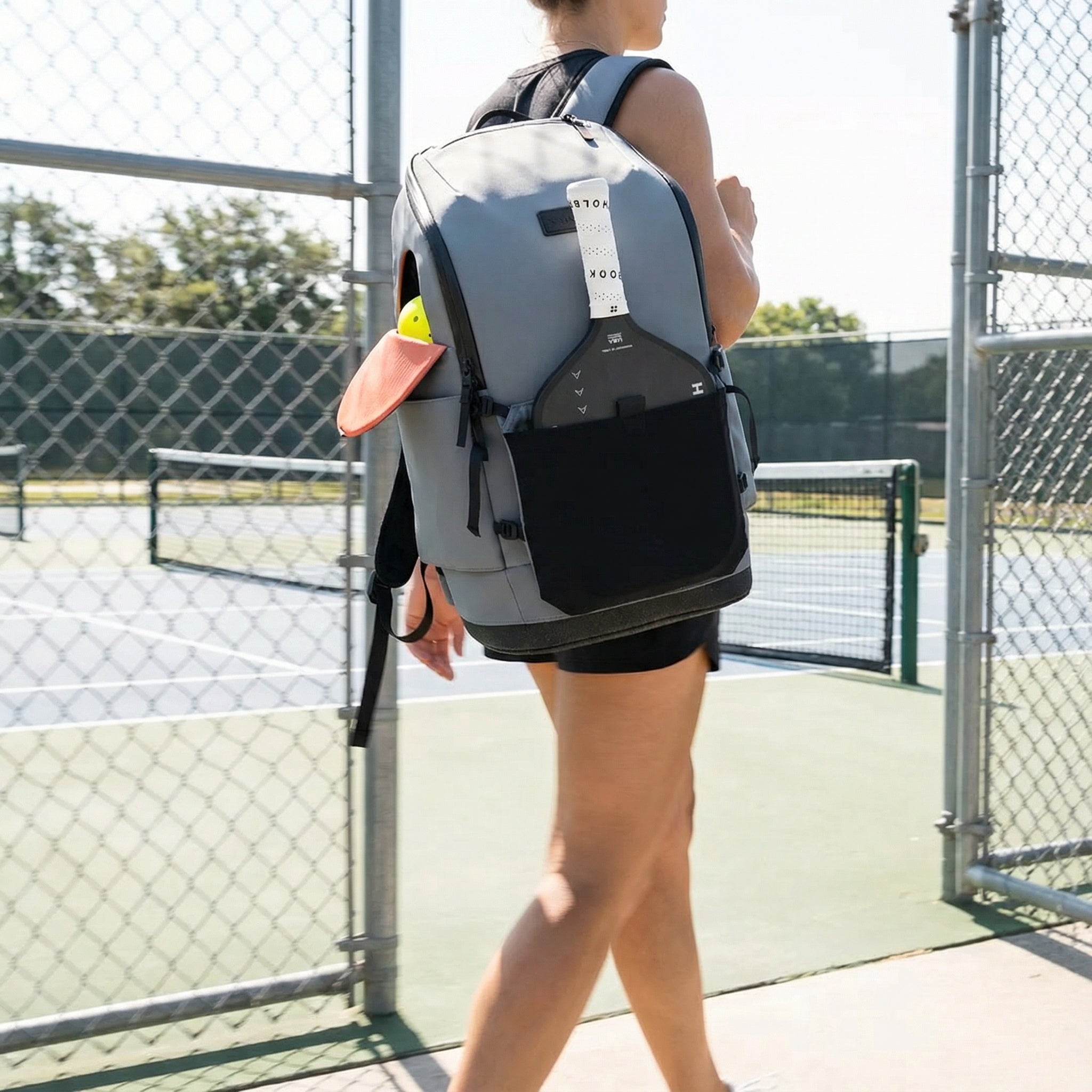
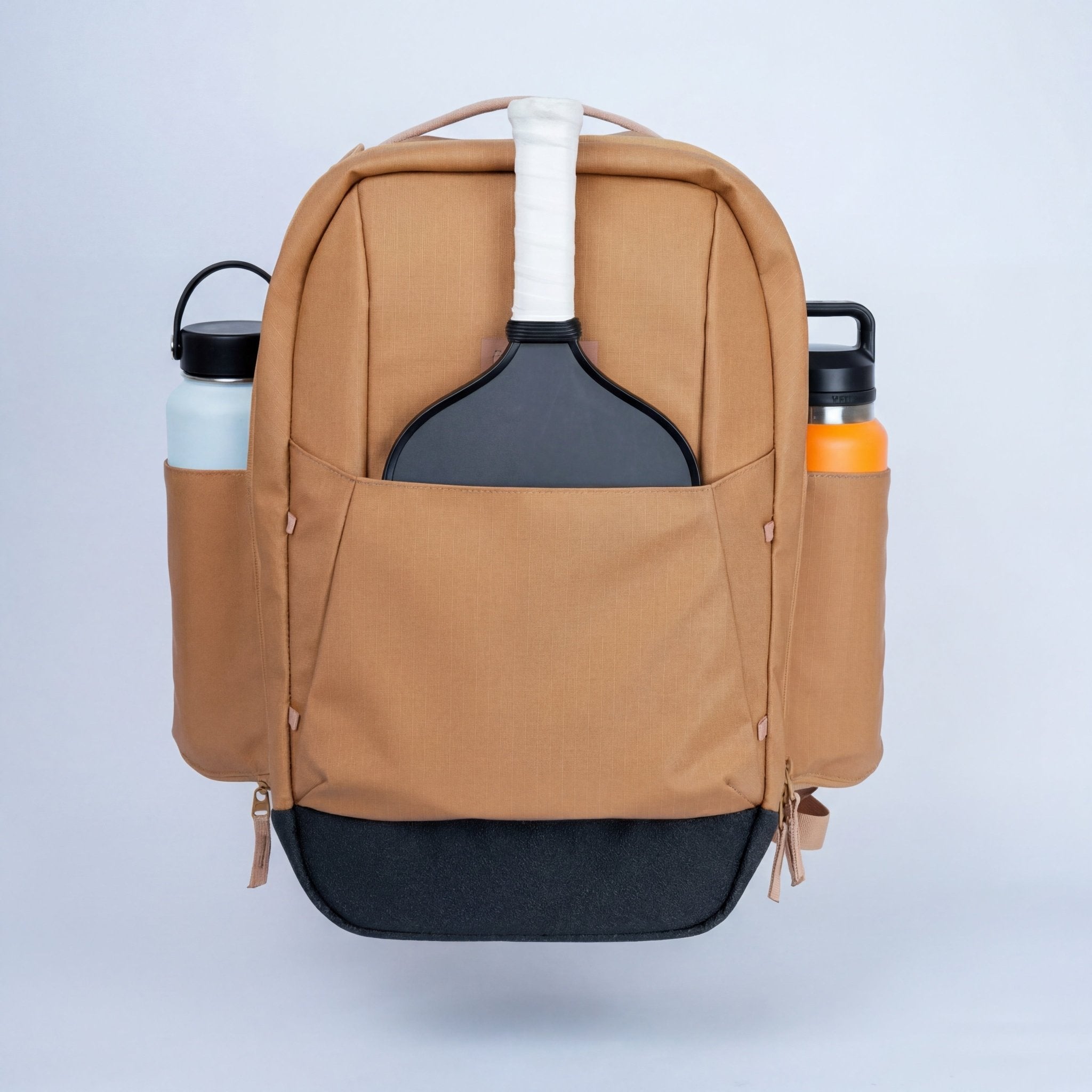
If you already know you'll play regularly — two or more sessions per week — the Court Caddy ($325) is the right first bag. It costs more than the entry-tier alternatives, but it eliminates the two-bag problem: you won't outgrow it in six months, the YKK AquaGuard zippers hold through years of outdoor use without degrading, and the lifetime warranty means FORWRD backs it indefinitely.
The practical specs that matter for beginners: a 15-inch padded modular paddle sleeve that keeps equipment separated and protected, a structured base that stands upright on any bench surface (so you're not righting a tipped bag repeatedly during sessions), and quick-access pockets laid out around what players actually reach for mid-session. Designed with feedback from 500+ real players — including beginners who surfaced the same organizational pain points you're likely to encounter. Featured in The Dink, Pickleball Effect, and The Kitchen as a top pick for regular players.
#2 — JOOLA Tour Elite (Best for Once-a-Week Casual Players)
If you play once a week or less and want a functional bag without spending $195, the JOOLA Tour Elite (~$130–150) is the most honest recommendation at this tier. It has thermal-lined paddle compartments, a fence hook, and the dual-zipper flap that opens the entire bag face for fast access. It's widely available at Dick's Sporting Goods and online retailers, which matters if you want to see the bag before buying.
Its limitations are real and worth naming: standard zippers that degrade with outdoor exposure, strap padding that compresses within six months for players carrying heavy loads multiple times per week, and no dedicated laptop sleeve. For once-a-week casual play, those limitations rarely matter within a typical ownership cycle. For more frequent play, they do. See our full mid-range bag review for how JOOLA compares to other options at this price tier.
#3 — JOOLA Tour Elite Pro (Best if You Want Backpack Carry at the $150 Tier)
The Tour Elite Pro adds convertible backpack straps and a ventilated shoe compartment over the base Tour Elite — meaningful if you want bilateral carry and shoe separation without spending $195. At approximately $149–160, it bridges the gap for players who want a backpack format but aren't ready for the Court Caddy's full spec set. The same standard-zipper limitation applies.
Features to Skip vs. Features Worth Paying For as a Beginner
This is the framework most beginner guides skip. The distinction between features that sound impressive and features that change your experience in the first six months is real — and getting it right determines whether you buy once or twice.
| Feature | Skip as a Beginner | Worth Paying For |
|---|---|---|
| Paddle capacity | 12+ paddles — you own 1–2 | 2–4 paddles in a protected sleeve |
| Carry format | Duffel-only (no backpack option) | Bilateral backpack straps |
| Zipper spec | Standard zippers (degrade outdoors) | YKK AquaGuard or water-resistant spec |
| Base design | Soft-sided (tips over on bench) | Structured base (stands upright) |
| Laptop sleeve | Skip if you don't go court-to-office | 15" isolated sleeve if you do |
| Strap padding | Thin foam that compresses quickly | Padding that retains shape over time |
| Warranty | Limited 1-year coverage | Lifetime coverage |
| Brand premium | Paying for the logo, not the specs | Paying for verifiable build quality |
The features in the "skip" column are the ones most beginner guides highlight — they're easy to photograph and describe in marketing copy. The features in the "worth paying for" column are the ones that determine whether your bag functions reliably for 12–24 months of regular outdoor use.
The one feature beginners consistently underestimate: zipper quality. Standard zippers on outdoor bags are the most common failure mode after one season of sunscreen and sweat exposure. Players who play outdoors year-round notice it first; beginners who play mostly in summer notice it by the second season. This is the spec that differentiates the Court Caddy from every bag under $150 — and it's why the price gap is real rather than arbitrary.
When to Upgrade: Moving From a Starter Bag to a Serious Bag
If you're playing 2+ times per week outdoors and you've owned your first bag for more than six months, run this checklist:
- Zipper stiffness — are any zippers harder to pull than they were when the bag was new? That's early degradation. Standard outdoor zippers follow a predictable pattern: stiff at six months, misaligned at twelve, failed at eighteen under heavy use.
- Strap compression — do your shoulder straps feel noticeably thinner than they did when you bought the bag? Foam padding that compresses shifts carry load directly onto the shoulder joint. For players with existing shoulder concerns, this compounds fast.
- Mid-session friction — are you digging through the bag to find a ball, a towel, or sunscreen during changeovers? Poor organization costs real time and focus during sessions.
If you're checking two or more of these boxes, you've outgrown your starter bag. The Court Caddy is the direct upgrade: YKK AquaGuard zippers, a structured standing base, 15-inch padded laptop sleeve, and a lifetime warranty. The math is straightforward — if you've already spent $130 on a bag that isn't working, the Court Caddy at $325 is a $195 incremental spend to get a bag that lasts indefinitely.
For players who've been playing 4+ sessions per week and are moving into competitive club or tournament play, the Court Ranger V2 adds 25-liter tournament capacity, a 16-inch laptop sleeve, and dual fence hooks at the same $195 price point. Know your carry load before deciding — the Court Caddy covers most club and recreational players; the Court Ranger V2 is built for full tournament days.
If you're a beginner who already knows you'll play often, the honest advice from USA Pickleball's most active recreational player segment is simple: buy the bag you'll have in two years, not the bag for the player you are today.
Frequently Asked Questions
What pickleball bag should a beginner buy?
If you play 2+ times per week, the FORWRD Court Caddy ($325) is the right first bag — it eliminates the two-bag problem by delivering the build quality you'd want in year two on day one: YKK AquaGuard zippers, a structured standing base, and a lifetime warranty. For once-a-week casual players, the JOOLA Tour Elite (~$130–150) is honest value at a fair price point.
Do I need a special bag to play pickleball?
No — technically you can play with any bag. But a dedicated pickleball bag solves specific practical problems: paddle protection (edge guards scratch against loose items), quick access to balls during changeovers, and organized carry for water, sunscreen, and a towel. A gym backpack works for a first session; after a few regular sessions most players want something purpose-organized.
How much should I spend on my first pickleball bag?
Honest answer: it depends on how often you'll play. Once a week or less — a $130–150 bag like the JOOLA Tour Elite is appropriate. Two or more times per week outdoors — spend $325 on the Court Caddy from the start. Spending $130 and replacing it with a $325 bag in six months costs $455 total; buying right the first time costs $325.
What features should a beginner look for in a pickleball bag?
In order of practical impact: bilateral backpack carry (hands-free from car to court), quick-access pockets for balls and small items, a structured base that stands upright on bench surfaces, and zipper quality appropriate for how much outdoor exposure the bag will see. Paddle capacity, thermal ratings, and shoe compartments are secondary for most beginning-level carry loads.

Leave a comment
This site is protected by hCaptcha and the hCaptcha Privacy Policy and Terms of Service apply.