


Disclosure: This post contains affiliate links to Pickleball Central. If you purchase through our links, FORWRD earns a small commission at no extra cost to you. We only link to products we'd recommend regardless.
Last updated: August 2026
The best sun protection for outdoor pickleball is a hat that actually stays on, a UPF-rated shirt, sunscreen with enough staying power for two hours of sweaty play, and eyewear that handles both glare and fast-moving balls. Most players nail one of these. Few nail all four — and that gap shows up as sunburns, headaches, and missed shots you shouldn't miss.
Here's the complete breakdown: what actually works, what's unnecessary, and why most outdoor pickleball sun protection advice misses the specific challenges of the sport.
Why Outdoor Pickleball Is Hard on Your Skin (and Eyes)
Most outdoor pickleball courts are oriented southwest — standard sports facility design for afternoon shade on the dominant side. Fine in theory. In practice, it puts the afternoon sun directly in your face for the most active hours of a typical session.
The UV index peaks between 10am and 2pm, reaching levels of 8–10 (very high to extreme) across most of the US during summer. At a UV index of 8, unprotected skin can burn in under 15 minutes. A 90-minute outdoor session at that index is serious cumulative UV exposure — the kind that adds up across a season. And pickleball players are on outdoor courts 3–5 times a week.
What makes this harder than a walk in the park:
- You can't feel the burn while it's happening. Constant movement creates a cooling effect that masks sun intensity. Players who "didn't feel hot" at a 10am session are often surprised by a burn by dinner.
- Court surfaces reflect UV from below. Concrete and asphalt bounce UV upward — you're getting hit from both directions.
- Sweat destroys sunscreen faster than the label assumes. SPF ratings are lab conditions. A hard doubles session is not a lab condition.
- Fast play makes poor eyewear dangerous. A ball at 40–50 mph is genuinely hard to track against a bright sky. Losing it isn't just a lost point.
The Best Hats for Pickleball: What Actually Stays On
Here's the problem with most pickleball hat recommendations: they come from general sports or tennis guides. Those sports don't have the same movement profile. Pickleball has split steps, lunges, overhead swings, and rapid directional changes — movement that launches a loosely fitted hat off your head immediately.
Three main hat styles, honest breakdown for pickleball movement:
Performance cap (curved brim): The most stable option. A well-fitted cap with an adjustable rear closure stays on through overheads and hard lateral lunges. Key features: lightweight sweat-wicking fabric, a non-glare undervisor (dark underside that reduces reflected sun bouncing back into your eyes), and an adjustable closure that fits snugly without squeezing. This is what most competitive outdoor players wear. Stay away from one-size strapless caps — they're decorative, not athletic.
Visor: Better airflow than a cap — the open top prevents heat buildup during 90-degree sessions. The tradeoff is no coverage on top of your head. Good for players who run hot or have long hair (most sports visors have a ponytail opening). A quality adjustable closure mostly solves the stability issue. Browse pickleball hats and visors at Pickleball Central →
Bucket hat / wide brim: Maximum coverage — face, neck, and ears all get shade. The stability problem is real. Cheap bucket hats become frisbees in a windy rally. Higher-quality athletic versions with chin straps or close-fitting profiles stay put, but they're harder to find in purpose-built pickleball versions. Worth the search if you play long outdoor tournaments where cumulative exposure is the concern.
Our Pick: VIBE Pickleball Curved Performance Hat
Purpose-built for court play — adjustable closure, moisture-wicking build, and a profile designed to stay put through overheads.
One thing worth noting: flat-brim hats are a consistent problem on the court. They sit higher on the head, don't conform to the skull the way curved brims do, and have no structural reason to stay put during lateral movement. If someone's hat keeps falling off during play, it's usually a flat brim.
UPF Shirts for Pickleball: What the Rating Means in Real Sun
UPF (Ultraviolet Protection Factor) and SPF (Sun Protection Factor) measure different things, and the confusion between them costs players actual protection.
- SPF estimates how long you can stay in direct sun before burning — an indirect measure, affected by your skin type and application thickness.
- UPF measures the fraction of UV radiation blocked by the fabric directly — more precise and consistent.
A UPF 50 shirt blocks 98% of UV radiation passing through the fabric. A plain white cotton t-shirt has a UPF of roughly 5 — blocking around 80% of UV. That 18% gap sounds small until you're accumulating it across four sessions a week for a full summer.
UPF 30+ is the practical outdoor minimum. UPF 50 is standard in sports-specific sun protection apparel. The difference between 30 and 50 is small (97% vs. 98% blocked) — either is meaningfully better than a regular athletic shirt. The better news: modern UPF pickleball shirts are lightweight and moisture-wicking. They don't feel like extra insulation. Shop UPF pickleball apparel at Pickleball Central →

For players who like their current shirts: arm sleeves are a practical add-on. SParms arm sleeves designed for court sports provide UPF 50 coverage on arms and fit snugly enough to stay in place during split steps. They also protect against the "sunburned forearm, not the bicep" asymmetric exposure pattern common in forehand-dominant sports. Shop arm sleeves at Pickleball Central →
Sunscreen Strategy for Multi-Hour Outdoor Play
The biggest sunscreen mistake in pickleball is one application before play and no reapplication. SPF ratings come from controlled lab conditions. Active sweating for 90 minutes on an asphalt court is not a lab condition.
What actually works:
- Reapply every 60–75 minutes of active court time, not every 2 hours as labeled. Sweat compromises protection faster than the label assumes. Set a phone reminder between games if you forget.
- SPF 30–50 is the sweet spot. The jump from SPF 15 to SPF 30 is meaningful (93% vs. 97% UV blocked). SPF 50 to SPF 100 is marginal (98% vs. 99%). Don't obsess over the number — obsess over reapplication timing.
- Water-resistant formulas matter here. "Sweat-resistant" and "water-resistant" are labeled on the product — that's the one you want for athletic use. Bonus if it has a dry-touch finish: slippery sunscreen on your grip hand affects your paddle control.
- Don't skip ears, back of neck, and hands. Ears are the second-most-common site for skin cancer in outdoor athletes. The back of the neck gets continuous sun exposure during bent-forward ready position. Both spots are frequently missed in a pre-game application.
Practically speaking: keep a small sunscreen tube in your bag's front pocket alongside your ball and towel. Treat it like water — you bring it every time, not just when you think you'll need it.
For current UV Index levels in your area, the EPA UV Index Scale is the same reference sports medicine programs use for outdoor training protocols — worth bookmarking for high-UV summer days.
Eye Protection: Polarized vs Photochromic for Pickleball
"Just wear sunglasses" is the most common eyewear advice for outdoor pickleball. It's also incomplete — standard fashion sunglasses weren't designed for a ball moving at 40–50 mph against a bright sky. The wrong lens tint makes tracking harder, not easier.
Polarized lenses cut glare from flat horizontal surfaces — the court, cars in the lot, puddles. Excellent for morning play when the court reflects low-angle sun. One caveat: polarized lenses can slightly affect depth perception on fast-moving objects in specific lighting. Most players adapt within a few sessions. If you find yourself misjudging ball distances early on, give it a week.
Photochromic lenses adapt automatically between darker and lighter states. Genuinely useful for players who move between covered and open courts, or play at times when light shifts quickly (early morning, late afternoon). The real-world adjustment speed — typically 20–40 seconds — means brief transitions can leave you temporarily over-darkened in shadow. Worth knowing before you spend the money.
Yellow/amber tint enhances contrast and ball visibility against light backgrounds. Best for overcast or mixed-light conditions, not full summer sun. Many serious players have two pairs: amber for indoor/overcast, polarized for outdoor sun.
For the full breakdown with specific product recommendations, our complete pickleball glasses guide covers every lens type with court-specific testing. If you play both indoor and outdoor, the JOOLA RJX Boost review covers the COLORBOOST lens technology specifically built for the indoor-outdoor transition problem. At the premium end, the Chamelo Domo Shield review tests photochromic HVL technology at $199 — whether the premium lens tech actually justifies the price.
Complete Your Court Kit
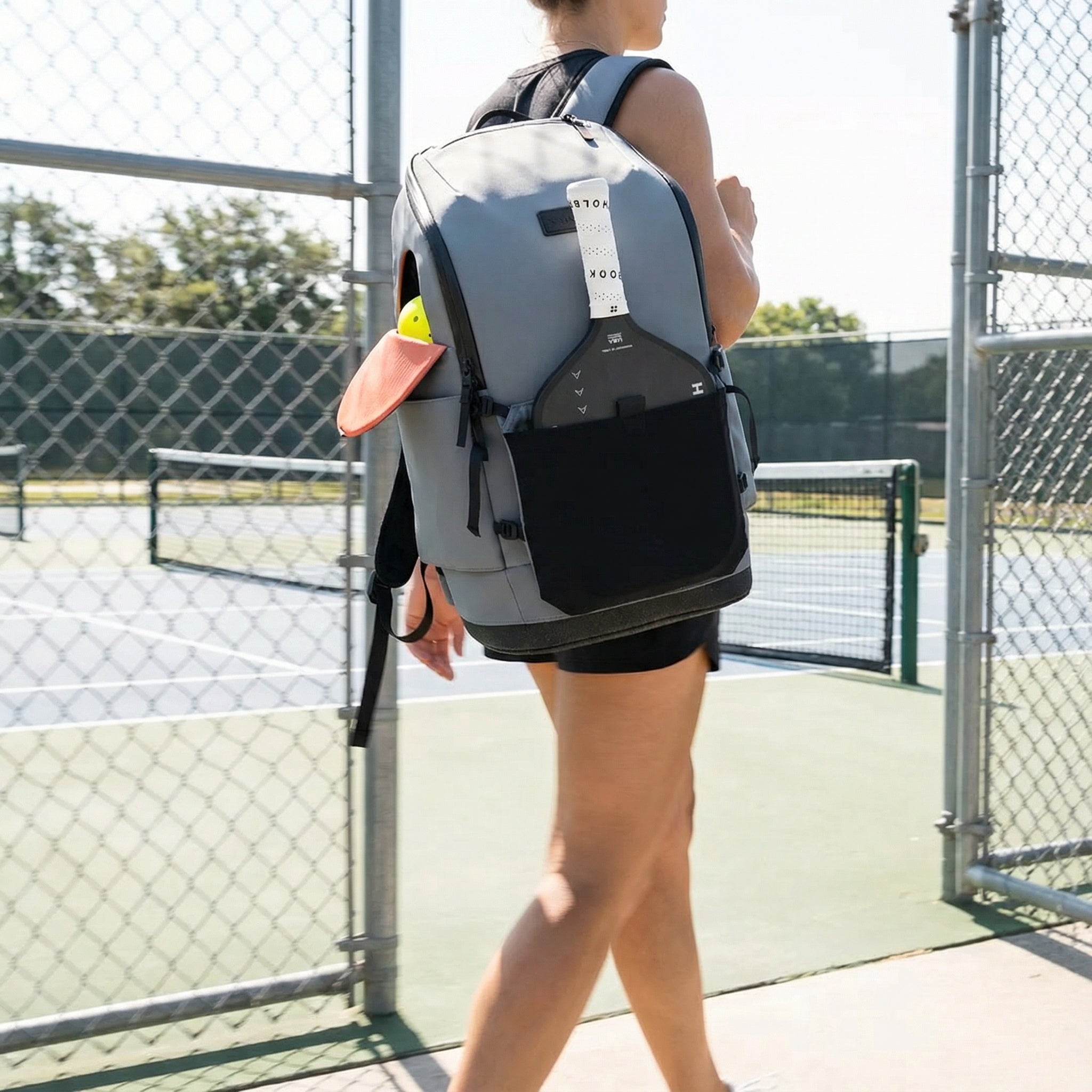
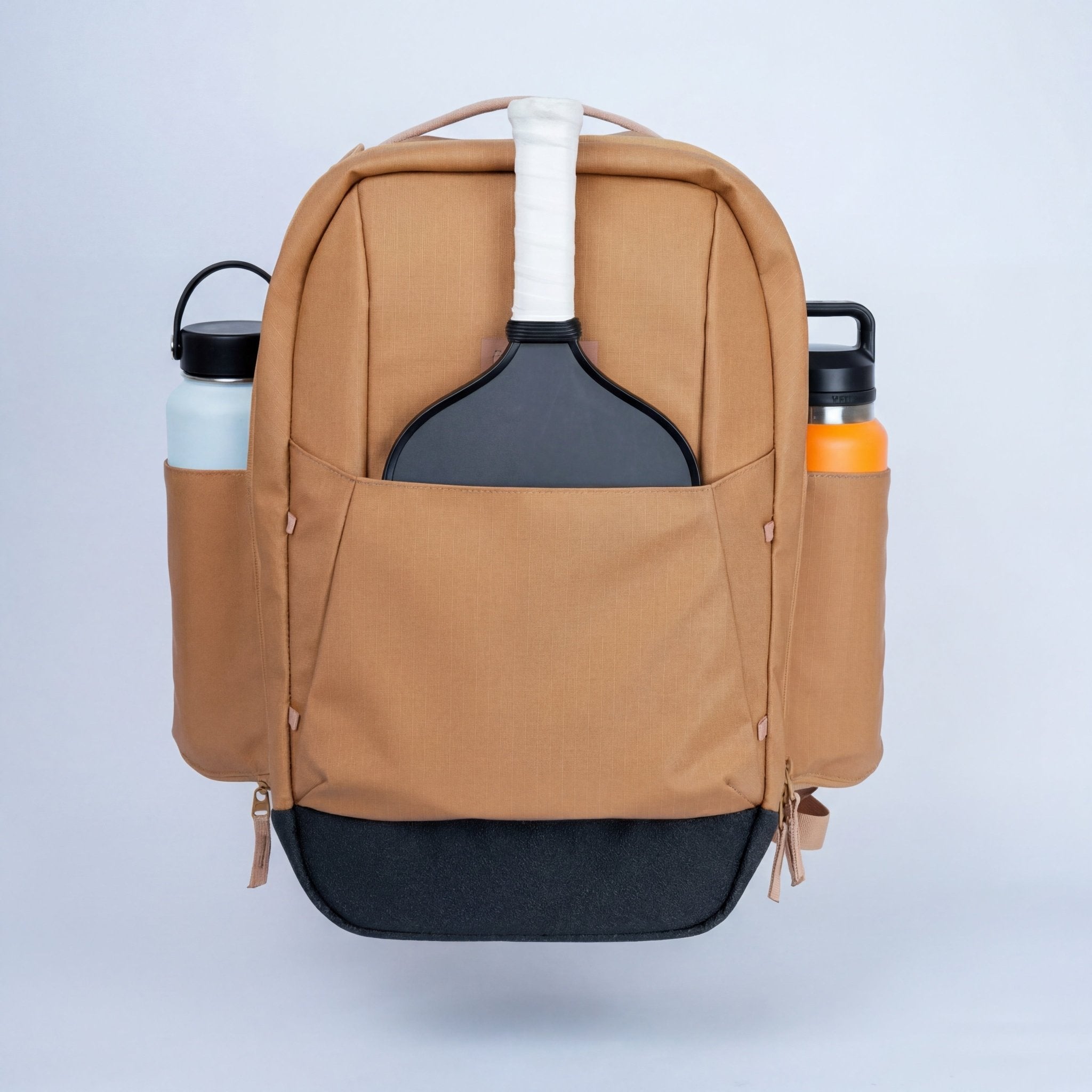
Got your sun protection dialed in? Make sure you've got a bag that carries all of it — hat, sunscreen, glasses case — without hunting through a single disorganized compartment.

The Court Ranger V2 ($195) has dedicated compartments for everything: a 16" padded laptop sleeve, modular paddle sleeve, and enough main compartment space for sunscreen, a spare shirt, and water bottles. Designed with feedback from 500+ real players who know the difference between a bag that works courtside and one that doesn't.
FAQ: Pickleball Sun Protection 2026
What hat is best for pickleball?
A well-fitted performance cap with an adjustable rear closure is the most stable choice for pickleball's movement patterns. Look for a dark undervisor to cut reflected court glare, lightweight moisture-wicking fabric, and a secure fit that won't shift during overhead swings. Visors are a solid alternative for players who run hot or prefer airflow at the expense of top-of-head coverage.
Do I need sun protection for indoor pickleball?
No. Indoor courts use artificial lighting with no meaningful UV exposure. Sunscreen, UPF shirts, and sun-protective eyewear aren't needed indoors. Standard sport eyewear with a yellow or amber tint can improve contrast and visibility under gym lights — but that's a performance choice, not a sun protection need.
What UPF rating is good for pickleball shirts?
UPF 30+ is the practical minimum for outdoor play. UPF 50 — standard in sports sun protection apparel — blocks 98% of UV radiation passing through the fabric. The difference between UPF 30 and UPF 50 is marginal (97% vs. 98%); any UPF 30+ garment gives you real protection. More important: pairing it with sunscreen on exposed skin (face, hands, neck).
What sunscreen lasts through a 2-hour outdoor pickleball session?
No sunscreen reliably lasts 2 full hours of active sweating. Apply SPF 30–50 water-resistant sunscreen before play, then reapply after 60–75 minutes of court time. Mineral-based formulas (zinc oxide, titanium dioxide) tend to hold up better under sweat than chemical-only formulas. A dry-touch finish avoids affecting your paddle grip.
What do competitive pickleball players wear for sun protection?
Most competitive outdoor players combine a performance cap or visor, a UPF-rated shirt or arm sleeves, mid-session sunscreen reapplication, and purpose-built pickleball eyewear. The eyewear is the most-skipped piece — and the one that directly affects on-court performance, not just long-term health. Polarized for full-sun courts, photochromic for mixed-light conditions.

Leave a comment
This site is protected by hCaptcha and the hCaptcha Privacy Policy and Terms of Service apply.