

Last updated: August 2026
This post contains affiliate links to Pickleball Central. If you purchase through our links, FORWRD earns a small commission at no extra cost to you. We only link to products we'd recommend regardless.
Pickleball paddles have advanced rapidly, and 2025’s best pickleball paddles set new standards for spin, control, power, and versatility. We’ve teamed up with industry experts to update our paddle recommendations. In this comprehensive guide, we break down the year’s top paddles by category (control, power, all-court, spin, and budget) and player personas. Whether you’re a finesse-oriented control player, a power hitter, a spin fanatic, an all-court strategist, or a budget-conscious beginner, you’ll find a paddle tailored to elevate your game.
Our goal is to help U.S. buyers choose the right paddle with confidence. Each section below provides a deep dive into the category’s best paddles, including unique features, core materials, face technology, and the ideal player profile for each paddle. We’ve also included plenty of images and alt text for visual reference, so you can see what makes these paddles special. By the end, you’ll not only know which paddles made the cut – you’ll understand why they’re the best and how to choose the perfect one for your playing style. Let’s jump in!
How We Selected The Best Pickleball Paddles of 2026
Our selections are based on extensive testing and trusted reviews, notably the 2026 Hot List curated by Pickleball Effect’s expert reviewer Braydon. Over 200 paddles were evaluated for performance, innovation, and quality. Only 24 paddles earned Gold or Silver awards on the Hot List, and those are the models you’ll see featured here. We’ve preserved the original structure of our guide but updated every recommendation to reflect 2026’s top-performing paddles, including several new paddles that showcase recent innovations in materials and design. Each product section has been rewritten with fresh insights on core construction, face materials, and playstyle suitability, so this guide remains evergreenand valuable well into the future.
In our evaluation process, we considered not just materials and innovation, but also how each paddle's design, size, and construction choices directly impacted the paddle's performance—including power, spin, control, and feel.
Why trust this guide? We combine independent lab data, player feedback, and expert opinions to to ensure each pick offers exceptional value. All paddles listed are USA Pickleball approved for tournament play and are widely available in the U.S. market.
Before diving into the categories, here’s a quick rundown of what each paddle “type” means:
-
Control Paddles: Emphasize touch, placement, and consistency over raw power. Great for soft game specialists and many beginners.
-
Power Paddles: Prioritize pop and speed, helping aggressive players put shots away (at the cost of some control).
-
All-Court Paddles: Balanced designs that blend power and control, ideal for versatile players who mix up strategies.
-
Spin-Optimized Paddles: Feature textured faces or unique materials to generate extra spin on the ball, helpful for sharp angles and cut shots.
-
Budget Paddles: Affordable yet performance-oriented options for those not ready to spend $200+, including starter sets that don’t compromise on quality. Some models offer a great price for their features. A beginner paddle is typically lightweight, easy to handle, and designed for newcomers to develop their skills with confidence.
Now, let’s explore the best paddles of 2026 in each category. Use the table of contents or skim the headings to find the paddle type or player profile that fits your needs, and check out the full FAQ at the end for answers to common buyer questions. Happy picking!
Table of Contents
-
Best All-Court Pickleball Paddles
-
-
paddletek-bantam-127-series" target="_blank">14. Paddletek Bantam 12.7 Series
-
Player Level Guide: Which Paddle for beginners vs Advanced?
Best Control Pickleball Paddles
Control paddles are designed to absorb pace and give you pinpoint command over placement, offering great control for players seeking accuracy and finesse. They make it easier to drop the ball softly into the kitchen, dink endlessly, and reset rallies without popping the ball up. Key attributes include a large sweet spot, superior feel/touch, ample forgiveness on off-center hits, and often enhanced spin for added control on cut shots. Some modern control paddles now feature a square shape, which further enhances forgiveness, control, and maneuverability by providing a larger sweet spot and easier technical shots. Control paddles tend to have softer cores (often thicker 14–16 mm polymer or even new foam cores) and textured carbon fiber faces to grip the ball. They’re typically the top recommendation for beginners (to reduce errors) and for seasoned “dink masters” who value consistency over power. Among these, the PIKKL Hurricane Pro stands out as the best control paddle, celebrated for its accuracy and forgiving nature.
In 2026, the best control paddles have pushed the envelope by blending touch with just enough put-away power to be dangerous when needed. The Hot List’s control category had six standout models that earned either Gold or Silver honors. Let’s explore each:
Chorus Shapeshifter Series (16 mm, Carbon+Fiberglass Face) – Modern Control, Medium Power
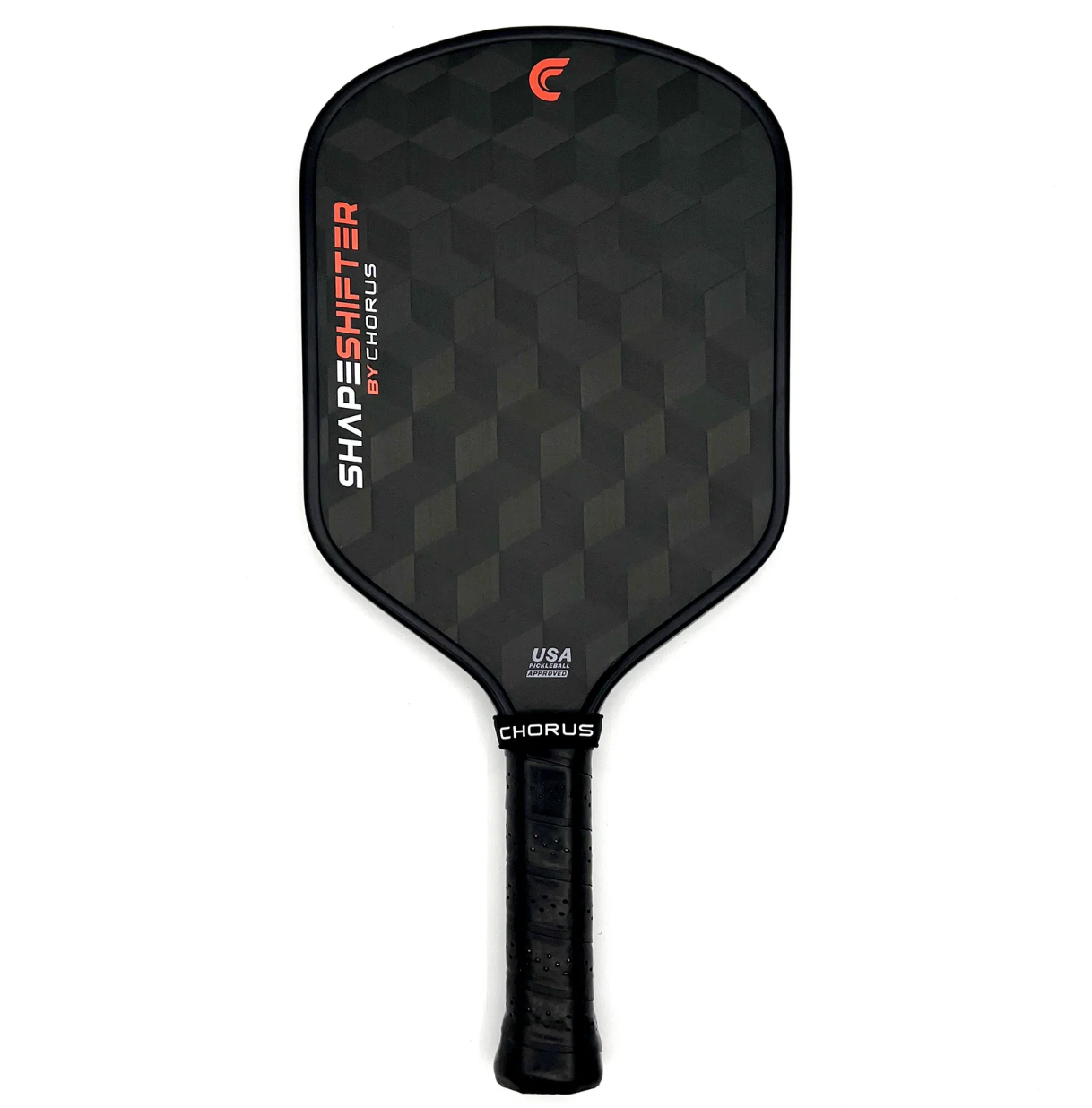
Chorus Shapeshifter Series – A control paddle that dynamically boosts power when you swing hard. This innovative series earned a 2026 Hot List Gold Award for control. Chorus accomplished something special here: two carbon fiber face layers are fused over a fiberglass layer, creating a unique face that plays soft on delicate shots and injects power on hard swings. In other words, the carbon provides touch for dinks, while the buried fiberglass “activates” on drives to give extra pop when you need it. The face design, especially the use of t700 raw carbon fiber, enhances the paddle's durability, stiffness, and overall performance, contributing to improved power, control, and feel. This material also helps players generate spin on their shots, while the textured surface provides good spin for a variety of playing styles.
These paddles feel light and maneuverable (about 7.8 oz average) with great hand speed. Despite the lighter weight, the Shapeshifter has a generous sweet spot and a very responsive feel. It comes in three shapes – elongated (EX), hybrid (HX), and widebody (SX) – so players can choose their preference. All shapes share the 16 mm thickness and face tech. Notably, spin generation is top-tier; that 3D cubic weave carbon surface grips the ball exceptionally well, earning spin rates above most control paddles. Chorus basically proved that a control paddle can also impart heavy spin and even some power without losing its soft touch.
Player profile: Perfect for control-oriented players (2.5 up to pro) who primarily play the soft game but want versatility to attack occasionally. Beginners will love the forgiveness and connected feel (it’s often described as “telepathic” in how it places the ball). If you’ve struggled with other control paddles lacking put-away power, the Shapeshifter strikes a beautiful balance. Just be ready to spend – it’s premium-priced around $175, but many find it worth it for the advanced materials and clever engineering inside.
Vatic Pro Prism Flash 16mm – “Pure” Control with a Plush Feel
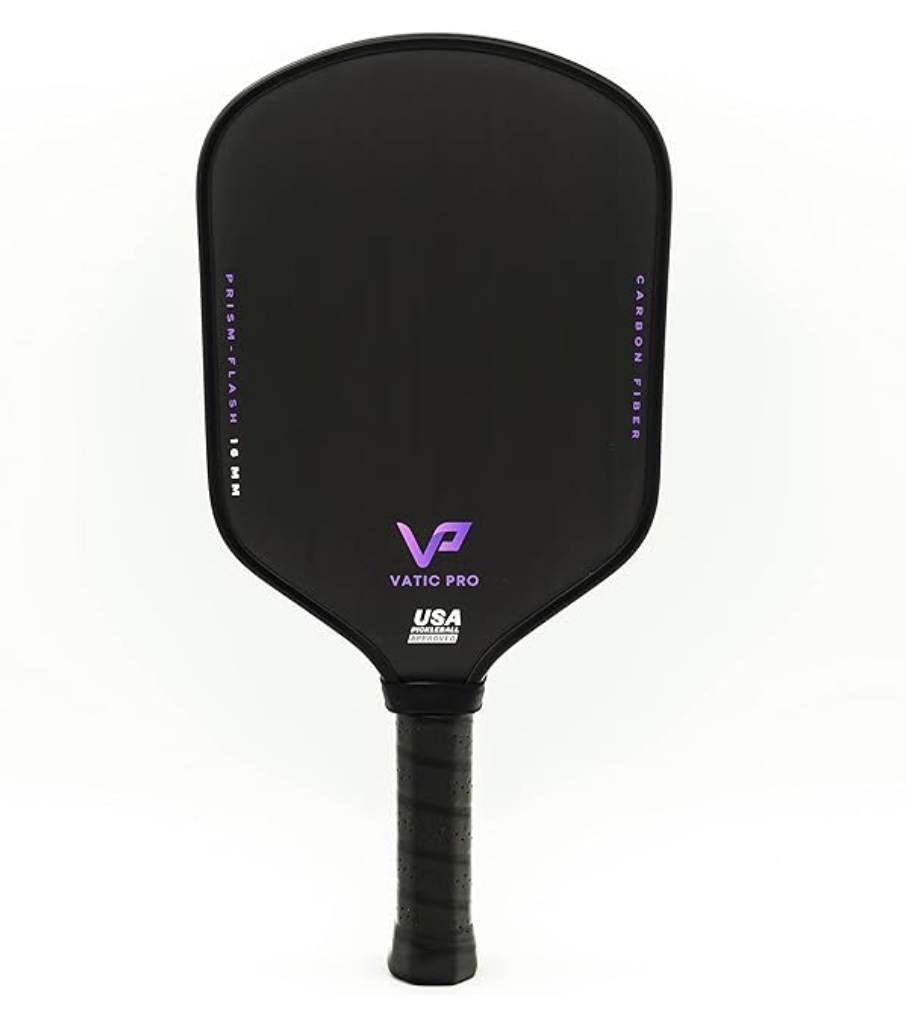
Vatic Pro Prism Flash 16mm – A wallet-friendly control paddle that feels high-end. The Prism Flash 16 mm has made Gold on the Hot List two years running, and it’s no surprise why. Priced around $99 (often on sale for $89 with a code), this paddle “feels like I’m getting away with something” in the words of the reviewer. You get a raw T700 carbon fiber face (uncommon at this price) which yields excellent spin and a very soft, forgiving feel.
At 16 mm thick with a polymer honeycomb core, the Prism Flash excels at absorbs incoming speed. Players who struggle with their soft game (e.g. hitting volleys too hard or popping up dinks) will find this paddle immediately makes it easier to reset and drop shots softly. The feedback is ultra plush – some describe it like a cushion hitting the ball – which breeds confidence in placement.
The shape is a moderate hybrid, slightly elongated for extra reach but still maintaining a wide sweet spot and low swingweight (~114) for quick hand motion. This means unlike some elongated paddles that feel head-heavy, the Prism Flash remains very maneuverable at the net. It won’t generate a ton of power unless you supply it (Vatic calls it a “pure control paddle”), so aggressive baseliners might want something firmer. But defensive specialists and touch artists love it.
Spin is another highlight. Despite the low price, Vatic gave this model a raw carbon surface that grabs the ball well. You can put plenty of topspin or slice on shots – great for precision placements. The only players who might not like the Prism Flash are those craving a stiffer, more explosive feel. If you prefer some “pop” or a firm response, note that this paddle is deliberately soft (low power). However, many 3.0–4.0 players actually play better with that kind of control – and you can always swing harder to generate pace when needed.
Player profile: Ideal for intermediate players developing their soft game, or anyone who wants a forgiving, spin-capable control paddle on a budget. It’s also an excellent beginner paddle for serious newcomers, thanks to its ease of use and great price. The performance belies the price, making it a strong starter paddle as well. As Vatic Pro’s own review said, it’s one of the best values in control paddles. Unless you know you need more power or a firmer feel, you can’t go wrong with the Prism Flash as a foundation of your game.
Volair Mach 2 Forza 16mm – Widebody Whiz with Top-Tier Spin
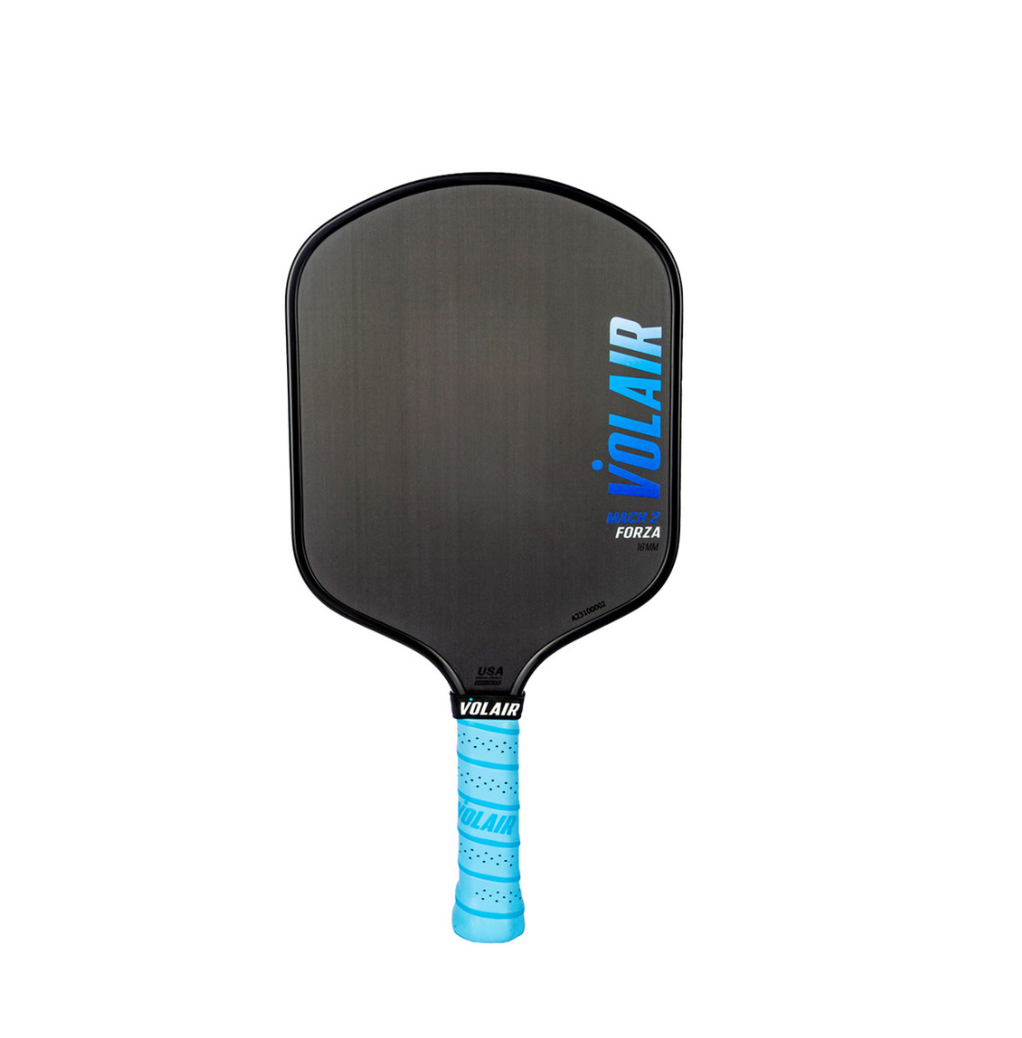
Volair Mach 2 Forza (16 mm) – A widebody control paddle that doesn’t sacrifice speed. Co-designed by pro Julian Arnold’s Volair brand, the Mach 2 Forza earned a Gold Award in the Hot List for its exceptional blend of control, forgiveness, spin, and even some power. If spin is your thing, pay attention: in testing, this paddle averaged ~2150 RPM on spin shots – “among the highest” measured in 2025. That’s largely thanks to Volair’s textured thermoformed carbon fiber face which bites the ball aggressively.
The Mach 2 Forza uses a 16 mm polymer core with thermoformed construction (heated, integrated edge and face) plus foam injection along the edges. The result is a controlled, slightly softer feel than older widebody paddles, yet with enhanced stability. The wide 8.5″ face is a bit bigger than standard, which contributes to a more forgiving sweet spot. This yields a huge sweet spot and plenty of forgiveness on off-center hits. Volair kept the weight moderate (~8.0 oz) and importantly gave it a 5.5″ handle, unusually long for a widebody paddle. That longer handle is a godsend for two-handed backhand players or anyone wanting extra leverage without choosing a narrow elongated paddle.
On court, the Mach 2 Forza is described as having “a great combo of speed, control, spin, and forgiveness”. It swings quicker than you’d expect for its shape – Volair lists a swingweight around 116, fairly average and quite manageable. Control players transitioning from standard shapes will love the stability and consistency. And if you occasionally drive the ball, that thermoformed pop (plus maybe a tad of hidden fiberglass layering) does give noticeable put-away power for a control paddle.
Volair even offers this model in both 16 mm and 14 mm thickness. Most picklers gravitate to the 16 mm for maximum control (which is what we and Pickleball Effect focus on). But if you crave more explosiveness and speed, know there’s a 14 mm Mach 2 Forza option too – it will play hotter at the expense of some touch.
Player profile: Those who want the forgiveness of a widebody paddle without the usual downsides (reduced reach or sluggishness) will love Mach 2 Forza. It’s particularly suited to spin-heavy players – if you rely on cut shots, topspin rolls, or heavy slice dinks, this paddle’s surface is a dream. Control-oriented doubles players will appreciate the quick hands and big sweet spot in fast kitchen exchanges. Unless you absolutely need an elongated shape, the Mach 2 Forza can likely elevate your control game while still letting you finish points (its motto might as well be “Spin it to win it!”). Just note the MSRP is around $180 – a premium price, but justifiable given the advanced build and performance.
Bread & Butter Fat Boy 16mm – Oversized Sweet Spot, “Pop” at the Net
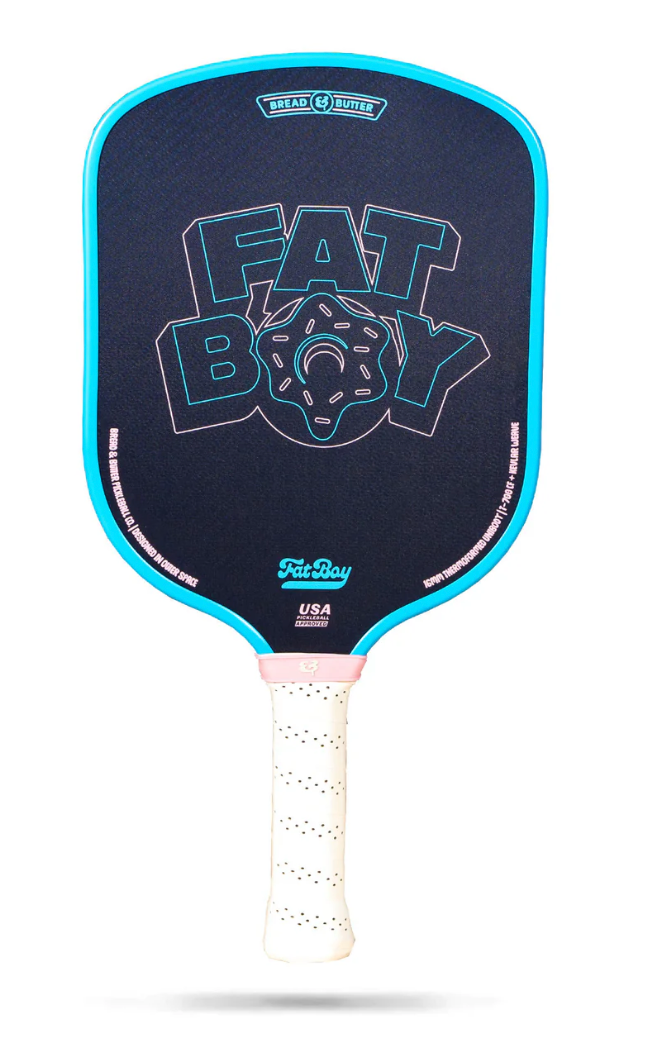
Bread & Butter Fat Boy – A fun, forgiving control paddle with surprising put-away pop. Don’t let the playful donut-themed graphics fool you – the Fat Boy means business on the court. It secured a Silver Award on the Hot List for control paddles by offering something uncommon: easy, consistent soft game plus extra punch in volleys. As the name implies, this paddle has a super-sized sweet spot (it’s an 8″+ widebody design) and a fairly lightweight build (~8.0 oz), making it very maneuverable and user-friendly.
One standout feature is its material combo: Bread & Butter uses a Kevlar-Carbon blend face with thermoforming. The face has a slightly firmer flex than pure carbon, which translates to a bit more “pop” on demand than many control paddles. Reviewers noted that at the net, the paddle moves fast and the pop is there to finish points. Yet it’s not so lively that you lose touch – dinking and dropping remain very much in control. Think of the Fat Boy as a control paddle that leans just a tad toward all-court in power. In fact, Bread & Butter intentionally dialed it to be right below an all-court paddle in pop: “enough pop to keep you dangerous but not so much that soft shots are compromised.”
Despite a listed swingweight around 112 (which is relatively low), the Fat Boy feels solid through contact. It doesn’t get pushed around easily or twist in your hand – likely thanks to some foam perimeter or just the stability of the shape. Players report they could swing out on thirds and trust the ball to stay in, yet when they got an easy high ball, the paddle had the stability to put it away.
Bread & Butter gave it a 5.3″ handle, which is a bit shorter than standard (they call it “semi-short”). Two-handed backhand players might find it just enough room, but those with big hands or heavy two-handed usage could feel cramped. The upside of the shorter handle is increased stability and a larger face area – and indeed the Fat Boy feels very stable. If you’re exclusively a one-hander, you’ll likely love this handle length.
Oh, and did we mention it looks cool? In a sea of plain black carbon paddles, the Fat Boy’s design (often featuring a donut alien logo) is refreshing and will turn heads. More importantly, it plays as good as it looks.
Player profile: Players who crave forgiveness and control but don’t want to completely give up on offensive firepower will gravitate to the Fat Boy. It’s great for 3.0–4.5 players who rely on consistent dink and drop execution but also like to counterattack at the net. If you’ve been using a traditional widebody paddle that felt a bit dead or lacked finishing ability, the Fat Boy will be a very pleasant surprise. It’s also one of those paddles that you can pick up at almost any level (novice to advanced) and play well with immediately – thanks to the huge sweet spot and lightweight feel, there’s minimal adjustment period. Just note the ~$189 price tag; it’s a boutique brand with premium pricing. However, Bread & Butter often provides discount codes (e.g., PBEFFECT) to bring it closer to $160, which is competitive for a top-tier thermoformed paddle.
11SIX24 Jelly Bean Series (16mm) – Control with an Offensive Twist
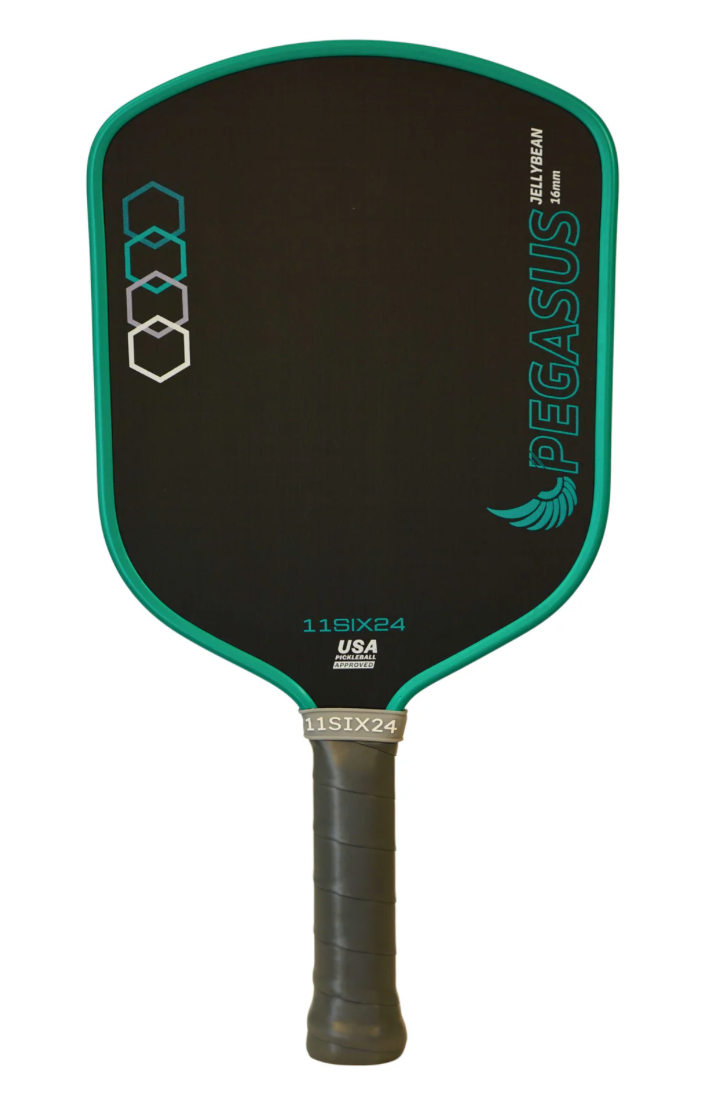
11SIX24 Jelly Bean 16mm Series – A trio of shapes offering more power than the average control paddle. This series snagged a Hot List Silver Award for pushing the limits of offense in the control category. Essentially, 11SIX24 (an up-and-coming brand) asked: “How can we give control players a bit more knockout punch without losing finesse?” Their answer: a smart materials blend and foam edge tech. The Jelly Bean paddles sandwich a fiberglass layer between two carbon fiber surfaces on the face – similar in concept to the Chorus Shapeshifter. This gives the paddle extra pop and power on hard swings, though not enough to reclassify it as an all-court paddle. They also injected foam around the edges (without full thermoforming), expanding the sweet spot and dampening vibrations for a solid feel.
The series comes in three shapes: Elongated (Pegasus), Hybrid (Hurache), and Widebody (Monarch). Impressively, each shape retails around ~$105 (after discounts), which is a fantastic value considering the tech. All are 16mm thick for a plush controlled feel. During testing, the Jelly Beans delivered noticeably more power and pop than other pure control paddles – enough that intermediate players can execute offensive shots when the opportunity arises. Yet, control on touch shots remains high, especially if you have decent technique. These aren’t as “auto-pilot” soft as something like a Vatic Prism Flash; they do have a slightly firmer, crisp impact (as expected with the fiberglass present). But they’re still firmly in the control category, just on the lively end of it.
An advantage here is variety: Few control paddles offer three shape options. So you can pick the Jelly Bean that suits your style: e.g. Pegasus (elongated) for reach and drives, Monarch (widebody) for maximum forgiveness (this one was highlighted as a great budget control paddle too), or Hurache (hybrid) for a blend. Despite the slight power bump, players transitioning from a pure control paddle will adapt quickly – the feel is still controlled, and the increase in pop is manageable, not overpowering. In fact, if you’ve hesitated to go to a true “all-court” paddle but want a bridge between control and all-court, Jelly Bean 16mm is that bridge.
Player profile: If you’re a control player (3.0–4.5 level) who’s starting to crave a bit more offense – perhaps you’re finding pure control paddles too underpowered in fast exchanges – the 11SIX24 Jelly Bean could be your Goldilocks paddle. It’s also ideal for improving players who aren’t ready to abandon control paddles but want to develop an attacking shot. For example, a strong 4.0 who predominantly dinks and resets might choose the Pegasus Jelly Bean to get extra baseline depth and put-away power when needed, without jumping to a full power paddle. Also, budget-conscious buyers should note: ~$100 for this level of performance is a steal (the Monarch Jelly Bean in particular is cited as “the best value wide-body control paddle” around). You’ll just need to get used to the slightly firmer feel compared to super soft models – but most players report they “adapt quickly” and even prefer the added firmness after a short adjustment.
Selkirk LUXX Control Air Invikta – Edgeless 20mm for Ultimate Soft Game
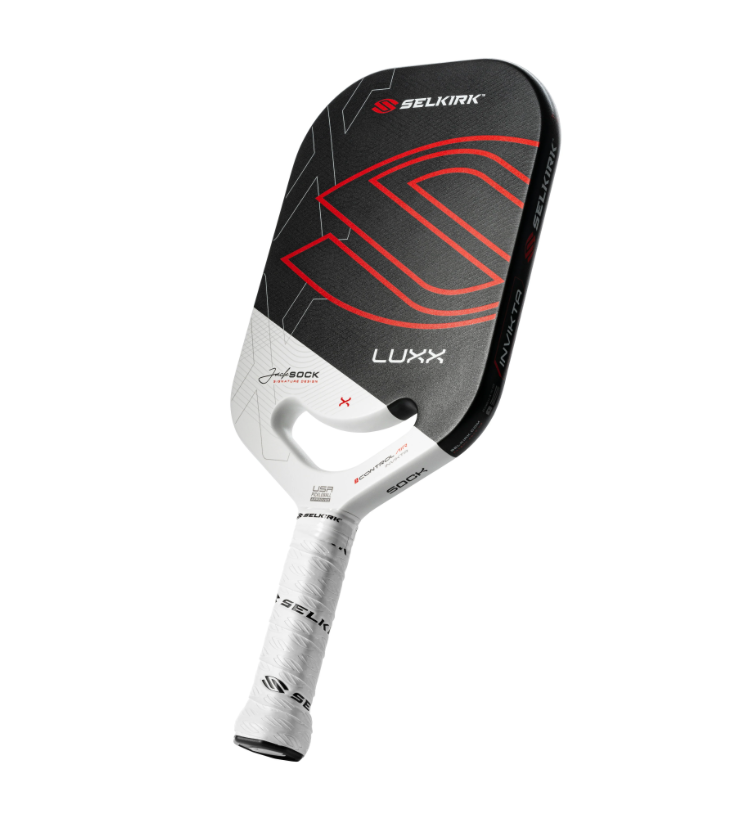
Selkirk LUXX Control Air Invikta – A 20mm thick control paddle that all but catches the ball on the face. Selkirk (a leading U.S. brand) went all-in on control with their new LUXX Control Air series, and the Invikta shape (elongated) is a flagship model that earned a Hot List Silver mention. This paddle is noteworthy for several reasons. First, it’s edgeless – there’s no traditional edge guard. That often shrinks the sweet spot, so Selkirk countered by making it a whopping 20 mm thick(!) to improve stability and sweet spot size. The result is an incredibly plush, stable feel on contact. The ball stays on the paddle a split-second longer (“enhanced dwell time”), allowing you to shape shots with ease and take the pace off fast balls. Many players say it’s like the paddle does the work for you in slowing down the ball.
The face is a proprietary Florek carbon fiber (Selkirk’s fancy term for a specific carbon layup) with a painted-on grittexture for spin. Spin is good (not as high as raw carbon surfaces, and note painted grit can wear off eventually), but plenty sufficient to add bite to your soft shots. Where this paddle shines is in the soft game: resets, blocks, dinks – it absorbs and controls pace beautifully. Pop-ups and accidental flyers become rarer because the 20mm core (Selkirk’s thick X7 honeycomb core) eats the ball’s energy. Many reviewers found it dramatically reduced their errors in the kitchen. It basically plays like the softest of control paddles – truly a “pure control paddle” as Selkirk markets it.
Because it’s edgeless, the paddle’s perimeter is vulnerable to damage from court scrapes, so Selkirk actually recommends using protective tape on it. Not a bad idea to prolong its life. Also, edgeless paddles can develop wear on the edges with heavy use – but Selkirk did reinforce it (and they have a lifetime warranty for defects).
Despite being ultra-thick, the LUXX Invikta has a surprisingly fast, maneuverable feel. Selkirk kept the swingweight low (the edgeless design helps reduce wind drag, and weight is ~8.0 oz). Handspeed at net is excellent – you get that thick core stability without the usual sluggishness. So defending hard drives and punching volleys are comfortable. However, note: this paddle is not built for power. If you rely on the paddle for pace, you’ll find it lacking. Advanced players who can generate their own power might be fine – as Selkirk notes, those with good swings can still hit hard with it, but you do have to swing out more often. It’s intentionally designed not to bounce the ball off too quickly (hence the “Control Air” moniker).
Player profile: The LUXX Invikta is tailor-made for control freaks – in the best way. If you’re a strategic player who values consistency and placement above all, this paddle will feel like an extension of your arm. It’s especially suited for bangers-turned-blockers – e.g., former tennis players who want to dial back power and improve their soft game. Also, any player suffering from tennis elbow or seeking vibration dampening will love the 20mm core and foamless edgeless design (it’s very low vibration). Be aware it’s one of the priciest paddles at $250 MSRP, though Selkirk often runs deals or gift card promos. Also, maintaining the grit (since it’s not raw carbon) may require occasional cleaning or eventual resurfacing – heavy spin players might wear it down over a year of play. Still, with its limited lifetime warranty and Selkirk’s quality, it’s a worthy investment for the serious control player who wants the softest touch in town. This paddle truly lets you “feel more connected to the ball” for delicate shots, making it a top choice for 3.5+ players who win with patience and precision.
Up next: Now that we’ve covered the kings of control, let’s switch gears to paddles that balance power and touch. In the next section, we’ll look at All-Court paddles – the versatile options for players who want a bit of everything.
Best All-Court Pickleball Paddles
All-court paddles are the jacks-of-all-trades – designed to give you a harmonious blend of power and control. They may not achieve the absolute softest touch of a pure control paddle or the insane pop of a pure power paddle, but they perform well in all aspects: dink, drive, block, spin, serve – you name it. For players with a balanced playstyle or those who like to mix up aggressive and soft shots, an all-court paddle can be the perfect choice. The following models are considered the best all court paddles for 2026, offering a balance of power, control, and versatility.
Typically, all-court paddles feature mid-weight, mid-thickness designs (often ~14–16 mm thick cores with a mix of carbon and possibly some reinforcing materials). Forgiveness and feel are decent, but they also pack more punch than true control paddles. Raw carbon fiber is a preferred material for paddles due to its durability and performance, making it a common choice in this category. Think of them as the ideal paddles for intermediate to advanced players who are comfortable in hand battles at the net yet also drive and spin the ball from the baseline. The 2026 Hot List highlighted six outstanding all-court paddles – each bringing something unique to the table. Let’s break them down:
Bread & Butter Invader 16mm – Balanced Power & Feel with a “Titanium” Twist
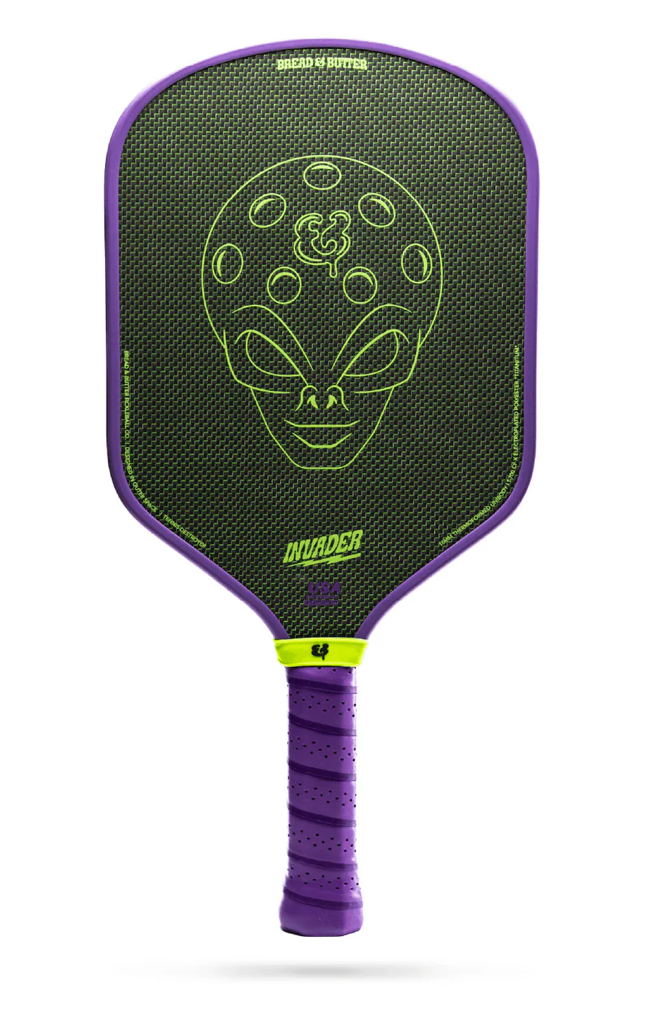
Bread & Butter Invader – A midweight, hybrid paddle with a soft and lively feel. This paddle took Gold in the All-Court category, impressing testers with its innovative materials. The Invader’s face layup is quite interesting: it uses a buried fiberglass layer under carbon fiber, similar to some control paddles, to increase power on full swings. But Bread & Butter noticed that can stiffen feel, so they topped the face with a polyester/carbon fiber weave (“titanium” layer) that softens the impact while keeping the power boost. In essence, the Invader manages to feel pleasantly soft on touch shotsyet still delivers above-average pop when you crank it.
Players report that offensively, it’s “above the median” for all-court paddles in power – plenty to put balls away – but it also has a nice, connected feel for control. The sweet spot is generous for a hybrid shape (it’s about 16.1″ x 7.6″ dimensions). Swingweight is moderate (~116–118), giving it enough heft to be stable through the ball but not so heavy that you can’t react quickly at net. Volleys feel solid; it plows through the ball with stability, likely aided by that bit of extra weight and the “titanium” face damping vibrations.
This paddle is midweight (~8.1–8.3 oz) and has a slightly head-heavy feel – which actually helps with power. Yet players didn’t find it cumbersome; it’s still maneuverable enough for defense. One review mentioned they didn’t even need to add lead tape; out of the box it felt great in terms of balance. (If anything, some all-court players might add a touch of weight in the handle to quicken it if desired, but it’s optional.)
The Invader also brings personality – literally. It often comes in fun graphic designs (e.g., an alien head theme to match its name). But underneath the looks, it’s technically sound. Spin production is good (carbon fiber textured surface), though not the highest in class. Control players transitioning to an all-court paddle will likely appreciate how forgiving and “easier to feel” this paddle is compared to some stiffer competitors. It gives confidence on soft shots that some hard-surface power paddles don’t. Yet when you swing fully, it responds with satisfying pace.
Player profile: The Invader is an ideal upgrade for intermediate players (3.5–4.5) who have a solid soft game but want to be more aggressive without losing control. For the intermediate player seeking to upgrade their game, the Invader provides good power while maintaining excellent touch and forgiveness. If you started with a control paddle and now find yourself desiring a bit more depth on drives and serves – but you hate paddles that feel hard or overly bouncy – the Invader hits the sweet spot. It’s often praised as being “easy to play with” because of its balanced nature. It’s also a great doubles paddle for those who both dink and attack – think front-court players who occasionally speedup or back-court players who drop and drive in equal measure. At ~$189 retail (often ~$162 with discounts), it’s a high-end paddle, but its versatility means it could be the only paddle you need for a long time. If you love a slightly softer feeling all-court paddle that still packs a punch, the Invader is worth an audition.
CRBN ² TruFoam Genesis – Foam-Core Innovation for Intuitive Play
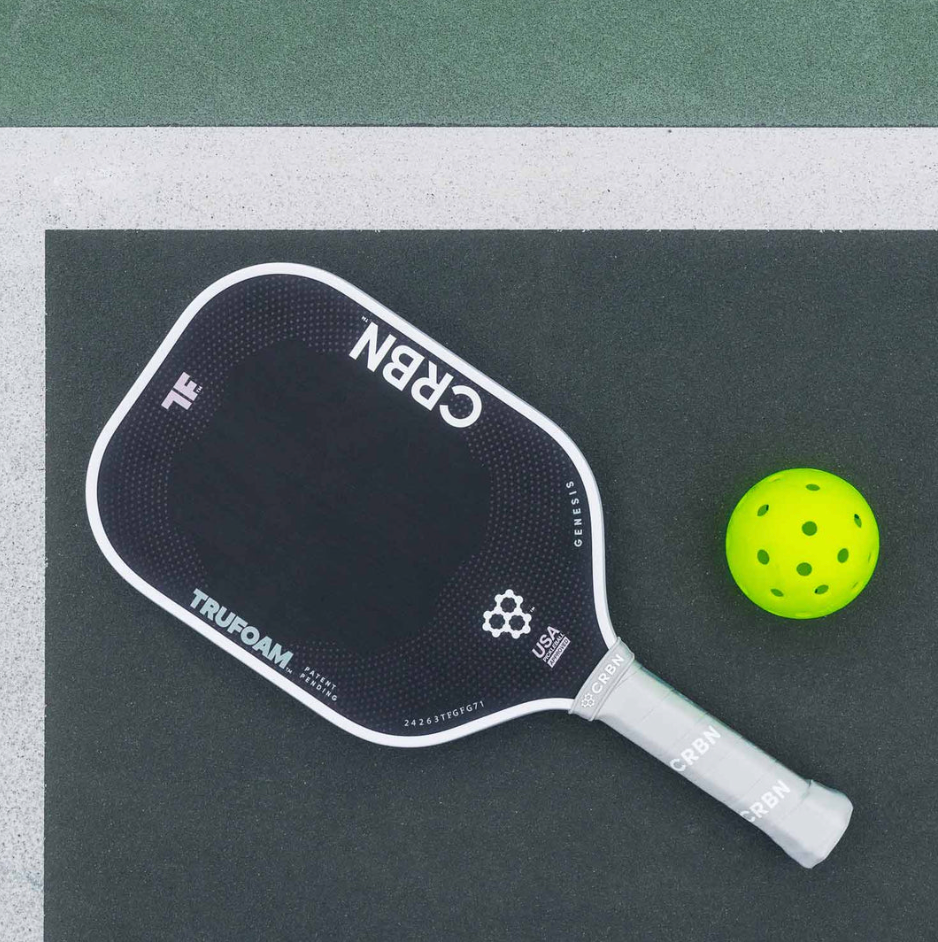
CRBN 2 TruFoam Genesis – A cutting-edge all-court paddle with a 100% foam core. This paddle is a game-changer, literally – it’s the first of its kind to use a full high-density foam core instead of the usual polymer honeycomb. CRBN’s TruFoam Genesis series blew away reviewers and earned a Gold Award in All-Court for its incredibly natural feel and consistent performance. By using a solid foam (no honeycomb), CRBN achieved a very springy, soft, and vibration-free feel. Players report it feels “intuitive” – almost like an extension of your hand, because there’s no hollow or weird hot spots that some honeycomb paddles have.
The CRBN ² (which denotes the widebody shape in their naming) is the recommended model, as CRBN found their elongated versions (CRBN ¹ & ³) were a bit heavy with the foam. The ² shape (about 16″ x 8″) offers a great blend of reach and forgiveness. Despite being only 14mm thick, the sweet spot is better than most 14mm paddles – though not quite as large as a 16mm would be. The foam core doesn’t “break in” or degrade like some polymers might; CRBN chose a high-density foam that stays consistent and resists compression over time. That means the paddle’s performance doesn’t change much even after heavy use – a big plus for longevity.
On court, the TruFoam Genesis provides above-average power (for an all-court) but with medium pop – meaning it’s not uncontrollable. Think of it as having the power gear when you swing hard, but not a bouncy trampoline effect on soft shots. The series is described as “all-court leaning power paddles”, which nails it: you get plenty of put-away ability (maybe 8.5/10 on a power scale) but still solid control for dinks and resets. Spin is excellent thanks to a raw T700 carbon fiber face (CRBN is known for gritty spin-friendly faces). Many players find they can shape shots easily because of the paddle’s great feel and feedback.
One thing to note: the CRBN ² TruFoam is a bit heavier than typical polymer widebody paddles. While CRBN doesn’t list exact weight, players mention it’s similar to a standard 8.4–8.5 oz paddle, but the swingweight can feel slightly higher due to the dense foam. Still, it’s manageable for most (and as CRBN advises, if you tried the elongated versions they feel heavier, which is why the ² is the sweet spot). If you do get an elongated, CRBN even suggests adding a lightweight “Slyce” butt cap to reduce weight in the head – but sticking with CRBN ² is easier.
Player profile: Advanced intermediate to pro players who crave a smooth, comfortable feel without sacrificing performance will love the CRBN 2 TruFoam. It’s practically built for 4.0+ all-court players – those who one moment crush a drive and the next feather a dink. If you’ve ever disliked the hollow feel or vibration of other paddles, this foam core fixes that. Also, if you have had arm pain, this paddle’s reduced vibrations could be therapeutic (many find foam cores more arm-friendly). The main barrier is cost: at ~$280, it’s one of the most expensive paddles on the market. But it’s loaded with new tech. Also, note it’s only UPA-A certified (a newer association) and not USAPA at the time of review (meaning some strict tournaments might not allow it), but many clubs do. Always check certification if you compete. Overall, the CRBN ² TruFoam Genesis is redefining all-court paddles – it gives you power, control, spin, and feel all in one, making it a top pick for serious players (and definitely one of the most talked-about paddles of 2025).
Honolulu Pickleball Co. J2K– Forgiving “Hybrid” Shape with Reach
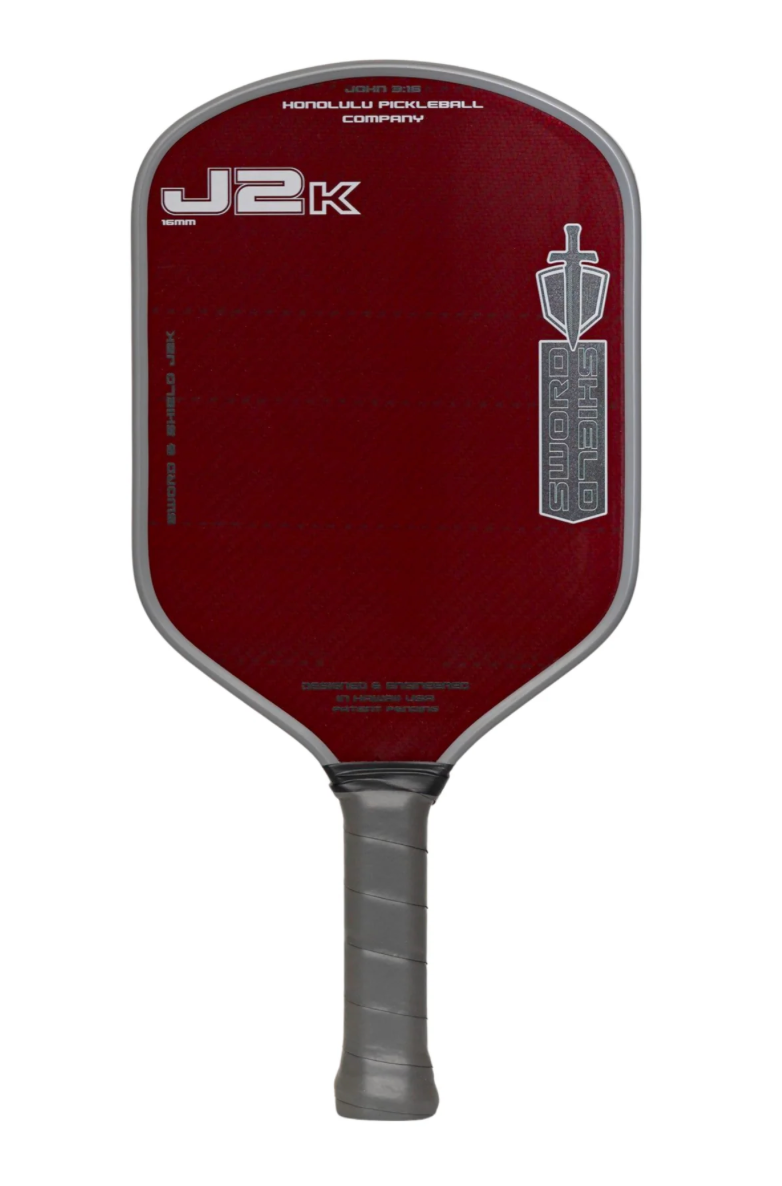
Honolulu J2K – An all-court paddle that’s as forgiving as a widebody but with extra reach. Hailing from a boutique Hawaiian brand, the Sword & Shield J2K earned a Gold Award for All-Court in 2024 and remains a strong 2025 contender. The J2K has what they call a “semi-elongated hybrid” shape, essentially giving you a longer paddle face andmaintaining a wide sweet spot. The result is an impressive combo: it’s “as forgiving as many widebody paddles while still offering the reach of an elongated shape”. For all-court players, that’s gold.
At 16.2″ x 7.8″ dimensions, the J2K indeed offers noticeable reach for stretching volleys or two-handed backhands, yet its sweet spot feels big and friendly – no scary dead zones near the edges. It’s medium weight (~8.2 oz) with a swingweight in the 113–115 range, making it not super fast, but not slow either. Maneuverability is adequate, though in head-to-head hand battles, slightly lighter paddles might be quicker (the J2K’s one slight drawback is a maneuverability rating around 81%, a bit lower than others – likely due to the extended shape and weight).
Where it shines is forgiveness and stability. The Hot List gave it a whopping 95% forgiveness rating – one of the highest. So if you occasionally mishit, the J2K will still send the ball back with decent quality. It also has great spin (95% spin in testing) thanks to a textured carbon face. And being an all-court paddle, it has a slight power bias – rated 84% power, 87% pop. Players found they could drive the ball effectively and counterattack well. Yet the control didn’t suffer much: 88% control/feel rating means it’s still quite adept at dinks and drops.
One note from testers: the J2K’s feel is on the stiffer side initially (it has a “slight power bias” and a firm face). Some mentioned it felt a bit stiff at first but once they adjusted, it felt “complete” – implying you might need a little time to get used to the harder face if coming from a softer paddle. But after breaking in, it’s an excellent option for players wanting an approachable paddle that can also play offense. And the price? Quite reasonable – about $155 (often on sale for $140 with code), which is less than many big brands.
Player profile: The Honolulu J2K is perfect for players who value a large sweet spot and extra reach – think aggressive doubles players who like elongated paddles but are tired of the smaller sweet spots they usually come with. If you’re around a 3.5–4.5 player who plays an all-court game and you want a paddle that will forgive your off days (we all have them) while still giving you the tools to attack, the J2K is a great fit. It’s also a cool, lesser-known brand choice – you won’t see everyone with this paddle, so it’s a bit of a conversation starter. Importantly, it’s quite approachable and easy to use despite its tech – many find it “unique” in how it balances both worlds. Perhaps the best compliment: one reviewer called it “an excellent option for players looking for an offensive edge but still want something forgiving and approachable.” That sums it up well.
Chorus Supercourt Series – Ultra-Versatile & Lightweight All-Court Bargain
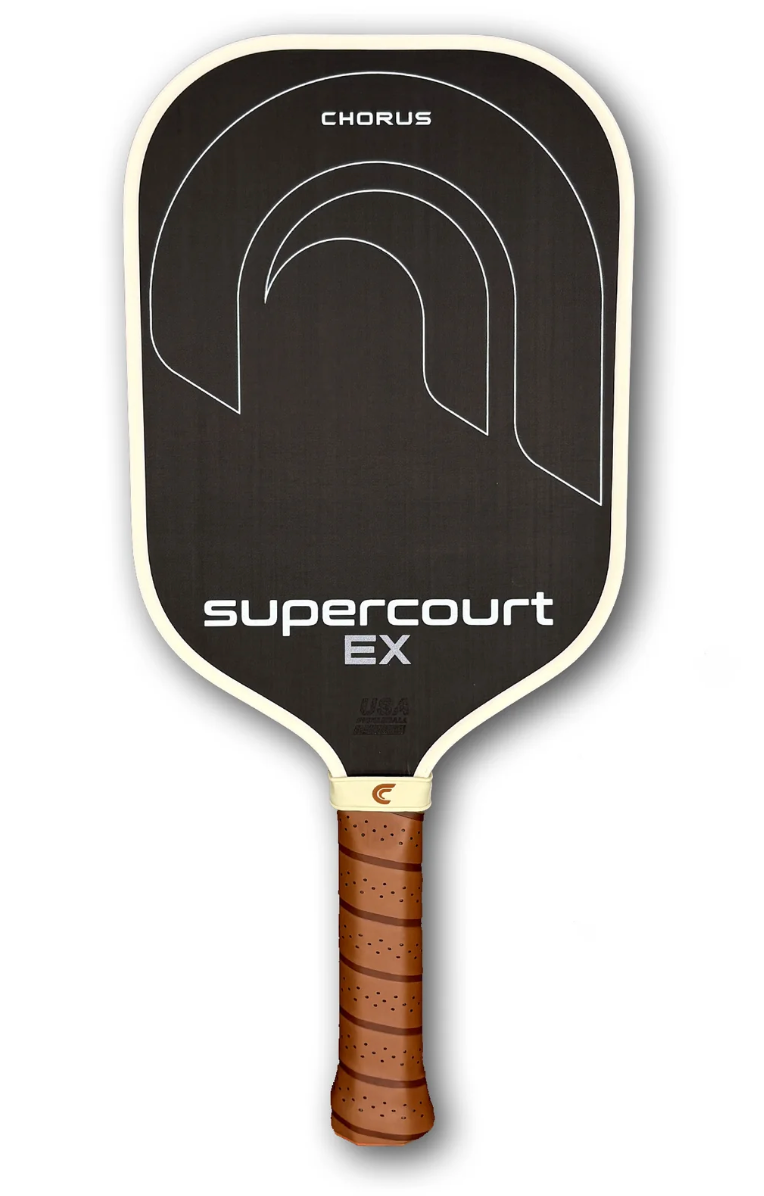
Chorus Supercourt Series – A shockingly affordable all-court lineup with multiple shapes. Chorus (the same brand behind the Shapeshifter control paddle) also makes the Supercourt, which took a Silver Award for All-Court. What stands out immediately is the value: these paddles retail around $119, a good $50–$150 less than many competitors, yet they deliver top-notch performance at a great price for what you get. Chorus achieved this by using “readily available technology and materials in a smart configuration” – in other words, no super exotic materials, but an optimized design that punches above its price.
The Supercourt is built for balanced play and easy handling. It’s relatively lightweight (~7.8–8.0 oz) and very maneuverable. In fact, it prioritizes being quick and forgiving – “hard to believe the low price” given how well it plays, note reviewers. They come in three shapes (Chorus seems to love offering shape options): EX (elongated), HX (hybrid), SX (widebody). All have 16mm polymer cores and 5.6″ handles. Notably, the handle is slightly longer than many widebodies and hybrids – 5.6″ is ample for two-handers while still keeping the face big.
Performance-wise, the Supercourt paddles have a medium-stiff, responsive feel – that translates to a “balanced blend of power and pop” for offensive shots, yet plenty of control for placement. Spin production is quite good as well, allowing players to hit sharp angles (they have some textured face tech, likely standard raw carbon). They’re described as maneuverable and quick at the net, great for hand battles, but also forgiving on mishits. Essentially, Chorus designed them to be extremely user-friendly: even if you aren’t perfectly hitting the sweet spot every time, the paddle performs nicely (and if you want to maximize that forgiveness, a little lead tape can further expand the sweet spot and soften feel, as Chorus notes).
These paddles won’t blow you away in any single category (they’re not the absolute spinniest or the most powerful), but their strength is having no glaring weakness. Everything is above average – which is exactly what an all-court paddle should be. And for the price, it’s astonishing. Many players could not believe they cost only ~$120.
Player profile: If you’re a budget-conscious player who wants an all-court paddle for under $150 that still competes with the big boys, the Chorus Supercourt is your best bet. It’s ideal for intermediate players (2.5–4.0) who are developing a well-rounded game and want a paddle that can grow with them. The customization of shape means you can pick what suits you: need more reach? EX. Want a balance? HX. Crave max forgiveness? SX. All will give you a comfortable blend of power and control. Also, if you’re a doubles player who values quick hands and reliable touch but occasionally rips a drive, you’ll appreciate the Supercourt’s quick handling and balanced pop. This series is also a smart choice for coaches or clubs looking to recommend a high-performance paddle at an accessible price – the performance-to-cost ratio is off the charts. In summary, Supercourt paddles make high-end all-court play accessible to more players, without many compromises (and they prove that sometimes you don’t have to spend $200+ for a top paddle). Evergreen tip: If you get one, maybe grab two – the price is that good and you’ll have a backup!
Pickleball Apes Pulse Series – Foam-Enhanced All-Court with Break-In Evolution
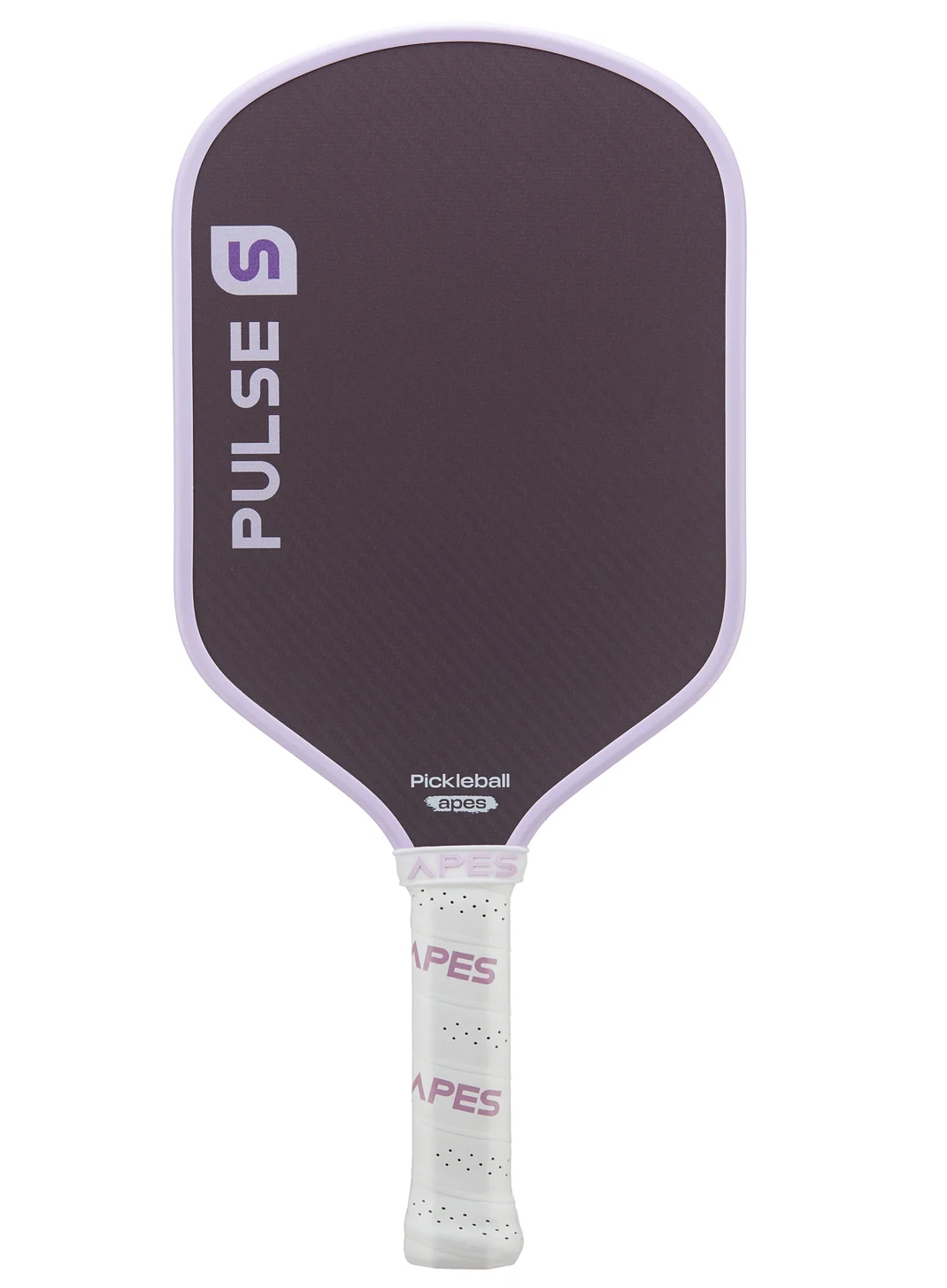
Pickleball Apes Pulse Series – An all-court paddle that literally transforms after break-in. The Pulse paddles (E, S, V models) earned a Silver Hot List Award for pushing innovation. The Apes extended foam around the paddle’s perimeter (like JOOLA did in their 3S series) but with a twist: their goal wasn’t max power, but rather to reduce vibrations, enlarge the sweet spot, and keep power in check. To achieve this, they added a carbon fiber reinforcement ring around the foam edge to limit foam expansion and overly bouncy behavior. The result? Out of the box, the Pulse plays as an “aggressive control” paddle – meaning it feels controlled, comfy, and solid on day one.
However, here’s where it’s unique: after a couple weeks of play, the paddle’s performance shifts. As the foam and materials settle (a kind of break-in period), the Pulse becomes faster and more like an “aggressive all-court paddle”. Essentially, it starts as a control-leaning all-court and then evolves to a power-leaning all-court after break-in. Throughout, it maintains reduced vibrations and generous sweet spots (thanks to that foam) – so you still get a soft feel and big forgiveness even when it livens up.
The series offers three shapes: Pulse E (extra extended), Pulse S (standard hybrid), and Pulse V (widebody). The Apes team favored the V (widebody) and S (hybrid) as the standouts for most people. The E shape is niche – extremely long for those who want maximum leverage (but a smaller sweet spot side-to-side). Most will prefer the Pulse V or S for balanced play. All have 16mm cores and are a bit heavy – static weights are slightly higher than average (the one downside noted was they have a “little higher static weight” than most paddles). But that contributes to stability and plow-through.
One caution: because these paddles change performance with break-in, if you buy two at the same time, they might not play identically. Each might break-in slightly differently, leading to subtle differences in feel or pop. This inconsistency is the trade-off for this design. Once broken-in, though, players love the feel and play – it’s like getting two paddles in one (a control-ish one and then a power-ish one).
Player profile: The Pulse series is great for players who don’t mind a paddle that changes over time – in fact, some might love that initial tame period to dial in their touch, then enjoy the increased power as it ages. If you’re a tech enthusiast who likes foam core advantages (vibration dampening, big sweet spot) but found some foam-injected paddles too powerful, the Apes Pulse is tuned to avoid that “too hot” problem. It’s suited for all-court players 4.0+ who enjoy tinkering with gear and appreciate nuanced performance. Also, if you have arm/elbow issues, the vibration reduction is appealing. Just be prepared for that heavier feel – especially the Pulse E which is long and heavier at the tip (the S and V are more balanced). And yes, the brand name is fun – you might get some questions about the “Apes” graphic on your paddle. But performance-wise, these paddles feel and play very well once broken in, so if you’re patient with the break-in, you’ll be rewarded with a paddle that truly marries comfort with aggressive play.
Six Zero Double Black Diamond(Control Edition) – The Safe All-Court Pick for Any Player
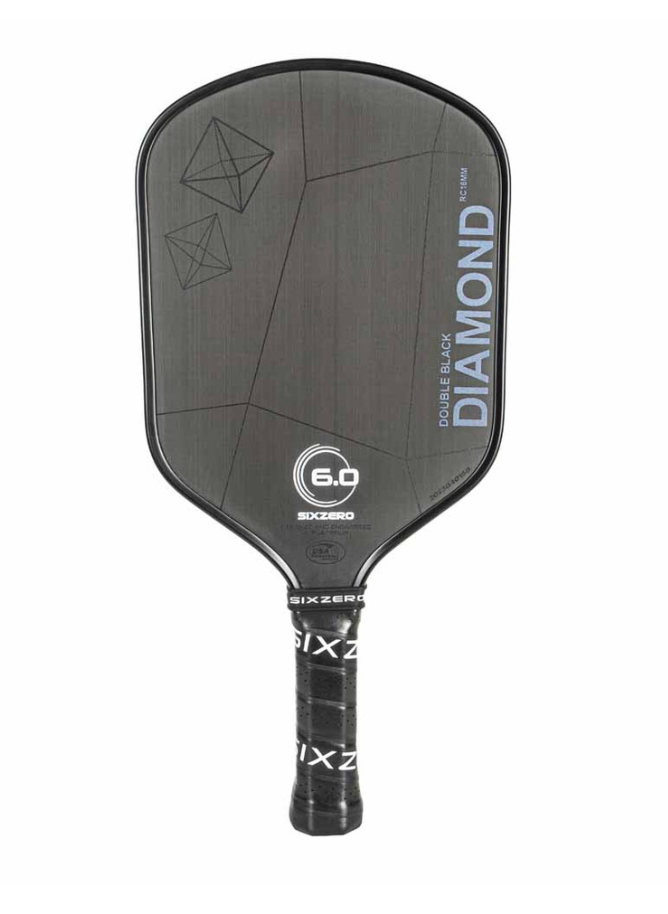
Six Zero Double Black Diamond – A proven all-court paddle with a control bias that’s easy to recommend. This paddle has been popular for a couple of years (hence “two years and counting” on its run), and it basically set the standard for the modern all-court category. Often abbreviated as DBD, it pioneered the now-common “hybrid shape” – somewhere between elongated and widebody – offering extra reach with minimal sacrifice to maneuverability. It became a benchmark for balanced play, and other brands have tried to copy it, but the original still holds strong.
The DBD earned a Silver Award for All-Court in 2025. Its appeal lies in its “uniquely pleasant, crisp, and stable feel”combined with that little extra reach that makes it versatile. Initially it was lauded as the perfect blend of power and control; over time and as new power paddles emerged, it’s now seen as an all-court paddle with a control bias. In practical terms: it gives you a noticeable step up in power/pop over true control paddles, but it still softens the ball and absorbs pace more than many all-court paddles (and certainly more than raw power paddles).
The best endorsement for the DBD: “If you’re unsure what type of paddle to get, get this one.” It’s that adaptable. It has a medium 16mm core (with optional 14mm version for those who want more pop). The 16mm is the popular one since it absorbs pace better and is more forgiving. The paddle’s shape (around 16.4″ x 7.5″) gives a touch of elongation for reach, a generous sweet spot, and it’s fairly quick in hand. It’s also forgiving – thanks to its stability, players find fewer mishits sailing on them. Control is easy to find, yet you still get enough power to finish points when the opening comes.
Six Zero offers both the 16mm and 14mm: the 16mm “Control” is great for players who prioritize soft game and consistency (easier on resets/dinks), whereas the 14mm “Power” variant is for those who want more put-away pop and a lighter swing feel (it’s faster but less forgiving). Most all-court players tend to choose 16mm, as did the Hot List for the control bias category.
Player profile: Quite literally any player could use the Double Black Diamond and be happy. It’s often recommended to 3.0+ players as a first high-end paddle because it doesn’t have quirks or extremes – it’s just very well-rounded. For balanced/all-court playstyles, it offers confidence in all shots. Are you a doubles player who sometimes drives and sometimes dinks? A singles player who wants both passing shot power and soft touch for drops? DBD has you covered. It’s also a great one to keep in your bag as a backup – if your specialty paddle isn’t working on a given day or conditions change (windy, etc.), switching to the DBD is like going back to fundamentals. It’s simply easy to connect with and retains some offensive ability. The DBD is often available around $170 (with discount code ~$162), so price-wise it’s middle of the road. Given the solid build and the fact that it “set the benchmark” for hybrid paddles, many consider it worth it. In short, if indecision strikes, the Double Black Diamond is a no-brainer that will suit a wide range of players and likely improve your consistency while still letting you play dynamically.
Transitioning to Power: We’ve now covered control and all-court paddles – those that emphasize finesse or balance. But what if your style (or curiosity) leans toward raw power and aggressive play? In the next section, we crank up the intensity with the Best Power Paddles of 2026 – designed for hard-hitting, attacking players and advanced competitors who can tame the extra juice. Let’s unleash the beasts!
Best Power Pickleball Paddles
Power paddles are built to bring the heat. A powerful paddle can help aggressive players dominate with forceful shots. These are the paddles for players who love to attack – driving shots through opponents, smashing overheads with authority, and countering speed with even more speed. The trade-off: pure power paddles typically sacrifice some control and forgiveness, so they’re best suited for advanced players (or anyone who can control their own power and doesn’t mind a smaller margin for error). They often have stiffer faces, thinner cores (13–16 mm but designed for pop), and aerodynamic shapes to maximize swing speed and ball rebound.
In 2026, power paddle technology has evolved to add more stability and even some comfort to these once brute-force tools. We have four standouts from the Hot List – each offering a different flavor of power, from controlled heavy-hitters to outright cannons. Let’s check out the heavy artillery:
JOOLA Hyperion 3S 16mm – Forgiving Power Paddle with “Exponential” Force
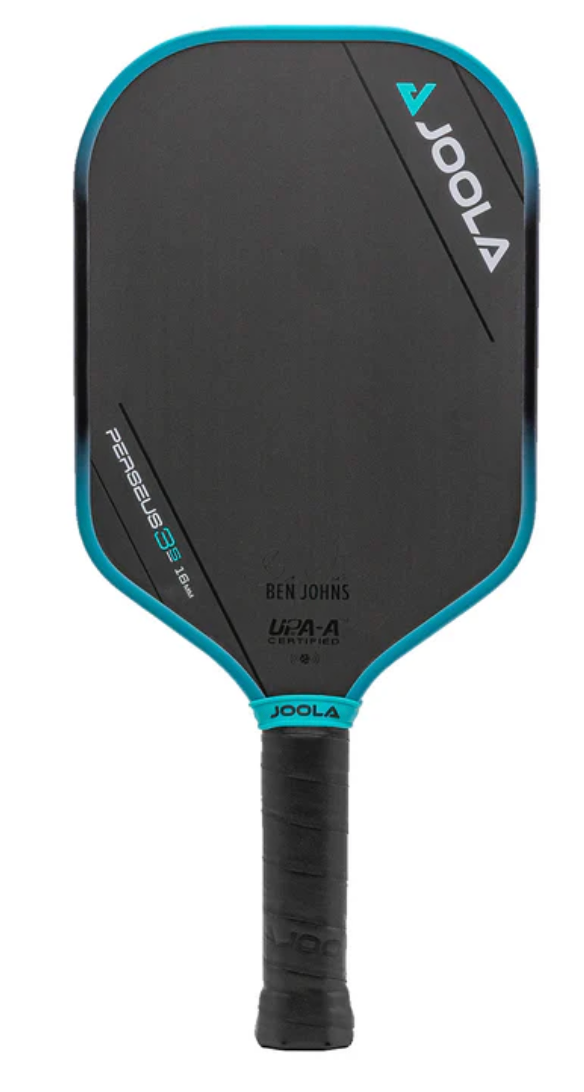
JOOLA Hyperion 3S – A power paddle that remarkably doesn’t skimp on forgiveness. JOOLA made waves with their Ben Johns Hyperion series, and the new 3S is their latest top-tier power stick. It earned a Gold Award for Power because it managed a rare feat: delivering big power and pop and some margins for mistakes. Typically, adding power shrinks sweet spots and forgiveness, but JOOLA’s 3S tech (think foam injected perimeter and tuned face) allows the paddle to crush the ball while still giving you a decent cushion on off-center hits. Notably, the Hyperion 3S stands out for its exceptional putaway power, enabling players to finish points decisively during fast-paced exchanges.
The “3S” stands for Shock, Spin, Stability presumably – as this series is known for its foam-injected edges and strategic layering that yield exponential power on hard swings. In fact, one hallmark of the 3S is its power scaling: swing soft, it behaves; swing hard, it kicks into overdrive, giving more than a 1:1 ratio of power input to output. This “increased power with harder swings” is JOOLA’s big innovation – essentially a kind of responsive power ramp. How? They incorporated a foam that flexes more on big swings but stays controlled on soft swings. So when you dink, it’s manageable (not overly bouncy, unlike some power paddles). But when you rip a drive, the foam and carbon face flex and rebound to give you extra oomph beyond what a standard paddle might.
The Hyperion shape is elongated (long handle ~5.5″, overall length ~16.5″) giving it reach and a head-heavy power feel, yet JOOLA kept swingweight moderate (~116). It’s a tad heavier (~8.4 oz) due to foam, but still maneuverable enough for experienced players. Many note its unique combo of power, forgiveness, and reach hadn’t been seen in other power paddles.
One thing: the JOOLA 3S paddles (including this Hyperion 16mm) are UPA-A certified, not USAPA. This means they may not be allowed in strict USA Pickleball tournaments. They are fine in many local tourneys and clubs, but if you play in official USAP events, double-check. This is likely due to their tech pushing boundaries on deflection or surface.
They come in 16mm and 14mm versions – interestingly, JOOLA says the 16mm actually offers more power and pop, and the 14mm is slightly subdued (contrary to typical thicker=more control, JOOLA’s foam and flex tech make the thicker one more explosive). So most will prefer the 16mm for maximum effect.
Player profile: The Hyperion 3S is ideal for advanced aggressive players (4.0+) who want to unleash heavy drives and counters but don’t want a paddle that completely compromises their soft game. It’s essentially the power paddle for the “everyday player” – meaning you don’t have to be a pro to handle it. If you were intrigued by raw power paddles like the JOOLA Ben Johns CFS or others but worried about control, the 3S Hyperion provides a friendlier entry into the power realm. It’s also great for singles players – the reach and power combination is lethal for passing shots. And if you’re a “tournament player who doesn’t play USAP events”, you’ll love it. For USAP-sanctioned warriors, check certification or consider the 16mm if allowed. Price is premium ($279), but you’re getting cutting-edge tech and JOOLA quality. Overall, if you want a power paddle that can also reset a dink and doesn’t feel like a brick on mishits, JOOLA Hyperion 3S is top of the class.
Paddletek Bantam 12.7 Series– Classic “Big Pop” Paddles for Advanced Players
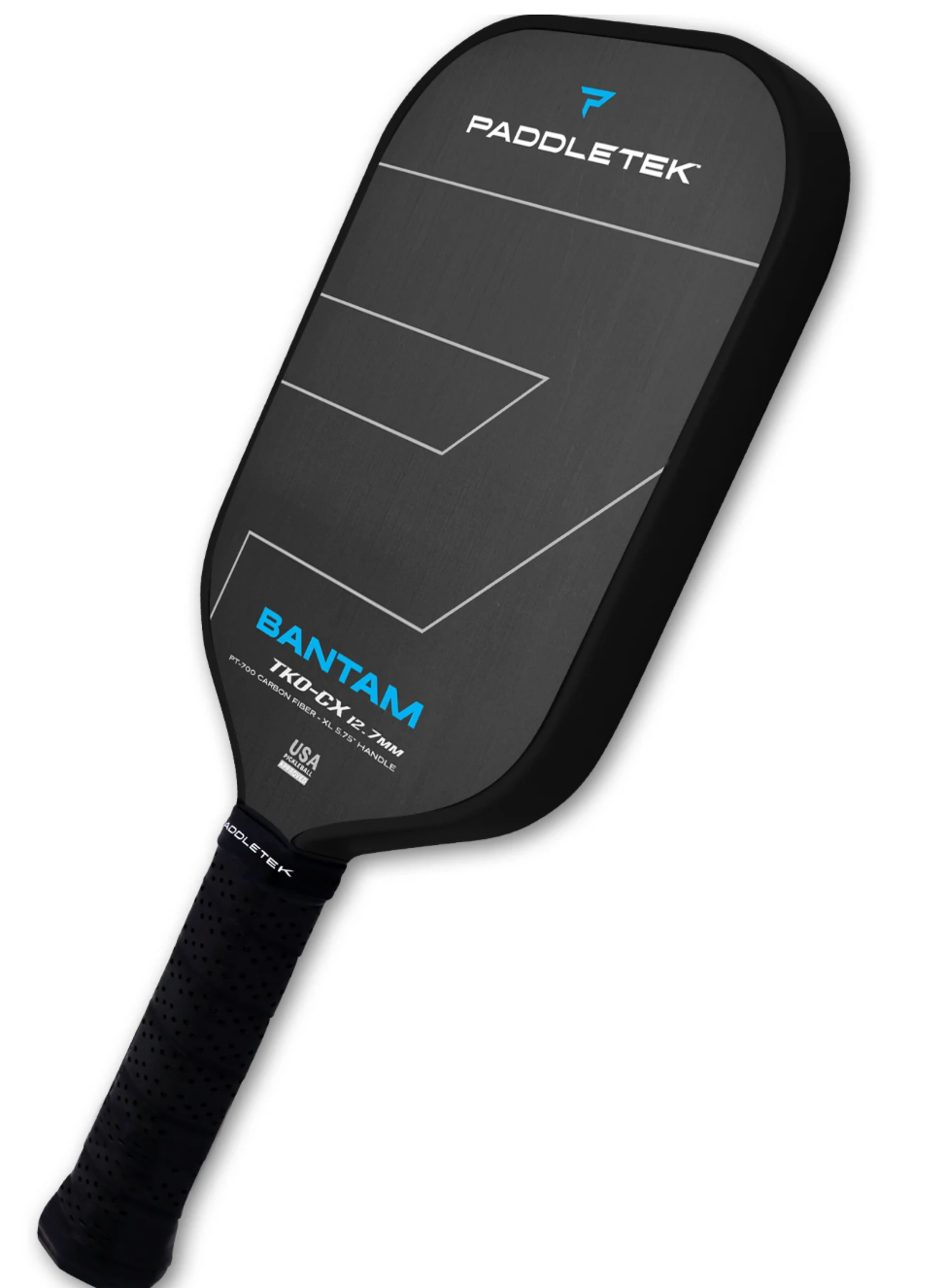
Paddletek Bantam 12.7mm Series – Explosive and consistent, but demands a skilled hand. The Bantam series has been one of the few true “power paddle” lines for years, and the latest 12.7mm thick versions earned a Hot List Gold. Paddletek achieved serious pop by using a highly compressible polymer core with a fiberglass face in a relatively thin 12.7 mm thickness – resulting in huge put-away power and a distinctive “popping” impact feel. These paddles (like the popular Bantam EX-L, TS-5 etc., now updated) give amazing baseline power and even more pop at the net.
However – and this is key – the pop is so big that it’s recommended only for advanced players who can control it. If a developing player uses these, they’ll likely send many balls long until they adjust. But for those who can manage it, you’ll “win more exchanges at the net than with any other paddle” due to the sheer velocity you can generate.
The series has multiple shapes:
-
TKO (elongated) with sub-variants TKO-C (mid handle) and TKO-CX (long handle). These are their more standard shapes, TKO-C being slightly lighter.
-
ALW-C & ESQ-C (both widebodies): ALW is a touch longer/narrower than ESQ, but marginally so. ESQ has a 5.5″ handle, ALW 5.25″. Both are very light, making them quick (so even though power paddles, they can be maneuvered easily).
All the shapes listed only reach the full “big power and pop” with the 12.7mm thickness – earlier Bantams had some thicker variants that weren’t as lively. So Paddletek kind of says if you want the real Bantam experience, go for the 12.7mm models.
One strong point: many power paddles now use foam or new materials, which can sometimes feel inconsistent (a foam shot might flex differently on different hits). But the Bantams are foam-free, classic polymer cores. This yields more predictable performance and great durability. In other words, while some other power paddles might give slightly more raw pop, the Bantams offer power with predictability – you know how it will respond every time. Advanced players often prefer that reliability. The consistent core also allows better precision and control compared to other ultra-power paddles that might unpredictably trampoline on some shots.
A downside: the top 25% of the paddle face has a notable dead spot – so hitting near the tip yields poor results. This effectively makes the paddle play shorter than it is. Paddletek acknowledges this and suggests if using the widebody ones (which are super light), you can add lead tape at the top to improve the sweet spot without making it too heavy. The elongated ones presumably already have more mass up top, but all share the dead zone. So placement of hits is important with Bantams (again reinforcing they are for skilled players with good contact).
**Player profile:**Advanced (4.5+) players who crave raw pop and are willing to tame it. The Bantam 12.7 series is a favorite among some pros and high-level players who want an “old-school” power paddle that’s consistent. The Bantam 12.7 Series provides more than enough power for advanced players, making it ideal for those who demand reliable strength in every shot. If you are an aggressive net player who can hand-speed your way through points, these paddles will give you an edge – as long as you don’t mind adjusting to the bounce on soft shots (or you have the soft hands to counter it). Tennis converts who still primarily drive and rip might also like the Bantam – it’s arguably one of the most tennis-like responses (fiberglass face, lively core mimicking a stringbed pop). However, if you’re not confident in your control, steer away – Paddletek themselves warn you’ll pop up balls inadvertently if you can’t manage the pop. For those who can, though, the Bantam series offers predictable explosiveness that many find superior to newer foamy power paddles. And if you’re coming from an older Bantam, the new shapes (TKO, ALW, etc.) give you tailor-made options to suit your style (elongated vs. wide). One note: these paddles aren’t cheap (~$249, and often no discount), but if power is your game, they deliver in spades – just be ready to grip a bit tighter and aim a bit lower on those put-aways because these paddles rocket the ball like almost no other.
Gearbox Pro Ultimate Hyper – Edgeless Carbon Power with a Plush Twist
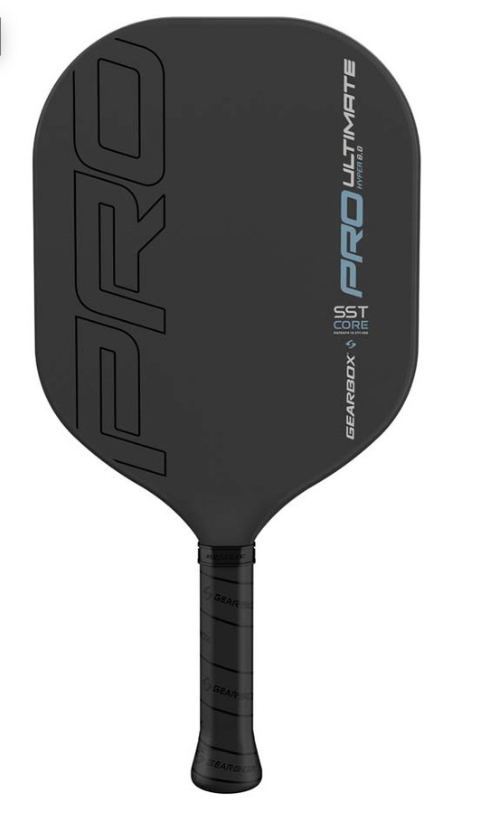
Gearbox Pro Ultimate Hyper – A 16mm edgeless powerhouse that doesn’t feel harsh. Gearbox has long been a unique player with their one-piece carbon fiber edgeless paddles. The Pro Ultimate Hyper (often just called “Hyper”) won a Silver Award for Power by combining Gearbox’s patented carbon “Power Matrix” core (carbon fiber tubes + foam) with a thick 16mm profile. The result is a power paddle that’s surprisingly plush and comfortable on contact, yet hits in the “tier 2” power range (i.e., very high power, if not the absolute max).
This paddle is described as having “high power and pop” but notably is easier to handle than the craziest power paddles, making it great for players who want to add punch without needing “expert-level control” to handle it. Essentially, it’s a power paddle for those who perhaps found Bantams or other tier 1 power paddles too wild.
The Gearbox Pro Ultimate Hyper is also recognized as a top spin paddle, excelling in generating spin and control thanks to its textured carbon fiber face and foam core. Players who rely on heavy spin will appreciate its ability to grip the ball and deliver consistent spin performance, making it a strong choice for spin-heavy play.
Gearbox’s Power Matrix is a core of carbon fiber honeycomb (not polymer) with some foam, yielding a powerful yet plush feel. Shots in the sweet zone feel smooth and comfortable – no hard jarring – partly because carbon tubes and foam absorb shock. The sweet spot is higher up on the paddle face (they note it has a “higher sweet spot than average widebody” making it feel longer). This helps with reach and means you can hit near the top with good results. Its swingweight ~115 is moderate, giving a good mix of stability and maneuverability.
Interestingly, while it’s edgeless, it’s still fairly forgiving around the edges on soft shots – a near-edge dink often stays in play (the foam helps). However, the power drops off more sharply outside the sweet spot than most paddles. That means if you mishit, you’ll lose more power than say a Bantam might – affecting your drops and resets negatively if not hit clean. So center your strikes for full effect.
Overall, players praise the power + feel combination – you get the pop but with a familiar soft-ish Gearbox feel. It’s stable (16mm thick helps), comfortable (carbon edgeless design feels solid and vibration-free), and still pretty quick for a widebody shape. Control is lower than an all-court, but better than some raw carbon power paddles – Gearbox prioritized a “controlled feel with impressive power”.
Player profile: This is a great paddle for intermediate-advanced players (3.5–5.0) who want to step into a power paddle without feeling like they’re wielding a jackhammer. If you’ve used Gearbox’s other paddles (like the CX14 or CX11), this is an easy transition to more power since the feel remains somewhat Gearbox-y (that smooth carbon impact). It’s especially suitable if you love to drive the ball or counter punch but also appreciate a bit of finesse; the Hyper can do both, though it favors offense. Singles players should also consider it – the extra reachy sweet spot and power is a boon for passing shots and serves.
Additionally, if you’ve had arm issues with stiff power paddles, the Gearbox might be kinder – its core design reduces shock, and our testing found it indeed felt comfortable even when unleashing big shots. And since it’s edgeless, say goodbye to mis-hit edge guard deflections. One caution: those who heavily rely on off-center resets might need to adjust, since edge hits will drop off power significantly (some may consider adding a bit of lead to edges if they really want to mitigate that, but then you risk sluggishness). Out of the box though, the Gearbox Pro Ultimate Hyper is one of the most compelling blends of power and feel in 2025’s lineup – a true contender for players seeking a competitive edge without giving up a familiar touch.
Spartus Olympus(Ascension Core) – Approachable Power Paddle with Quick Hands
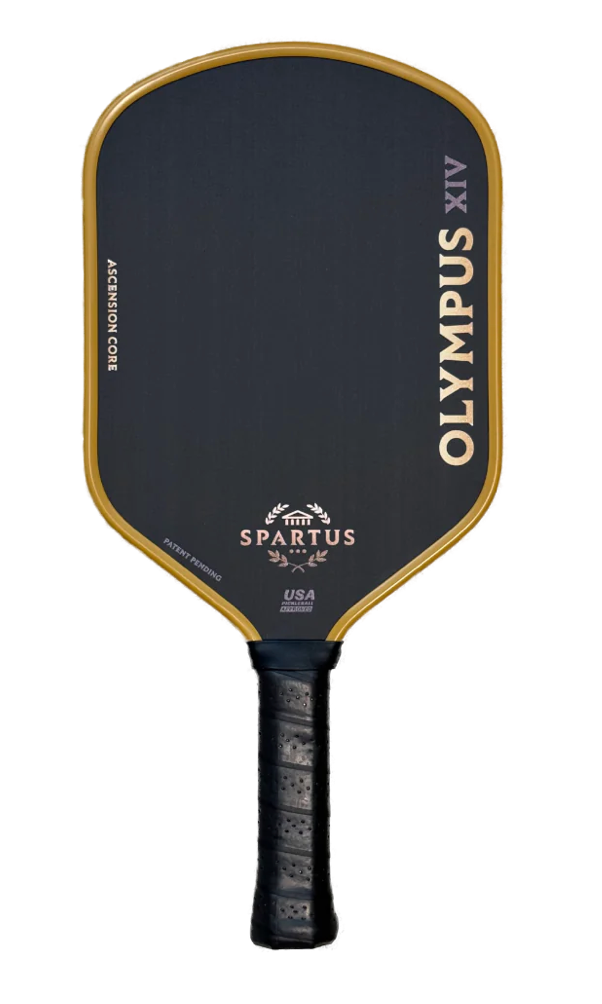
Spartus Olympus – A 14mm thick power paddle that’s surprisingly easy to maneuver and control. The Olympus, with its unique foam-filled “Ascension Core”, took a Silver Award for Power by offering a more approachable style of power. At 14mm, it’s thin enough to generate ample pop, but Spartus engineered the core to avoid the usual foam pitfalls (overheating, breakage) by using a denser foam formula. This yields a paddle with enhanced power yet not overwhelmingly so – it doesn’t feel like a wild stallion, more like a strong but manageable horse.
The Olympus provides plenty of pop for aggressive shots, but testers note “it doesn’t feel overwhelming” – meaning they could still control it more easily than many 14mm paddles. That likely comes from the foam dampening and the paddle’s stable feel. It’s great at the net: quick in hand and excellent for fast exchanges and counters. Many power paddles trade off hand speed, but the Olympus manages to keep it – maneuverability near 89% which is high for power paddles.
Forgiveness is above average for 14mm: it has an above average sweet spot for a thin core (and they also mention adding a bit of weight cured minor twisting on very off-center hits). So while it’s a power paddle, if you miss slightly, it’s not as punishing as some. It also has a satisfyingly “full” feel on impact, thanks to foam filling – so you don’t get that hollow ping or big drop-off at the edges. In fact, the feel stays consistent out towards the edges (less drop-off than some, though of course less power at extreme edge because of 14mm).
At the baseline, players can rip with it but still felt it easier to control than say a Bantam – because Olympus’s power is described as “approachable” and it still has decent control and feel for an aggressive paddle. It’s basically a power paddle that doesn’t require an expert to control (similar philosophy to Gearbox Hyper but executed differently). Spin is high (95% spin in tests) thanks to a raw carbon surface presumably. And one more plus: durability. The foam is more durable than many, they say not immune but less likely to break than other foam cores.
Player profile: Great for intermediate players jumping into power paddles or advanced players who want power without excessive risk. If you found some top power paddles too lively or heavy, the Olympus offers a compelling blend of quickness, power, and moderate control. Doubles players who love to speed up hands battles will benefit from its fast handling. Its sweet spot and spin also make it decent for soft game when needed – it’s not going to sail every dink, especially once you adjust to the lighter weight and core response.
Think of the Spartus Olympus as the power paddle for someone who says, “I want more power, but I don’t want to feel out of control.” Spartus dialed it in exactly for that crowd. Also, if you historically play with 16mm all-court paddles and want to experiment with more power, this could be a good stepping stone since it’s not too extreme. At ~$199 (often $180 with code), it’s priced competitively given its tech. Summing up, the Olympus offers a “compelling blend of approachable power, decent control, and feel” – meaning you can swing big and still find the court, all while enjoying a speedy, maneuverable paddle that won’t demand absolute perfection to use.
At this point, we’ve covered the spectrum: from gentle touch paddles to full-throttle power paddles. But there’s one more category worth exploring, often overlapping with control or all-court: Spin-optimized paddles. While many of the paddles above boast great spin, some players specifically seek paddles that maximize spin potential (for wicked topspin serves, nasty cut volleys, etc.). In the next section, we’ll briefly highlight the Best Spin-Focused Paddles of 2025 – including which of our top picks excel in spin and any model specifically known for spin supremacy.
Best Spin-Focused Paddles
Spin, in many ways, is a byproduct of paddle texture, core softness (for dwell time), and player technique. While there isn’t a dedicated Hot List category solely for spin, several 2025 paddles stand out for their spin-generation prowess. The following models are considered the best spin paddle options for 2025, excelling in grip, control, and responsiveness. Here we highlight a few for the spin addicts.
Volair Mach 2 Forza– Next-Level Spin Potential in a Control Paddle
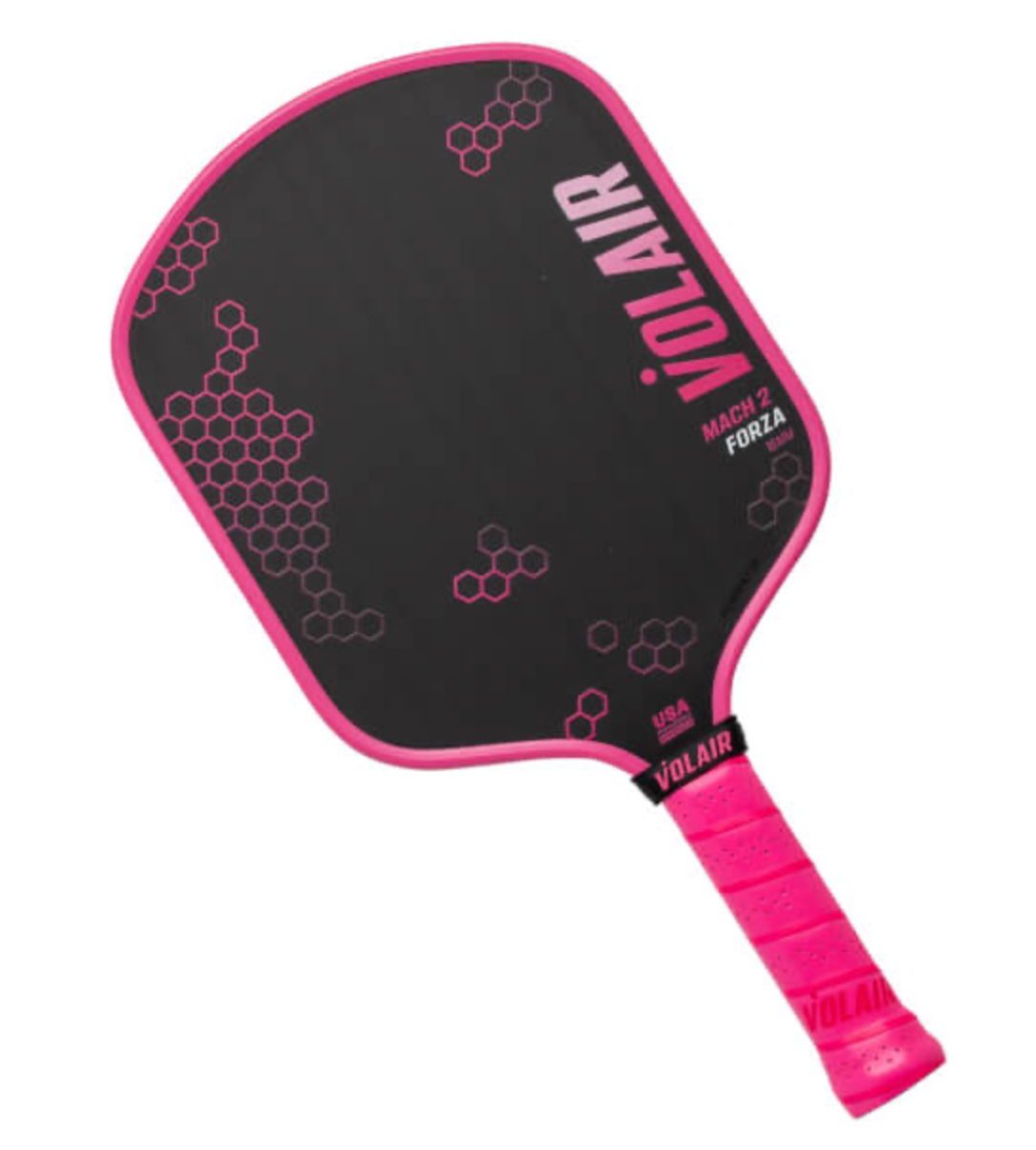
We already discussed the Mach 2 Forza 16mm in the control section, but it deserves another mention for spin. With its raw carbon fiber surface and high spin measurements (~2150 RPM), the Mach 2 Forza is arguably one of the spiniest paddles of 2025. The triaxial carbon weave face literally grabs the ball, allowing you to shape crazy angles and heavy topspin shots. If you’re a spin junkie who prioritizes placing the ball with spin over sheer power, this paddle is a top choice. It gives up some reach due to its widebody shape, but the trade-off is a massive sweet spot and spin that can surpass even some elongated “spin” paddles. Players who have used JOOLA’s Ben Johns CFS or Electrum are often equally impressed or more with the Mach 2’s spin – plus it’s a control paddle at heart, so you get consistency too.
CRBN ² TruFoam Genesis– Foam Core = Spin Galore
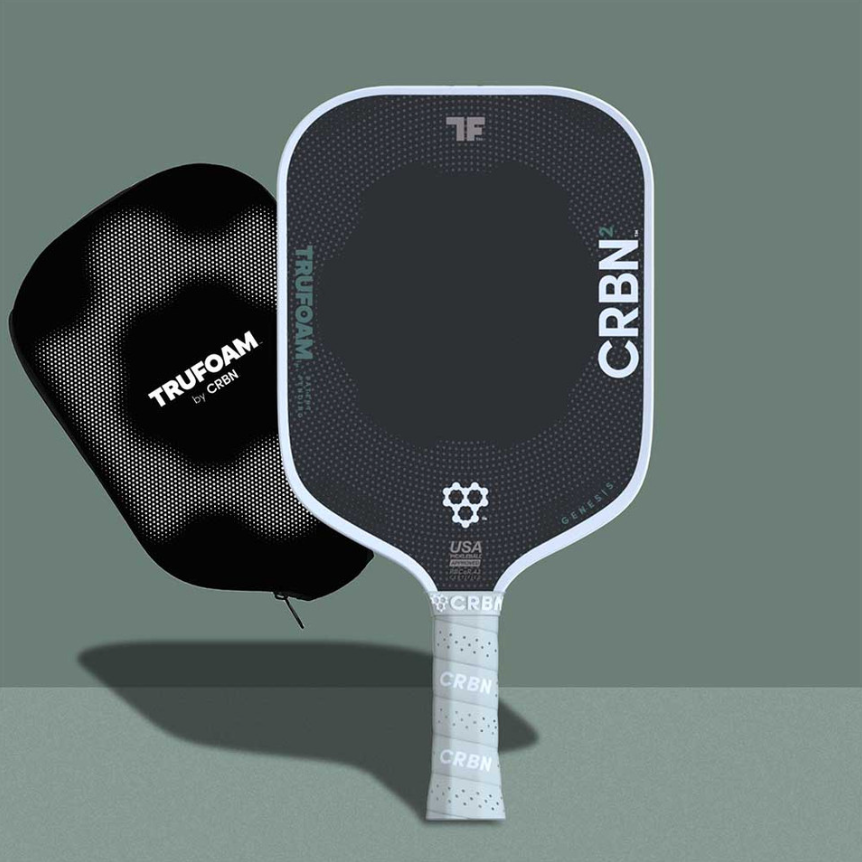
Another previously covered paddle, the CRBN ² TruFoam Genesis, merits attention for spin. CRBN paddles historically rank very high in spin (their raw T700 carbon faces with sticky texture excel at imparting rotation). The TruFoam Genesis is no exception – testers gave it “excellent” spin ratings. The all-foam core might also contribute by increasing dwell time a tad (the ball sinks slightly into the foam surface). The result is a paddle that can rip heavy topspin while still feeling soft. So if you’re an all-court player who uses spin as a weapon (rolls, dips, nasty cut serves), the CRBN TruFoam series will not disappoint. It’s essentially a spin-friendly paddle that doesn’t compromise other aspects – a rare gem.
Gearbox Pro Ultimate Hyper – Edgeless Surface for Consistent Spin
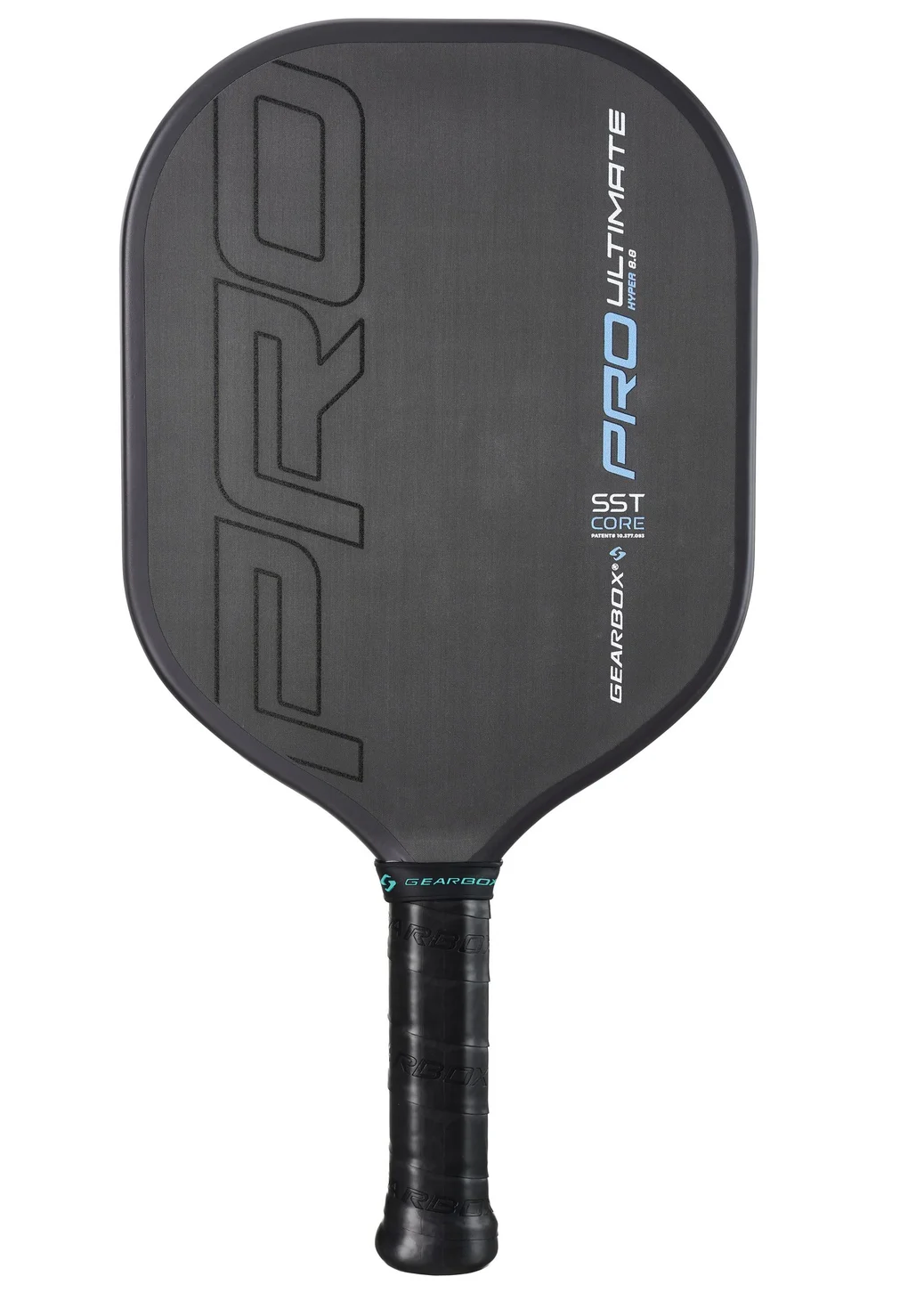
The Gearbox Pro Ultimate Hyper also shines for spin – Gearbox’s carbon fiber texture plus edgeless design means you have a uniform surface to brush the ball without interference. It achieved ~94% spin in testing, putting it among the top spin paddles in the power category. The edgeless aspect ensures no edge-guard mishaps when you really brush low on the ball. If you love hitting heavy slice third shots or topspin drives, the Hyper will happily oblige – and you’ll find the spin very “true” (consistent) thanks to Gearbox’s one-piece face. Many aggressive players pair this paddle with a poly ball to maximize spin effect – it can truly bend shots.
Honorable Mentions for Spin:
-
Selkirk Vanguard Power Air Invikta (not detailed above, but known for high spin with its gritty face).
-
Electrum Model E 16mm (from late 2024, raw carbon + spin hold high, albeit not on Hot List 2025, still a spin beast).
-
JOOLA Ben Johns Hyperion CFS 16 (2023 model but still one of the highest RPM measured due to textured carbon – though the new 3S has similar surface).
-
Diadem Warrior Edge 19mm(2024/25 thick control paddle with a super grabby face – heavy and slow, but spin monster).
-
Proton Series (high-performance paddles featuring advanced spin capabilities, innovative NanoTac surface technology, and exceptional durability—multiple models tailored for power, spin, and control, making them ideal for serious players).
In summary, if spin is your primary concern, look for raw carbon fiber surfaces, textured or sandblasted faces, and paddles that offer good dwell time. The ones we highlighted – Volair Mach 2 Forza, CRBN TruFoam, Gearbox Hyper – each bring top-tier spin with different underlying strengths (control, balance, power respectively). Combine one of those with proper technique, and you’ll be hitting r olling topspin passing shots and vicious cut serves that make opponents curse the day you discovered spin.
Having navigated through the best paddles by performance category, let’s address some broader questions: What should different levels of players choose? How do you decide between these categories? The next section will provide a quick Player Level Guide to help beginners, intermediates, and advanced players focus on what matters most when selecting a paddle, along with some pointers on making a choice that will serve you well in the long run.
Player Level Guide: Which Paddle for Beginners vs Advanced?
Beginners (3.0) – Start with control or balanced paddles. As a newer player, your priority is keeping the ball in play and developing consistency. A forgiving paddle with a large sweet spot (e.g., Chorus Supercourt SX or 11SIX24 Monarch Jelly Bean) will reduce mishits and help you focus on placement. Avoid the temptation of a super stiff power paddle – it may lead to frustration with balls flying out. Many coaches recommend beginners choose a mid-weight (~7.5–8.0 oz) all-court paddle that leans toward control. For example, the Friday Original or Selkirk LUXX Control Air (if budget allows) are excellent for starting out – they offer a nice soft feel and let you build proper technique. As a beginner, also look for value (no need to splurge $250 right away) and durability. The Supercourt Series or Invader are good picks that you won’t outgrow quickly, but even a high-quality ~$100 paddle like the Vatic Prism Flash can serve you extremely well in your first year. When selecting a paddle, pay attention to available grip sizes—choosing the right grip size for your hand can make a big difference in comfort and control as you learn.
Intermediate (3.5–4.0) – At this stage, you know your style better. Choose a paddle that complements your strengths but also shores up weaknesses. An intermediate player can start exploring all-court paddles more seriously, or even a mild power paddle if they have an aggressive game. For example, a 3.5 who loves the net and quick exchanges might upgrade to a Six Zero Double Black Diamond for a balance of everything, or the Spartus Olympus for added power that’s still manageable. A 4.0 who relies on spin and control might stick with a high-end control paddle like the Mach 2 Forza (to maximize spin and consistency). Think about your common errors: if you’re popping up balls, stay with control-oriented choices; if you feel you can’t put away points, consider a step towards power. An intermediate player may also benefit from trying a slightly heavier paddle for added power and stability, especially if you’re looking to increase your shot effectiveness. Intermediates benefit from paddles with versatility – so all-court picks like the Bread & Butter Invader or CRBN ² TruFoam are often ideal because they won’t limit your shot selection as you refine your all-around game. Also, intermediate level is when investing in a more premium paddle can pay off – you have the skills to appreciate the nuances, and a quality paddle (with good tech like foam or carbon) can give you that 5–10% edge to reach the next level.
Advanced (4.5–5.0+) – By now, you likely have a clear playing identity (e.g., “I’m an aggressive left-side player with a tennis background” or “I’m a dink specialist setter”). Choose a paddle that amplifies your style and gives you an edge in competition. Advanced players often gravitate towards specialized paddles: power paddles (like the JOOLA Hyperion 3S or Paddletek Bantam) for attackers, control paddles (like the Selkirk LUXX Invikta) for reset masters, or the latest tech (like CRBN TruFoam) for those looking for a unique advantage. At this level, feel preferences are huge – some top players love the crisp pop of fiberglass (Bantam), others the plush hold of carbon/foam (Gearbox or CRBN). There’s no wrong answer; it’s what complements your natural timing and swing. If competing seriously, also consider legality: e.g., the JOOLA 3S series might not be USAP legal, so a pro playing sanctioned events might opt for a different model like the Hyperion CFS or another USAP-approved equivalent. Advanced players can also benefit from tweaking paddles (lead tape to adjust balance/swingweight, overgrips to perfect handle size). The key is that at high levels, small paddle differences can impact performance, so it’s worth demoing and finding exactly what feels right. Many pros in 2025 are using the paddles we’ve covered – Ben Johns with JOOLA Hyperion line, JW Johnson with CRBN, top senior pros with Gearbox, etc. But remember: the best paddle for you is the one that enhances your strengths and mitigates yourweaknesses.
In summary: Beginners – err on the side of control and forgiveness. Intermediates – seek balance and consider stepping slightly outside your comfort zone (either a tad more power or more spin) to grow. Advanced – be selective and align your paddle with your playing DNA, as you have the skills to leverage high-performance features (and the discipline to handle any trade-offs).
Lastly, always factor in comfort and injury prevention. If a paddle is too heavy or too stiff for you, it could strain your arm – regardless of your level. It’s not just about what your game can handle but what your body can handle for hours of play. Fortunately, many of the paddles above incorporate shock-reducing tech (foam cores, edgeless design, thicker cores) that can help protect your arm without sacrificing performance. For example, the Selkirk LUXX 20mm and Gearbox Hyper 16mm are both power/control paddles that are also gentle on the arm.
Now that we’ve covered selecting paddles by playstyle and skill, let’s address some frequently asked questions that often come up when people are paddle shopping. From choosing core materials to maintaining paddle grit, we’ve got you covered in the FAQ below.
Frequently Asked Questions
Q: What core material is best – Polymer, Foam, or something else?A: Most paddles use a polymer honeycomb core– it’s tried and true, offering a good mix of power, control, and durability. Polymer cores are the most common material for the insides of paddles as they provide a good balance of feel and control. Newer alternatives include foam cores or foam-infused designs (like CRBN’s 100% foam core or JOOLA’s foam edges). Foam can offer a softer feel, larger sweet spot, and sometimes more power due to increased flex, but historically foam cores could break down or “heat up” (get bouncier) over time. Brands have improved foam tech in 2025 – e.g., CRBN’s high-density foam that resists deforming and Spartus’s foam that avoids overheating issues. There are also Nomex (hard paper-like) cores and aluminum cores in a few paddles, but those are less common nowadays. In general, polymer is a safe bet for most players (predictable and long-lasting), foam can be amazing for feel and evolving power (like in the Pickleball Apes Pulse which gets poppier after break-in), and Nomex is super hard and loud (mostly found in older paddles or specialty “pop” paddles). Bottom line:There isn’t a single “best” core – it depends on what you value. Polymer honeycomb is still king for balanced play. Foam is the rising star for those seeking exceptional feel or specific performance tweaks (like more dwell time or reduced vibration). The paddle's performance is influenced by the core material, as well as the paddle's shape and construction, all of which contribute to power, control, and spin.
Q: How do I maintain the spin/grit of my paddle’s face?A: Over time, the textured surface of your paddle will wear down, especially if it’s a sandpaper-like grit or painted surface. To maintain spin:
-
Clean the surface regularly. Use a damp cloth or mild soap and water to wipe off ball residue (the green/yellow fuzz or dirt can fill in the texture). For raw carbon fiber surfaces, a gentle scrub with a Magic Eraser works (many use a Pickleball Paddle Eraser product to remove ball residue safely).
-
Avoid abrasive court contact. Digging the paddle on the court for low balls will scrape away texture fast (edgeless paddles like Selkirk LUXX need tape on edges to prevent that). Try to use the flat of your paddle, not the edge, if you brush the ground.
-
Limit use of very old balls. Super worn pickleballs can be slick and also they might polish your paddle face more quickly. Fresh balls actually often increase wear too (since they’re rough), but slick balls make you swing harder (further wearing the face). It’s a bit of a catch-22. Replacing balls at a reasonable interval and rotating which ball you use can help even it out.
-
Check if your paddle has a replaceable surface. Some paddles (like certain pro models) allow resurfacing or come with a factory sanded texture that can be lightly re-sanded. Most don’t, but worth checking brand info.
-
Over months of play, accept that some reduction in grit is inevitable. Many competitive players replace their primary paddle every 6–12 months to keep maximum spin. If you notice a big drop in spin and you’ve cleaned it, it might just be smooth now – time for a new one or a backup for slick conditions.
Q: Do I need a different paddle for singles vs doubles?A: Not necessarily, but some high-level players prefer it. In singles, power, reach, and spin are at a premium (you have more court to cover and fewer soft dink rallies). So singles specialists might choose a slightly more power-oriented or elongated paddle for singles – e.g., using a JOOLA Hyperion 3S or Paddletek TKO-CX for singles to bang drives and serves, and maybe a more control/all-court paddle like a Double Black Diamond for doubles to excel in dinking. Most amateur players will use the same paddle for both; it’s one less thing to adjust to. But if you find your doubles paddle lacks something in singles (like you can’t generate passing shot pace, or conversely your singles paddle is too lively for tight doubles kitchen battles), you could consider two paddles. Keep in mind switching paddles also means adjusting timing and feel, so practice with both if you do this. Many top pros actually stick with one model for both singles and doubles nowadays (e.g., Ben Johns uses JOOLA Hyperion for everything, JW Johnson uses CRBN for everything). So unless you have a very pronounced difference in playstyle between singles and doubles, one good paddle should suffice.
Q: What weight should I choose?A: Paddle weight significantly affects play. Lighter paddles (< 7.5 oz) are quicker for hand speed and reactions, but offer less stability and power (ball doesn’t pop as hard, paddle can twist on off-center hits). Heavy paddles (>8.5 oz) hit harder and feel solid, but can tire your arm and slow down fast exchanges. The “golden range” for most is 7.8–8.4 oz (which most of our recommended paddles fall into). Within that: Most pickleball paddles range between 6 ounces and 14 ounces in weight, offering a variety of options for players to find their ideal balance of speed and power.
-
If you’re a smaller player or have arm injuries, err lighter (~7.8–8.0 oz) to reduce fatigue. You can always add a bit of lead tape to bump power if needed.
-
If you’re a strong player or come from tennis, you might prefer mid-heavy (~8.3–8.5 oz) for extra plow-through and not feeling pushed around.
-
Remember balance matters too: a paddle at 8.2 oz with weight mostly in the handle will feel lighter to swing than an 8.2 oz paddle with weight in the head. Some paddles (like elongated ones) feel head-heavy (more power, but slower swing), whereas widebodies can feel evenly balanced or handle-heavy (faster swing). For example, the Selkirk Invikta 20mm is thick and ~8.0 oz but actually feels quick (low swingweight) because weight is distributed, whereas the Paddletek TKO-CX elongated may feel heavier in swing even at similar static weight.
-
If unsure, start around 8.0–8.2 oz – that’s a versatile weight most adjust to easily.
Also note, adding things like overgrips (a typical overgrip adds ~0.1–0.2 oz) or lead tape (you can add anywhere from 0.1 oz up to 1+ oz with tape depending on amount) can change weight after purchase. Many players fine-tune their paddle weight that way. So, focus on choosing the right paddle model first; you can always tweak weight slightly.
Q: Are edgeless paddles fragile? Will a foam core paddle break quickly?A: Edgeless paddles (no plastic edge guard) like Gearbox, some Selkirk, etc., can be slightly more prone to cosmetic chipping on the rim if you scrape the ground or hit the court, since there’s no guard to protect them. Using edge tape (like protective tape) can mitigate that. However, structurally, well-made edgeless paddles (Gearbox, Selkirk) are solid and not inherently less durable than guarded ones, especially if they have carbon fiber reinforcing (Gearbox’s whole paddle is carbon; Selkirk uses a thick core to strengthen it). So just be mindful and perhaps use protective tape if you often scuff the paddle.
Foam core paddles have historically had breakage issues (e.g., some first-gen foam edge paddles got dead spots or cracking after heavy use). But brands have improved formulations. CRBN’s foam doesn’t collapse easily (they specifically made it high-density to hold shape). Pickleball Apes reinforced their foam with carbon to ensure consistency. Still, extreme heat (like sitting in a hot car) could potentially affect any paddle with foam, so avoid that to be safe. Most manufacturers offer warranties (often 1 year) – e.g., CRBN is likely confident enough in TruFoam durability to warrant it, as is Gearbox with their SST core. In our research, no epidemic of foam paddle failures has been noted for these 2025 models yet. So, use them normally and you should get similar lifespan to polymer paddles. If you do smash paddles frequently on the ground or hit many edge shots, any paddle can break – foam or not. So try to treat your equipment kindly!
Q: How do I choose the right grip size and handle length?A: Grip size is the circumference of the handle. Most paddles come in a standard ~4.25″ circumference. If you have very small hands, some offer 4.0″ (or you can wrap a thinner grip). If you have large hands or prefer a more solid feel, you can build up to 4.5″ with overgrips. It’s generally better to go smaller and add overgrip if needed, than too large and not be able to reduce (a too-big grip can cause slippage or strain). The rule of thumb is you should be able to just fit your index finger of the opposite hand in the gap between your fingertips and palm when holding the grip – that indicates a good size. Many players use an overgrip on top of the factory grip for sweat absorption, which also increases size ~0.1–0.2″.
Handle length matters if you use two-handed backhands. Standard is ~5″. If you feel your second hand is falling off or you want more leverage, look for longer handles (5.5″+). Many elongated paddles have 5.5″ (JOOLA Hyperion, CRBN 1 & 3, etc.), which are great for two-handers. Conversely, if you never use two hands and want max face area or a bit more stability, a shorter handle (4.5–4.8″ like some widebodies) could be fine. Just note, shorter handles can cramp two-handers and sometimes have slightly different balance (more weight in head, since handle is lighter/shorter). All the paddles we reviewed list handle lengths: e.g., Selkirk Invikta ~5.3″, Gearbox Hyper ~5.5″, Babolat paddles (not covered) often 5.25″, etc. Choose what suits your style – two-handed backhand players should stick to 5.3″ or longer if possible for comfort. If you’re a one-hander, anything 4.5–5.5″ works; you might like a bit shorter for added stability (like Bread & Butter Fat Boy’s 5.3″ which they claim adds stability vs longer handles).
Q: How often should I replace my paddle?A: There’s no hard rule, but paddles do wear out gradually. Polymer cores can soften over time (leading to a loss of pop or a “dead” feeling sweet spot). Textures wear down, as discussed. Pros often change paddles every few tournaments or months. For regular players:
-
If you play daily or competitively, consider replacing every 8-12 months to keep performance optimal (or have a backup to rotate).
-
If you play a few times a week at moderate intensity, a good paddle can easily last 1–2 years.
-
If you notice specific issues – e.g., a distinct dead spot (ball just dies off the paddle in one area), cracks, handle becoming loose – it’s time for a new one.
-
Sometimes just the loss of grit might prompt a change if spin is vital to you (some will replace at 6 months when grit is half-gone even if core is fine).
Upgrading to a new paddle can also provide access to the latest technology and improved paddle's performance, as many new paddle releases feature advanced materials and design innovations.
Keep in mind, temperature and usage affect longevity. Extreme heat can break down polymer faster. Lots of wall hits or court scrapes can shorten life. Taking care of the paddle (not leaving in hot car, not throwing it, etc.) extends it. But generally, modern paddles are much more consumable sports equipment than, say, a tennis racquet. They do have a performance lifespan. Budget for it accordingly if you play a lot.
Q: What about new USA Pickleball spin regulations or paddle testing?A: USA Pickleball has testing standards for paddles (like coefficient of friction for surface roughness, deflection, etc.). All the major brands/paddles we listed (except noted ones like JOOLA 3S line that are only UPA-A) should be approved for sanctioned play as of 2025. There’s talk of stricter spin testing possibly in the future (like a “spin decay” test that might weed out some textured surfaces). But as a buyer, if you’re playing recreationally or local tourneys, this isn’t a big worry. If you play high-level sanctioned tournaments, stick to known compliant models (everything on Pickleball Effect’s Hot List is compliant except where they mention “only UPA-A, not USAP” for JOOLA 3S). The rules on spin are evolving; however, most manufacturers design within current limits. If rules tighten, some paddles might get slight redesigns, but it’s hard to predict. For now, buy the paddle that suits your game. If a rule change ever makes a certain tech illegal, the community will know and manufacturers likely offer some remedy or new model.
Q: How can I add lead tape, and where, to tweak paddle performance?A: Adding lead tape is the common way to customize your paddle’s weight and balance:
-
To increase power and stability, put lead tape at 12 o’clock (top of paddle) or spread from 10 to 2 o’clock positions on the edge. This adds swingweight, punch, and enlarges sweet spot upward.
-
To increase hand speed or reduce head-heaviness, add weight to the handle (some use a washer under the butt cap or wrap lead tape around the handle under the grip). But handle weight only increases overall mass, not swingweight much, so it won’t boost power, just makes the paddle heavier feeling in hand (usually not desired unless trying to balance a very head-heavy paddle).
-
Many players do a perimeter tape: e.g., 4–6 inches of tape at 10, 12, 2, and sometimes 8 & 4 o’clock. This overall increases stability and plow but will slow it a tad.
-
A little goes a long way: Start with maybe 1–2 grams (a 4″ strip of 1/4″ lead tape is ~1 gram) at a location, test it out. You can always add more. Most folks end up adding ~2–6 grams total. For example, adding 2g at the tip can noticeably boost power, but beyond 6-8g total you’ll definitely feel the paddle is heavier to swing.
-
Use self-adhesive lead tape (it’s cheap online or from tennis shops). Press it firmly. Some secure it further with athletic or electrical tape on top to ensure it doesn’t peel.
-
Follow any manufacturer guidelines: a few paddles have edge designs you can’t easily put tape on (edgeless paddles you can still tape the rim though). Lead customization helped, for instance, some testers of the Bantam widebodies to enlarge sweet spot without hurting swing too much. It’s a handy tool if you want to fine tune after you’ve played a bit with your paddle stock.
That covers our most frequent paddle questions! If you have others – like comparing specific models, which paddles are arm-friendly, or how weather affects paddles – feel free to reach out to the pickleball community or experts at FORWRDor Pickleball Effect.
In conclusion, armed with the knowledge from this guide and the right paddle in hand, you’re ready to elevate your pickleball game – whether you’re gently dinking in the kitchen or blasting drives from the baseline. Now get out there and play!
Happy Pickleballing! 🏓🥒
Written by FORWRD Pickleball Gear Experts
Q: Are expensive paddles worth it?A: Paddle prices can range from budget to high-end. Premium paddles often use advanced materials, larger sweet spots, and specialized technologies to deliver superior power, control, spin, and durability. These features make them a top choice for serious players seeking the best paddle's performance and long-term value.
Q: What are some examples of innovative paddle models?A: There are many new paddle releases each year, but a standout is the Joola Mod TA-15, which is recognized for its high-performance foam core and excellent control and spin. Other innovative models include the Perseus Pro IV and Gearbox Pro, all of which use advanced materials and technology to push paddle performance forward.
Q: What should I know about paddle technology?A: Paddle technology has advanced rapidly, with features like thermoforming, foam-injected edges, and replaceable skins. Some brands use the same technology across multiple models to ensure consistent performance and feel, giving players more options without sacrificing quality.
Introduction to Pickleball Paddles
Pickleball paddles are the heart of your game—no matter if you’re just starting out or you’re an advanced player looking to win more matches. With so many pickleball paddles on the market, finding the perfect paddle for your play style can feel overwhelming. The best pickleball paddles are designed to give you the right mix of power, control, and spin, helping you elevate your performance on the court.
Whether you’re drawn to the precision of control paddles, the explosive energy of power paddles, or the versatility of all court paddles, there’s a paddle out there that’s tailored to your needs. Each type of paddle is engineered to support different strategies and skill levels, so understanding what works best for you is key to unlocking your potential. In this guide, we’ll break down the main paddle categories—control, power, and all court paddles—so you can confidently choose the best pickleball paddle for your game. No matter your experience, the right paddle can make all the difference in helping you play your best pickleball and enjoy every moment on the court.
Paddle Materials and Construction
The materials and construction of your pickleball paddle play a huge role in how it feels and performs on the court. T700 raw carbon fiber is a premium material used in some high-end paddles, known for its exceptional durability, stiffness, and ability to enhance power, control, and feel. Today’s paddles are crafted from advanced materials like raw carbon fiber, graphite, and composite blends, each offering unique benefits for different play styles. For example, raw carbon fiber paddles are prized for their durability, lightweight feel, and ability to generate more power and spin, making them a favorite among competitive players.
Thermoformed paddles are another innovation, created by heating and molding materials to produce a seamless, ultra-strong paddle. This process not only boosts durability but also enhances the paddle’s pop and stability, giving you more confidence in fast-paced rallies. If you’re looking for extra reach and the ability to generate powerful shots, elongated paddles are designed with a longer face, helping you add both power and spin to your game. On the other hand, control paddles often feature thicker cores and softer materials to absorb pace and deliver a gentle, precise touch for resets and dinks.
When choosing a paddle, it’s important to consider the paddle face material, core material, and grip size. The combination of these elements determines how much power, control, and spin you can generate. Whether you’re after a forgiving paddle for consistent play or a high-performance model for tournament action, understanding paddle construction will help you find the right fit. With so many options—thermoformed paddles, elongated paddles, raw carbon fiber faces, and more—you can select a paddle that matches your skill level and play style, ensuring you get the most out of every game.
Understanding Player Needs
For a comprehensive look at paddles for new players, see our Best Beginner Paddles guide. Choosing the right pickleball paddle starts with understanding your unique needs as a player. Every player brings a different play style, skill level, and set of preferences to the court, and the perfect paddle is the one that complements and enhances your natural game. For beginners, a forgiving paddle with a large sweet spot is essential—these paddles help you keep more shots in play and build confidence as you develop your skills. Look for a paddle that absorbs pace and offers plenty of control, so you can focus on placement and consistency without worrying about mishits.
Intermediate players often find themselves seeking a balance between power and control. At this stage, you might want a paddle that gives you more power for putaways and serves, but still offers enough touch for dinks and resets. The best pickleball paddles for intermediate players are those that provide a responsive feel and a generous sweet spot, allowing you to experiment with different shots and refine your play style. If you’re coming from a tennis background, you may prefer a paddle with a bit more pop and a longer handle, which can make two-handed backhands and aggressive drives feel more natural.
Advanced players, on the other hand, often know exactly what they want from their paddle. Whether you’re an aggressive player who thrives on fast-paced exchanges and needs a paddle with more power, or a control specialist who values precision and finesse, there are premium paddles designed to match your approach. Some advanced players look for paddles that maximize spin, while others prioritize stability and a crisp, connected feel. If you’re an aggressive player, a paddle with a stiffer face and more pop can help you dominate at the net and finish points with authority.
Ultimately, the best pickleball paddle for you is the one that fits your play style, skill level, and personal preferences. By considering factors like sweet spot size, power, control, and how the paddle feels in your hand, you can find a paddle that not only helps you improve but also makes the game more enjoyable. Whether you’re just starting out or pushing for tournament wins, understanding your needs is the first step toward finding the perfect paddle and elevating your performance on the court.
Conclusion
In conclusion, the world of pickleball paddles is more dynamic and diverse than ever, offering something for every type of player. Whether you’re searching for the best pickleball paddles to boost your control game, unleash more power, or simply enjoy a forgiving sweet spot, there’s a paddle out there designed to help you win games and play your best pickleball. From beginner-friendly paddles with large sweet spots and soft cores to advanced, premium paddles packed with the latest technology, today’s options make it easier than ever to find the perfect paddle for your needs.
When selecting your next pickleball paddle, consider key factors like core material, grip size, paddle weight, and price. These elements all contribute to how the paddle feels and performs, and the right combination can make a significant difference in your confidence and results on the court. Power paddles are ideal for aggressive players who want to put away points, while control paddles help you master the soft game and keep rallies going. All-court paddles offer a balanced approach, making them a great choice for players who want versatility and adaptability.
With so many premium paddles and innovative designs available, investing in a high-quality paddle is a smart move for anyone serious about improving their game. The best pickleball paddles are built to last, deliver consistent performance, and help you reach your full potential—whether you’re playing for fun or competing at the highest level. Take the time to research, compare, and test different paddles to discover which one feels like an extension of your hand. With the right paddle in your grip, you’ll be ready to step onto the court with confidence and enjoy every moment of the game.
Frequently Asked Questions: Pickleball Paddles 2026
- What's the best pickleball paddle in 2026?
It depends on your play style. For control-focused players, the Selkirk Vanguard Power Air S2 leads the category. For all-court versatility, the JOOLA Hyperion CAS 13mm is the most complete option. For budget players, the Paddletek Bantam EX-L Pro delivers touring-level feel under $100. No single paddle is best for everyone — match the category to your game first.
- How much should I spend on a pickleball paddle?
$80–$120 gets you a solid intermediate paddle that lasts. $200–$300 buys thermoformed carbon construction with better spin and consistency — worth it once you're playing 3x/week competitively. Under $60, paddles feel and perform noticeably worse. Don't overspend before you've developed a play style; a $100 paddle beats a $250 paddle in the wrong hands.
- What core thickness should I choose — 13mm or 16mm?
13mm cores give more pop and a livelier feel — better for experienced players who want pace and spin. 16mm cores are softer, more forgiving, and better for dinking and kitchen play. Most intermediate players (3.0–3.5) perform better with 16mm. Most competitive players (4.0+) prefer 13mm once their touch game is consistent enough to handle the speed.
- What's the difference between a control paddle and a power paddle?
Control paddles use softer cores (16mm+) that absorb pace and reward placement-first play. Power paddles use denser, thinner cores (10–13mm) that maximize ball rebound. Neither is universally better — control paddles help you keep the ball in the kitchen, power paddles reward aggressive attacks from mid-court. Most players need control first, then add power as consistency improves.
- Are thermoformed paddles worth the premium price?
For players at 3.5+ who play regularly, yes. Thermoformed carbon construction creates a stiffer, more consistent frame with better spin generation than cold-press manufacturing. The difference is measurable — thermoformed paddles typically spin 100–200 RPM more per stroke. For beginners or casual players, a quality cold-press paddle at $80–$100 is genuinely good enough.
One More Thing: The Bag You Carry Your Paddle In Matters
You’ve found your paddle. Now think about how you carry it. Most players cycle through two or three bags before landing on one that actually works — one that protects their paddle, fits a laptop for the office-to-court commute, and holds up under daily use.
The FORWRD Court Caddy was designed for exactly that player. Modular paddle sleeve for 4–5 paddles, padded 15” laptop compartment, rapid-grab ball pockets, and 840D ballistic nylon construction built to outlast cheaper alternatives. Designed with 500+ real players over 15 months of development. Featured in The Dink, Pickleball Effect, and The Kitchen.
If you carry a 16” laptop or 5+ paddles, the Court Ranger V2 steps up with the same construction scaled to fit. Same YKK AquaGuard zippers, same ballistic nylon — just bigger where it counts.
A paddle upgrade and a bag upgrade tend to happen at the same time. Players who invest in a better paddle quickly realize their old bag doesn’t protect it properly. The Court Caddy’s dedicated paddle sleeve keeps even a premium carbon fiber face separated and scratch-free between sessions.
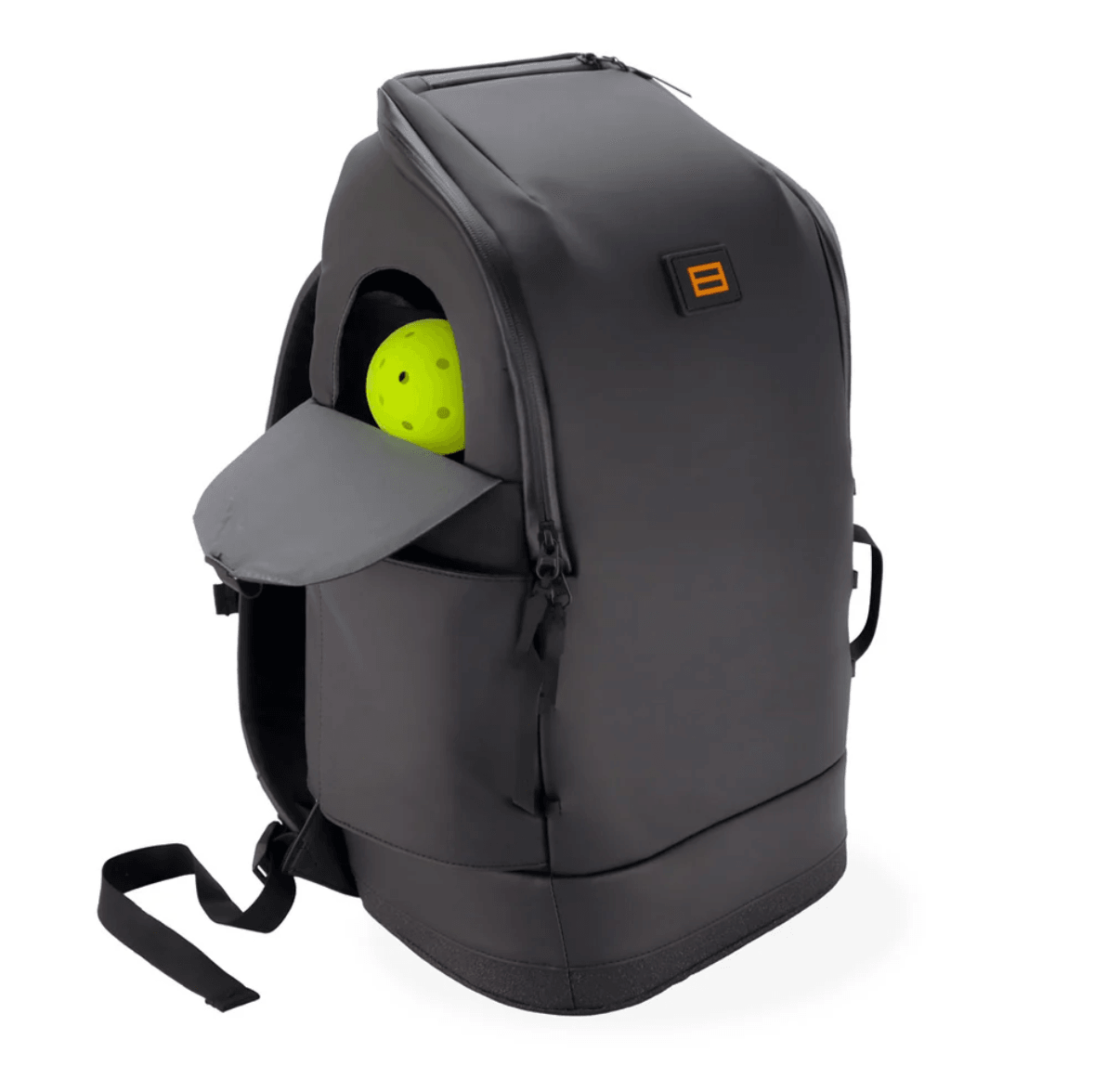
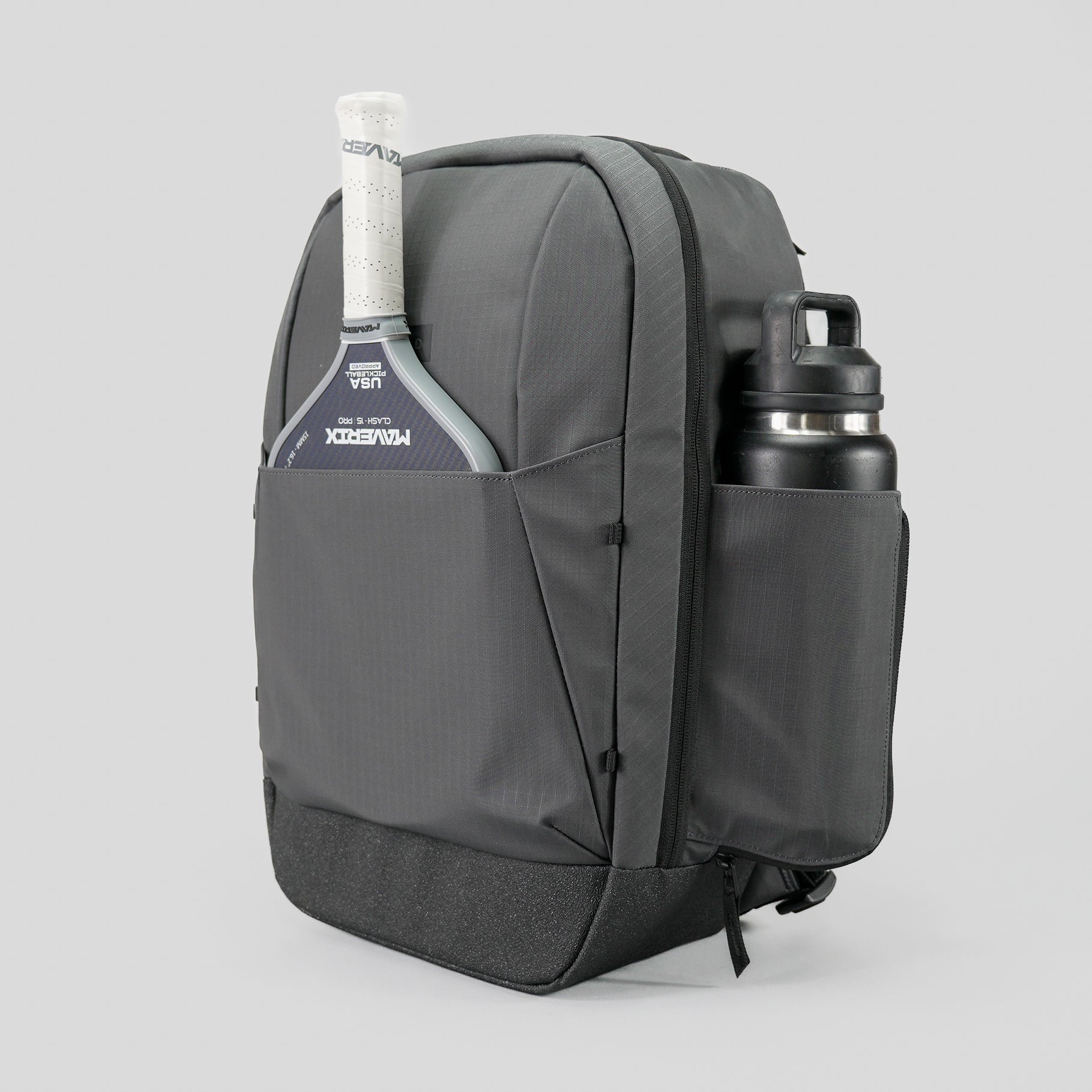

Leave a comment
This site is protected by hCaptcha and the hCaptcha Privacy Policy and Terms of Service apply.