

Last updated: June 2026

Competitive pickleball has never been more accessible. With over 1,000 active tournaments across the U.S. each year and a DUPR rating system that makes fair competition findable at any level, there's no good reason to stay on the sideline. This guide covers everything you need: how tournaments are structured, where to find them, how to register, and what to pack so tournament day doesn't become gear day.
Whether you're planning your first event or looking to move up from local club competition to APP or PPA play, the pathway is more straightforward than most players realize.
How Pickleball Tournaments Are Structured
Pickleball tournaments run under standardized rules set by USA Pickleball: courts are 20' × 44' with a 7' non-volley zone, equipment must be approved, and matches follow consistent scoring formats. Most events play to 11 points (win by 2), while some championship rounds extend to 15 or 21.
Tournament formats vary by event size and organizer preference:
- Single elimination with consolation bracket — ensures everyone plays multiple matches, even after an early loss
- Double elimination — you need to lose twice to go home; more forgiving for first-timers
- Round-robin into bracket — pool play first, then knockout. Common in larger events for better seeding
- Pool play only — good for community events where participation matters more than a champion
Tournament Divisions: Where Do You Fit?
Most pickleball tournaments divide players by three variables: skill rating, age, and format (singles vs. doubles vs. mixed doubles). Understanding how these work before you register saves frustration on the back end.
Skill-Based Divisions
DUPR (Dynamic Universal Pickleball Rating) has become the standard for competitive events. It assigns players a rating from 2.0 to 8.0 based on actual match results — not self-assessment. If you've never played a rated match, start at an open or beginner event and let your rating develop naturally. Don't sandbag to a lower bracket; referees and tournament directors know what sandbagging looks like.
Age Group Categories
Most tournaments offer age brackets in 5- or 10-year increments, typically starting at 19+ and running through 80+. Senior divisions (50+, 60+, 70+, 75+, 80+) are consistently well-attended — pickleball's demographics skew older, and those players take their competition seriously.
Gender and Format Divisions
Standard options: men's doubles, women's doubles, and mixed doubles. Singles events exist but are less common — they reward endurance and court coverage over the team strategy that makes doubles pickleball what it is.
Major Tournament Tours: PPA, APP, and Golden Ticket
The professional pickleball landscape has consolidated significantly since 2022. Three main pathways deserve attention for any competitive player:
PPA Tour (Professional Pickleball Association)
The PPA Tour is the premier professional circuit in North America. Events feature the sport's top-ranked players — Ben Johns, Anna Leigh Waters, Federico Staksrud — and are held in major venues with media coverage, fan engagement, and vendor exhibitions. If you want to watch the highest level of play in person, PPA events are the destination. PPA also offers amateur draws at some events, which is worth checking if you want to compete where the pros compete.
APP Tour (Association of Pickleball Players)
The APP Tour runs events across the country year-round, with stops ranging from regional qualifiers to national championships. The APP Next series ($15K events) is specifically designed for developing players under 23 — a clear signal that the tour is building its pipeline alongside its main draws. APP events tend to be more accessible for competitive amateurs than PPA, with broader division offerings and regional tour stops in smaller markets.
USA Pickleball Golden Ticket Series
Golden Ticket events are sanctioned qualifying tournaments where winners earn automatic bids to the USA Pickleball National Championships. If nationals is on your radar, Golden Ticket events are the direct pathway. Check USA Pickleball's tournament calendar for the current Golden Ticket schedule — it updates seasonally.
How to Find and Register for Tournaments Near You
Two platforms dominate tournament search and registration:
- Pickleballbrackets.com and Pickleballtournaments.com — the two most widely used registration platforms. Filter by location, date, skill level, age bracket, and format.
- UTR Sports (utrsports.net) — growing adoption among DUPR-integrated events. Useful for finding rated tournaments that will update your DUPR.
- DUPR app — the DUPR app itself now surfaces tournaments near your rating level, which saves the step of figuring out which bracket fits you.
Registration typically runs $30–$80 per event depending on format and level. Most tournaments open registration 4–8 weeks out and close once brackets fill. For popular local events, register early — brackets at the 3.5 and 4.0 level fill fast.
Registration Steps (for First-Timers)
- Create a player profile with accurate contact info and your DUPR rating (or estimated skill level)
- Select your division — when in doubt, pick a level lower than you think. Your first tournament should be about learning the format, not winning a gold medal.
- Pay the entry fee and save your confirmation
- Note the check-in time — most tournaments require check-in 30–60 minutes before your first match
Tournament Preparation: What Actually Matters
Physical fitness helps. Mental preparation helps more. Here's what competitive amateurs consistently get wrong in their first few events:
Practice Under Match Conditions
Drilling your third-shot drop for 30 minutes in casual practice doesn't prepare you to execute it at 10-9 in a first-match tiebreak against a stranger. Practice with consequences — play points, keep score, play to 11. The gap between drilling and match-play is larger than most players expect until they've experienced it in competition.
Know Your Opponent's Side
At most amateur tournament levels, your opponents aren't scouted — but you can watch their warm-up. Pay attention to which hand they favor, whether they have a weak backhand, and how they move laterally. Five minutes of observation before your first match is worth more than any pregame ritual.
Nutrition and Hydration
Multi-match tournament days (two to four matches over 4–6 hours) require proactive hydration — not drinking when you feel thirsty, but drinking every 15–20 minutes. Bring electrolytes. The most common performance drop in amateur tournament play comes from dehydration, not fitness. Pack easy snacks (bananas, protein bars, trail mix) that won't cause GI issues during play.
Tournament Day Bag: Don't Improvise This
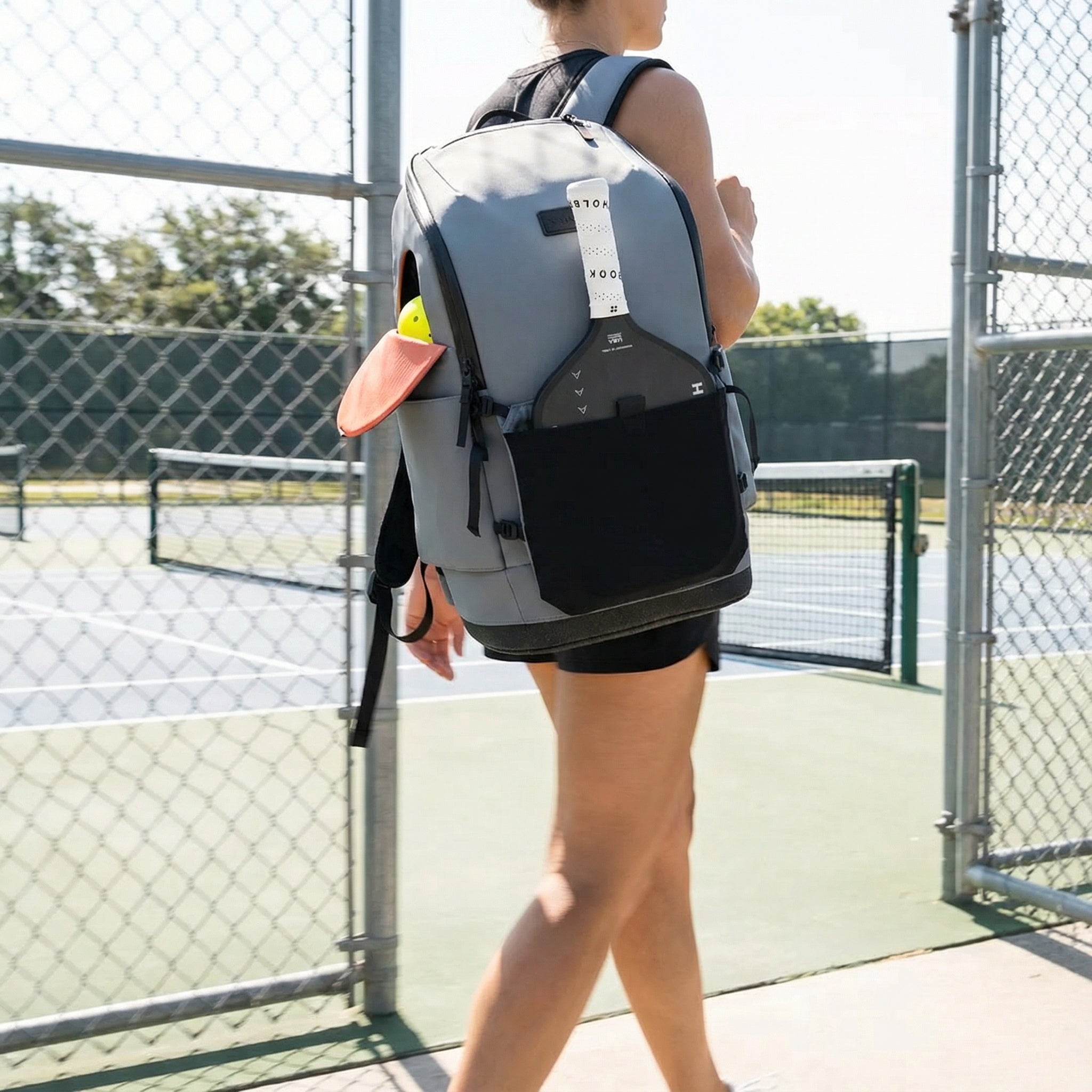
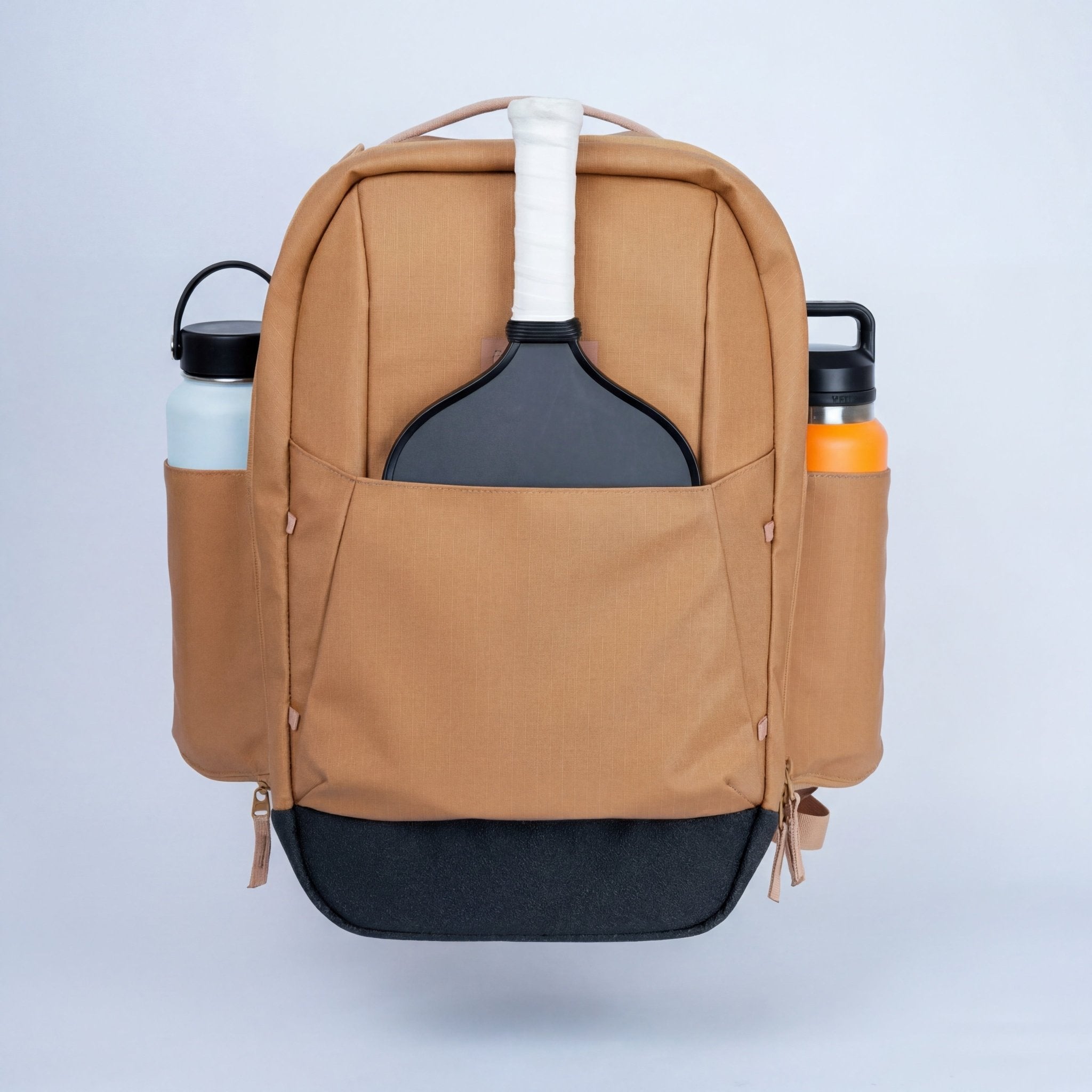
A disorganized bag turns tournament mornings into stressful gear hunts. The Court Caddy was designed for exactly this — modular paddle sleeve keeps paddles separated and protected, two water bottle pockets, a 15" padded laptop sleeve, and compartments that make sense when you're unpacking at 7 AM before a 7:30 check-in. Built with feedback from 500+ real players including regular tournament competitors.

What to Pack for Your First Pickleball Tournament
A quick packing list refined from the experience of players who've shown up underprepared:
- 2–3 paddles (strings don't break but paddle faces crack — have a backup)
- Court shoes with proper lateral support — running shoes wear out laterally on hard court surfaces and increase injury risk during long matches
- 2+ changes of athletic wear (multi-day events especially)
- Water and electrolytes — bring more than you think you need
- Snacks for between matches (bananas, bars, nuts — something portable and stomach-stable)
- Sunscreen for outdoor events
- A bag with real compartments — you'll thank yourself during check-in
See our full pickleball backpack guide for how to choose the right bag for tournament vs. casual play. For players upgrading from a basic bag, the Court Ranger V2 at $195 is the most popular tournament-day upgrade among players who want a 16" laptop sleeve alongside their gear.
Frequently Asked Questions: Pickleball Tournaments
What skill level do I need to enter a pickleball tournament?
Most tournaments accept all skill levels. Beginner brackets (2.5–3.0 DUPR) are specifically designed for players new to competition. If you've been playing consistently for 3–6 months and can sustain rallies, you're ready for a local recreational tournament. Don't wait until you feel "good enough" — competition accelerates improvement faster than any amount of drilling.
How does DUPR rating work in tournaments?
DUPR (Dynamic Universal Pickleball Rating) assigns a numerical rating from 2.0 to 8.0 based on your actual match results — wins against higher-rated players raise your rating more than wins against lower-rated opponents. When you register for a DUPR-sanctioned tournament, your result updates your rating. Sandbagging (registering below your actual level) is heavily penalized and can result in tournament disqualification.
How much does it cost to enter a pickleball tournament?
Entry fees typically range from $30 for a local club event to $80+ for a major sanctioned tournament. Multi-event weekends (playing both doubles and mixed doubles, for example) add per-event fees. Budget $50–$100 for a local recreational tournament including entry, parking, and food. Professional-level events with amateur draws may charge $100–$150 for access to that competitive experience.
What's the difference between a PPA and APP tournament?
The PPA (Professional Pickleball Association) is the top-tier professional circuit featuring the world's highest-ranked players. The APP (Association of Pickleball Players) has a broader national footprint with more regional events and is more accessible for competitive amateurs looking for sanctioned play. Most competitive amateurs start with APP events; PPA draws are available at select events but more selective. Both update DUPR.
Can I enter a tournament without a DUPR rating?
Yes — many tournaments offer "open" divisions or accept self-rated entries for first-time tournament players. Your self-rating establishes a provisional DUPR that adjusts quickly once you start competing. Be honest about your self-rating; tournament directors see this consistently and inaccurate self-ratings affect everyone in your bracket.
Ready to compete? Start with a local club or recreational tournament to learn the format — and make sure your gear is ready before the morning of. Shop the Court Caddy — the bag built for players who play to win, not just play.

Leave a comment
This site is protected by hCaptcha and the hCaptcha Privacy Policy and Terms of Service apply.