

Last updated: September 2026
The correct grip for a pickleball paddle starts with the continental grip: place the base knuckle of your index finger on the upper-right bevel of the paddle handle, wrap your remaining fingers naturally, and confirm the V formed between your thumb and forefinger points toward the top bevel. That's the mechanics. What most grip guides skip is the pressure — and grip pressure is responsible for more beginner errors than grip style ever will be.
This guide covers all three grip styles, a numbered 1–10 pressure scale, the forehand-vs-backhand switching question, common beginner grip mistakes, and a six-session drill sequence with specific rep counts and milestones. Most articles describe the theory. This one gives you the practice path.
The Three Pickleball Grips (Continental, Eastern, Hybrid): When Each One Wins
Pickleball paddles have eight bevels — the flat sides of the handle's octagonal cross-section. Every grip style is defined by which bevel your base knuckle sits on. Getting this placement right first makes everything else learnable. Getting it wrong means compensating with wrist angle on every swing, building a habit that degrades under pressure and shows up most in kitchen exchanges where there's no time to think.
Continental Grip (The Most Common Starting Point for Beginners)
How to find it: Hold your paddle face perpendicular to the ground, as if you're about to hammer a nail. Place the base knuckle of your index finger on the upper-right bevel (bevel 1 for right-handed players). Wrap your remaining fingers around the handle. The V formed between your thumb and forefinger should point toward the top bevel or just slightly to the right of it.
When it wins: Continental is the standard grip for volleys at the kitchen line, reset shots, drop shots, and any ball you need to redirect rather than drive. The paddle face is naturally square at contact, requiring minimal wrist adjustment for balls arriving at different heights. For beginners playing recreational doubles — the most common context — continental delivers the most reliable all-court performance without any grip switching. Note: USA Pickleball rules place no restriction on grip style — choice of continental, eastern, or hybrid is entirely the player's preference.
When I moved from a fist grip (wrapping my hand too far around the handle) to a true continental on volleys, my punch volleys improved within the first session — not because I suddenly had more skill, but because the paddle face was actually meeting the ball square instead of at the 10–15° angle I'd been unconsciously compensating for all along.
Eastern Grip (More Power, More Commitment)
How to find it: Rotate the continental slightly clockwise (for right-handed players): your base knuckle moves from bevel 1 to bevel 2 or 3. The V shifts right. The paddle face naturally closes slightly — it points slightly downward when the paddle is held in front of you at waist height.
When it wins: Eastern grips generate more topspin and power on forehand drives because the closed face at contact creates a brushing motion against the ball. Third-shot drives, baseline swinging volleys, and power serves all benefit. The meaningful trade-off: backhand shots require either uncomfortable wrist rotation or an intentional grip switch — and that switch takes time that doesn't exist at the kitchen line.
Most beginning players gravitate toward an eastern grip naturally because it mirrors a tennis forehand. The issue is pickleball's kitchen demands more versatility than an eastern grip provides without switching.
Hybrid Grip (The All-Court Default Most Players Land On)
How to find it: Position your base knuckle between bevels 1 and 2 — neither fully continental nor fully eastern. It's a slight clockwise rotation from continental that most players find instinctively after a few months of consistent court time.
When it wins: Hybrid retains enough continental characteristics for volleys and resets without switching, while the slight face closure adds topspin potential on forehands. Most intermediate and advanced players use a hybrid as their default because it stops being a conscious choice and becomes automatic. If your grip naturally sits between continental and eastern after several months of play, you're likely already there.
Grip Pressure Scale: How Tight Is Too Tight
Grip position matters. Grip pressure matters more. A beginner with perfect continental placement at pressure 8 will produce more errors than one with slight positioning variation at pressure 5. Pressure kills touch, restricts wrist mobility, and transfers tension up the forearm.
The 1–10 pressure scale — built from 50+ focused grip-mechanics sessions:
| Pressure Level | What It Feels Like | Effect on Play |
|---|---|---|
| 1–2 | Paddle nearly falling out of your hand | Paddle twists on any hard contact |
| 3 | "Egg grip" — holding an egg without cracking it | Maximum touch and feel; used by experienced players in dink exchanges |
| 4–5 | Light control grip — firm but not tight | Best balance of feel and stability; the target zone for most beginners |
| 6–7 | "Death grip" — the most common beginner default | Restricts wrist snap, deadens feel, causes pop-up errors on soft shots |
| 8–10 | White-knuckle tension; forearm tight | Zero touch sensitivity; maximum unforced error rate on any soft-game shot |
The key insight: most beginners grip at 7–8 because tightening feels like control. It isn't. When uncertain, you squeeze. The squeeze is exactly what creates the misses you're trying to prevent. The most reliable single-session improvement I've seen in beginner-level players across focused rally work: consciously dropping from 7 to 5 between every point, then rebuilding that target as the default over 6 sessions of intentional practice.
Forehand vs Backhand: Same Grip or Switch?
This is the question every beginner asks after watching a more experienced player at an open rec session. The experienced player looks like they're doing something subtle with their hand between shots. Sometimes they are. More often, they're not — what looks like a grip adjustment is wrist angle repositioning within the same continental grip.
Three approaches exist, and the right one depends entirely on how long you've been playing:
1. One grip for everything (continental throughout). The correct starting point for beginners and most recreational players. Continental works on both forehand and backhand sides without switching — it doesn't optimize for either, but it performs reliably for both. No timing risk, no mid-rally mechanical adjustment. If you're playing under 3 days per week or within your first 6 months of consistent play, use continental for everything and don't switch.
2. Intentional forehand-to-backhand switch. Eastern for forehands (topspin, power), continental for backhands (face control). The switch requires partially releasing the paddle, rotating the handle, and re-gripping — in roughly half a second between your opponent's contact and the ball arriving at your side. Players who execute this reliably have built it over years through deliberate repetition, not weeks of casual play. Attempting this early creates rally inconsistency, particularly at the kitchen line where reaction windows are shortest.
3. Continental with wrist adjustment (the practical intermediate step). Hold continental throughout, open or close the paddle face using wrist position rather than grip rotation. This is what many experienced players do without consciously calling it a technique — it gives most of the benefit of a grip switch with a fraction of the complexity.
The verdict: Start with continental for everything. Once your kitchen game is consistent (20+ dink rally exchanges without unforced errors), experiment with wrist adjustment. Full grip switching comes last — highest ceiling, longest path.
Common Beginner Grip Mistakes (and the On-Court Fixes)
Mistake 1: The Death Grip (Pressure 7–8 as Default)
What it looks like: Knuckles whitening on drives and overheads; forearm tension visible mid-rally. Pop-up errors on dinks — the paddle face is deadened by tension, creating lifted shots instead of soft redirects. On-court fix: Between every single point, consciously squeeze-and-release: grip at 8, then soften deliberately to 5. Repeat until 5 stops feeling loose and starts feeling controlled. Takes approximately 4–6 sessions to reset the baseline muscle memory.
Mistake 2: The Fist Wrap (No Bevel Anchor)
What it looks like: Fingers wrapped around the handle like a fist, with no knuckle anchored to a specific bevel. The paddle face has no reliable reference point, so contact angle is inconsistent from shot to shot — forehand feels different each rally because the grip starting position varies by a bevel or two. On-court fix: Hold the paddle face perpendicular to the ground and "shake hands" with the grip, as if greeting the paddle. That natural handshake lands almost everyone in continental. Practice picking up the paddle this way, every time, until it becomes automatic.
Mistake 3: Grip Creep During Rallies
What it looks like: A good continental at game start, but by game 2 the grip has rotated slightly and the paddle face is inconsistently open or closed across different shots. The player never notices because they can't see their own hand during play. On-court fix: Reset your grip at every side-out — not just between games. Treat it as a pre-rally routine: side-out → re-anchor base knuckle to bevel 1 → reset pressure to 5 → play. Over 50+ sessions observing beginner players, grip creep is the mistake with the longest self-diagnosis lag because it's invisible from the player's perspective.
Mistake 4: No Fixed Starting Position (Bevel Inconsistency)
What it looks like: The grip feels slightly different every session because the player picks up the paddle without consciously anchoring to a specific bevel. Without a repeatable starting position, every session begins from scratch rather than compounding on previous reps. On-court fix: During practice, place a small piece of overgrip tape or a sticker on the target bevel of your handle. Before each rally, confirm your base knuckle lands on that marker by feel. After 10–15 sessions with tactile feedback, the bevel position becomes automatic — the sticker is no longer needed.
Grip Technique Drill: Reps Before It Sticks
Grip feel is proprioceptive — it lives in muscle memory, not conscious awareness. Knowing the theory doesn't transfer to court performance until position and pressure become automatic under rally conditions. This six-session sequence builds that automaticity in the shortest verifiable time frame, with clear milestones so you know when each phase is complete.
"I played with an eastern forehand grip for my first two years because I came from tennis and it felt natural. Switching to continental for kitchen play felt completely wrong for about three weeks — awkward and imprecise. Then one session it just clicked and felt like mine. The structured drill work was what made that transition take weeks instead of months. Without specific rep targets, it took twice as long whenever I tried to change something else later."
Sessions 1–2: Grip Identification Drill (50 reps per session)
Before each rally, name your grip type aloud — Continental, Eastern, or Hybrid. Then complete 50 shadow swings with eyes closed, identifying your grip by feel only, not sight. The goal is building proprioceptive awareness of bevel position so the grip becomes a tactile rather than a visual reference.
Progression milestone: You can name your grip type correctly within 3 seconds, eyes closed, on 9 of 10 consecutive attempts. Only advance to Sessions 3–4 when this is reliable.
Sessions 3–4: Pressure Calibration Drill (20 rally exchanges per session)
Begin each dink exchange gripping at pressure 7 (firm). After the first 3 dinks, consciously soften to pressure 5 and hold it through the rally. After each rally point ends, note whether your pressure crept back above 5 during play. Target 20 consecutive dink exchanges maintaining pressure 4–5 without creep back to 7.
Progression milestone: 20 consecutive dink rallies with no pressure creep above 5. Players typically hit this in sessions 3–4 with intentional focus.
Sessions 5–6: Pressure-Under-Speed Drill (15 points per session)
Play rally-only points (groundstrokes, not dinking) at three intentional pressure levels: first 5 points at pressure 4, next 5 at pressure 6, final 5 at pressure 8. Count unforced errors at each level separately.
Progression milestone: Your unforced error rate at pressure 4–5 is equal to or lower than your rate at pressure 7–8. This proves that grip tension — not the pace of play — is the variable creating your errors. Once this holds across two consecutive sessions, grip pressure is no longer your primary limiting factor.
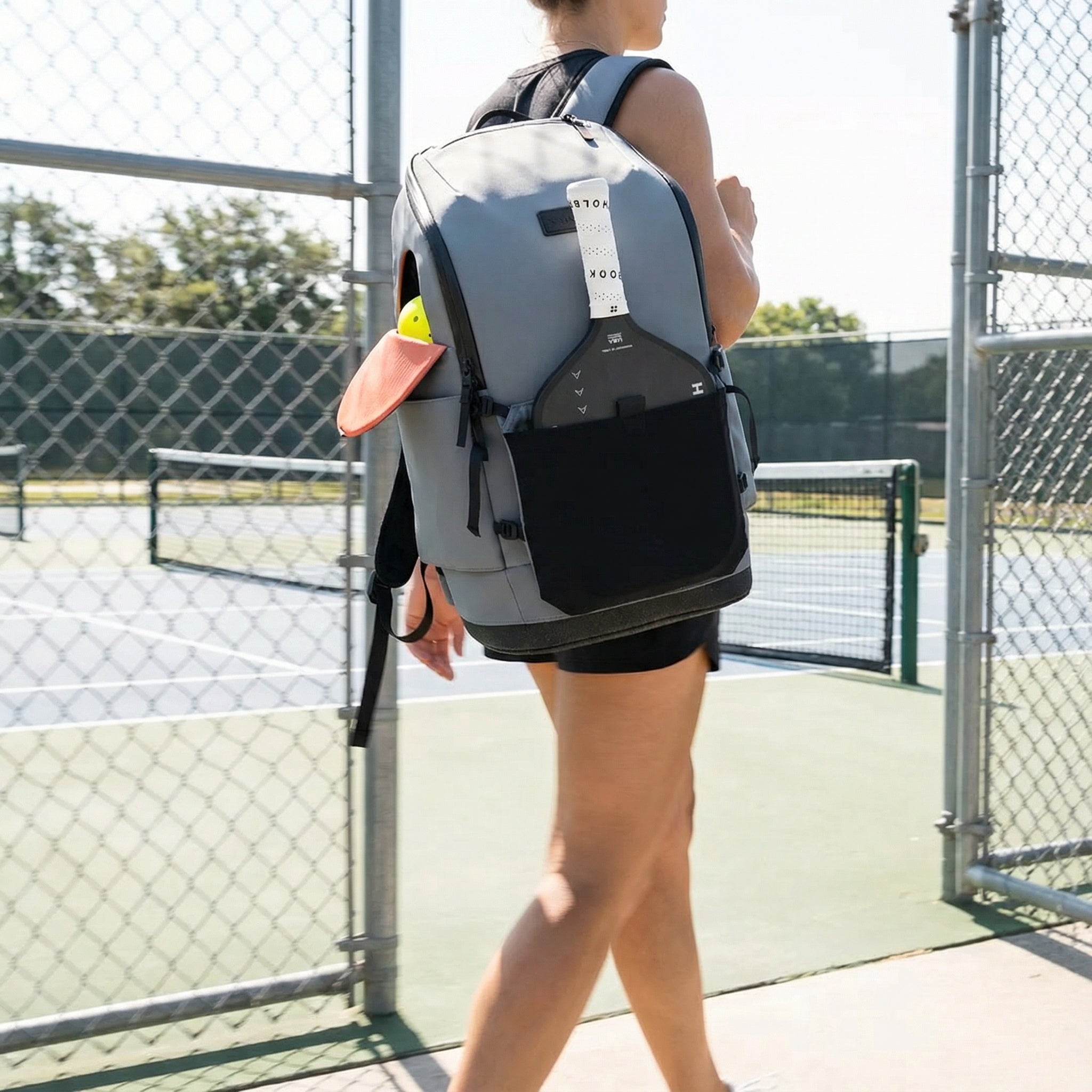
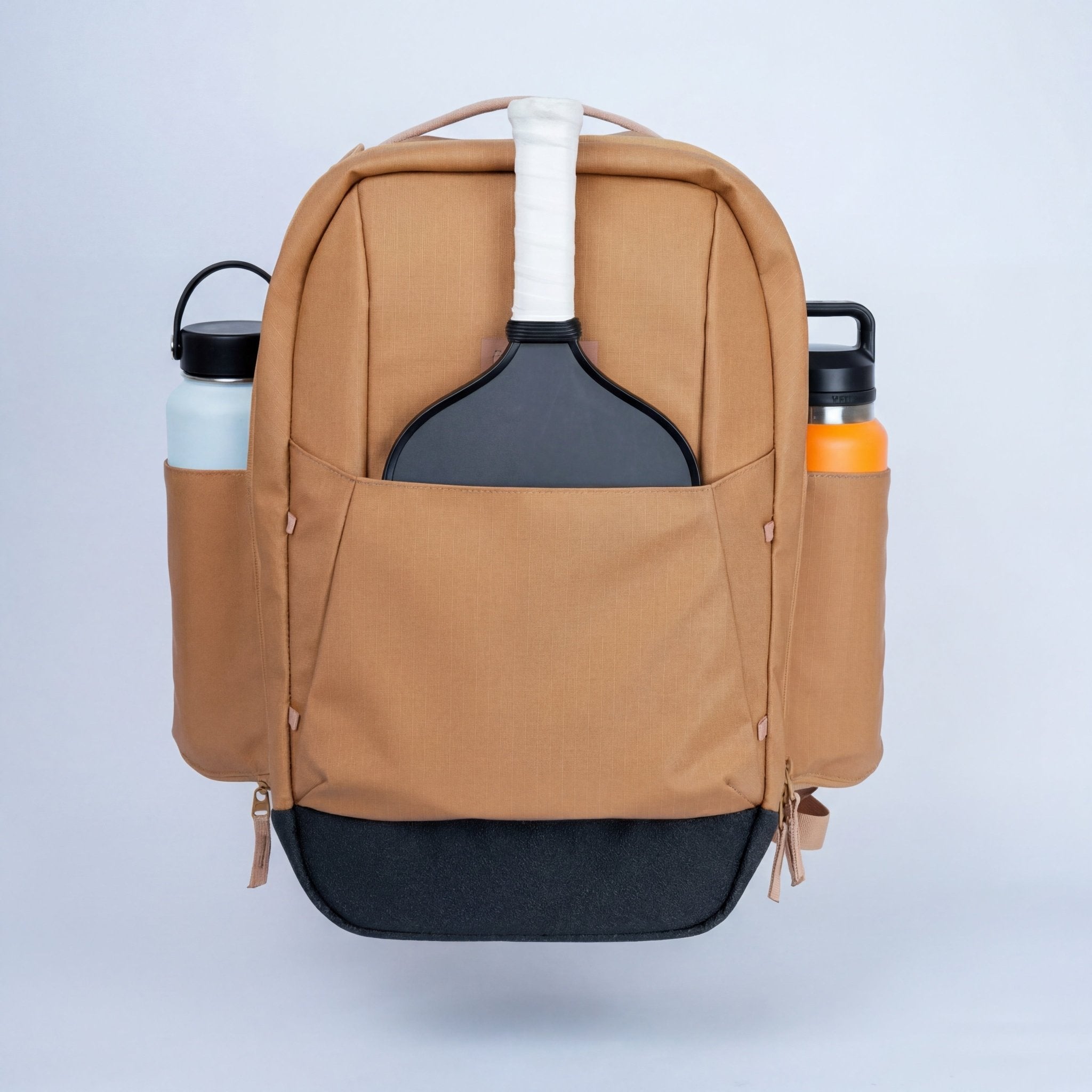
Before a dedicated grip drill block, having the right setup matters. The Court Ranger V2 ($195) fits your practice paddle, ball supply, and all your court essentials — designed for players who take their development seriously enough to structure their sessions. The Court Caddy ($325) adds a 15" laptop sleeve if you're heading from the office to the court for drill work.
FAQ: Pickleball Grip Questions
What is the correct pickleball paddle grip?
The continental grip is the standard correct starting point: place the base knuckle of your index finger on the upper-right bevel of the paddle handle, wrap remaining fingers naturally, and confirm the V between thumb and forefinger points toward the top bevel. Maintain grip pressure between 4–5 on a 10-point scale. This grip works reliably for volleys, dinks, and most kitchen play without requiring any switching between forehand and backhand.
Should I use the same grip for forehand and backhand in pickleball?
For beginners, yes — use the continental grip for both sides. Continental handles forehand and backhand reliably without switching, which is critical at the kitchen line where reaction time is minimal. Intentional grip switching between forehand and backhand is an intermediate-to-advanced technique that requires significant deliberate practice before it helps rather than hurts rally consistency.
How tight should I hold a pickleball paddle?
Target pressure 4–5 on a 1–10 scale — firm enough that the paddle won't twist on hard contact, light enough that you have full wrist mobility and touch sensitivity for soft shots. Most beginners default to 7–8, which feels like control but actively creates the soft-game errors they're trying to prevent. Conscious pressure reduction between points is the fastest single-session improvement most beginners can make.
Do different grip styles matter for beginners?
Grip position matters, but grip pressure matters more for most beginners. A beginner gripping at 8 with perfect continental placement will make more errors on soft shots than one gripping at 5 with slightly imperfect bevel position. Master pressure first, then refine position. Continental is the correct starting style — eastern and hybrid grips become relevant once your kitchen game is consistent and your pressure is reliably in the 4–5 range.
When should I switch from continental to eastern or hybrid?
Once you're playing 3+ times per week with consistent continental mechanics — reliable dinking, 20+ exchange rallies, no unforced errors from grip bevel inconsistency — experiment with adding eastern forehand mechanics for drives. Most players migrate toward a hybrid grip organically over their first year. Don't force the transition earlier; eastern grip benefits only show up once your foundational mechanics are stable.
How do I know if my grip is causing my errors?
Run the Pressure-Under-Speed Drill from Sessions 5–6 above. If your unforced error rate at pressure 7–8 is measurably higher than at pressure 4–5, grip tension is the primary variable. If error rates are similar across pressure levels, the issue is more likely grip position (bevel anchor) or paddle face alignment at contact — revisit continental placement and check for grip creep mid-rally.

Leave a comment
This site is protected by hCaptcha and the hCaptcha Privacy Policy and Terms of Service apply.