

Last updated: July 2026 · By Benjamin Carper
Your footwork is broken. For most recreational pickleball players, that's just the honest starting point — not an insult. Reaching for balls instead of moving to them. Arriving at the kitchen while still in motion. Standing flat-footed when your opponent hits. None of these are hand problems. They're foot problems, and the good news is that foot problems are fixable.
I played for six months before anyone told me my footwork was chaos. My hands were decent. My movement was a mess — reaching for drives, getting caught mid-court on third shots, shuffling with my feet crossing like I was doing a bad dance. Once I locked in the four fundamentals here, my error rate dropped in a way that felt almost embarrassing. It wasn't talent. It was mechanics I hadn't drilled.
This guide breaks down the four core movements, a diagnostic reference table for common mistakes, and a practice plan you can run solo or with a partner. We'll also cover what changes by court position — because the right footwork at the baseline is not the same thing as the right footwork at the kitchen.
The 4 Core Movements Every Pickleball Player Must Own
Before we dig into each one, here's the full list. Most footwork problems trace back to one of these four patterns done wrong — or not done at all:
- The split step — a small reactive hop timed to your opponent's contact point. Pre-loads your muscles for movement in any direction.
- The shuffle step — lateral movement along the kitchen line. Keeps hips square and balance centered.
- The transition drive — how you advance from the baseline toward the kitchen after your third shot. Most players botch this by sprinting in continuously.
- Adjustment steps — micro-corrections in the last half-second before contact. They set your strike zone and let you hit from a real position, not wherever you happen to be standing.
Beginners typically have none of these. Players who've been around for a year usually have a partial shuffle and some vague awareness of the split step. Players who actually drill footwork have all four — and it shows in a way that's immediately obvious to anyone watching.
Each movement lives in a specific zone. The split step is universal. The shuffle dominates at the kitchen line. The transition drive belongs to the middle of the court. Adjustment steps fire everywhere, but you'll feel their absence most when you're defending from the baseline. We'll cover all four, plus where each one breaks down.
Split Step: The Foundation of Every Shot (Most Players Skip This)
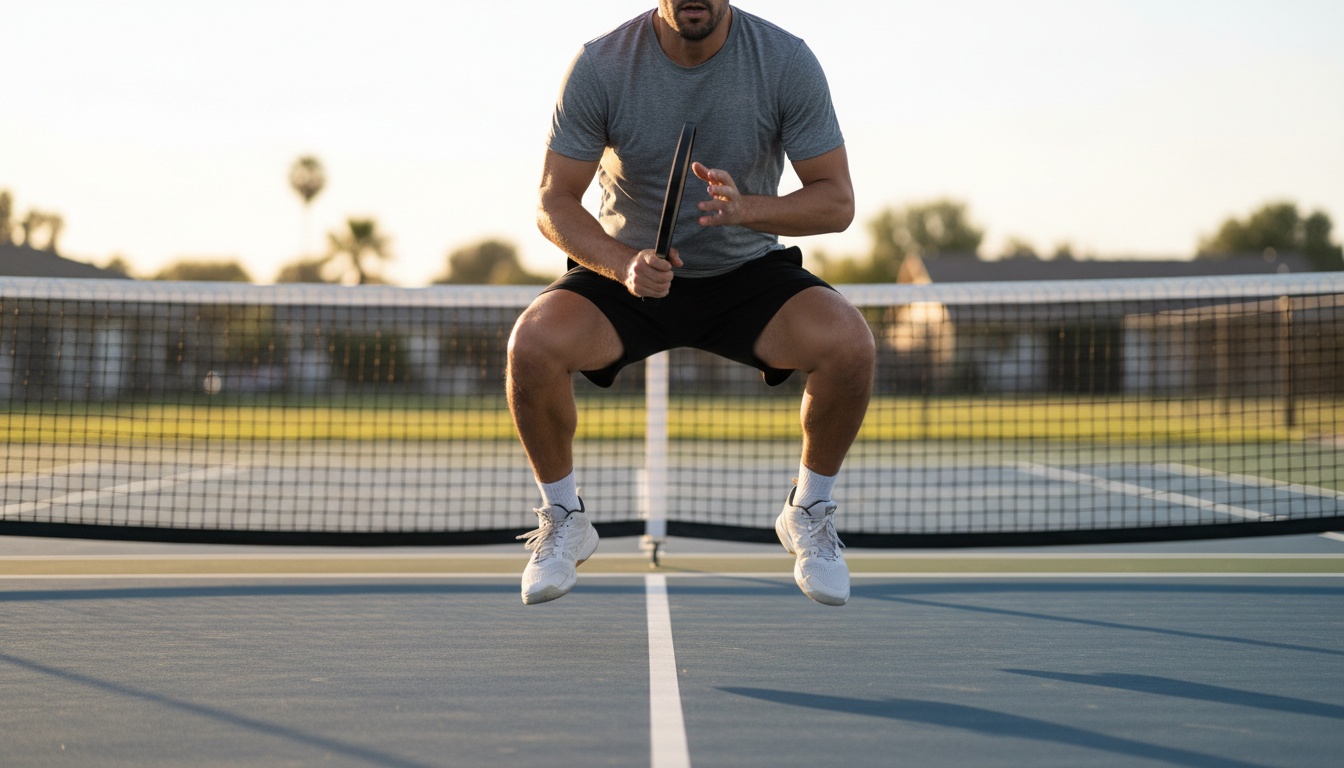
The split step is a two-footed hop — small, maybe two inches off the ground. Timed to land exactly when your opponent makes contact with the ball. Not when they start their swing. Not when you see the ball leave their paddle. When contact happens.
You land in an athletic ready stance: feet shoulder-width apart, weight on the balls of your feet, knees soft. From that loaded position, you can push off in any direction in a fraction of a second. Without it, you're flat-footed — and flat-footed means perpetually half a step late, no matter how fast your hands are.
The reason players skip it feels logical: standing still seems stable. Hopping feels like it might throw you off. Both of those instincts are wrong. A stationary player has zero reactive potential — the muscles aren't pre-loaded. The hop is what loads them.
At the baseline: Split step every single time your opponent hits. Through the whole rally, without exception. This is where the habit gets built — when you're comfortable and confident enough to stop thinking about it, that's exactly when you stop doing it.
At the kitchen: Smaller hop, same timing. Reaction windows are shorter here so timing matters even more. A half-second of flat-footedness at the non-volley zone can be the entire difference between a put-away and a pop-up.
The common mistake is skipping the hop when you think you know where the ball is going. Anticipation kills the habit. You pre-move, and when they go the other way, you're stuck. The split step is what lets you read direction correctly without getting punished when you're wrong.
"The split step is the one habit that separates players who move well from players who just look like they move well. I see 3.5-rated players guessing their way through rallies, skipping the hop. The moment they lock it in, they start winning exchanges they'd been losing for months." — Grub, co-founder of FORWRD, 4.5-rated player
Two-week challenge: in every rally this week, make the split step your primary focus — not your shot selection, not your placement. Just hop on every contact. Do this for 2 weeks straight and watch how many reaching errors disappear on their own.
How to Get to the Kitchen Without Getting Caught in No Man's Land
No man's land — the transition zone between roughly the service line and the non-volley zone line — is the most dangerous real estate in pickleball. You're too close to the net to let the ball drop, too far to volley offensively, and the ball arrives at its hardest angle when it reaches you mid-court. Getting stuck there costs you points systematically.
The goal after your third shot is to close distance to the kitchen. The mistake is treating this as a sprint. Players hit their drop shot, jog forward at constant pace, and arrive at the kitchen line just as the ball reaches them — feet still moving, no ready position established. That's exactly the sequence that produces pop-ups and easy put-aways for the opposing team.
The correct transition pattern:
- Hit your third shot drop or drive
- Advance 2-3 shuffle steps forward during the ball's flight time
- Split step and reset into ready stance as your opponents are about to make contact
- Read their shot — continue advancing only if they're not in attack position
- Repeat: advance, freeze, read, advance
This is sometimes called "moving in bursts." You don't walk in at a constant pace — you advance, stop, read, advance again. The stopping is what makes the moving work. Each freeze resets your readiness before you cover the next few feet of court.
In doubles, this movement is synchronized. If your partner advances while you lag behind, you've created a gap that good opponents will exploit every time. Move as a unit. It's fine to call "moving" out loud as you transition — it keeps both players on the same timing.
One more thing: when you're in the transition zone and the ball is at your feet, you don't need a perfect shot. You need a controllable, low-trajectory return that keeps the rally going while you finish closing the gap. A soft, low return that buys you two more steps is a real skill. A perfect dink from no man's land is mostly a fantasy.
The Shuffle: When to Use It and When It Fails You
Along the kitchen line, the shuffle is your default movement. Feet stay just outside shoulder width, weight centered, short lateral steps — maybe 6-8 inches of actual displacement per step — and your feet never cross. Hips square to the net throughout. This keeps you ready to hit from wherever you stop.
Done right, it's not flashy. It's controlled. You're not covering ground fast — you're covering it in a way that keeps your mechanics intact.
Done wrong, it looks like two things: feet that cross each other (overreaching per step), or a lateral lean that throws your weight to one side. Either version means you arrive at the ball off-balance — and that kills your shot quality regardless of how good your swing mechanics are in isolation.
Where the shuffle fails you: shots that pull you more than 2-3 shuffle steps. A ball hit sharply to your wide backhand corner is outside shuffle range. If you try to shuffle to it, you'll arrive late and reaching — which is the exact problem you were trying to solve. Wide balls outside shuffle range need a crossover step to close distance first.
The crossover step: one foot crosses in front of the other to cover more ground in a single movement, then you transition back into shuffle positioning once you're close. Players who only develop the shuffle get beaten consistently by wide balls. Build both and that weakness closes.
Serious about your court game?
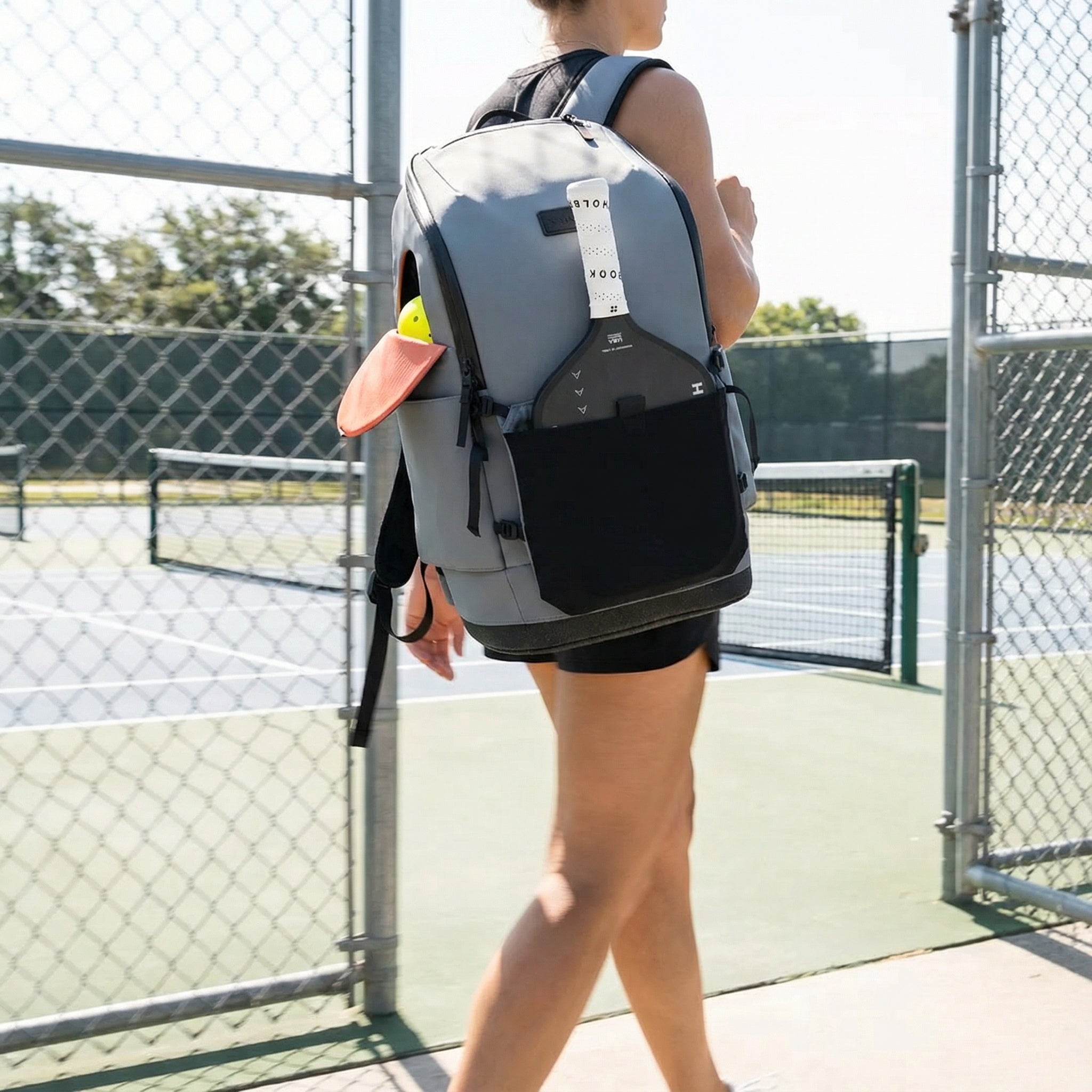
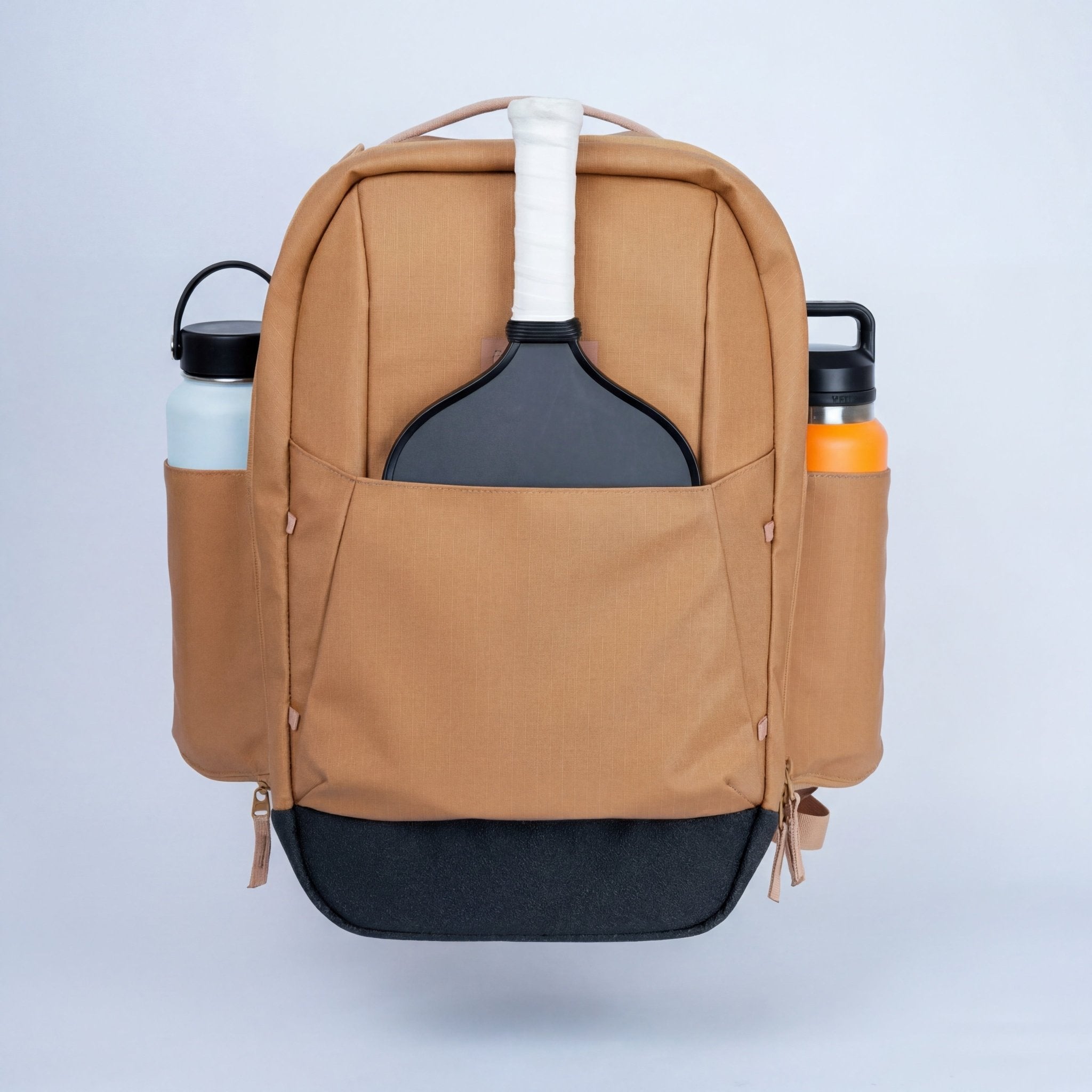
Players who drill regularly need a bag that keeps up — extra balls, grip rolls, and a 16" laptop sleeve for the commute that comes with taking pickleball seriously. The Court Ranger V2 was designed with 500+ real players for exactly that kind of use. $195.

Common Footwork Mistakes (With Drills to Fix Each One)
Here's what makes footwork troubleshooting hard: the same visible mistake can come from two different root causes, and fixing the wrong one wastes your practice time. The diagnostic table below is designed for this. Match your symptom to the root cause — then use the drill that actually addresses the problem.
Screenshot this. It's a more useful reference than watching generic "better footwork" tutorials, because it helps you identify which footwork problem you actually have.
| Mistake You Notice | Root Cause | Fix Drill |
|---|---|---|
| Always reaching for the ball | No split step — flat feet when opponent contacts ball | Partner calls "hit" on every swing; you hop on every call. Full 10-min rally, zero exceptions. |
| Feet crossing during lateral movement | Shuffle steps too wide; overreaching per step | Shadow shuffle: full kitchen length with no ball, self-check feet each step. 3 sets of 6 round trips. |
| Stuck in no man's land on every third shot | Continuous sprint — no burst-and-stop advance pattern | 3-shot pattern drill: feed, hit drop, advance 3 steps, freeze into ready stance. Solo. 10 reps. |
| Consistently late on wide backhand balls | Over-relying on shuffle for balls outside shuffle range | Partner feeds wide alternating balls. First step must be crossover. 20 balls each side. |
| Off-balance immediately after contact | No adjustment steps before contact — swinging from a static wide stance | Micro-steps rally: both players take at least 2 tiny adjustment steps before every contact. Forces the habit through play. |
Your Footwork Practice Plan: Solo and Partner Drills
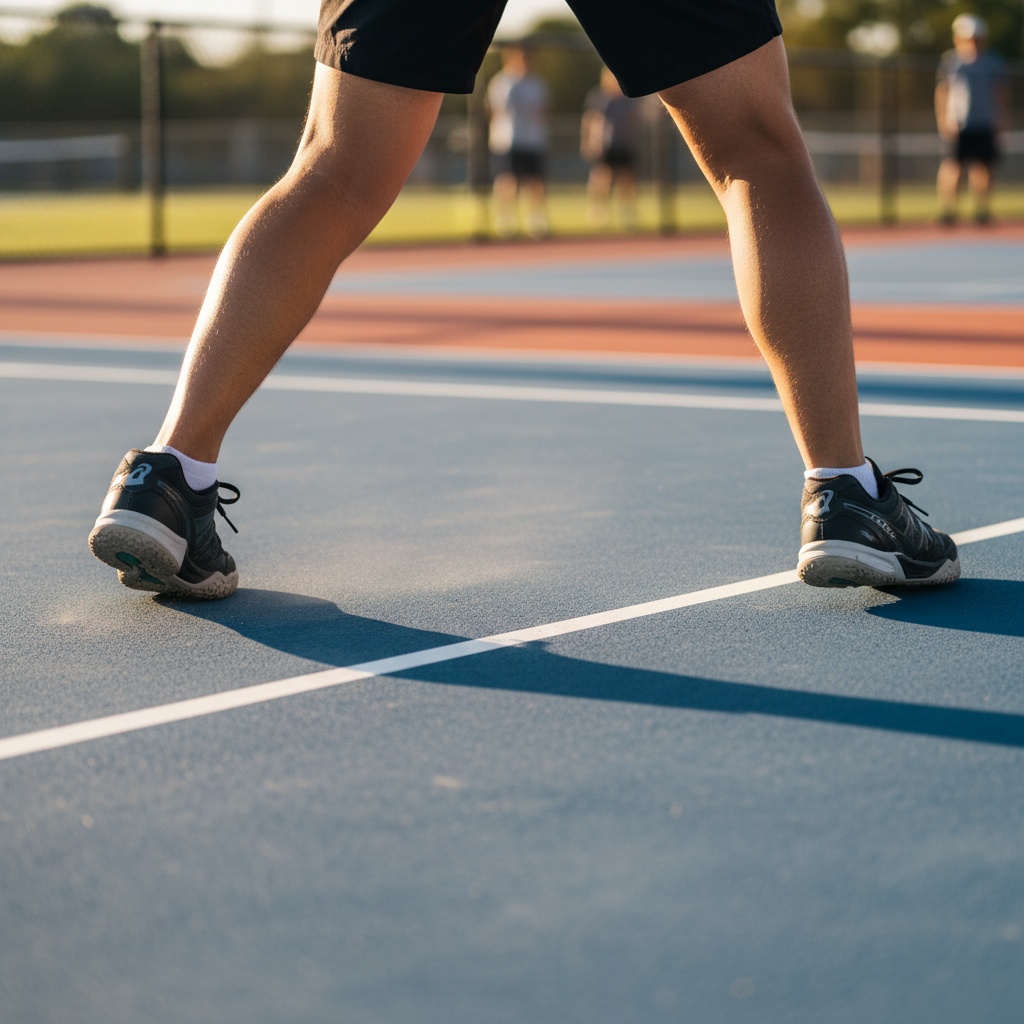
Most players only practice footwork while a ball is in play — which means they're simultaneously managing trajectory, shot selection, score, and movement at the same time. Cognitive overload kills habit formation. Shadow work, movement without a ball, is how the patterns actually become automatic.
Solo — 15 minutes, 2-3x per week:
- 5 min — Split step timing: Walk slowly across the court. Every 4-5 steps, pause and hop (simulating opponent contact), land balanced in ready stance, reset. Focus entirely on landing quiet and balanced. 10 reps across the baseline.
- 5 min — Kitchen shuffle circuits: Side-to-side the full kitchen length, 6 round trips. At each end, add a quick pivot to simulate turning for a lob. No ball. All mechanics.
- 5 min — Transition burst pattern: From the baseline, advance 3 shuffle steps forward, freeze in ready stance. Advance 3 more, freeze at the kitchen. Return to baseline. 8 reps.
Partner — add to any regular rally session:
- Split step drill: Your partner calls "hit" every time they swing. You hop on every single call, full 10-minute rally, without exception. Do this weekly for a month and it becomes unconscious.
- Wide-ball crossover drill: Partner alternates wide forehand and backhand feeds. Your first step must always be a crossover, not a shuffle. 20 balls each side. Force the pattern.
- Transition pattern drill: Standard 3-shot pattern — after every drop shot, the hitter advances in 2-3 burst steps before the next ball is fed. The focus is the stopping, not just the moving forward.
Fifteen minutes of deliberate shadow footwork three times a week produces more real improvement than three months of ball-only practice where movement is an afterthought. Players who move well didn't get lucky — they drilled it, usually on their own, usually before the ball came out of the bag.
For drills that build on solid movement fundamentals, see our pickleball drills guide for beginners and our court positioning guide — movement and positioning compound each other.
Complete Your Setup
Got your footwork dialed in? Now you need a bag that keeps up with regular court sessions. The Court Ranger V2 Backpack fits everything players who drill need — 16" laptop sleeve, modular paddle storage for up to two paddles, YKK AquaGuard weatherproof zippers. Designed with feedback from 500+ real players. $195 — built for court time, not just court appearances. Court Caddy if you're running a full tournament kit.
FAQ: Pickleball Footwork Questions
What is the split step in pickleball?
The split step is a small two-footed hop executed just as your opponent makes contact with the ball. You land with feet shoulder-width apart, weight on the balls of your feet, knees bent. This pre-loaded stance lets you push off in any direction immediately. It's the single most impactful footwork habit in the sport — and it's the most commonly skipped.
How do you move to the kitchen line in pickleball?
Move in bursts: advance 2-3 shuffle steps after your third shot, split step and freeze into a ready stance when your opponent is about to hit, then advance again. Don't sprint continuously or you'll arrive at the kitchen with your feet still moving and no time to reset your position.
Why is footwork important in pickleball?
Footwork determines whether you arrive at the ball in a balanced hitting position or off-balance and reaching. Most shot errors aren't hand problems — they're arrival problems. Good footwork puts you in the right place at the right time so your actual technique can work. Without it, even solid stroke mechanics produce inconsistent results.
What's the correct way to shuffle in pickleball?
Keep your feet just outside shoulder width, weight centered, and take short lateral steps (6-8 inches) without your feet ever crossing. Hips stay square to the net. Use the shuffle along the kitchen line for lateral coverage; for balls more than 2-3 shuffle steps away, lead with a crossover step to close the distance first.
How do you avoid reaching errors in pickleball?
Reaching errors almost always trace back to a missing split step. When you're flat-footed at your opponent's contact moment, you're always half a step late and forced to extend. Add the partner split step drill — partner calls "hit" on every swing, you hop on the call — for 2-3 sessions and watch the reaching frequency drop significantly.
What footwork drills work best for beginners?
Start with the split step timing drill — highest return for the time invested. Then add the kitchen shadow shuffle (no ball, just lateral movement practice). Both are solo-friendly, take under 15 minutes, and address the two most common beginner movement failures: flat-footedness when the ball arrives, and crossing feet along the kitchen line.

Leave a comment
This site is protected by hCaptcha and the hCaptcha Privacy Policy and Terms of Service apply.