

The 10 Pickleball Rules Every Beginner Gets Wrong — and the Correct Versions
Last updated: July 2026
Pickleball's basic rules: serve underhand crosscourt from behind the baseline, let the ball bounce on each side before volleying (two-bounce rule), don't volley from the kitchen, and only the serving team scores in traditional play. Games go to 11, win by 2. That's the framework. What the rulebooks don't tell you is which rules actually trip people up the first dozen times they play — and why.
I played my first six months thinking you could never step into the kitchen. I watched a full game convinced someone's score was wrong because I didn't understand the server number. And I'm willing to bet the kitchen momentum fault sent at least one point to my opponent before I learned what it was. These aren't edge cases — they're the rules that actually decide recreational games. Here are the 10 that get beginners every time.
The Beginner's Cheat Sheet — Screenshot This
| Rule | Common Mistake | Correct Version |
|---|---|---|
| Kitchen (NVZ) | "You can never stand in the kitchen" | You can stand there freely — just don't volley from it |
| Kitchen momentum | "I stepped out before I hit the NVZ" | If your volley's momentum carried you in, it's still a fault |
| Two-bounce rule | "After my return, I can volley anything" | Serving team must also let the return bounce before volleying |
| Serve height | Contacting ball above waist level | Ball must be hit below your navel on contact |
| Serve foot fault | Toes touching the baseline during serve | Both feet must be completely behind the baseline |
| Traditional scoring | "We score every time we win a rally" | Only the serving team scores — receiving team wins the serve back |
| Doubles score call | Calling only two numbers ("5-3") | Always call three numbers: serving score, receiving score, server number |
| Kitchen line | "The line itself is fine to touch while volleying" | The kitchen LINE is part of the NVZ — touching it while volleying is a fault |
| Out ball etiquette | Hitting a ball that was clearly going out | Once you hit it, it's in play — you can't "undo" the swing |
| 2026 freeze rule | "Only the server can win from game point" | The freeze is gone in 2026 — either team can win from game point |
The 10 Rules Beginners Get Wrong Most Often (And Why)
These aren't obscure technicalities. Every one of these comes up in a typical open play session. The reason they trip people up isn't stupidity — most rule explanations skip the context of WHY the rule is there, which makes the "wrong" version seem just as logical as the right one.
1. "You can never stand in the kitchen"
The most common kitchen misconception by a wide margin. Players get told "stay out of the kitchen" and interpret it as a permanent restriction. It's not. You can stand in the kitchen any time you aren't volleying. When your opponent hits the ball and it bounces in the NVZ, you can hit it from inside the kitchen. During dinking rallies, players routinely step in to let the ball drop. The restriction is narrow: don't volley (hit the ball before it bounces) while standing in the NVZ or touching the kitchen line.
2. The kitchen momentum fault
This one surprises experienced players too. You volley from behind the kitchen line, cleanly. The shot lands. But your forward momentum from the swing carries your foot into the kitchen. Fault. The rule covers the entire chain of events caused by the volley — the shot itself AND the movement that resulted from it. You don't have to touch the kitchen while contact happens. The moment your momentum puts you in the NVZ after the volley, it counts as a violation. The only fix: don't let your swing create forward momentum you can't stop before the line.
3. Misreading the two-bounce rule
Beginners usually learn the two-bounce rule as "the serve has to bounce." That's half of it. The return also has to bounce before the serving team can volley. So: serve bounces, receiver hits it, that return must bounce before anyone on the serving team can volley. After those two bounces, both teams can volley freely. The point of the rule is to prevent serve-and-volley rushing to the net. Both teams have to go through a bounce phase before the kitchen battles begin.
4. Serve contact above waist height
Traditional serves require the paddle to contact the ball below your navel. Specifically: the highest point of the paddle head must be below your wrist at contact, AND the contact point must be below your waist. It's one of the most common serve faults in recreational play — players who are used to tennis or racquetball naturally swing high. The drop serve (releasing the ball and letting it bounce before serving) is the easiest way to guarantee legal contact if the waist-height rule is confusing you. It's been fully legal since 2021 and was confirmed again in the 2026 rulebook.
5. The foot fault during the serve
Both feet must be completely behind the baseline and within the sideline and centerline extensions at contact. Not at the baseline — behind it. Toes on the line counts as a foot fault. In casual open play, this gets called less than it should, but in any organized game or tournament it will cost you. The fix is simple: step back one extra foot before serving and you'll never worry about it again.
6. How traditional scoring actually works
In traditional side-out scoring, only the serving team scores. When the receiving team wins a rally, they win the serve — but not a point. They then start serving and can score. This feels counterintuitive coming from tennis or volleyball. The logic: the serving team has a structural advantage (they get to execute the first shot), so the scoring system compensates by only letting the server score. You have to earn the serve before you can earn the point.
7. Calling the score wrong in doubles
Doubles score is always three numbers: serving team score, receiving team score, server number. "5-3-2" means the serving team has 5 points, the receiving team has 3, and the current player is Server 2. The server number resets to 1 at the start of each new service game. Each side gets two servers per service game (except the very start of the match — the team that serves first only gets one server to limit early advantage). Calling just "5-3" is technically a fault and definitely causes confusion.
8. Hitting a ball that was going out
One of the more painful beginner experiences: a ball sails clearly outside the sideline, you swing instinctively, and suddenly it's your fault even though the ball would have been out. Once you make contact, the result stands. If you hit an out ball, it's in play. This is one of the most valuable habits to develop early: letting balls drop and reading the trajectory before committing to a swing. Players who master "let it go" early save points constantly.
9. The kitchen LINE is part of the NVZ
The white line marking the boundary of the non-volley zone is included in the NVZ. Touching the line with your foot while volleying is a fault — same as being fully inside the kitchen. This surprises people because in most racket sports, boundary lines are "in." In pickleball, the kitchen line is treated as kitchen. If your heel brushes the line mid-swing, you've faulted.
10. The 2026 freeze rule elimination
This one trips up experienced players, not just beginners — which means you have an opportunity to know the rule better than people who've been playing for years. In traditional scoring, when a team reached game point, a "freeze" rule kicked in: only the serving team could win the game on that point. The receiving team could win the serve but not the game.
In 2026, USA Pickleball eliminated the freeze (Rule 14.A.2). Now, either team can win from game point — whether they're serving or receiving. If you're at 10-9 and your team is receiving, and you win the rally, that's match. No freeze, no waiting to be the server. This changes how game-point pressure plays out and is worth knowing before your first tournament.

The Basics: What You Actually Need to Know Before Your First Game
Court dimensions: 20 feet wide, 44 feet long (same as a doubles badminton court). Net height: 36 inches at the sidelines, 34 inches at center. Kitchen extends 7 feet from the net on each side. That's the whole court — simpler than most people expect.
The game plays to 11, win by 2. Tournament play sometimes goes to 15 or 21, but 11 is standard for recreational doubles. Singles uses the same rules with one player per side.
On gear: you need a paddle (graphite and fiberglass are the two most common face materials for beginners — carbon fiber comes later), balls (outdoor balls are harder and have smaller holes, indoor balls are softer with larger holes), and court shoes. Regular sneakers work for casual play, but dedicated court shoes make a real difference once you're playing twice a week.
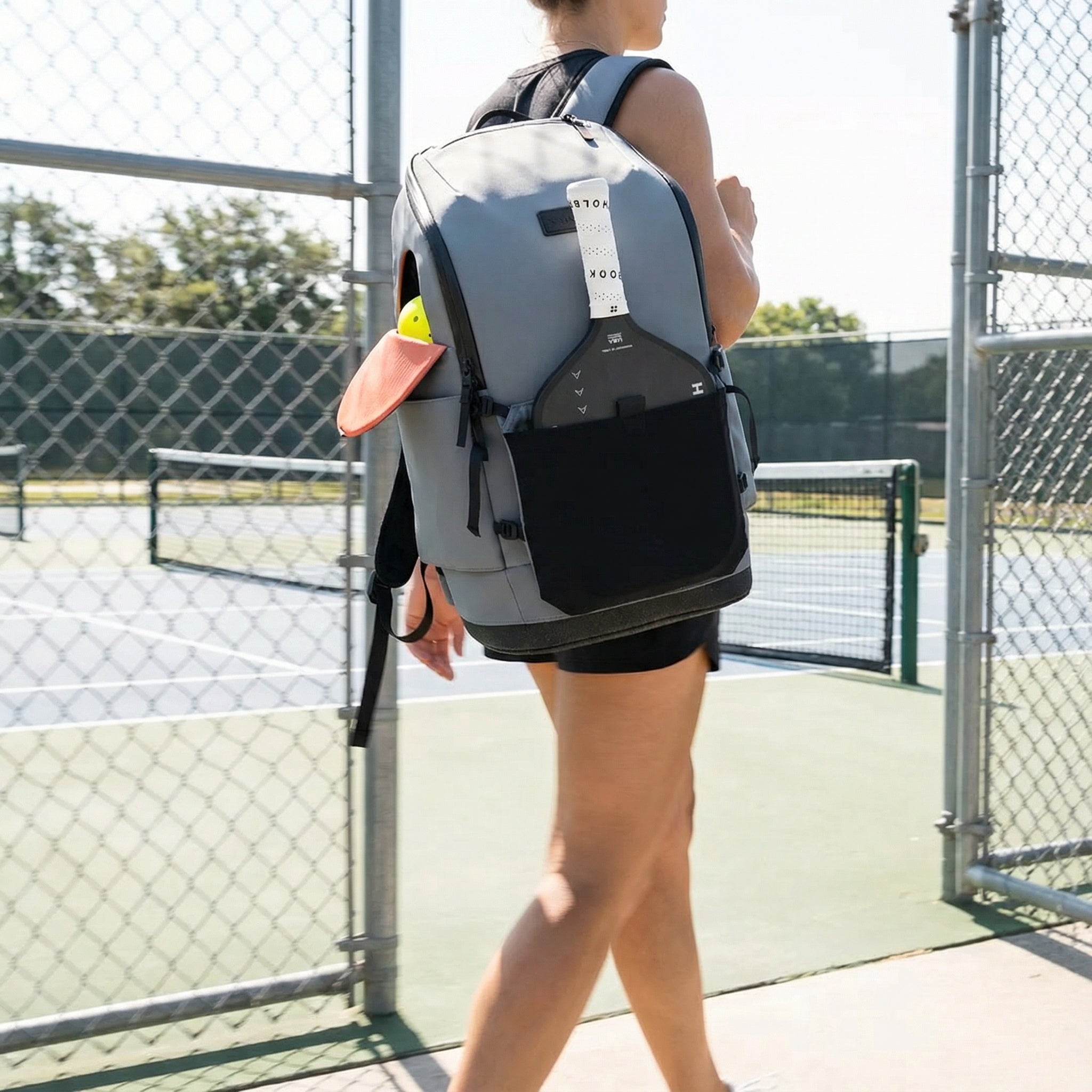
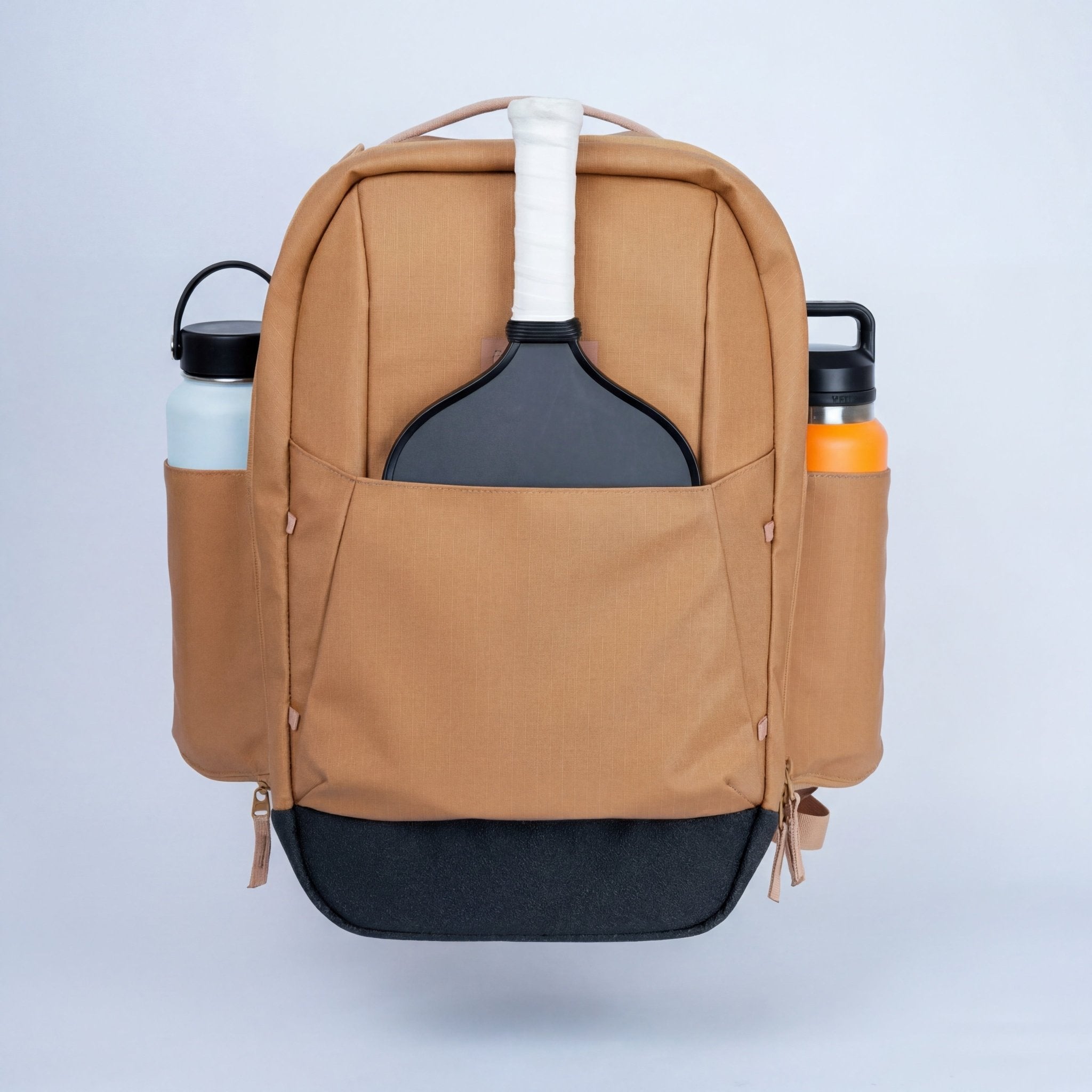
For a bag: you'll be carrying paddles, a water bottle, extra balls, and eventually a change of shoes. The Court Ranger V2 ($195) fits everything cleanly — 16" padded laptop sleeve doubles as a gear compartment, weatherproof zippers hold up on outdoor courts, and it doesn't look like a sports bag from 2009. If you're just starting out and don't want to invest in a full bag yet, any backpack works. The Court Ranger V2 is worth it once you're playing 3+ times a week.

Learn the beginner drill progressions alongside the rules — drilling serve targeting and cross-court dinks in your first month builds the mechanical foundation that makes the rules actually make sense on court.
The Kitchen Rule: It's Simpler Than Everyone Makes It Sound
Here's the one-sentence version: don't volley while standing in or touching the kitchen. Everything else about the kitchen is either elaborating on that sentence or defining what counts as "touching the kitchen."
What counts as NVZ contact: your feet, any part of your clothing, your paddle. If your hat falls in during a volley, that's a fault. These scenarios are genuinely rare, but they're in the official rulebook.
What's legal in the kitchen:
- Standing in it at any time you're not volleying
- Hitting the ball after it bounces in the NVZ
- Reaching into the NVZ with your paddle to hit a ball that's bouncing there
- Standing in the kitchen and then stepping out to volley — as long as both feet are out of the NVZ and not touching the line at contact
The NVZ forces the soft game. Without it, every player would camp at the net and smash every ball out of the air. The kitchen creates dink rallies, patience, and strategy. Once you understand WHY it exists, the rule makes more intuitive sense.
For the full breakdown of kitchen rules including the most-argued interpretations in 2026, the Pickleball Kitchen Rules guide covers everything with specific scenarios.
"The kitchen rule is the thing that makes pickleball pickleball. Every player I've taught who got frustrated by the kitchen in their first month became obsessed with the dinking game six months later. The rule that feels restrictive becomes the skill you're proudest of."
— Grub, FORWRD Co-Founder
Serving Rules: The One Fault Every Beginner Hits
The serve is the only shot you control completely — no reaction time, no opponent pressure. So it's also the only shot where faults are entirely self-inflicted. Most beginner serve faults fall into three categories:
Height fault. Contact must be below your navel. The paddle head must be below your wrist at contact. If you swing with a high swing path like a tennis serve, you'll fault this consistently. The fix: drop the swing path. Think of it as a pushing motion upward from hip height, not a swing from shoulder height.
Foot fault. Both feet behind the baseline, completely. One common variation: players stand with their dominant foot slightly forward, toes touching the line. That's a fault. Step back six inches and the problem disappears permanently.
Crosscourt only. The serve must land in the diagonally opposite service box. Down-the-line serves are illegal. The ball must clear the kitchen (non-volley zone) — serves that land in the kitchen are faults.
If the height and foot fault rules are creating mental overhead, use the drop serve. Release the ball, let it bounce once, then serve after the bounce. The waist-height restriction still applies on contact, but the bounce naturally puts the ball at a lower strike zone. The drop serve has been legal since 2021 and is explicitly confirmed in the 2026 rulebook — there's nothing informal or unofficial about it.
Scoring in Pickleball: Side-Out vs Rally Scoring (2026)
Traditional pickleball uses side-out scoring: only the serving team scores, games go to 11 (win by 2), and you call the score as three numbers in doubles. This is the format you'll play in most recreational open play and most tournaments.
How doubles scoring works: The first server in each service game is Server 1. If Server 1 faults, Server 2 serves. If Server 2 faults, serve passes to the other team (a "side-out"), and they start with Server 1 on their side. Each team scores only when they're serving. This creates the rhythm of recreational pickleball: trading rallies for serve without scoring, then capitalizing once you have the serve.
Rally scoring — where every rally is worth a point regardless of who serves — does exist in some formats. The PPA Tour uses rally scoring to 15 in some events. Most recreational play doesn't use it, but if you're playing a modified format, ask before the first serve which scoring system is in play.
The 2026 rule change worth knowing: the "freeze" is gone. In the old traditional scoring, once a team reached game point (10 in an 11-point game), a "freeze" rule prevented the receiving team from winning the game — they could only win the serve, not the point, until they became the server. In 2026, USA Pickleball eliminated the freeze entirely. Either team can win from game point, whether serving or receiving. If you're at game point and you're receiving, and you win the rally — game over. No more "serving team only wins from game point."
Mid-game score reminder:
Always call the full score before serving — serving score, receiving score, server number. "Four-two-one" means your team has 4, they have 2, and you're Server 1. Calling the score isn't optional; it's a requirement under official USA Pickleball rules.
Ready to move from rules to strategy? The Transition Zone Strategy guide covers how to get from the baseline to the kitchen without getting picked off in no man's land — the position problem that rules-knowledge alone won't fix.
New to pickleball and serious about improving fast?
The Court Ranger V2 is built for players who practice 3x/week — 16" padded compartment, weatherproof YKK zippers, modular paddle sleeve. Designed with 500+ real players. $195.
Shop the Court Ranger V2 →FAQ: Common Beginner Pickleball Rule Questions
What are the basic rules of pickleball for beginners?
Serve underhand crosscourt from behind the baseline. Both sides must let the ball bounce once each before volleying (two-bounce rule). Don't volley from the kitchen (NVZ). In traditional scoring, only the serving team scores; games go to 11, win by 2. That covers 90% of what you need for your first game.
What's a fault in pickleball?
A fault stops play and awards the rally to the other team. Common faults: volleying from inside the NVZ or touching the kitchen line while volleying, serving above waist height, foot fault on serve, hitting a ball out of bounds, and the two-bounce violation. The kitchen momentum fault — where your volley's momentum carries you into the NVZ after contact — also counts.
What's the two-bounce rule in pickleball?
After the serve, the ball must bounce once on each side of the net before either team can volley. Serve bounces for the receiver, return of serve bounces for the serving team. After those two bounces, both teams can volley freely. The rule prevents serve-and-volley rushing and forces a ground-stroke exchange before kitchen battles begin.
Can you volley in the kitchen in pickleball?
No. Volleying while standing in the kitchen or touching the kitchen line is a fault. You can stand in the kitchen freely when you're not volleying — between shots, during bounced-ball exchanges, any time you're not hitting the ball out of the air. The restriction is specific to volleys, not to presence in the zone.
What are the 2026 pickleball rule changes beginners should know?
The main 2026 change: the "freeze" is eliminated (Rule 14.A.2). Previously, at game point in traditional scoring, only the serving team could win the game — receiving teams had to win the serve first. In 2026, either team wins from game point, serving or receiving. The drop serve also remains fully legal and confirmed in the 2026 rulebook.
How do you keep score in pickleball?
Doubles score is always three numbers: serving team's score, receiving team's score, server number. "6-4-1" means serving team has 6, receiving team has 4, and it's Server 1's turn. Only the serving team scores in traditional play. When the serving team faults, serve goes to their partner (Server 2), and if they also fault, serve goes to the other team entirely — a side-out.

Leave a comment
This site is protected by hCaptcha and the hCaptcha Privacy Policy and Terms of Service apply.