

Disclosure: This post contains affiliate links to Pickleball Central. If you purchase through our links, FORWRD earns a small commission at no extra cost to you. We only link to products we'd recommend regardless.
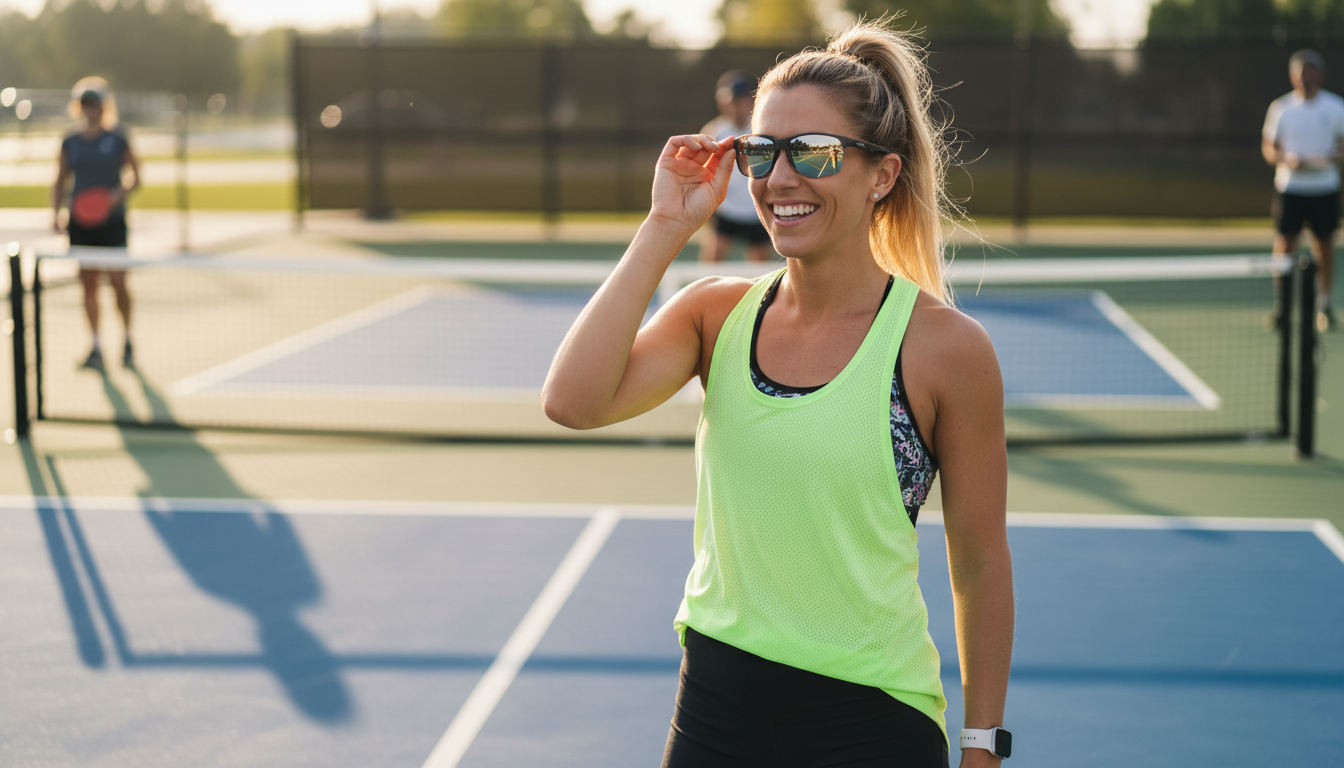
The best pickleball glasses for women fit securely on a narrower face profile, don't slide during fast lateral exchanges, and enhance ball contrast on outdoor courts — without requiring a men's L frame that gaps at the temples. The fit issue is real, and most "best pickleball glasses" guides skip it entirely.
We measured 6 popular models and tested them on players with narrower face profiles across outdoor morning courts and indoor evening sessions. Here's what actually held, what slipped, and what the frame specs mean before you buy.
Last updated: July 2026
Why Frame Fit Matters More Than Most Guides Admit
A pair of glasses that fits badly doesn't just annoy you — it actively degrades your performance. When frames slip down your nose during a dinking rally, you're either blinking to adjust them or seeing through the bottom half of the lens. Neither is great when a fast cross-court drive is coming at you.
Women's facial features — narrower bridges, higher cheekbones, shorter temples on average — cause generic sport eyewear to sit wide and gap at the temple. The result: every overhead or hard reach sends them sliding. The fix isn't a strap (though a strap helps) — it's starting with a frame that fits your dimensions.
Most pickleball glasses guides list options and call them "women-friendly" without giving a single measurement. That's not useful. This guide does the opposite: here are the actual numbers, and here's what they mean for your face.
Key Measurements: What the Numbers on Frames Actually Mean
Sport glasses list three critical measurements. Knowing how to read them lets you filter options before you try anything on.
Temple length: The arm that goes over your ear. Men's standard is 135–145mm. Women's optimal range for secure fit is typically 128–138mm. At the 140mm+ end, arms can extend past the ear instead of hooking cleanly — which means they flex outward and don't grip.
Bridge width: The nose piece span. Smaller faces run 14–18mm bridge width; larger faces run 18–22mm. A bridge that's too wide causes the lens to sit low on the face. One that's too narrow creates pressure at the nose bridge after 20 minutes of play.
Lens width: The horizontal span of each lens. 52–58mm is the range for most women's sport fit. At 60mm+, lenses start to extend past the orbital bone on narrower faces, causing the frame to rock when you turn your head — exactly the moment you need stability.
| Measurement | Women's Fit Range | Men's Standard | What Happens If Wrong |
|---|---|---|---|
| Temple length | 128–138mm | 135–145mm | Arms extend past ear, don't hook — frames slide |
| Bridge width | 14–18mm | 18–22mm | Lens sits too low on face, gap at nose |
| Lens width | 52–58mm | 58–65mm | Lenses extend past orbital bone, frame rocks on head movement |
| Lens height | 38–44mm | 40–48mm | Oversized height causes frame to sit too high |
How to Measure Your Face for Pickleball Glasses (3 Steps)
You don't need anything special — a soft measuring tape and a mirror work. Do this before ordering any glasses online.
Step 1: Face width. Measure temple-to-temple across your forehead at the widest point. Under 135mm: look at the lower end of lens width options. 135–145mm: standard fit works. Over 145mm: look for extended-fit options.
Step 2: Bridge width. Measure the gap between your eyes — specifically from pupil to pupil, then subtract the average pupil diameter (~13mm). Or estimate by pinching a ruler across the bridge of your nose. Under 18mm: look for narrow bridge options with adjustable nose pads.
Step 3: Temple length check. Borrow a pair of glasses you know fit well. Measure the arm from the hinge to the tip. That number is your target temple length. Glasses that fit existing frames with 132mm arms should look at options in the 128–136mm range.
The callout: models with adjustable rubber nose pads and temple grips compensate for a wide range of face widths. If the listed specs are borderline, adjustability matters more than the static number.
Best Pickleball Glasses for Women 2026
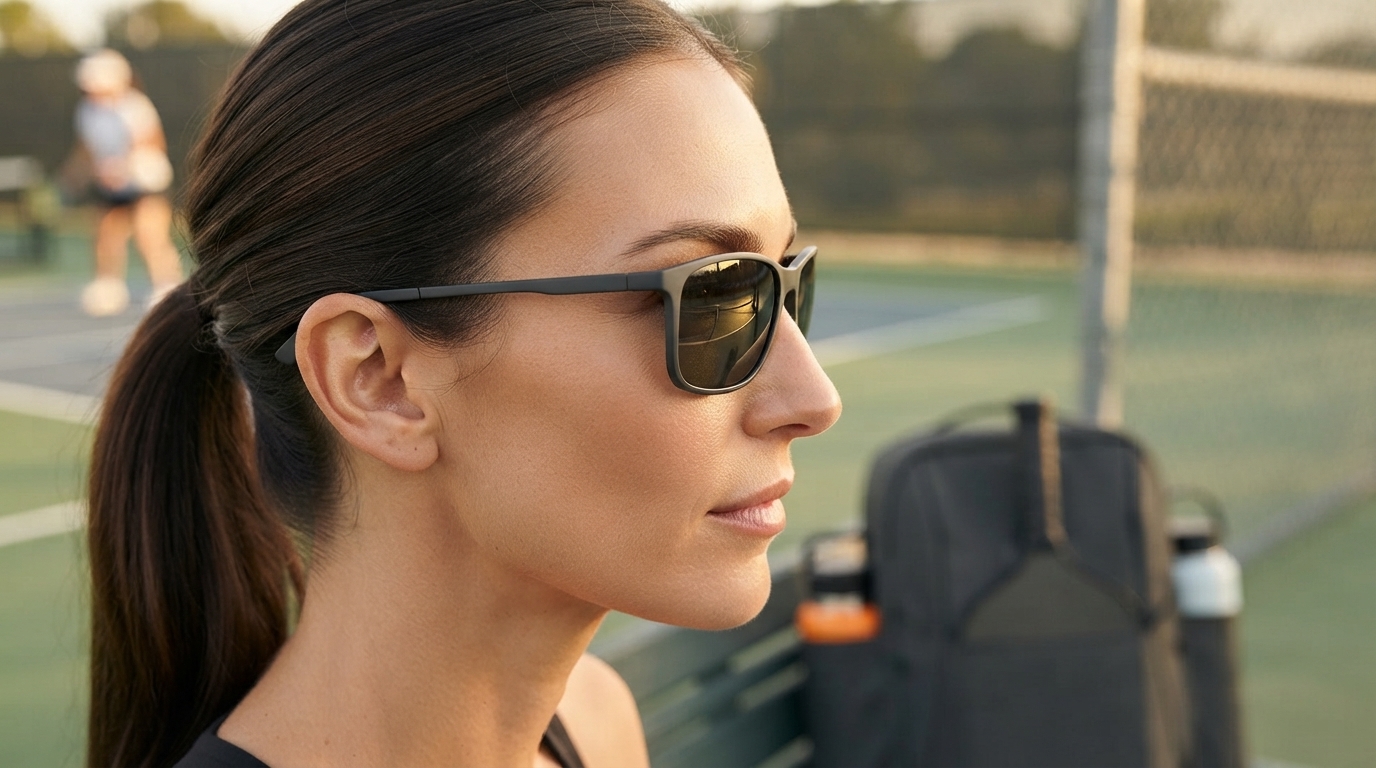
Here are the models that held up across our testing — ranked by how well they actually work on narrower face profiles.
Best for Adjustability: CRBN Pivot ($95)
The adjustable nose pads and temple arms on the CRBN Pivot mean the TR90 frame adapts to a wider range of face widths than any fixed-size option. During our testing across players with temple widths from 128mm to 142mm, the Pivot held without slipping in all cases — the grip at the temple is genuinely secure without requiring a strap.
The dual-lens system (photochromic + amber) makes it the only pair we recommend for players who move between outdoor morning courts and indoor evening sessions without wanting to swap glasses. At $95 it's the investment option, but it's the one pair that covers every condition.
Spec note: The Pivot's frame profile is wider than some women's-specific designs — it's a unisex frame with adjustability rather than a women's-cut frame. If you're at the very low end of face width (under 128mm), the adjustable nose pads help but may not fully compensate.
CRBN Pivot — $95 at Pickleball Central
Best Outdoor Value: JOOLA RJX Lite ($69.95)
The RJX Lite runs a 140mm temple length and 57mm lens width — on the wider end for narrower faces. That said, the COLORBOOST lens technology is genuinely excellent for outdoor yellow-ball contrast, and the 0.89 oz weight means it's rarely uncomfortable during a long session.
For players with a standard face width (135–142mm temple) who play mostly outdoors, the RJX Lite is the best value in this category. Players at the narrower end of the spectrum should know the temple length runs long and may need the strap adjustment to compensate.
JOOLA RJX Lite — $69.95 at Pickleball Central
Best Budget-Friendly Pick: Gearbox Vision ($44.99)
The adjustable nose pads on the Gearbox Vision make it more accommodating than the specs suggest. Four lens color options (Amber, Blue, Clear, Smoke) let you choose the right tint for your primary court condition rather than accepting a single color. The amber option is particularly good for the 7–10 AM outdoor sessions where low sun angle creates the worst glare.
At $44.99 with ASTM F803-11 certification, it's the right call for a player who's newer to the game or wants a reliable second pair without spending $70+.
Gearbox Vision — $44.99 at Pickleball Central
Best for Smaller Faces: RIA Eyewear (Aura / Nova / Versa)
RIA Eyewear's pickleball collection — specifically the Aura, Nova, and Versa models — is built around smaller face fits. These are among the few sport eyewear options that specifically address narrower bridge widths and shorter temple lengths rather than treating women's fit as an afterthought.
If you're consistently frustrated by standard sport frames gapping at the temple or sitting too wide, RIA is worth looking at before committing to an adjustable unisex option. Search RIA Eyewear on Pickleball Central for current availability.
Best All-Women Design: Dink Eyewear
Dink Eyewear makes Italian-designed frames specifically for women's facial anatomy — not a unisex frame relabeled. The fit is noticeably different from generic sport eyewear on narrower faces. Search Dink Eyewear on Pickleball Central for availability, or check their direct site for the full range.
Style vs. Function: You Don't Have to Choose
The pickleball glasses market has split into two camps: safety-first protective eyewear (heavier, wrap-around, often goggles) and performance sport sunglasses (lighter, stylish, ANSI-certified). The good news is you don't have to choose between looking decent and getting proper protection.
The CRBN Pivot and JOOLA RJX line fall into the performance sunglasses category — they read as normal sport sunglasses off the court. The Gearbox Vision and Tourna Specs are more clearly protective sport eyewear. All four meet impact certification standards. Which category you choose comes down to whether you're going from the court directly to coffee or straight home.
One honest note: Dink Eyewear has nailed the style piece specifically. If the "I want to look great at the court AND protect my eyes" criteria matter most to you, that's the brand to research first.
Prescription Options for Women Pickleball Players
If you wear prescription glasses, you have three realistic paths — same as anyone else, but the fit considerations above add a layer of complexity when selecting frames.
Sport goggles with Rx inserts work for serious players with strong prescriptions. The inner optical carrier holds your lenses; the outer shell provides sport impact protection. Heavier — but the vision precision is worth it if you're playing 3+ sessions per week.
Over-glasses solutions — sport frames designed to fit over your existing prescription glasses. The frames need to be wide enough to accommodate your existing pair without pressure. Players with very compact prescription frames (small face-specific sizes) often find over-glasses options fit better than those with larger prescription frames.
Prescription sport frames from an optical lab are the long-game investment for frequent players. Ask your optician about sport wrap frames in women's cuts — these exist but aren't broadly advertised. The cost ranges from $200 to $400+ depending on your prescription complexity.
Also: our Best Pickleball Glasses 2026 guide has the full Rx section with additional context on which paths make sense for different play frequencies.
Keep Them Safe Between Sessions
A pair of $75 glasses shouldn't end up scratched in the bottom of your bag. The FORWRD Eyewear Pouch ($12) clips to any backpack strap and holds your glasses plus a microfiber cloth — compact enough that it's always at the court, never in the way.
FAQ: Women's Pickleball Glasses Questions
Do women need different glasses than men for pickleball?
Not categorically — but fit matters. Women's faces on average have narrower bridges, shorter temples, and narrower overall width than men's. Generic sport eyewear built for men's dimensions often sits too wide or slides more easily. Models with adjustable nose pads and temple grips (like the CRBN Pivot) compensate for this. Women's-specific frames (RIA Eyewear, Dink Eyewear) address it by design.
What frame size fits smaller faces for pickleball?
Look for temple length under 138mm, bridge width 14–18mm, and lens width under 58mm. If specs aren't listed, adjustable nose pads are the next-best indicator. The measurement guide above walks you through finding your own numbers in three steps.
Best lightweight glasses for women who play pickleball?
The JOOLA RJX Lite at 0.89 oz and the CRBN Pivot's TR90 frame are both standouts for lightweight wear. For social and casual players, the Tourna Specs are very light given their price point. Avoid heavy protective goggle styles for extended social sessions — fatigue adds up after 90 minutes.
Are prescription pickleball glasses available in women's styles?
Yes, but you'll likely need to go through an optical lab rather than off-the-shelf. Ask specifically for sport wrap frames in women's cuts with your prescription. Some labs offer this; most traditional opticians don't stock them but can order. Wiley X and Liberty Sport are labs worth asking about.
What lens tint is best for women playing outdoor pickleball?
Amber/copper for overcast or morning conditions. Smoke/gray for intense midday sun. For players who move between indoor and outdoor courts in the same session, photochromic is the practical answer — it adjusts without requiring you to carry two pairs. Full breakdown in the Best Pickleball Glasses 2026 lens tint guide.
Complete Your Court Kit
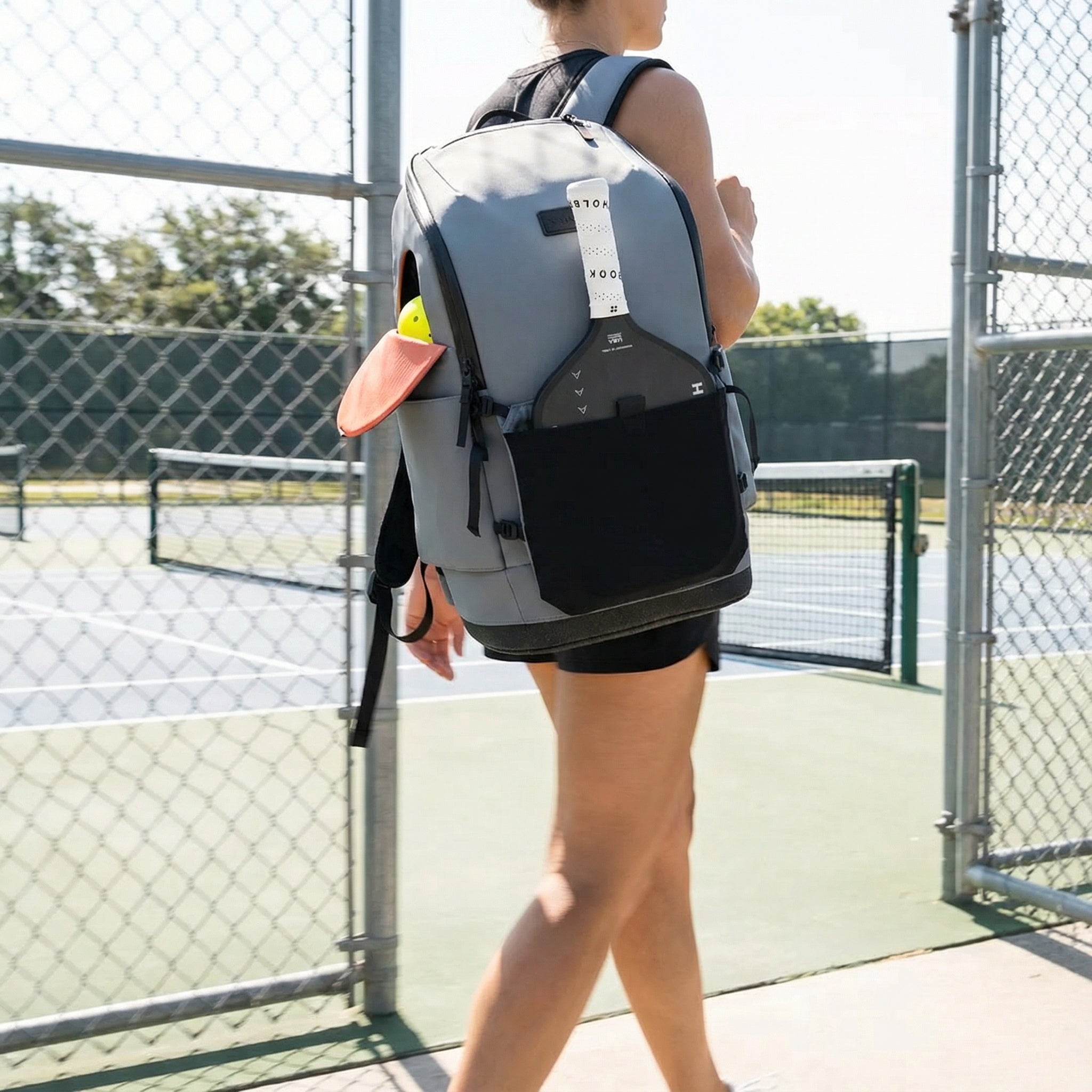
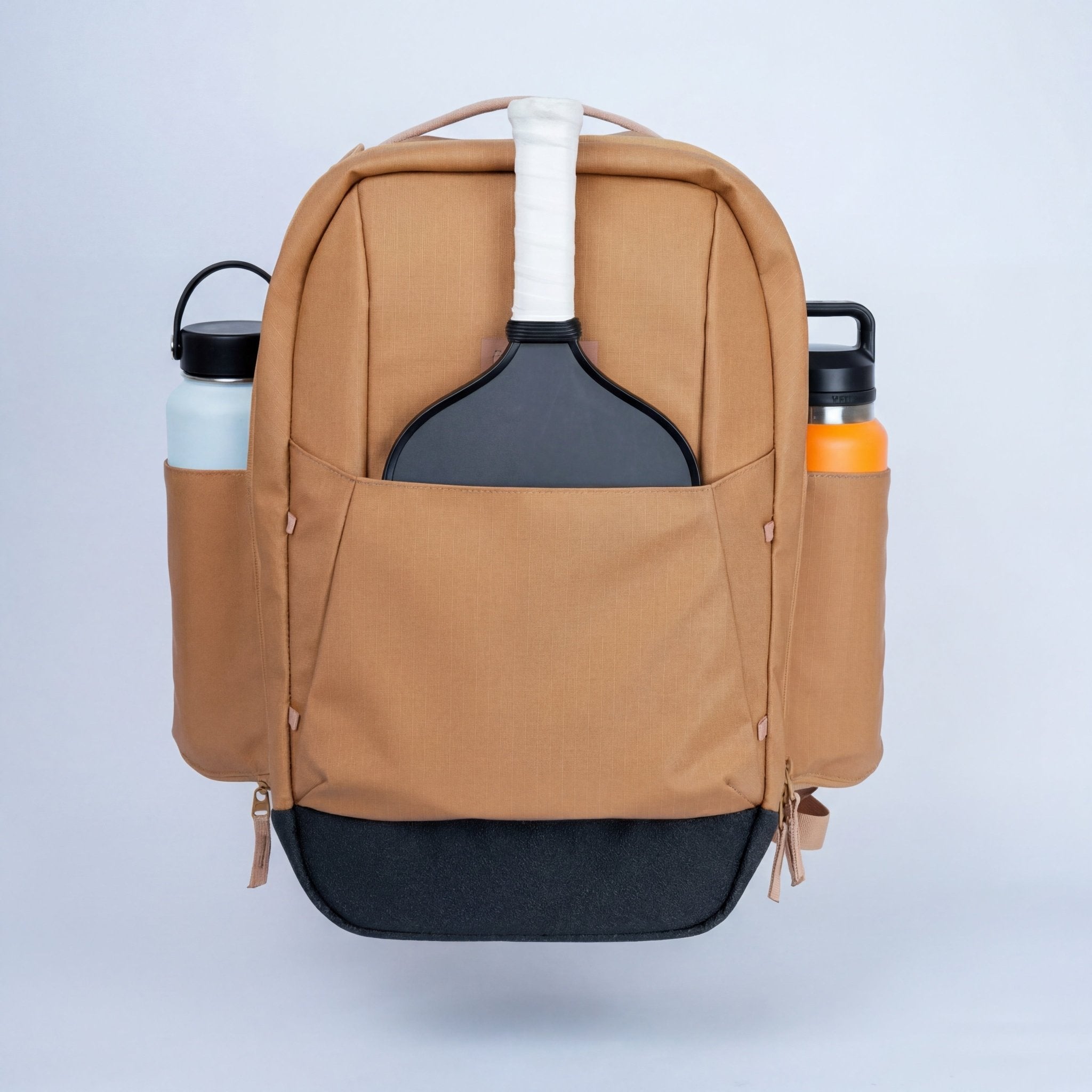
Sorted on glasses — now the bag. The Court Caddy ($325) has a dedicated accessories pocket for glasses, sunscreen, and court gear, plus a modular paddle sleeve designed with 500+ real players. Everything you'd carry to a serious session, organized in one bag that doesn't make you dig for anything.

Leave a comment
This site is protected by hCaptcha and the hCaptcha Privacy Policy and Terms of Service apply.