

Disclosure: This post contains affiliate links to Pickleball Central. If you purchase through our links, FORWRD earns a small commission at no extra cost to you. We only link to products we'd recommend regardless.
TL;DR: The right pickleball shoe has a herringbone outsole for multi-directional grip, a firm midsole for lateral stability, and a snug midfoot fit. Running shoes fail on the pickleball court — they're built for forward movement, not the lateral cuts, split-steps, and pivot stops pickleball demands constantly. This guide covers every major brand, every key use case (men, women, wide feet, budget, seniors, indoor/outdoor), and gives you a framework for picking based on your actual play style — not just "best overall."
Last Updated: October 2026
Table of Contents
- Why Pickleball Shoes Actually Matter
- The 5 Factors That Separate a Good Court Shoe from the Rest
- Choose by Your Play Style: Banger, Dinker, or All-Court
- Indoor vs. Outdoor Pickleball Shoes
- The 2026 Brand Report Card: Honest Grades
- Best Pickleball Shoes for Men
- Best Pickleball Shoes for Women
- Best Pickleball Shoes for Wide Feet
- Best Budget Pickleball Shoes Under $100
- Pickleball Shoes vs. Tennis Shoes
- How Long Do Pickleball Shoes Last?
- What Your Shoe Wear Patterns Say About Your Game
- Transporting Your Court Shoes Without Wrecking Your Bag
- All Our Deep-Dive Shoe Guides
- Frequently Asked Questions
Why Pickleball Shoes Actually Matter
Here's the honest version: most players are wearing the wrong footwear on the pickleball court, and it's slowing them down and putting their knees at risk at the same time.
Running shoes are built for heel-to-toe forward propulsion. That's great if you're running. On a pickleball court, you're not running — you're shuffling, split-stepping, pivoting, and lunging sideways at angles that running shoes were never designed to handle. The thick, squishy heel cushion that makes running shoes comfortable for miles becomes a liability the moment you need to change direction fast. You're essentially trying to cut on a waterbed.
Cross-trainers are better, but still not purpose-built. Most cross-trainers lack the specific outsole geometry that grips pickleball courts without catching and torquing your ankle.
The difference a proper court shoe makes isn't subtle. Players who switch from running shoes to real court shoes consistently report three things: faster lateral movement (less energy wasted fighting the shoe's geometry), less knee fatigue (the midsole is stiffer, so your joints aren't absorbing shock through a thick foam stack), and fewer slips and rolled ankles (the outsole is actually designed for the surface you're playing on).
If you're playing three or more times a week, this isn't optional gear — it's protective equipment. Your ankles will tell you.
"I played in running shoes for my first six months. When I finally switched to K-Swiss court shoes, I couldn't believe how much more stable I felt at the kitchen. It's like the difference between driving on ice and driving on dry pavement."
The 5 Factors That Separate a Good Pickleball Shoe from the Rest
You don't need to be a shoe engineer to pick the right pair. But you do need to know what actually matters, because the footwear industry's marketing copy is full of impressive-sounding terms that mean almost nothing in practice. Here are the five that do matter.
1. Outsole Pattern
This is the most important spec most people ignore completely. The outsole pattern — the geometric shape of the rubber on the bottom of the shoe — determines how your shoe grips the court surface and, crucially, how it releases during lateral movement.
Herringbone pattern (a V-shaped zigzag) is the gold standard for court sports. It grips in all directions without "catching" — so you can pivot smoothly without your foot sticking while your body keeps moving. Modified herringbone patterns (with rounded edges or wider channels) are common on modern pickleball-specific models and tend to be slightly more forgiving on older, rougher outdoor courts.
Avoid shoes with circular pod patterns or pure zigzag linear treads — they're designed for gym floors and grip unevenly on acrylic hard courts.
2. Midsole Cushioning
More cushion isn't better for court sports. It sounds counterintuitive, but a thick foam midsole creates instability — you're higher off the ground and on a compressible surface, which makes lateral movements feel mushy and unpredictable.
What you want is medium-density cushion with an impact-absorbing heel and a firmer forefoot. The heel can have more give because you land heel-first on split-steps. The forefoot needs to be stiff because that's where you push off for lateral movement and where most of your weight sits at the kitchen line.
3. Lateral Stability Features
Look for: reinforced sidewalls, a low-to-ground profile (stack height under 35mm), and a wide base at the heel. Some higher-end models include a TPU shank — a thin plastic plate inside the midsole that resists torsional flex. The JOOLA FUNKSH1N R4lly uses a carbon-fiber shank; it's expensive but genuinely effective for power players who push hard off every step.
4. Weight
Lighter isn't always better, but heavier is usually worse. Most quality pickleball court shoes land between 9.5 and 12.5 oz (men's size 10). Above 13 oz, you'll notice the drag on quick lateral movements by the third game of a session. Below 9 oz, you're usually giving up durability.
The K-Swiss Express Light lives up to its name at around 9.6 oz. The ASICS Gel-Resolution X sits around 12 oz — heavy, but that weight comes with a rubber compound that outlasts most competitors 2-to-1 on outdoor hard courts.
5. Fit — Including the Width Factor
Pickleball players skew older than most sports, and older feet tend to be wider — especially after decades of wearing regular shoes. Standard (D/medium) width fits most people, but if you've ever had blisters on the outside of your pinky toe, or if your foot slides laterally inside the shoe during cuts, you probably need a 2E (wide) or 4E (extra wide) fit.
K-Swiss, Skechers, and ASICS all offer 2E options in their main court shoe lines. Most other brands do not — which is a real gap in the market and a major frustration for the wide-foot segment of pickleball's growing player base.
Choose by Your Play Style: Banger, Dinker, or All-Court
The best shoe for your game depends on how you actually play — not what marketing says about the shoe's "versatility." Here's a framework for matching shoe characteristics to player type.
The Banger
You drive the ball hard. You attack the transition zone. You plant and rip. Your court movement is explosive, short-burst, and aggressive. You burn through outsoles on the lateral edge first (more on wear patterns below).
What you need: Maximum lateral stability (TPU or carbon-fiber shank), reinforced toe cap, durable rubber outsole, snug midfoot lockdown to prevent heel slip during explosive cuts.
Top picks for this style: JOOLA FUNKSH1N R4lly, ASICS Gel-Resolution X, SQAIRZ XRZ
The Dinker
You live at the kitchen line. Most of your court time is standing, shuffling 12 inches left and right, and bending to reach low balls. You're not doing explosive 20-foot lateral sprints — you're doing hundreds of small, precise micro-movements over two hours.
What you need: Lightweight construction (fatigue matters when you're on your feet for two hours), sufficient toe-box room for those bent-knee dinking stances, and enough underfoot cushion that standing on hard courts doesn't wreck your knees by game four.
Top picks for this style: Skechers Viper Court Pro, K-Swiss Express Light, Head-pure-2-outdoor-pickleball/`?oid=1&affid=8612342" target="_blank" rel="sponsored noopener">HEAD-motion-pro-pickleball-shoe-mens/?oid=1&affid=8612342" target="_blank" rel="sponsored noopener">HEAD Motion Pro
The All-Court Player
You're balanced. You drive when the opportunity's there, you dink when it's smart, and you cover the whole court. You need a shoe that doesn't sacrifice any single thing dramatically — and you probably need the best durability you can get since you're covering more overall court distance per session than either specialist above.
Top picks for this style: Skechers Viper Court Pro, K-Swiss Express Light, Diadem-court-burst-court-shoe-mens/?oid=1&affid=8612342" target="_blank" rel="sponsored noopener">Diadem Court Burst
Indoor vs. Outdoor Pickleball Shoes
This matters more than most guides acknowledge. The same shoe that grips perfectly on a polished wood gym floor can be dangerously slippery on a rough outdoor acrylic surface — and vice versa.
Outdoor Courts (Hard Acrylic)
Outdoor courts — the kind you find at parks, recreation centers, and most dedicated pickleball facilities — are typically coated acrylic over concrete or asphalt. The surface is rougher and more abrasive. You need:
- Harder rubber compound (Shore A hardness 70-75) that resists the abrasion without wearing through in a month
- Deeper tread channels to grip a rougher surface
- UV-resistant materials — direct sun degrades softer rubber compounds surprisingly fast
ASICS and K-Swiss both use proprietary rubber compounds engineered for hard-court longevity. The ASICS AHAR (ASICS High Abrasion Rubber) compound is worth the extra weight — it routinely lasts 400-500 hours on outdoor courts where a budget shoe might give you 100.
Indoor Courts (Wood or Synthetic)
Indoor courts (polished gym wood, rubber sport tiles, or VCT tile at recreation centers) need:
- Softer, non-marking gum rubber outsole (Shore A 62-65) that grips the smooth surface without leaving marks
- Tighter, finer herringbone pattern — you don't need deep tread channels on a smooth surface; you need more surface contact
- Non-marking requirement — most indoor courts will turn you away at the door if your shoes aren't non-marking. Check the spec before you buy.
The HEAD Motion Pro has exceptional indoor court grip — the gum rubber outsole sticks to polished wood floors in a way that gives genuine confidence on quick lateral movements. If you play primarily on gym wood, HEAD is the brand to look at first.
Can You Use One Shoe for Both?
Yes — but you're compromising one direction. Most "all-court" shoes are tuned for outdoor use with rubber compounds and tread depths that work on hard acrylic. They'll grip indoor courts fine, but not as well as a dedicated indoor shoe. If you play 80% indoors, get an indoor-specific shoe. If you play 80% outdoors, get an outdoor shoe. If it's a genuine split, go outdoor — it's the harder surface to optimize for, and the rubber will outlast an indoor-tuned compound on rough courts.
The 2026 Brand Report Card: Honest Grades
Every brand has marketing copy about why their shoe is "purpose-built for pickleball." Here's the actual picture.
| Brand | Grade | Wins | Honest Weakness |
|---|---|---|---|
| Skechers | A | Best comfort-to-price ratio; Viper Court Pro line is deeply field-tested | Outsole wears faster than ASICS on outdoor hard courts |
| K-Swiss | A− | Best pure pickleball engineering; lightest models in class | Narrow last — wide-foot players need the 2E models specifically |
| ASICS | B+ | Best outsole durability; AHAR rubber genuinely outlasts competitors on outdoor courts | Models run heavy; heel counter can be too rigid initially |
| HEAD | B+ | Best indoor court grip; BOA dial closure is legitimately useful | Short warranty on some models (6 months on Revolt Pro 5.0 is bad) |
| JOOLA | B | FUNKSH1N R4lly is excellent — carbon fiber shank is a real differentiator for power players | Very limited SKU range; minimal fit options |
| Wilson | B | Rush Pro LITE is the best value at the $65-75 price point | Inconsistent across the lineup — other Wilson models don't match Rush Pro LITE's value |
| Selkirk | B | Legacy Pro is an impressive debut; InfiniGrip outsole delivers on outdoor courts | Limited colorways; brand still building its shoe reputation |
| SQAIRZ | C+ | Square toe box genuinely helps wide-toe players; ankle stability is class-leading | Looks odd; the square toe takes getting used to visually and physically |
| adidas | B− | Courtflash is excellent value; brand credibility is genuine | Sparse pickleball-specific lineup; many models are tennis shoes with pickleball branding |
| Diadem | B− | Court Burst is a solid all-around court shoe at a competitive price | Niche brand — harder to find in stores, less community durability data |
Best Pickleball Shoes for Men
Men's pickleball shoes have the deepest selection of any segment. The top men's categories break down by priority: stability-first (for aggressive 4.0+ players), comfort-first (for recreational 2.5-3.5 players), and budget (for new players who aren't sure how committed they'll be yet).
The Skechers Viper Court Pro is the recommendation most often standing at the top of men's lists — and for good reason. It's comfortable from minute one, grips well on both indoor and outdoor surfaces, and doesn't require a break-in period that most ASICS and K-Swiss models do. But it's not the best shoe for every man. If you're an aggressive 4.5 player who drives hard and moves explosively, the JOOLA FUNKSH1N R4lly or K-Swiss K-Frame will serve your game better.
Our Pick (Men's): Skechers Viper Court Pro
Best combination of out-of-box comfort, lateral grip, and value for the majority of men's recreational players.
Read the full guide: Best Pickleball Shoes for Men 2026 →
Best Pickleball Shoes for Women
Women's pickleball footwear has improved dramatically over the past 18 months. The old approach — taking a men's shoe and making it pink — is mostly gone. Skechers, K-Swiss, HEAD, and ASICS all now engineer women's models with narrower heel cups, different forefoot geometry, and last widths calibrated for women's feet specifically.
The Skechers Viper Court Pro 2.0 (women's version) leads the women's category for the same reasons it leads the men's: comfort, grip, and an immediate-wearable fit. The HEAD Motion Pro is the recommendation if you play primarily indoors — the gum rubber outsole on polished gym floors is noticeably superior. For players who want maximum durability on outdoor hard courts, the ASICS Gel-Resolution X is the top choice despite its weight.
Our Pick (Women's): Skechers Viper Court Pro 2.0
Exceptional comfort from game one, reliable all-court grip, women's-specific last that actually fits women's feet.
Read the full guide: Best Pickleball Shoes for Women 2026 →
Related: Best Pickleball Shoes for Women Over 50 → | Lightest Women's Pickleball Shoes 2026 →
Best Pickleball Shoes for Wide Feet
Wide feet are genuinely underserved in the pickleball shoe category. Most standard (D/medium) shoes are built on a last that's fine for average-width feet — but if your foot measures 4E, you'll experience blistering on the pinky-toe edge, your heel will slip because you've laced the shoe too tight trying to compensate, and your lateral cuts will feel unstable because your foot is sliding inside the shoe.
The good news: the major brands have started paying attention. K-Swiss offers a 2E wide version of their Express Light. ASICS offers 2E in the Gel-Resolution X. Skechers offers a 2E version of the Viper Court Pro 2.0. SQAIRZ goes further — their square toe box accommodates wide toes and wide forefeet in a way traditional court shoes don't.
One thing to know before buying wide-width shoes: don't just size up in regular width. A size-up regular-width shoe gives you a longer shoe, not a wider one — you'll have extra space at the toes while the sides still pinch. Get the right width designation.
Read the full guide: Best Pickleball Shoes for Wide Feet 2026 →
Also: Men's Wide Feet Picks → | Women's Wide Feet Picks →
Best Budget Pickleball Shoes Under $100
You don't need to spend $180 to get a good pickleball shoe. The sub-$100 category has improved significantly — brands building entry-level court shoes have gotten serious about making them actually good, not just affordable.
The Wilson Rush Pro LITE sits around $65-75 and is genuinely the best value in the category — not the best shoe overall, but the best shoe relative to what you're spending. At that price, the outsole will wear faster than ASICS, and the lateral stability features are more basic, but it's a real court shoe that will meaningfully outperform your running shoes on the pickleball court.
adidas Courtflash is worth knowing about if it goes on sale below $70 — it's technically a tennis-court shoe, but the outsole geometry and lateral stability spec work fine for pickleball. The FILA Volley Zone is the budget-budget pick if you're under $60 — it has one real flaw (the tongue slides) but the grip is legitimately court-appropriate.
Best Budget Pick: Wilson Rush Pro LITE
Real court shoe performance at the lowest price point in our test set — the value pick for new players and budget-conscious rec players.
Read the full guide: Best Pickleball Shoes Under $100 →
Pickleball Shoes vs. Tennis Shoes
This is the most common question beginners ask, and it's more nuanced than most guides let on.
Tennis shoes work well for pickleball — the movement demands are similar enough that a quality tennis shoe designed for hard courts will do most of what a pickleball-specific shoe does. The outsole pattern, lateral stability features, and court-grip rubber compounds are built for similar movements. This is why you see pros playing pickleball in what are technically tennis shoes.
Where pickleball-specific shoes have started pulling ahead: toe-cap reinforcement for the dragging, scraping toe movements at the kitchen line (almost no tennis player is bending into a dinking stance for extended periods), and the specific heel-cup geometry for the split-step landing that's more prominent in pickleball than in baseline tennis.
The practical verdict: if you have quality tennis shoes in good condition, play in them until you're ready to invest in pickleball-specific gear. But don't buy tennis shoes as a proxy for pickleball shoes — for the same money, a pickleball-specific model will fit the movement patterns better.
How Long Do Pickleball Shoes Last?
The honest answer: it varies enormously based on court surface, playing frequency, and shoe brand.
Outdoor hard courts are the most destructive surface. Budget shoes typically last 3-4 months of regular play (3x/week) on outdoor acrylic. Mid-range shoes from Skechers and Wilson: 5-7 months. Premium models with ASICS AHAR rubber or Selkirk's InfiniGrip compound: 8-12 months. The durability gap between budget and premium is dramatic on rough outdoor surfaces.
Indoor wood courts are much gentler. A decent court shoe can last 18-24 months on gym wood with regular play. The limiting factor switches from outsole wear to midsole compression — the cushioning breaks down before the outsole shows serious wear.
Replace your shoes when: The outsole pattern has worn smooth on the high-pressure areas (lateral edge, ball of foot). The midsole feels distinctly less responsive than when new — you'll notice this as increased knee fatigue during and after play. The upper shows separation from the midsole at the toe or heel.
One specific sign that gets ignored: when your split-step doesn't feel as planted. If your footwork felt confident and decisive when your shoes were new and now your feet are slipping slightly on plant-and-cut moves, the outsole has worn beyond its performance threshold even if it doesn't look worn out visually.
What Your Shoe Wear Patterns Say About Your Game
This section doesn't appear in other shoe guides, and it's genuinely useful data. The location of wear on your outsole is a direct map of where your foot contacts the court most — which tells you both what shoe features you actually need AND what your playing style looks like from the ground up.
Wear concentrated on the lateral edge (pinky-toe side): You're a hard lateral mover — a banger who drives hard and cuts explosively. Your shoes need maximum lateral stability and a reinforced sidewall on that edge. Your next shoe needs: durable rubber compound (not just a grip compound), reinforced outsole edge, possibly a TPU or carbon-fiber shank.
Wear concentrated at the toe: You're a forward-heavy player — probably a kitchen player who bends into dinking stances frequently and drags your front toe during serves. You need a reinforced toe cap. Many budget shoes skip this; it shows within 3 months of dinking-heavy play as a hole or separation at the toe box.
Heavy heel wear: You're spending a lot of time in a standing position — possibly waiting at the kitchen or serving from the baseline. Watch the heel counter (the firm backing at the back of the shoe) — if it's collapsing inward, your ankle support is degrading even if the outsole looks fine.
Even wear across the ball of foot: You're a split-step person — your feet are landing with weight distributed across the metatarsals, which is actually correct technique and a sign of solid footwork fundamentals. Most court shoes handle this well; the main thing to watch is midfoot support longevity.
Almost no outsole wear after 6+ months of outdoor play: Check the midsole instead. You may be compressing cushioning without wearing rubber — the shoe is softer than it looks. Press your thumb firmly into the midsole; if there's almost no resistance, the foam is dead even if the outsole looks new.
The practical value: use your current shoe wear pattern to determine what to prioritize in your next purchase. Lateral edge wear → stability over cushion. Toe wear → reinforced toe cap. Heel wear → heel counter quality. Even wear → you have the flexibility to optimize for weight or width.
Transporting Your Court Shoes Without Wrecking Your Bag
Pickleball shoes are court-specific gear — and court shoes are filthy from outdoor courts or sweaty from indoor sessions. Throwing them loose into your pickleball bag contaminates everything else: your grips get dirty, your extra balls sit in shoe debris, your clean T-shirt picks up rubber dust and grit.
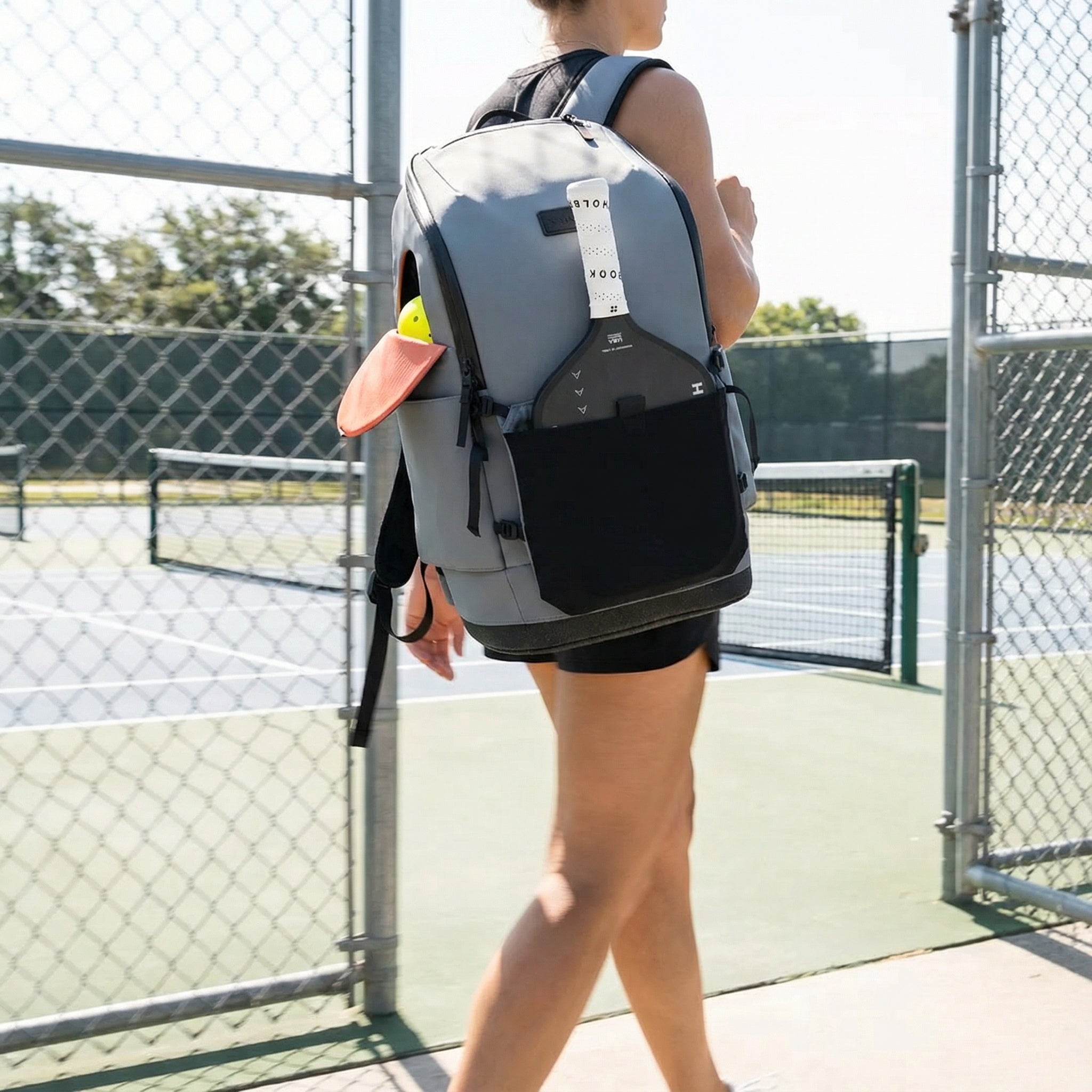
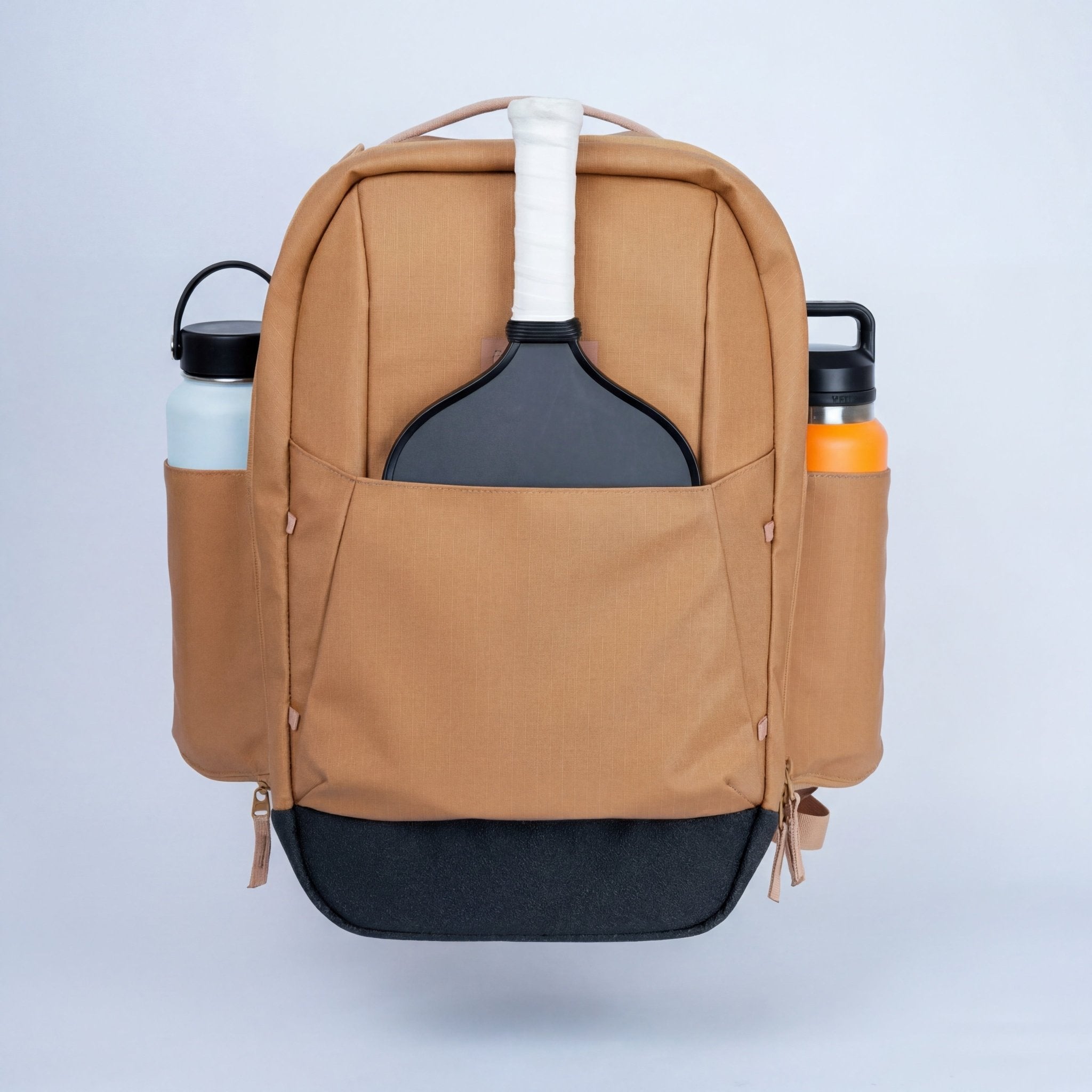
The solution is a dedicated shoe compartment or shoe bag. Most quality pickleball bags now include one — or accommodate a separate shoe organizer. FORWRD's Court Caddy ($325) has a designated shoe cube compartment that keeps footwear completely isolated from the rest of the bag. If you need a standalone solution, the FORWRD Court Caddy Shoe Cube ($49.99) is an insulated shoe case that clips onto or fits into most full-size pickleball bags.

If you want a bag that handles court-to-work commuting — court shoes and paddles in one organized pack — the FORWRD Court Ranger V2 ($195) is built for exactly that. The 16" laptop sleeve sits separate from the gear compartment, and the modular paddle sleeve keeps your paddle protected while the shoe cube (sold separately) clips onto the main compartment. It's the bag that makes the commute-to-court routine actually work.
A few practical notes that extend shoe life: let your shoes dry completely before putting them in any bag or shoe case — sealed wet shoes develop mold and the foam degrades faster when it stays wet for hours. Remove the insoles and let them dry separately if you play in heat. A quick wipe of the outsole before you bag them prevents court grit from grinding into the bag interior.
If you're in the market for a full-size bag that handles shoes properly: Best Pickleball Bags with Shoe Compartments 2026 →

All Our Pickleball Shoe Deep Dives
This pillar gives you the framework. The links below go deep on each sub-topic — specific models tested, honest verdicts, and the detailed breakdowns you need to make a confident purchase decision.
By Player Type
- Best Pickleball Shoes for Men 2026
- Best Pickleball Shoes for Women 2026
- Best Pickleball Shoes for Wide Feet 2026
- Best Men's Pickleball Shoes for Wide Feet 2026
- Best Women's Pickleball Shoes for Wide Feet 2026
- Best Pickleball Shoes for Women Over 50
- Lightest Women's Pickleball Shoes 2026
By Budget
Brand Deep Dives
- K-Swiss Express Light Review 2026
- ASICS Gel-Renma Review 2026
- Skechers Viper Court Pro 2.0 Review 2026
- HEAD Motion Pro Review 2026
- JOOLA R4lly Review 2026
- Selkirk Legacy Pro Review 2026
- Wilson Rush Pro LITE Review 2026
Comparisons & How-To
Frequently Asked Questions
Do I really need pickleball-specific shoes, or will tennis shoes work?
Tennis shoes work fine for pickleball — the movement patterns are similar enough that a quality hard-court tennis shoe is a legitimate option. Where pickleball-specific shoes improve: toe-cap reinforcement for the kitchen dinking stance, and heel geometry tuned for the split-step pattern. If you have good tennis shoes, use them. If you're buying new, a pickleball-specific model will fit the sport's movements better.
Can I wear running shoes for pickleball?
Running shoes are the one type you should actively avoid. They're engineered for forward heel-to-toe movement — the thick heel cushion creates instability during lateral cuts, and the outsole provides almost no multi-directional grip. You'll slip, you'll feel unstable on direction changes, and you'll increase your ankle-roll risk. Almost any court shoe is better than a running shoe on the pickleball court.
How much should I spend on pickleball shoes?
For recreational play (1-2x/week), $65-100 is the right range. For serious recreational or competitive play (3+ times/week), spend $100-160. For tournament or high-frequency play on outdoor hard courts, $130-200 is worth it for outsole longevity alone — the ASICS or K-Swiss models at that price range will outlast a $75 shoe by 2-3x on rough outdoor surfaces.
What's the difference between indoor and outdoor pickleball shoes?
Outsole rubber compound and tread depth. Outdoor courts need harder rubber (Shore A 70-75) with deeper channels. Indoor courts need softer, non-marking gum rubber (Shore A 62-65) with finer tread. Most "all-court" shoes are tuned for outdoor use. If you play primarily indoors, look for shoes specifically listed as indoor or non-marking.
How do I know if I need wide-width pickleball shoes?
Signs you need a wider shoe: blistering on the outside of your pinky toe, your foot feels compressed sideways inside the shoe, you're loosening laces to relieve pressure and your heel slips, or you've historically worn wide-width athletic shoes in other sports. Don't size up in regular width — get the right width designation (2E or 4E).
How do I make my pickleball shoes last longer?
Four things: (1) Let them fully dry between sessions. (2) Use them only for pickleball — not errands or other activities. (3) Store them in a shoe case or bag, not loose. (4) Rotate two pairs if you play 4+ times per week — foam needs 24-48 hours to decompress between sessions.
Are pickleball shoes different for men and women?
Modern pickleball-specific shoes are built on gender-specific lasts — not just different colors. Women's lasts typically have a narrower heel cup, different forefoot width proportions, and geometry for the statistical distribution of women's foot shapes. The underlying technology is the same; the fit geometry is different. Buy gender-specific when you can.
What's the best brand for pickleball shoes in 2026?
For most recreational players: Skechers (best comfort-to-price ratio). For durability on outdoor courts: ASICS. For lightweight court feel: K-Swiss. For indoor play: HEAD. There's no single best brand because the right shoe depends on your surface, play style, and foot shape.
Do pickleball shoes need a break-in period?
It depends on the brand. Skechers shoes are typically comfortable from game one. ASICS and K-Swiss models often need 4-8 sessions before the heel counter and midsole fully conform to your foot. Wear them for practice before taking them into a competitive match.
What socks should I wear with pickleball shoes?
Court sports socks with arch compression and moisture-wicking material. OS1st FS4 Compression Socks are the specific recommendation for players with foot fatigue or plantar fascia concerns — the arch compression meaningfully extends how long you can play without discomfort.

Leave a comment
This site is protected by hCaptcha and the hCaptcha Privacy Policy and Terms of Service apply.