

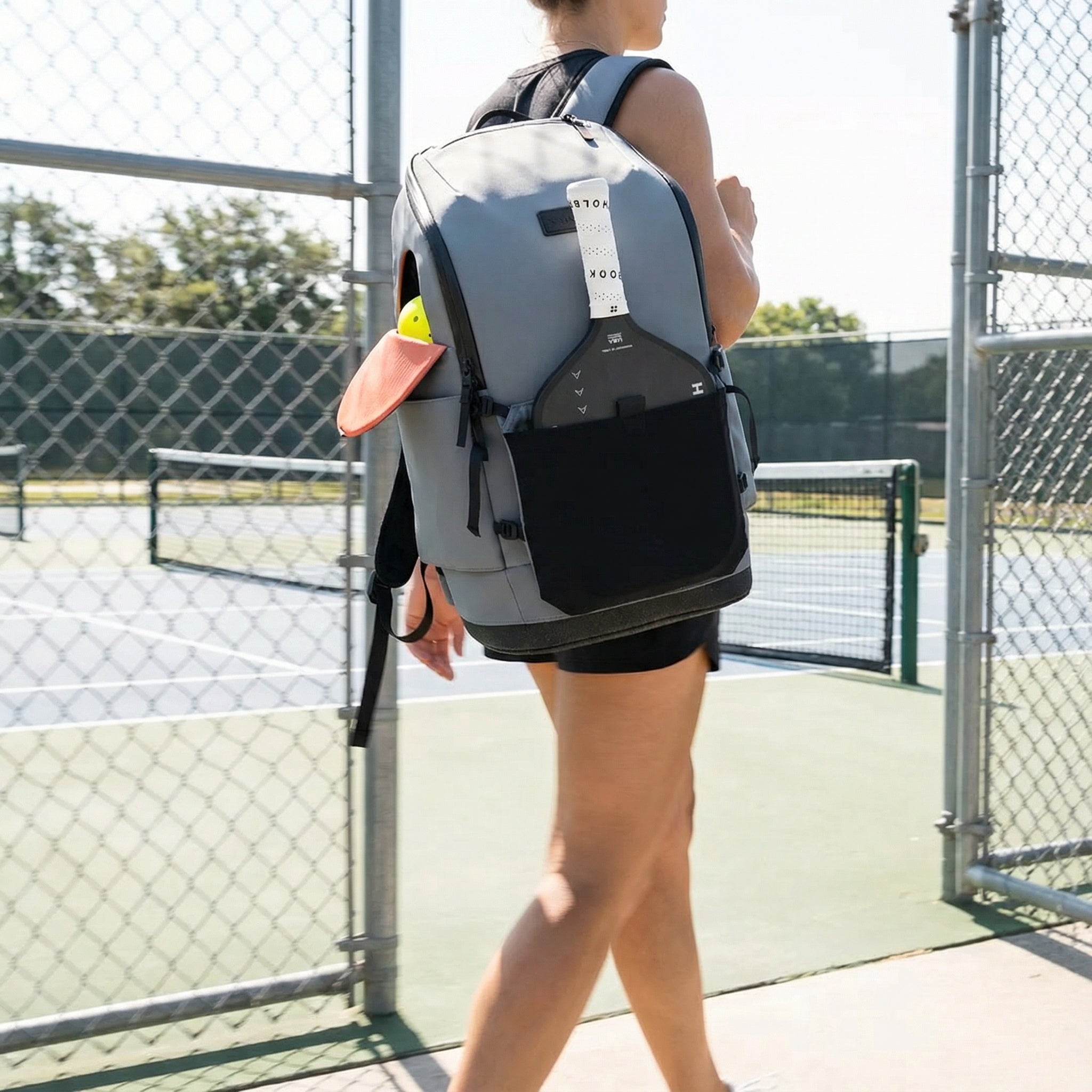
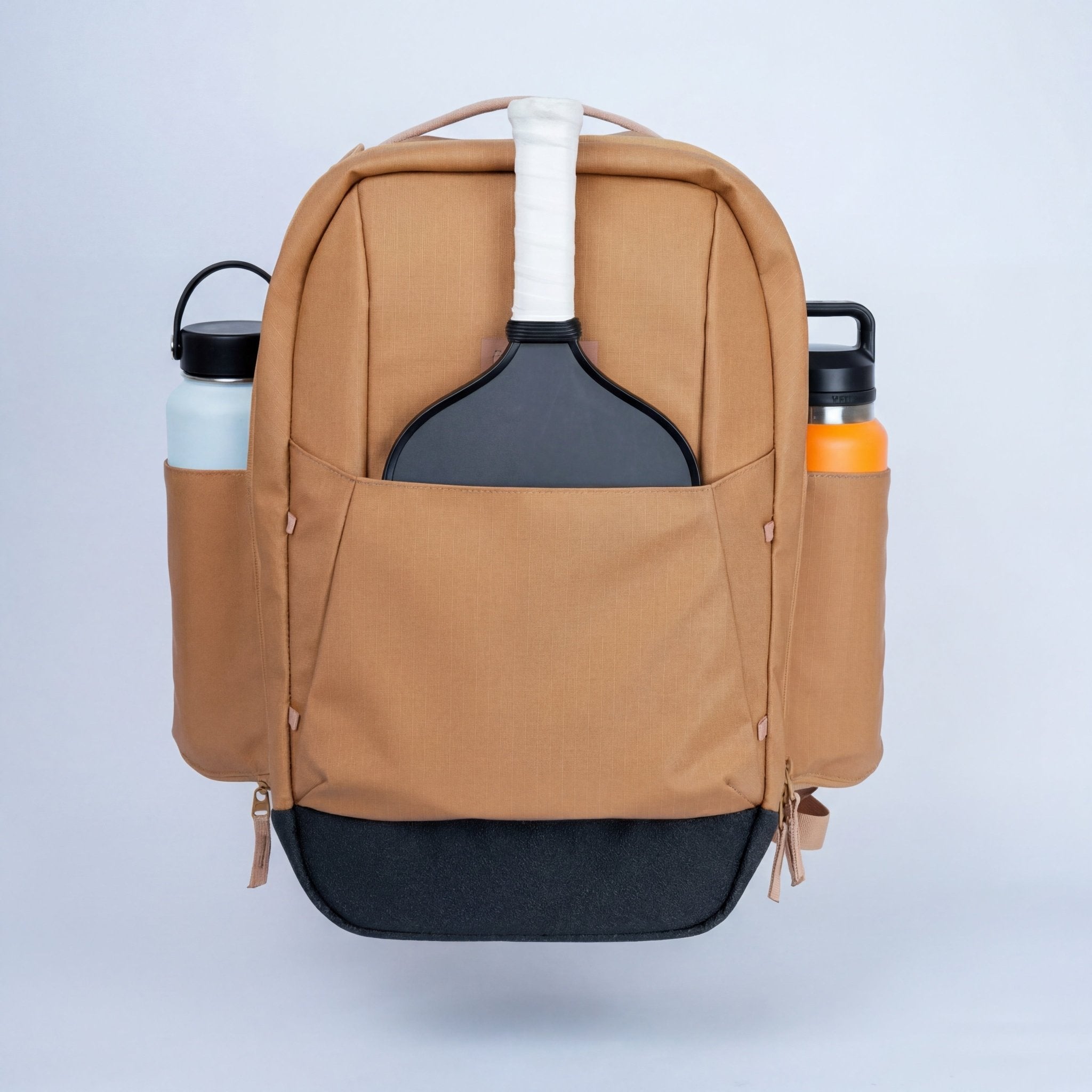

Last updated: June 2026
The fastest way to lose a point before the game starts: spending 90 seconds digging through your bag at the court trying to find your overgrip. Bag organization isn't neatness for its own sake — it's court readiness. The players who unzip, grab, and go are the ones who show up mentally ready. Here's exactly how to set up your bag so you never dig again.
Organize a pickleball bag by compartment function: paddles in the dedicated sleeve (isolated from electronics), water bottles in side pockets, accessories and balls in front quick-access pockets, and laptop or valuables in a padded back sleeve. Pack heavy items close to your back. Remove everything after each session to stay ready for the next one.
Key Bag Organization Facts

- Paddle isolation matters: Graphite and carbon fiber paddle faces scratch on contact with keys, zippers, or laptop edges. A dedicated paddle sleeve — or at minimum a fully separated compartment — prevents surface damage.
- Weight distribution: Heaviest items (shoes, full water bottle) packed close to your back reduce shoulder and spine strain over a 3-hour court session.
- 500+ players shaped the layout: The Court Caddy's modular paddle sleeve and compartment placement came directly from feedback sessions with 500+ real players about what they consistently couldn't find fast.
- Electronics need a wall: Laptop sleeves that share a wall with the paddle compartment expose your device to graphite edge guards. The Court Caddy's 15" padded sleeve and Court Ranger V2's 16" sleeve both have independent walls.
- Tournament vs. rec day packing differs: Tournament players carry 2–4 paddles, spare balls (6–12), extra overgrips, a change of clothes, and electrolytes. Rec players typically need 1–2 paddles, 3–6 balls, and water.
- Clean out after every session: Wet towels and sweaty gear left in a closed bag create odor and fabric degradation. Takes 2 minutes post-session to unpack; saves hours of maintenance later.
- Quick-access pocket rule: Whatever you reach for during a game — balls, phone, snack, overgrip — belongs in the front-access pocket. Everything else can be deeper.
Why Bag Organization Actually Affects Your Game (It's Not Just Neatness)
Most players think of bag organization as a personality preference — the tidy players organize, the rest don't. The reality is more practical: a disorganized bag costs you focus before you've hit a single ball.
Every second you spend hunting for your paddle grip tape at courtside is a second you're not warming up, watching the opponent's warm-up, or settling mentally into match mode. Players who know exactly where everything is arrive at their first point with a mental state advantage over players who just spent 45 seconds rummaging. It's small. It compounds over a tournament day.
There's also a gear protection case. Paddles stored loose against keys, zipper pulls, or a laptop edge accumulate micro-scratches on face surfaces. Over months of daily carry, unprotected graphite faces show wear that affects grip texture and (in extreme cases) structural integrity. The right organizational system keeps paddle faces isolated from everything metal or hard-edged.
"We asked 500+ players what they consistently couldn't find fast in their bags. The answer was almost always small accessories — overgrips, balls, a second phone charger. That feedback drove the Court Caddy's quick-access front pocket design. The goal was: if you need it mid-game or between points, it should be in the front. Everything else is secondary."
— Grub, FORWRD Co-founder
The best bags solve this architecturally — compartments that physically prevent your paddle from contacting your laptop, front-access pockets for mid-game items, side sleeves that hold bottles without needing to unzip. But even with a less architecturally sophisticated bag, the organizational principles below apply.
How to Organize a Pickleball Bag: Compartment by Compartment

Paddle Compartment
Paddles go in first, come out first. Store them face-to-face (grip tape toward the opening) so they slide out without turning. If your bag has a modular paddle sleeve, use it — the sleeve keeps paddle faces from contacting anything except each other. If your bag has no sleeve, wrap paddles in a microfiber towel as a makeshift separator.
Keep zero metal objects in the paddle compartment. Keys, zipper pulls, carabiners, and phone edges are the most common sources of face scratches. If your sleeve shares a wall with the main compartment, place a thin cloth barrier between the shared surface and the paddle face.
Laptop / Electronics Sleeve
Use the dedicated padded sleeve — not the main compartment. The padded sleeve exists specifically to isolate your device from paddle movement and bag flex. A 15" MacBook Pro M3 fits in the Court Caddy's 15" sleeve. A 16" MacBook Pro fits in the Court Ranger V2's 16" sleeve.
Critical: verify your bag's laptop sleeve has an independent wall separating it from the paddle compartment. If the two share a wall, your laptop surface is in contact with paddle edge guards when the bag is full. The Court Caddy and Court Ranger V2 both engineer independent walls specifically to prevent this.
Water Bottle Side Pockets
Both side pockets typically handle a 32oz bottle. Pack one with water, one with an electrolyte drink for longer sessions. Side pockets are designed to be accessible without putting the bag down — pull the bottle out by reach, not by dropping the bag and unzipping. The bottle goes in mouth-up, cap tight.
Don't store food in side pockets. Electrolyte powder, snacks, and anything that can spill belong in a zippered interior pocket, not the same sleeve as your water bottle. Spilled powder on the interior of a side pocket is a long-term maintenance problem.
Front / Quick-Access Pocket
This pocket is for things you reach for between games or during changeovers — not storage. Standard contents: 2–3 spare balls, 1–2 overgrip rolls, phone, keys, chapstick, small snack. If it needs to come out in 10 seconds or less, it belongs here.
Keep this pocket edited. The moment it becomes a catch-all, it loses its function. After every session, clear it down to just the essentials for next time.
Main Compartment
Secondary gear goes here: change of clothes, extra shoes (if no shoe compartment), full towel, spare paddle, portable charger, first aid kit. Pack heavy items (shoes, full change of clothes) at the bottom and closest to your back panel. Lighter items (towel, apparel) fill around them. This keeps the bag's center of gravity close to your spine and reduces strain on a long walk from the parking lot.
Weight Distribution Rule
Heavy items → back panel, bottom of bag. Medium items → middle. Light items (towel, wristband, apparel) → top or front. This applies regardless of bag model. A bag packed with shoes at the top pulls away from your back and creates shoulder fatigue after 20 minutes of walking.
Court Caddy Pocket Guide: Where Everything Goes
The Court Caddy is designed around a specific organizational logic. Every compartment has a function. Here's the exact layout:
Court Caddy: What Goes Where
- Modular Paddle Sleeve (main compartment, front): 2–5 paddles, face-to-face. The sleeve holds paddles completely isolated from the laptop and main compartment. Add-on paddle dividers available for players carrying 4–5 paddles.
- 15" Padded Laptop Sleeve (back panel): Laptop or tablet only. Independent wall — paddle surfaces never contact device. Fits 15" MacBook Pro M3 and all 14" or smaller laptops comfortably.
- Main Compartment (behind paddle sleeve): Change of clothes, shoes, towel, portable charger, first aid kit. Pack heaviest items (shoes) flat at the bottom against the back panel.
- Front Quick-Access Pocket: Balls (3–6), overgrip rolls (1–2), phone, keys, small snack, chapstick. If you need it in 10 seconds, it's here.
- Side Water Bottle Pockets (both sides): One 32oz water bottle per side. Accessible without removing the bag. Bottles in mouth-up, caps secured.
The result: paddles are protected and accessible first. Laptop is safe and never touching paddle surfaces. Mid-game items are front and reachable without digging. Everything else is sorted by weight in the main compartment.
For players carrying 4+ paddles to tournaments, our multi-paddle bag guide covers specific capacity configurations for the Court Caddy and the full competitive field.
After the Court Caddy pocket guide, the mid-post CTA is natural: if you want a bag organized so you never have to think about it — shop the Court Caddy here.
Tournament Day Packing: What Goes Where When It Counts
Recreational day bags and tournament day bags serve different functions. A tournament day means 4–8 hours at the court, potentially 3–5 matches, weather changes, and the need to be self-sufficient for an entire day. Here's what goes where:
Tournament Day Packing List
Paddle Sleeve:
- Primary paddle + 1–2 backup paddles (string or polymer core — not your primary)
- Ball tube (3–6 tournament-approved balls — check USA Pickleball official rules for approved ball brands at your event)
Main Compartment:
- Full change of clothes (including spare socks)
- Court shoes in a drawstring bag (keeps them from dirtying apparel)
- Small towel × 2 (one court towel, one post-match towel)
- Portable charger (enough for a full tournament day)
- Compact first aid: blister pads, athletic tape, ibuprofen, bandages
- Rain jacket if outdoor tournament (ultralight, stuffable)
Laptop Sleeve:
- Laptop or tablet (for bracket tracking, video between matches)
- Earbuds in case (mental warm-up protocol between matches)
Front Quick-Access Pocket:
- Overgrip rolls × 3–4 (you'll change grips between matches at a full-day tournament)
- Electrolyte packets × 4–6
- Energy bar or snack × 2
- Phone + tournament registration QR code (screenshot or printed)
- Tournament badge / wristband
- Sunscreen packet
Side Water Bottle Pockets:
- 32oz water bottle (one side) — refill between matches
- 32oz electrolyte drink (other side) — premixed for match day
One rule that tournament players consistently follow: pack the night before, not the morning of. Pre-match mental load is real. Packing the morning of a tournament adds decision fatigue to an already high-stakes day. The Court Caddy's compartmentalized layout makes the night-before pack a 5-minute process — everything has a place, and the place doesn't change.
For a deeper look at tournament bag strategy, see our best pickleball tournament bags guide — it covers which bags handle the full-day load best across five criteria.
Weather is the other tournament variable most players underpack for. If you're playing outdoor tournaments in variable conditions, our waterproof pickleball bag guide covers zipper performance in sustained rain across eight bags — including what happens to standard water-resistant zippers versus YKK AquaGuard during a full rain delay.
FAQ: Common Questions About Pickleball Bag Organization
How do you organize a pickleball bag for a tournament?
Pack paddles in the dedicated sleeve (2–3 paddles minimum for a full tournament day), change of clothes and shoes in the main compartment, overgrips and electrolytes in the front quick-access pocket, and two water bottles in side pockets. Pack the night before. Tournament day packing takes 5 minutes with a consistent system; rushing it the morning of adds mental load you don't need.
What goes in the front pocket of a pickleball bag?
The front quick-access pocket is for items you need between games or during changeovers: spare balls (3–6), overgrip rolls (1–2), phone, keys, snack, and electrolyte packets. Keep it edited to these essentials only. Once it becomes a catch-all, it defeats its purpose and you're back to digging.
Should you keep paddles in a separate compartment?
Yes — always. Paddles stored in the main compartment with keys, zippers, laptops, or hard accessories accumulate micro-scratches on graphite and carbon fiber face surfaces. A dedicated paddle sleeve — or at minimum a cloth-wrapped separation — keeps faces protected. The Court Caddy and Court Ranger V2 both use modular paddle sleeves that fully isolate paddles from all other compartments.
How do you store pickleball balls in a bag?
Store balls in the front quick-access pocket or a side zippered pocket — somewhere accessible without fully opening the bag. Loose balls in the main compartment roll to the bottom and get buried under apparel. A mesh pocket or tube holds 3–6 balls together and keeps them reachable. For tournament days, pack 6–12 balls across two pockets to avoid hunting for a ball at the changeover.
The right bag makes the right organization effortless. Shop the Court Caddy — designed with 500+ real players and built so every compartment has a job. Never dig through your bag at courtside again.

Leave a comment
This site is protected by hCaptcha and the hCaptcha Privacy Policy and Terms of Service apply.