

Callaway Inertia Pickleball Paddle Review 2026: Golf Giant's First Paddle, Honestly Tested
Callaway's Inertia is a legitimate control paddle — not a gimmick, not a branding play. The Power Edge Technology is real and measurable: the paddle holds its line on off-center hits in a way most carbon paddles in this price range don't. If resets, dinks, and consistency are where you lose points, this paddle is worth serious consideration at $249.
Disclosure: This post contains affiliate links to Pickleball Central. If you purchase through our links, FORWRD earns a small commission at no extra cost to you. We only link to products we'd recommend regardless.
Last Updated: July 2026
Quick Verdict
Pros:
- Power Edge Technology genuinely expands the effective sweet spot
- Elite stability on off-center hits — paddle doesn't twist in your hand
- Karakal grip is excellent quality (unusual for paddles at this price)
- Solid T700 carbon face with real spin texture
- 16mm core is the right thickness for control-first players
Cons:
- At $249, the spec sheet (polypropylene core, no foam) doesn't fully justify the premium over competitors
- Limited pop — not the paddle if you want power-first performance
- Standard widebody shape offers nothing distinctive for advanced players
Price: $249.99 on Pickleball Central
Who it's for: Control-oriented 3.0–4.0 players, golfers new to pickleball, players who struggle with consistency on resets and dinks
Who should skip it: 4.5+ power-first players, players who want foam core feel, budget-conscious buyers
Specs at a Glance
| Spec | Callaway Inertia |
|---|---|
| Price | $249.99 |
| Weight | 8.1 oz avg (7.9–8.3 oz range) / ~230g |
| Core | 16mm Polypropylene + Power Edge Technology |
| Face | Unidirectional T700 Carbon Fiber + Fiberglass Stabilizing Layer |
| Paddle Length | 16.25" |
| Paddle Width | 7.66" |
| Handle Length | 5.5" |
| Grip Circumference | 4.2" (Small/Medium) |
| Grip Brand | Karakal Precision Performance Grip |
| Edge Guard | Yes (weighted corners) |
| Key Tech | Patent-pending Power Edge (4 corner weight inserts) |
See Current Price on Pickleball Central →
Why Trust This Review
FORWRD designs pickleball bags — which means we spend a lot of time around paddles, players, and the conversations serious players have about gear. We've watched over 500 players go through gear decisions, talked through what works for different play styles, and spent enough time on outdoor courts in varying conditions to have genuine opinions. Our interest is in honest information, not affiliate click-farming — if the Callaway Inertia is wrong for you, we'd rather you know that upfront.
We also come to this review with a specific angle that other reviewers don't bring: Callaway is a golf equipment company, and the physics behind their Inertia design is directly borrowed from golf club engineering. We know what MOI means in practice because it's been the defining metric of golf club forgiveness for 30 years. That context matters here.
What Callaway Actually Built: The Power Edge Technology Explained
Callaway has been engineering high-MOI golf clubs longer than most pickleball brands have existed. The Callaway Big Bertha driver from the 1990s was the first mass-market implementation of perimeter weighting in a club — moving mass away from the center and distributing it toward the edges to reduce rotational twisting on off-center hits. The Inertia applies that same principle to a pickleball paddle.
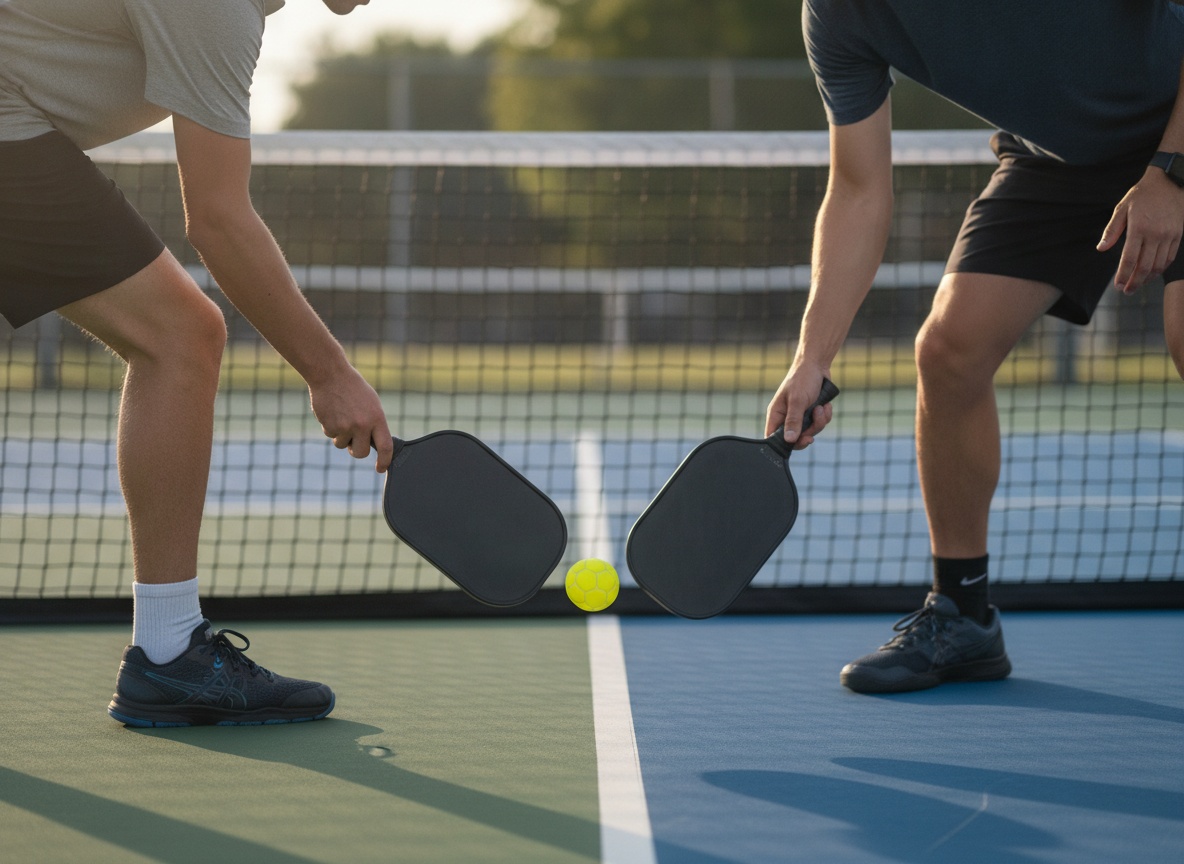
Here's what that actually means. The paddle has four weighted inserts in the corners of the edge guard. When you make contact off-center — say, you reach for a wide ball and catch it on the outer third of the paddle face — the extra corner weight resists the twisting force. The paddle stays squarer to your target. Off-center shots fly less erratically than they would on a standard construction paddle.
This is the "moment of inertia" in action. MOI measures resistance to rotational acceleration. Higher MOI = the paddle resists twisting more = more consistent shot direction even on mishits. Golf equipment testers have been measuring this in clubs for decades. It's a real metric with real on-court impact.
What Callaway didn't do here: they didn't use foam core technology. The CRBN TruFoam Barrage line, JOOLA's Gen 3 thermoformed paddles, and the ProKennex kinetic system all use fundamentally different approaches to improving feel and vibration reduction. The Inertia's core is standard 16mm polypropylene honeycomb — solid, proven, but not cutting-edge by 2026 standards. The innovation is in the edge design, not the core material. That distinction matters when you're evaluating whether $249 is the right price.
Performance: What It Actually Feels Like to Play With
Control and Dinking
This is where the Inertia earns its price. The dinking game feels remarkably consistent — more so than most paddles at this price point. When you're trading cross-court dinks from the kitchen line, the paddle's high MOI keeps each contact feeling predictable. You stop second-guessing shots that weren't centered. That's a real mental load reduction, particularly for players at the 3.0–4.0 range who are still building consistent mechanics.
Soft shots, drop shots, and resets all benefit from the 16mm core thickness — the extra depth absorbs pace and makes it genuinely easier to de-escalate hard exchanges. This is a kitchen paddle first and a baseline banger second.
Power and Speed
Don't buy this paddle expecting Hyperion-level pop. The Inertia plays softly for a carbon paddle — by design. The polypropylene core at 16mm has a longer dwell time than thinner cores or foam-enhanced constructions, which translates to more control and less trampoline effect. Attackers who rely on hard drives and speed-ups will find the Inertia feels like it's holding the ball back.
For power-first players, this is a dealbreaker. For control-first players, it's exactly what they ordered.
Spin
The T700 carbon face provides solid spin texture. It won't generate the aggressive grit of a raw carbon surface that's been left uncoated (like some CRBN models), but it's meaningfully better than composite face paddles for spin consistency. Topspin third shots carry reliably. You can brush cross-court serves with good kick. This isn't a spin monster, but it doesn't need to be.
Vibration and Arm Feel
This is where players with arm sensitivity — tennis elbow history, pickleball elbow developing — will notice something real. The corner weighting reduces the vibration transmitted to the handle on off-center contact. It's not zero vibration, but the reduction is perceivable after a long session. Compare it to playing with a thin-core power paddle for two hours: the Inertia leaves your arm feeling less worked.
Callaway Inertia vs ProKennex Black Ace XF14
The ProKennex Black Ace XF14 ($279) is the most interesting direct comparison for the Inertia — and it's an honest fight. Both paddles are built around reducing vibration and improving stability, but they do it differently.
ProKennex uses kinetic technology: tiny metal beads inside the handle that absorb impact vibration at the point of contact. Callaway uses MOI weighting: heavy inserts in the edge guard that prevent rotational twisting. ProKennex absorbs the energy. Callaway resists the motion. Different physics, overlapping results.
In practice, the ProKennex Black Ace XF14 feels slightly more lively — the kinetic system gives it a fractionally better feel at contact without sacrificing stability. It's also $279 vs $249, which means the Callaway is the better value on paper. The ProKennex edges it for players who want vibration absorption and slightly more touch. The Callaway wins for players who specifically want that larger-feeling sweet spot from the perimeter weighting.
ProKennex also has a longer handle (5.75") vs. Callaway's 5.5" — meaningful for two-handed backhand players.
→ Check ProKennex Black Ace XF14 price on Pickleball Central
Callaway Inertia vs Franklin C45 Tempo 16mm
Franklin's C45 Tempo 16mm ($230) is the budget-conscious alternative — $20 cheaper, same core thickness, same control-first philosophy. Franklin is a legitimate pickleball brand (their X-40 ball is the standard at many tournaments), so this isn't a step down in terms of brand credibility.
The Callaway beats it on grip quality (Karakal vs Franklin's standard grip) and on edge stability. The Power Edge weighting is a real performance differentiator vs. the C45 Tempo, which uses a standard construction without any MOI engineering. If you consistently make centered contact and rarely mishit, the Franklin C45 saves you $20 with minimal real-world difference. If you're still building your mechanics — as most 3.0–4.0 players are — the Callaway's MOI stability will make a measurable difference in your game.
→ Check Franklin C45 Tempo 16mm price on Pickleball Central
Who Should Buy the Callaway Inertia
Golfers picking up pickleball. This is the Inertia's natural home. Golfers transitioning to pickleball have a specific tendency: they try to power the ball rather than placing it. The Inertia's soft feel and high stability will push them toward control-first play faster than a power paddle would. For the first 6–12 months of a golfer's pickleball journey, the Inertia is probably the single most appropriate paddle choice in the $200–$300 range.
Control-focused 3.0–4.0 players. Players who are actively working on their reset game and dinking consistency will see the Inertia's high-MOI design as genuinely useful. When every third-shot drop doesn't go where you aimed it, the stability and predictability of this paddle help you iterate faster toward consistent mechanics.
Players with arm sensitivity. Not the best solution for arm injury prevention (court shoes and technique matter more), but the vibration reduction is real enough to matter for players coming back from pickleball elbow or managing early-stage issues.
Who Should Skip It
Power-first players at 4.0+. The Inertia's soft feel and control-first design will actively frustrate players who rely on drives and speed-ups to win points. Buy a JOOLA Hyperion Pro V or CRBN TruFoam Barrage instead.
Foam core enthusiasts. If you've played CRBN TruFoam, JOOLA's Gen 3 foam paddles, or similar and love the feel — the Inertia's polypropylene core will feel dated by comparison. Foam technology has changed what premium feels like.
Budget buyers. At $249, the Inertia is only a compelling value if you specifically need what the Power Edge provides. If you're shopping on a tight budget, the Franklin C45 Tempo 16mm at $230 does 80% of what the Inertia does for $20 less.
Pricing and Where to Buy
The Callaway Inertia retails at $249.99. Pickleball Central has it in stock as of this review — they're one of the few authorized US retailers carrying the full Callaway pickleball lineup.
Buy Callaway Inertia on Pickleball Central ($249.99) →
One note on sizing: the grip is 4.2" circumference, which runs small-to-medium. Players with larger hands (4.3"+ grip size) may want to add an overgrip to build it up. Check out our pickleball overgrip guide if you're unfamiliar with sizing up a grip.
Complete Your Setup
Now that you've found your paddle, don't carry it in a gym duffel.
The FORWRD Court Ranger V2 is built specifically for pickleball players who take their gear seriously. It holds up to 4 paddles in a modular sleeve system, has a 16" laptop compartment, and uses YKK AquaGuard weatherproof zippers — the same hardware on outdoor gear that costs twice as much.

FAQ: Callaway Inertia Pickleball Paddle
Is the Callaway Inertia a good pickleball paddle?
Yes, for control-oriented players. The Callaway Inertia uses patent-pending Power Edge Technology — four weighted corner inserts — to increase moment of inertia and expand the effective sweet spot. It excels at dinking, resets, and consistent soft play. Power-first players looking for a harder-hitting paddle will find it too soft.
What is Power Edge Technology in the Callaway Inertia?
Power Edge Technology uses four weighted inserts in the paddle's corner edge guard to increase its Moment of Inertia (MOI) — a measure of how strongly the paddle resists rotational twisting on off-center contact. Higher MOI means the paddle stays squarer to your target even when you hit the ball on the outer third of the face, producing more consistent shot direction and a larger effective sweet spot.
How does the Callaway Inertia compare to JOOLA paddles?
The Callaway Inertia focuses on stability through perimeter weighting (MOI), while JOOLA's premium line (Hyperion Pro V, Kosmos Pro V) uses advanced foam core or thermoformed construction for a livelier, more powerful feel. JOOLA paddles at comparable prices ($250–$300) generally offer more pop and a more modern core feel. The Inertia beats JOOLA's standard models on off-center stability, but lags behind JOOLA's pro-tier paddles on pure performance ceiling.
Is the Callaway Inertia good for golfers learning pickleball?
Yes — it's one of the best crossover choices for golfers. The high MOI design compensates for the inconsistent swing mechanics that most golfers bring to pickleball in their first 6–12 months. The paddle's control-first construction also naturally encourages the dinking-focused play style that separates average pickleball players from improving ones. Callaway's brand heritage in golf also means golfers will have intuitive trust in the engineering.
What are the specs of the Callaway Inertia paddle?
The Callaway Inertia weighs 8.1 oz average (7.9–8.3 oz range), features a 16mm polypropylene core with Power Edge Technology, a Unidirectional T700 Carbon Fiber face with Fiberglass Stabilizing Layer, 16.25" paddle length, 7.66" width, 5.5" handle, and 4.2" grip circumference (small/medium). Grip is a Karakal Precision Performance Grip. Retails for $249.99.
Does Callaway make other pickleball paddles besides the Inertia?
As of mid-2026, the Inertia is Callaway's primary entry into the paddle market. Callaway distributes pickleball equipment through their OGIO brand in addition to the Callaway Golf direct channel. Whether they expand the lineup depends on how the Inertia performs commercially — but given Callaway's resources and the continued growth of pickleball, additional models seem likely within the next 12–18 months.
Final Verdict
The Callaway Inertia is a genuinely well-built control paddle that does what it claims. Power Edge Technology isn't marketing fluff — the perimeter weighting produces measurably better off-center stability than standard construction paddles at this price point. Callaway's decades of MOI engineering experience translate directly and honestly to the paddle court.
The honest caveat: at $249, you're paying a mild brand premium over comparable spec paddles. The polypropylene core, while solid, isn't the foam core technology that paddles like the CRBN TruFoam Barrage or JOOLA Pro V series use. If raw specs-per-dollar is your metric, paddles like the Franklin C45 Tempo 16mm ($230) offer similar core performance for less.
But if you're a golfer picking up pickleball, a control-focused player who wants the stability benefit, or someone coming back from arm sensitivity issues — the Inertia earns its price. For everyone else, check whether the Power Edge benefit justifies the $30–50 premium over your alternatives before buying.
Buy Callaway Inertia on Pickleball Central →
Related: JOOLA Ben Johns Hyperion CAS 16 Review 2026 | CRBN3 TruFoam Barrage Review 2026 | Power vs. Control Paddles: How to Choose

Leave a comment
This site is protected by hCaptcha and the hCaptcha Privacy Policy and Terms of Service apply.