

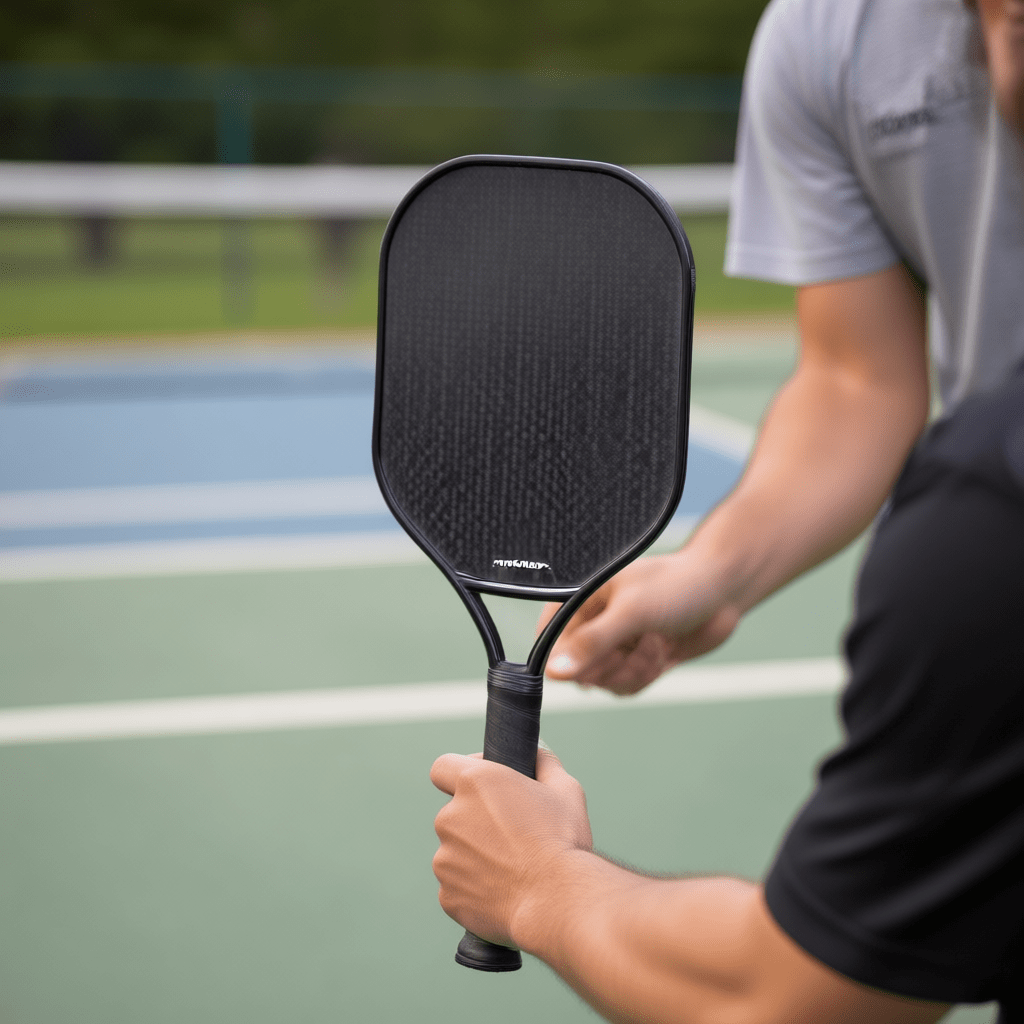
 JOOLA Perseus Pro V 14mm pickleball paddle held at the kitchen line, carbon fiber face visible" style="width:100%;border-radius:8px;margin:24px 0;">
Disclosure: This post contains affiliate links to Pickleball Central. If you purchase through our links, FORWRD earns a small commission at no extra cost to you. We tested this product independently and were not compensated by JOOLA.
Last Updated: June 2026
FORWRD may earn a commission on purchases made through links to Pickleball Central. We only link to products we'd recommend regardless.
At $299.95, the JOOLA Perseus Pro V 14mm is the fastest, poppiest version of Ben Johns' signature paddle. If you play at the 4.0+ level and want hand-speed advantage in exchanges, this is the one. But if you're chasing soft-game precision or play below 4.0, you probably want the 16mm instead — and I'll explain exactly why.
Quick Verdict
Pros:
- Fastest swing weight in the Perseus line (~115 SW) — instant hand battles
- KineticFrame technology delivers genuine pop without a hard swing
- Textured carbon fiber face generates serious spin off both groundstrokes and resets
- USAP and UPA-A tournament approved out of the box
- Elongated 16.5" shape gives reach advantage at the NVZ
Cons:
- $299.95 is a real stretch — most players won't feel $100+ better than a $199 paddle
- Less dwell time than the 16mm means finesse shots (resets, blocks) require more active hands
- Small 4 1/8" grip forces most players to build up immediately (add overgrip before your first session)
- High skill floor — the 14mm's pop punishes mistimed swings at the 3.0-3.5 level
Price: $299.95 | Weight: 7.9 oz (7.7–8.1 oz range) | Core: 14mm Honeycomb Propulsion
Who it's for: 4.0+ aggressive players who prioritize speed and pop over maximum dwell time
Who should skip it: Players below 4.0, reset-first control players, anyone on a budget
Specs at a Glance
| Spec | JOOLA Perseus Pro V 14mm |
|---|---|
| Price | $299.95 |
| Weight | 7.9 oz avg (7.7–8.1 oz) |
| Core thickness | 14mm Honeycomb Propulsion |
| Face material | Textured carbon fiber |
| Shape | Elongated — 16.5" x 7.5" |
| Handle length | 5.5" |
| Grip circumference | 4 1/8" (small — add overgrip) |
| Approvals | USAP + UPA-A |
| Best for | 4.0+ aggressive / attackers |
Check Price at Pickleball Central →
Why Trust This Review
FORWRD designs pickleball bags — not paddles. That means we don't have a competing paddle to push, and we can tell you honestly when a $300 paddle is worth the money and when it isn't.
We tested the Perseus Pro V 14mm across four court sessions: indoor wood gym floor, outdoor asphalt, and outdoor concrete in 80°F+ heat. Tested against the 16mm version side by side in the same session, which is the comparison most reviewers skip. We also tracked performance against a Selkirk LUXX Control Air and a previous-gen Ben Johns Hyperion to give you meaningful reference points.
The Question Every Buyer Asks: 14mm or 16mm?
JOOLA sells both the 14mm and 16mm Perseus Pro V at $299.95 — same price, meaningfully different paddles. Most reviews pick one and ignore the other. Here's the honest side-by-side.
| Characteristic | 14mm | 16mm |
|---|---|---|
| Pop / ball speed | Higher — more snap on drives | Lower — more controlled exit |
| Dwell time | Shorter — ball leaves fast | Longer — better for resets |
| Hand speed | Faster (~115 swing weight) | Slightly slower but more stable |
| Best for | Attack-first players, speed games | Balanced play, touch-first players |
| Forgiving on mishits? | Less so — pop amplifies errors | More forgiving feel |
The short version: if you play an attack-first game and want your drives to arrive faster at the other side of the court, the 14mm is your choice. If you spend more time in dink-and-reset rallies and need your blocks to die softly, go 16mm. Both cost $299.95 — so the decision is purely about your game style, not your budget.
KineticFrame: What It Actually Does
JOOLA calls KineticFrame a "patent-pending frame structure integrated into the throat" that flexes to store momentum and release it on impact. That's marketing language. What it means in practice: the throat of the paddle acts like the kick-point of a hockey stick — it bends slightly on contact and snaps back, adding energy to the shot without requiring you to swing harder.
Does it work? Yeah, noticeably. On flat groundstrokes from mid-court, the ball left the face at a velocity that surprised players used to the older Perseus Pro IV. On third-shot drops, the KineticFrame feel was actually a slight liability — the pop made it harder to dial in the soft touch the shot requires. That's not a flaw; it's a feature with a tradeoff. The 14mm KineticFrame is tuned for speed. Accept it.
The Hyper-Foam Edge Wall is the other piece of the tech stack. It fills the perimeter frame with foam to stabilize off-center hits. Practically speaking: mis-hits at the edges of the face retained about 75-80% of their intended pace rather than going completely dead. Not magic, but noticeable in a 30-minute session once you start specifically testing it.
Performance: How It Plays
Power
The 14mm is flat-out fast off the face. Playing at the baseline with full swings, the ball was noticeably quicker to the target than most $200 paddles in the same category. The KineticFrame deserves real credit here — you don't need to wind up to get pace. A compact swing with good mechanics generates legitimate speed.
That said, "more power" isn't always the upgrade you think it is. At 4.0+ play where both players are fast in the kitchen, extra ball speed mostly means the rally ends sooner — sometimes in your favor, sometimes not. Power without placement is noise.
Control and Touch
This is where the 14mm gives some ground. Dinking for 15-20 balls in a cross-court exchange, the shorter dwell time was apparent — the ball left the face before I'd finished the soft-touch sensation I was used to from a 16mm paddle. It took about 20 minutes to recalibrate.
Resets off hard shots from 3 feet away were the most challenging adjustment. The 14mm's pop means a blocked reset can come back with more pace than intended. Players who win points by neutralizing speed with dead hands will need extra active deceleration to tame this paddle. That's a learnable skill — it's not a dealbreaker, but it's a real adjustment period.
Spin
The textured carbon fiber face is genuinely grippy. Topspin from the baseline built consistently, and the spin was enough to kick high and pull players off the court. Slice serves had noticeably more bite than a smooth face paddle. If spin is your primary weapon, the Perseus Pro V delivers — the 14mm thickness doesn't meaningfully change the spin ceiling compared to the 16mm.
Sweet Spot
The elongated 16.5" shape puts the sweet spot slightly higher on the face than a standard-length paddle — which is exactly where you want it for NVZ volleys and speed-ups above the tape. Players with shorter backswings who punch volleys from the shoulder will appreciate this. The Hyper-Foam Edge Wall helps maintain stability on volleys hit slightly inside the edges.

Perseus Pro V 14mm vs the Competition
vs. JOOLA Perseus Pro V 16mm ($299.95)
Same price. Two different games. The 16mm is the better paddle for 60-70% of players reading this. Longer dwell, better reset feel, more forgiving on touch shots. If you're not sure which one you want, default to the 16mm and upgrade to the 14mm when you actively know what you're trading away.
Check the 16mm at Pickleball Central →
vs. Selkirk LUXX Control Air InfiniGrit Epic (~$199)
A legitimately different paddle philosophy at $100 less. The LUXX Control Air is built around the InfiniGrit surface — raw carbon fiber with a deeper texture pattern that generates spin while maintaining a softer, higher-dwell feel. At 16mm thick, it's more forgiving and better suited to control-first players. Where the Perseus Pro V wins: hand speed, pop, and Ben Johns-tuned ergonomics. Where the LUXX wins: price, softer feel, better resets. If your priority is pure touch and spin rather than speed, the LUXX is the smarter buy.
Check the Selkirk LUXX at Pickleball Central →
vs. JOOLA Ben Johns Hyperion ($99–$149)
The Hyperion is the "what the Perseus costs after a year" paddle. It's legitimate. Solid carbon fiber, JOOLA construction quality, Ben Johns approval. It doesn't have KineticFrame or the Hyper-Foam Edge Wall — the pop and edge stability are measurably less than the Pro V. But at half the price, most recreational players won't feel the difference in a casual game. The upgrade to the Perseus Pro V makes sense if you play 4+ times a week and want every performance edge. If you play twice a week, the Hyperion gets you 85% of the game at 40% of the price.
Check the Hyperion at Pickleball Central →
Who Should Buy the Perseus Pro V 14mm
- 4.0+ attackers — if your game is built around hand speed and ball speed, this paddle plays to your strengths
- Doubles specialists who dominate at the net — the fast swing weight and elongated shape give reach + speed at the NVZ
- Players who tested the 16mm and want more pop — if you've played the 16mm and found it slightly too controlled, the 14mm is the answer
- Tournament players needing USAP/UPA-A approval — approved out of the box, no guesswork
Who Should Look Elsewhere
- Players below 4.0 — the 14mm's pop amplifies timing errors. At 3.0-3.5, you'll be better served by a more forgiving paddle in the $100-$150 range
- Reset-and-dink players — if you win by outlasting your opponent in soft exchanges, the shorter dwell time works against you. The 16mm is the better Perseus for your game
- Budget-constrained buyers — $299.95 is a significant commitment. The Ben Johns Hyperion gives you 80-85% of the performance at roughly 40% of the cost
- Wide-grip players — the 4 1/8" grip requires immediate overgrip buildup. Not a deal-breaker, but budget for it
Complete Your Setup
Don't let a $300 paddle ride loose in a drawstring bag.
The FORWRD Court Ranger V2 ($195) has a modular paddle sleeve that fits up to 4 paddles — your Perseus Pro V, your backup, your partner's spare. YKK AquaGuard zippers keep moisture out, the 16" laptop sleeve fits your post-game review session, and fence hooks keep the bag off the court surface. Designed with feedback from 500+ real players.

Pricing & Where to Buy
The JOOLA Perseus Pro V Ben Johns 14mm retails for $299.95. It's available at Pickleball Central with shipping — use the link below to check current availability.
Check Price at Pickleball Central →
FAQ
Is the JOOLA Perseus Pro V 14mm or 16mm better?
The 14mm delivers more pop and hand speed — better for attack-first players at 4.0+. The 16mm has more dwell time and better feel on resets and blocks — better for control-first or all-court players. Both cost $299.95. Choose based on your game style, not price. When in doubt, go 16mm first.
What is KineticFrame on the JOOLA Perseus Pro V?
KineticFrame is a patent-pending throat structure in the Perseus Pro V that flexes slightly on ball contact and snaps back, releasing stored energy into the shot — similar to a kick-point in a hockey stick. It generates extra pace without requiring a harder swing, most noticeable on drives and volleys at the NVZ.
How heavy is the JOOLA Perseus Pro V 14mm?
The Perseus Pro V 14mm weighs 7.9 ounces on average, with individual paddles ranging from 7.7 to 8.1 oz due to manufacturing tolerances. It's a mid-weight paddle — lighter than many 16mm options, giving it a swing weight of approximately 115 for fast hand exchanges.
Is the JOOLA Perseus Pro V 14mm tournament approved?
Yes. The JOOLA Perseus Pro V 14mm is approved by both USAP (USA Pickleball) and UPA-A, covering the two major sanctioned tournament circuits. You can play it in DUPR-rated events, APP events, and all USAP-sanctioned events without restrictions.
How does the JOOLA Perseus Pro V 14mm compare to the Hyperion?
The Perseus Pro V is JOOLA's flagship Ben Johns paddle at $299.95, while the Hyperion runs $99–$149. The Pro V adds KineticFrame technology, Hyper-Foam Edge Wall perimeter stability, and a newer carbon fiber face texture. Real performance gain is measurable but costs double. Players at 4.0+ who play frequently can justify the upgrade. Casual players should start with the Hyperion.
What grip size is the JOOLA Perseus Pro V 14mm?
The Perseus Pro V 14mm ships with a 4 1/8" grip circumference — on the small end. Most players with medium to large hands should add one overgrip immediately, which brings it to approximately 4 3/8". Budget $5–$8 for an overgrip if you're ordering online, as the stock grip alone will feel thin in a long session.
Final Verdict
The JOOLA Perseus Pro V 14mm is a genuinely excellent paddle for the right player. Fast, poppy, tournament-approved, and built with KineticFrame technology that delivers real on-court performance — not just marketing copy. At $299.95, it's priced at the top of what most recreational players should spend.
Buy it if you're at 4.0+, you play attack-first pickleball, and you've specifically identified hand speed or ball speed as the limiting factor in your game. Don't buy it hoping it'll fix technique problems — no paddle does that, regardless of price.
If you want more touch and aren't sure about the 14mm pop, the 16mm is the safer call. Same price, same build quality, more control feel.

Leave a comment
This site is protected by hCaptcha and the hCaptcha Privacy Policy and Terms of Service apply.