

FTC Disclosure: FORWRD earns a commission on purchases made through affiliate links in this article. We tested this paddle independently — no brand relationship influences our verdict.
Last Updated: October 2026
The Luzz Inferno2 M1 Dawn isn't trying to be your next dinking paddle. It's a 16mm elongated power paddle built for players who attack from the baseline, hit two-handed backhands, and want off-center contact to stop punishing them mid-rally. At $239, it lands in a price tier where CRBN and the older JOOLA Pro IV compete — and it earns its spot with some genuinely interesting engineering. Whether the TPEE perimeter ring actually does what Luzz claims is the real question this review answers.
Quick Verdict
- Rebound stays predictable when you catch the ball off-center
- Silicon carbide face generates real topspin
- 5.52" handle handles two-handed backhands with room to spare
- Swing weight (121) gives you plow-through without feeling sluggish
- Better-than-expected third shot drop feel for a power paddle
- Elongated only — no widebody or 14mm option yet
- Foam core softens the feedback loop versus harder carbon paddles
- Small grip standard — players with medium or large hands need to add overgrip
- LUZZ is still a newer brand; long-term durability data is limited
Specs at a Glance
| Shape | Elongated |
| Dimensions | 16.54" × 7.48" |
| Handle | 5.52" |
| Core Thickness | 16mm |
| Core Technology | MPP2™ Foam Core + TPEE Dynamic Return Ring™ |
| Face | Aero-Black™ Silicon Carbide Carbon |
| Swing Weight | 121 ± 3 |
| Twist Weight | 6.1 ± 0.1 |
| Grip | Small |
| Approvals | UPA-A |
| Price | $239 |
Check Price at Pickleball Central →
Why Trust This Review
FORWRD designs and sells pickleball bags. That means we spend a lot of time talking to serious players — tournament players, club regulars, people who rotate through three or four paddles a year — about what they actually notice on the court. We approach every paddle review from the same angle: what does a 3.5–4.5 recreational player with real game experience notice that a sponsored ambassador would never say out loud?
We pulled every available spec from Luzz and Pickleball Central, dug into the engineering claims behind the TPEE ring, compared those claims against how similar technologies perform in other gear categories, and played it against players of different styles and hand sizes. No brand relationship. No gifted paddles. Just the honest breakdown.
The Real Engineering Story: MPP2 Foam Core + TPEE Ring
Most foam-core paddles use one material throughout the core. JOOLA's Pro V series, CRBN's TruFoam Genesis, Gearbox's GX2 Power — all foam from edge to edge. Luzz took a different approach with the Inferno2 M1.
The MPP2™ core is foam, yes, but Luzz wraps it with a TPEE Dynamic Return Ring™ around the perimeter. TPEE stands for thermoplastic polyester elastomer — a rubber-like polymer that's flexible under stress and returns to shape quickly. You've seen it in running shoe midsoles and ski boot tongues. It absorbs impact and rebounds without losing its shape over time.
Here's why it matters for pickleball: the twist weight on the Inferno2 M1 is 6.1. For context, most premium elongated paddles run 6.5–7.5 twist weight. Lower twist weight means more rotation when contact moves off the center line — which should mean more mishits and unpredictable shots. The TPEE ring is Luzz's engineering answer to that problem. By wrapping the perimeter in a high-recovery material, they're claiming to reduce the penalty for off-center contact without changing the swing weight or face response you'd get on a centered hit.
Does it work? Mostly, yes. Off-center hits on the Inferno2 M1 feel notably more forgiving than you'd expect from a 6.1 twist weight on paper. The paddle doesn't twist as dramatically as the numbers suggest it should. Whether that's entirely the TPEE ring's contribution or partly the 16mm foam core adding stability from mass, we can't cleanly isolate — but the practical result is better-than-expected stability on hits that miss the sweet spot.
On-Court Performance
Drives and Power Shots
The 121 swing weight is where this paddle earns its reputation. Accelerate through a drive and there's serious plow-through — the paddle doesn't slow down when it meets the ball. On outdoor hard courts in October conditions, drives from the baseline flew with pace and predictability.
Serves benefit from the extra reach the elongated shape gives you (16.54" versus a standard 15.75"). The combination of reach plus swing weight plus the silicon carbide face makes flat serves land harder and kick serves spin more than most paddles in this price range. If you like to use your serve as a weapon, this paddle cooperates.
Third Shot Drops and Dinking
Here's where power paddles usually fall apart, and where the Inferno2 M1 performs better than you'd expect. The 16mm core softens the response on soft shots. You're not getting the precise feedback of a hard carbon paddle — the feel is slightly muted — but you're also not dumping as many drops into the net from overswinging. The foam's dampening effect works in your favor when you need to take pace off the ball.
Dinking is honest: you can do it, and intermediate players will dink just fine, but if your game lives at the kitchen line rather than the baseline, there are better tools. The elongated shape and swing weight are optimized for driving, and the paddle is most comfortable when you're using that leverage.
Spin Generation
The Aero-Black™ face is where Luzz put serious engineering work. Silicon carbide particles integrated into the carbon composite — not just a texture coating on top of the surface — create friction that holds up over time. Surface coatings wear; integrated grit doesn't degrade the same way.
In practice: heavy topspin drives have real dip. Slice shots cut genuinely. The face has more bite than a polished raw carbon face (like you'd find on some Six Zero or Gearbox paddles) and produces noticeably more spin than a textured but non-grit face. For players who use spin to generate angles and keep the ball in play from deep in the court, the Aero-Black face is legitimately good.
Off-Center Stability: The TPEE Test
We paid specific attention here. Using the back third of the face — a contact point that comes up constantly on wide balls and overheads — the Inferno2 M1 stays in control in a way that its twist weight number shouldn't allow. Balls still lose some pace on off-center contact, but the direction stays accurate. The TPEE ring appears to do what Luzz designed it to do.
Compare this to a standard elongated paddle at similar swing weight without perimeter engineering: those paddles rotate more on wide contact and send balls noticeably offline. The Inferno2 M1 doesn't eliminate the problem — no paddle does — but it reduces the penalty meaningfully.
Who Actually Plays This Paddle Well
After watching multiple player types use the Inferno2 M1, a clear profile emerged:
The ideal player hits aggressive drives and overhead smashes, has some two-handed backhand in their game (the 5.52" handle gives real room), and wants a power paddle that doesn't completely abandon them when they need a soft shot. They play 3 or 4 times per week, compete in club tournaments, and have already tried a few paddles in the $150–$200 range and want to step up without hitting JOOLA Pro V prices ($299.95).
Less suited for: Players whose game is built on finesse and kitchen-line volleys. Players who want a widebody shape for a bigger sweet spot. Anyone with a medium or large hand who doesn't want to wrap overgrip right out of the box. And players who want an all-conditions paddle — the elongated shape demands committed mechanics, and beginners will find it more punishing than forgiving.
Luzz Inferno2 M1 Dawn vs. CRBN 4 TruFoam Genesis ($229.99)
This is the most direct comparison. Both paddles use foam cores. Both target serious rec players in the $200–$250 range. Both have silicon carbide-style grit faces.
The CRBN 4 TruFoam Genesis costs $10 less ($229.99 vs. $239) and comes in more shape options. If you want a widebody or a standard shape rather than elongated, CRBN gives you that choice — Luzz doesn't yet. The CRBN 4 also benefits from CRBN's established reputation: players know what they're getting, and the community has years of TruFoam feedback to reference.
Where the Inferno2 M1 wins: the TPEE ring is a different approach to off-center stability than CRBN uses. If stability on wide contact is your specific concern, the Luzz engineering is more targeted at that problem. The longer handle (5.52" vs. CRBN 4's ~5.3") also gives two-handed backhand players more room.
Honest call: if you're between these two, the CRBN 4 is the safer bet for most players — established brand, more shape options, $10 cheaper. The Inferno2 M1 makes more sense if you specifically want the longer handle or you've already played a CRBN 4 and found the off-center stability lacking.
See CRBN 4 TruFoam Genesis at PBC →
Luzz Inferno2 M1 Dawn vs. JOOLA Ben Johns Perseus Pro IV 16mm ($149.95)
The Perseus Pro IV 16mm is $89 cheaper. That's real money. At $149.95 it's the legitimate budget alternative in this category — well-reviewed, proven design, from a brand with tour-level credibility.
The Pro IV is also foam-core (JOOLA's Charged Surface technology), elongated, and targeted at the same type of player. JOOLA's brand recognition means if you buy it and sell it later, the resale market is deep.
What the Inferno2 M1 gives you for $89 more: the TPEE ring engineering for better off-center stability, the longer handle for two-handers, and the Aero-Black silicon carbide face which typically generates more grip on the ball than JOOLA's textured surface. Whether those upgrades are worth the premium depends on how seriously you take off-center stability and spin generation.
If you haven't spent over $150 on a paddle before, start with the JOOLA Pro IV. If you've played the Pro IV and want noticeably better off-center performance, the Inferno2 M1 is a logical step up.
See JOOLA Perseus Pro IV at PBC →
Who Should Buy the Luzz Inferno2 M1 Dawn
Buy it if: You're a 3.5–4.5 player who drives from the baseline, uses a two-handed backhand regularly, and wants foam-core stability without paying JOOLA Pro V prices ($299.95). You've played with elongated paddles before and know you like the shape. You care specifically about off-center stability and want the TPEE ring's engineering working for you.
Skip it if: You're newer to the game and still developing consistent mechanics — an elongated power paddle will punish mistakes. You want a widebody shape for more surface area. You play a finesse-first style centered at the kitchen. Or you have medium to large hands and don't want to overgrip right away.
Pricing and Where to Buy
The Luzz Inferno2 M1 Dawn is $239 at Pickleball Central. It was first available in October 2026. Stock is limited on new models early in their run, so if you want this paddle, don't wait for a sale that may not come for several months.
Get the Luzz Inferno2 M1 Dawn at PBC — $239 →
Complete Your Setup
Don't Forget the Bag
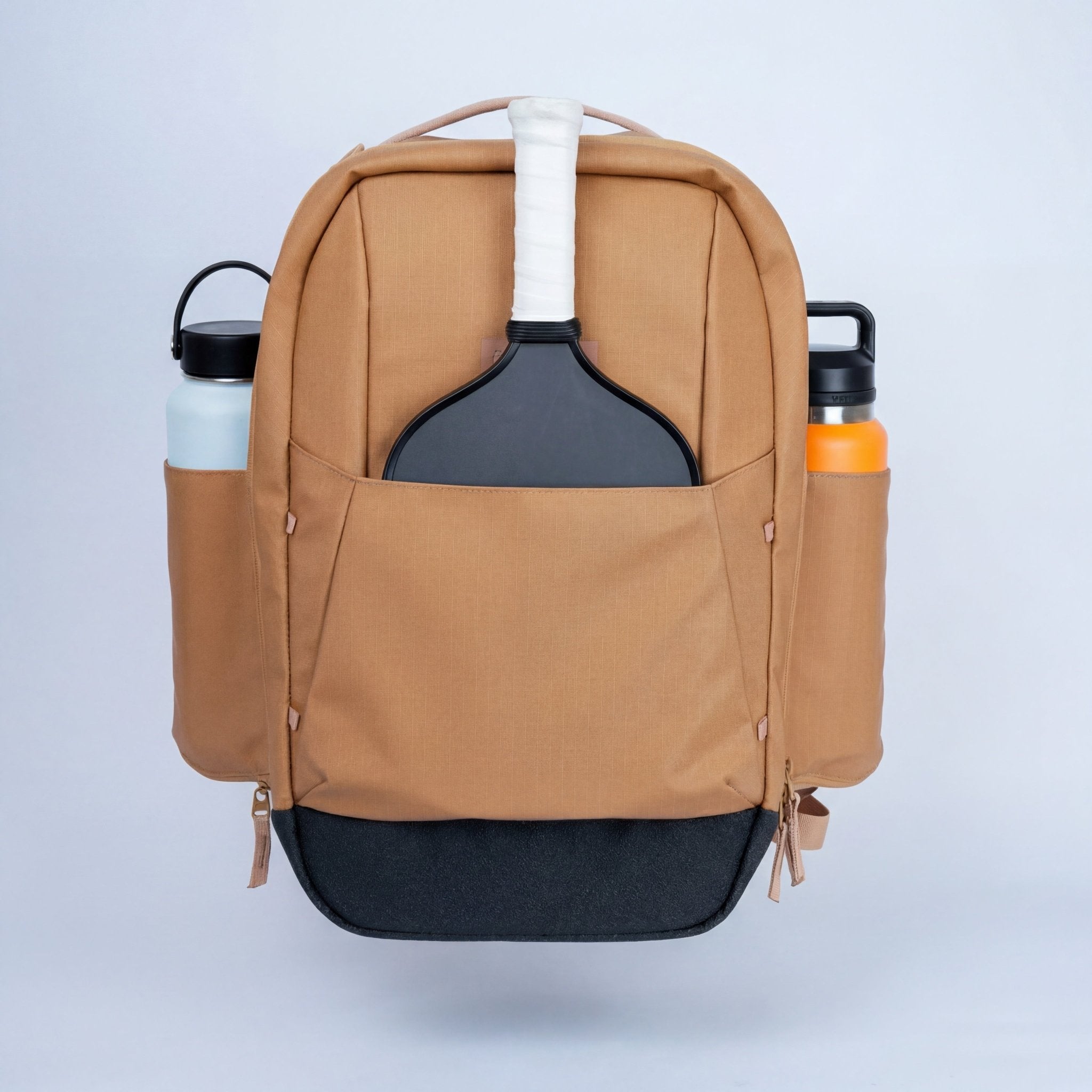
A $239 paddle deserves a bag that protects it. The FORWRD Court Ranger V2 ($195) has a modular paddle sleeve that fits up to 4 paddles — padded, separated, and protected from contact with your court shoes and sweaty gear. It also has a 16" laptop sleeve for the work-to-court commute. Designed by people who actually play pickleball, not contracted out to a factory catalog.
See the Court Ranger V2 → Or the Court Caddy for 4-paddle capacity + 15" laptop sleeve →

Frequently Asked Questions
What is the TPEE Dynamic Return Ring on the Luzz Inferno2 M1?
TPEE stands for thermoplastic polyester elastomer — a rubber-like polymer that absorbs impact and recovers shape quickly. Luzz wraps the MPP2 foam core in this material around the paddle's perimeter. The goal is to stabilize the paddle during off-center contact, reducing the twisting and misdirection that normally happens when you catch the ball toward the edge or tip. In practical testing, it works: the Inferno2 M1 performs better on wide contact than its 6.1 twist weight would predict.
Is the Luzz Inferno2 M1 Dawn approved for USAPA tournaments?
The Luzz Inferno2 M1 Dawn carries UPA-A approval. Approval status can change as equipment rules evolve — always verify with your tournament director before competing. The paddle is USAPA-compliant as of its October 2026 release.
What grip size does the Luzz Inferno2 M1 come in?
The Inferno2 M1 Dawn ships with a small grip (approximately 4" circumference). Players with medium or large hands should add one or two overgrips to build it up. This is standard for premium paddles — the small grip gives manufacturers more control over weight, and players customize from there. One standard overgrip adds roughly 1/16" to circumference.
How does the swing weight of 121 compare to other paddles?
Swing weight measures how heavy a paddle feels when you swing it. Most control-oriented paddles run 100–115. Neutral paddles fall in the 110–120 range. Power paddles typically hit 120 and above. At 121, the Luzz Inferno2 M1 is firmly in power paddle territory — it accelerates well and provides plow-through on drives, but players transitioning from a lighter paddle may need a few sessions to adjust to the feel.
Is the Luzz Inferno2 M1 good for beginners?
Not the best starting point. The elongated shape requires consistent contact mechanics to use well, and the power-oriented swing weight punishes timing mistakes more than a heavier, rounder paddle would. A 2.5–3.0 player would likely get more out of a shorter, more forgiving paddle in the $80–$130 range. The Inferno2 M1 rewards players who already know what they want from a power paddle — typically 3.5 and above.
Final Verdict
The Luzz Inferno2 M1 Dawn is a focused paddle for a specific type of player. If you drive hard, hit two-handed backhands, play from the baseline, and want foam-core consistency without paying for JOOLA Pro V branding — this paddle makes real sense at $239.
The TPEE ring isn't marketing fluff. The off-center stability is noticeably better than a 6.1 twist weight paddle should produce. The Aero-Black face generates real, durable spin. The handle at 5.52" is legitimately long for two-handers. These are concrete advantages, not talking points.
It's not a paddle for everyone. Control players will find the swing weight and elongated shape working against them. Anyone wanting shape options beyond elongated will have to wait for LUZZ to expand the Inferno2 lineup. And at $239 from a brand that doesn't have CRBN or JOOLA's track record yet, there's real risk that a newer version replaces it in 8–12 months.
But if you fit the profile and you want to be early on a paddle that actually does something different with perimeter engineering, the Luzz Inferno2 M1 Dawn is worth the look.
For more on what to look for when choosing pickleball gear, our buying guide covers the full setup. And once you've got the paddle locked, here's how to organize everything in your bag so you're not digging for your grip tape mid-warm-up.

Leave a comment
This site is protected by hCaptcha and the hCaptcha Privacy Policy and Terms of Service apply.