

Disclosure: This post contains affiliate links to Pickleball Central. If you purchase through our links, FORWRD earns a small commission at no extra cost to you. We only link to products we'd recommend regardless.
Yes, you can play pickleball with prescription glasses — but which solution works depends entirely on your correction type, budget, and how often you play. Three real options exist for pickleball players who need corrective lenses: contacts under sport wrap frames, Rx insert trays inside sport glasses, and direct prescription-fill sport frames with proper optical surfacing. Each one works for the right player. Each one fails for the wrong one.
Last updated: July 2026
After 18 months of cycling through all three — starting with contacts under a $35 pair of wrap frames, then testing a clip-in insert tray, and finally investing in direct Rx-fill frames to handle my mild astigmatism — here's what most guides get wrong and what actually matters on the court.
Table of Contents
- The Three Ways to Handle Prescription Needs on the Pickleball Court
- Option 1: Contact Lenses Under Sport Wrap Frames (The Practical Default)
- Option 2: Prescription Insert Trays (The Compromise Option)
- Option 3: Direct Rx-Fill Sport Frames (The Premium Solution)
- Best Prescription-Compatible Pickleball Glasses 2026
- The Prescription Decision Tree: Which Option Fits You
- Prescription Glasses for Women: Frame Width Matters Even More at Rx
- FAQ: Prescription Pickleball Glasses Questions
The Three Ways to Handle Prescription Needs on the Pickleball Court
Most pickleball glasses guides treat prescription eyewear as an afterthought — a bullet point near the bottom that says something like "check if the frame is Rx-compatible." That doesn't help anyone who actually needs corrective lenses to see a 2.875" ball moving at 45 mph.
Here's the real framework. Three options exist, and they're meaningfully different in cost, optical quality, and who they're actually suited for:
- Contacts under any sport wrap frame. The cheapest route and the most flexible. Works for most players unless you have a compelling reason not to wear contacts.
- Prescription insert trays. A clip-in Rx insert sits behind the main lens. A genuine compromise — better than nothing, with real optical quality limits at stronger prescriptions.
- Direct Rx-fill sport frames. The frame is manufactured to accept ground prescription lenses with proper optical surfacing. Best optical quality, highest cost, worth it for the right player.
The right choice comes down to your specific prescription, whether you can tolerate contacts, and how seriously you're playing. USA Pickleball recommends protective eyewear for all competitive play, which means your Rx solution needs to meet that standard too — not just correct your vision, but protect against ball impact. All three options below can include impact-rated lenses; just confirm ASTM F803 certification when buying.
Option 1: Contact Lenses Under Sport Wrap Frames (The Practical Default)
If you wear contact lenses comfortably, this is your answer — full stop. Put your contacts in, pick any sport wrap frames you want, and you're done. You get the full range of pickleball-specific frame options, no optical lab lead times, and no prescription markup. A quality pair of sport glasses runs $30–$120. The contacts you already own are the "prescription" part of this setup.
What this solves: almost every Rx situation, including pretty strong prescriptions, because modern contact lenses handle complex corrections well. The frame choice is entirely about lens tint, coverage, weight, and fit — not optical correction.
Three groups of players genuinely can't use this approach well, though:
- Players with dry eyes or contact intolerance. Outdoor play in heat and wind is rough on contact lens wearers. If you're already borderline, 90-minute sessions on a hard court in summer will push you past comfortable.
- Players with very high or highly complex prescriptions. Some corrections — severe astigmatism, extreme myopia — are difficult or uncomfortable to fully correct with contact lenses. Your optometrist knows if this applies to you.
- Players 45+ who need progressive correction. This is the big one. Contacts correct for distance, but if you need bifocal or progressive correction, contacts alone don't cover reading distance. You'd need monovision contacts (which some players find disorienting) or you're simply not getting full correction on the court.
If none of those apply: contacts under sport wrap frames is the right answer. Browse the FORWRD women's pickleball glasses guide or the men's guide to pick frames optimized for tint and fit, then bring your own optical correction in contact form.
Option 2: Prescription Insert Trays (The Compromise Option)
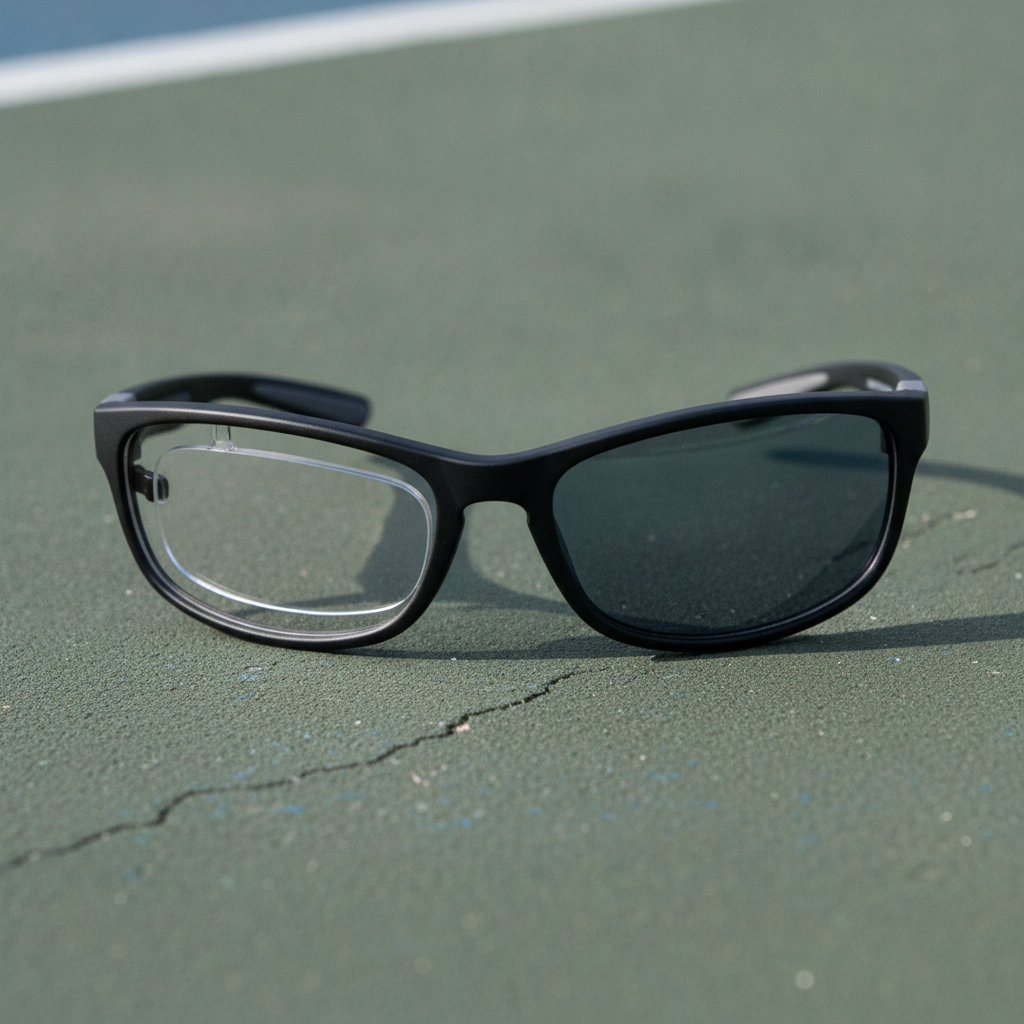
Several sport glasses brands include a removable inner clip — a slim insert frame that sits just behind the main wrap lens. You take the insert to your optician, they fit prescription lenses to it, and it clips back into the sport frame. The JOOLA RJX series and the ONIX Owl RX both use this approach.
The appeal is obvious: you keep the sport frame aesthetic and the peripheral coverage that makes wrap glasses good for pickleball, without paying for a full custom Rx build. Typical cost for the insert at your optician: $30–$80 on top of whatever the frame costs.
Here's what most guides don't say about insert trays: optical quality is genuinely limited, especially at the edges. The insert lens sits behind the main curved lens — two different curves in sequence, not one optically-ground prescription lens matched to the frame geometry. For mild prescriptions (roughly −3.00 to +2.50 with minimal astigmatism), center-of-vision quality is acceptable. Push past that and you'll encounter peripheral distortion and eye strain — particularly during the fast lateral shuffles pickleball demands.
Insert systems also add weight. Not dramatically — 8–12 grams for the insert, typically — but it can shift the balance of the frame on your face. If you're between sizes, go with the more secure fit when adding an insert.
Who this is right for: players who can't wear contacts but have mild-to-moderate prescriptions, don't want to spend $250–$500 on Rx-fill frames, and can accept slightly-less-than-perfect edge optics in exchange for the full sport frame design.
"A lot of our community — players 40 to 60 — gave up on glasses entirely because nothing worked with their prescription. The insert tray option genuinely solves the problem for mild corrections. For stronger prescriptions or progressives, you need to go the full Rx-fill route or you'll spend 45 minutes on the court with a headache." — Grub, FORWRD co-founder
Option 3: Direct Rx-Fill Sport Frames (The Premium Solution)
Direct Rx-fill means the frame accepts prescription lenses using proper optical surfacing — the same process as regular eyeglasses, not a clip-in insert. RIA Eyewear, Blinded Wear Co., and Rudy Project (via their dedicated Rx program) all offer this. The lens curves match the frame geometry. Peripheral distortion is dramatically reduced. For players with strong prescriptions, significant astigmatism, or progressive correction, this is the only option that actually works correctly.
Cost is the honest barrier: $200–$600+ depending on prescription complexity, lens materials, and coatings. Turnaround time runs 2–4 weeks. Plan ahead if you're ordering before a tournament season.
The progressive lens constraint nobody writes about: if you wear progressive lenses and you're considering sport wrap frames with Rx-fill, understand this first — most wrap frames are too narrow for progressive correction to work well. Progressive lenses require a minimum vertical lens height (typically 28–30mm) for the reading corridor to be optically useful. Sport wrap frames are often 22–25mm at the lens. The result isn't "less reading correction" — it's active optical distortion and headaches from the narrow focal zone sitting in the wrong place.
If you wear progressives, confirm the minimum lens height requirement with the Rx-fill provider before ordering. Some providers specifically design frames with adequate height for progressive correction; most don't. Many progressive wearers find that using single-vision distance correction in their sport frames — with reading glasses kept in the bag for scorecard use — is the more practical solution overall.
Browse Wiley X prescription-compatible options at Pickleball Central for frames with direct Rx programs, or search prescription pickleball glasses at PBC to see what's currently in stock.
Best Prescription-Compatible Pickleball Glasses: What's Available in 2026
Most of what's on the market falls into two buckets: insert-tray systems and direct Rx-fill programs. Here's a quick reference for where each option lands, based on the glasses currently available and how each system performs in real play:
| Frame Option | Rx Method | Prescription Range | Best For |
|---|---|---|---|
| JOOLA RJX Series | Insert tray (clip-in Rx insert) | Mild to moderate (up to ~−4.00 / +2.50) | Players who want the RJX's contrast-enhancing lens without wearing contacts |
| ONIX Owl RX | Removable Rx insert | Best for mild prescriptions | Budget-conscious players needing a basic functional Rx solution |
| Wiley X (Rx program) | Direct Rx-fill | Most prescriptions including stronger corrections | Players needing ANSI safety-rated lenses for competitive or outdoor play |
| Direct Rx-fill (PBC search) | Direct Rx-fill (frame-dependent) | All prescriptions including progressives (confirm frame height) | Serious players with strong or complex prescriptions who play 3+ times/week |
For deeper frame reviews — lens tints, fit profiles, and court performance — see the FORWRD pickleball glasses buyer's guide.
Sorted your glasses. Now sort your bag.
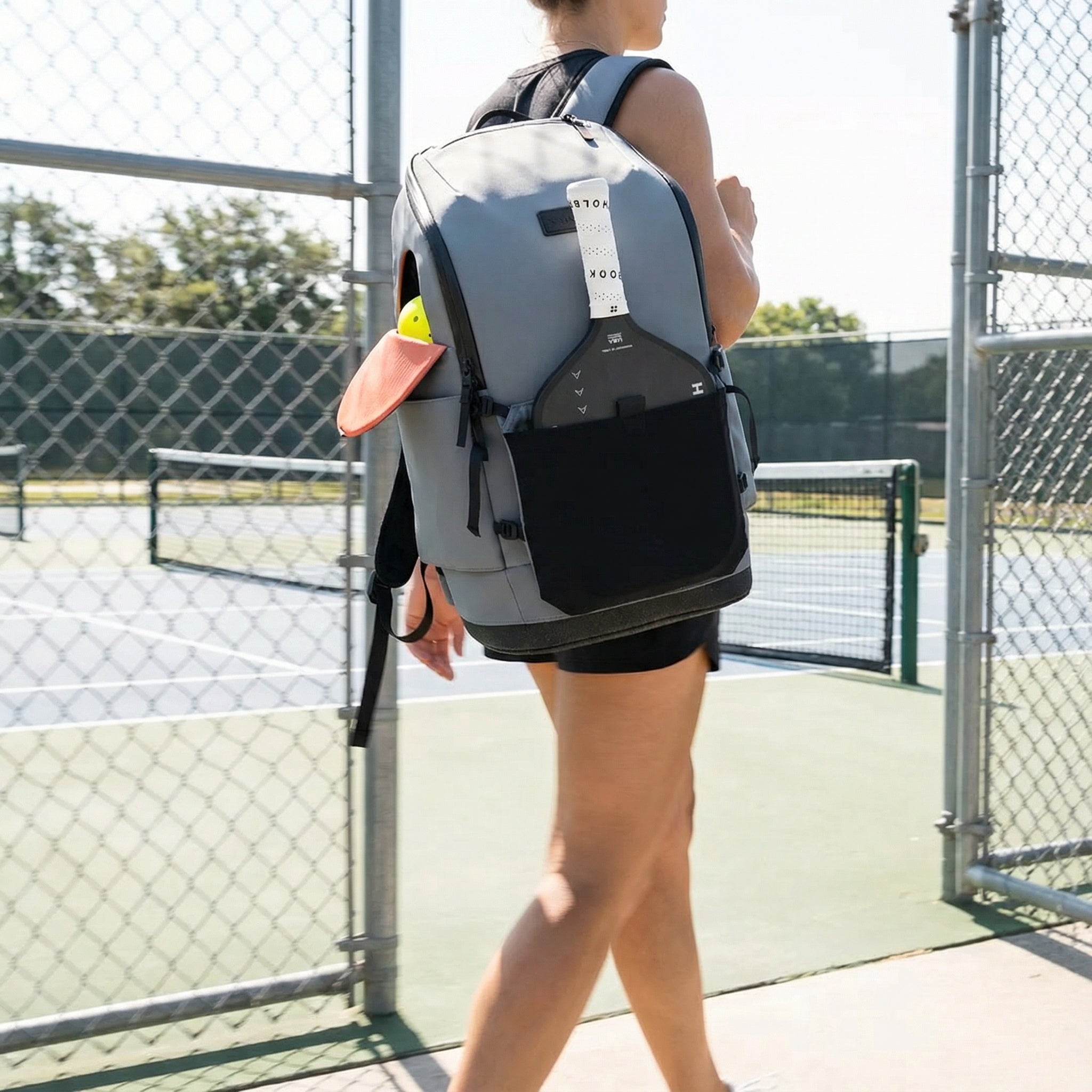
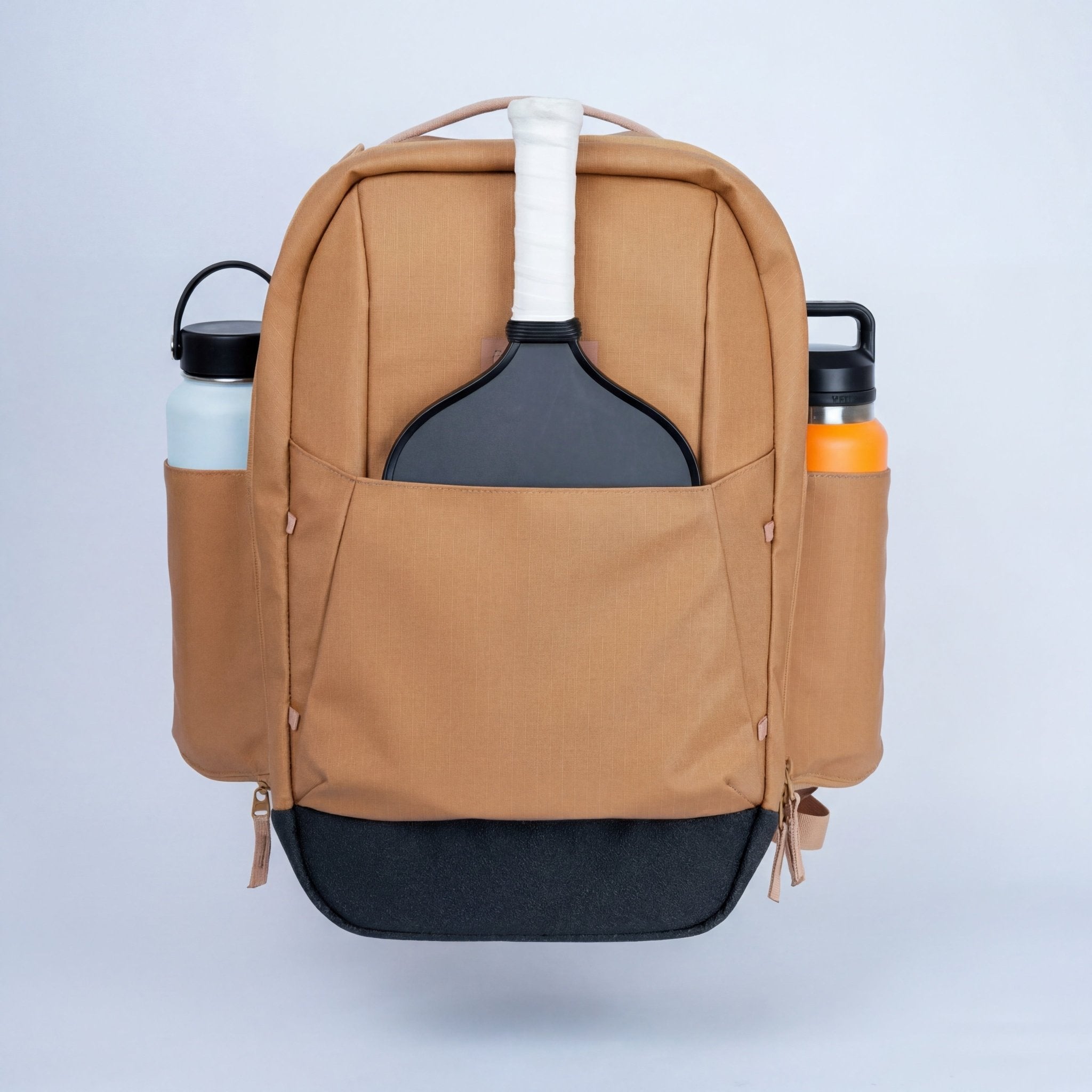
Court Ranger V2 — $195 → Soft-lined compartments designed not to scratch lenses. 16" laptop sleeve. Built for players who carry good gear.
The Prescription Decision Tree: Which Option Fits You
Stop guessing. Run your situation through this table and you'll have your answer in 30 seconds:
| Your Situation | Best Option | Why |
|---|---|---|
| Wear contacts comfortably; low-to-mid prescription | Contacts + any sport wrap frames | Cheapest, widest frame selection, zero optical compromise |
| Can't wear contacts; mild prescription (under ±3.00, minimal astigmatism) | Rx insert tray frame (JOOLA RJX or ONIX Owl RX) | Acceptable center-of-vision quality, significant cost savings over Rx-fill |
| Strong prescription or significant astigmatism; plays 3+ times/week | Direct Rx-fill sport frames | Only option with accurate edge optics for complex corrections |
| Wear progressive lenses; need multi-focal correction | Consult optometrist first; likely monovision contacts or single-vision Rx-fill | Progressive lenses in narrow wrap frames cause optical distortion — this requires professional guidance on your specific correction needs |
| Budget under $75; mild prescription; already own contacts | Contacts + $30–$60 sport wrap frames | Maximum value; spend on a good lens tint, not an optical lab |
| 45+ with presbyopia; plays competitive pickleball | Discuss with optometrist — likely monovision contacts or direct Rx-fill | Presbyopia adds real complexity; get professional guidance on which correction system handles sport-specific visual demands |
Prescription Glasses for Women: Frame Width Matters Even More at Rx
Prescription eyewear adds a consideration that purely-aesthetic frame shopping ignores: the relationship between frame width and how well the Rx insert or Rx-fill lens actually sits. For players with narrower facial profiles — which skews toward women on average, though this applies to anyone with a narrower face — a few things matter more than the marketing suggests.
First: insert tray systems are typically designed for medium-to-large facial profiles. On a narrower face, the insert may not sit flush inside the outer frame, creating a small air gap that introduces distortion and light bleed. Before committing to an insert-based system, try the frame on with a dummy insert if possible, or at minimum check the manufacturer's face width specifications.
For direct Rx-fill frames, narrower frames can actually be an advantage in some ways — they're more likely to sit correctly on a narrower face. But narrower also means less vertical lens height, which is the precise dimension that matters for progressive correction. If you need progressive lenses, a narrower frame is more likely to fall below the minimum height threshold. Plan accordingly.
The FORWRD women's pickleball glasses guide covers frame-specific sizing in detail, including which frames have nose bridge and arm adjustment range for narrower profiles.
FAQ: Prescription Pickleball Glasses Questions
Can you play pickleball with prescription glasses?
Yes. Three options work: contacts under sport wrap frames (best for most players), prescription insert trays inside sport glasses (solid for mild-to-moderate Rx), and direct Rx-fill sport frames (best optical quality, highest cost). Your specific prescription type is the deciding factor. USA Pickleball recommends protective eyewear for competitive play — all three options can meet impact resistance standards with the right lens selection.
What are the best prescription sports glasses for pickleball?
For insert-tray systems: the JOOLA RJX series and ONIX Owl RX are widely used and available at Pickleball Central. For direct Rx-fill: RIA Eyewear, Blinded Wear Co., and Rudy Project (via Rx program) specialize in sport frames with full optical surfacing. Wiley X offers both insert and direct Rx options depending on frame model.
Do prescription inserts work for pickleball glasses?
For mild prescriptions — roughly −3.00 to +2.50 with minimal astigmatism — center-of-vision quality is acceptable. For stronger corrections or significant astigmatism, edge optics suffer because the insert lens sits behind a differently-curved main lens, creating sequential optical surfaces that aren't properly matched. Players with complex prescriptions will notice distortion during lateral movement.
Are there prescription pickleball glasses for women?
Yes. Most insert-tray frames (JOOLA RJX, ONIX Owl RX) are unisex and come in sizes that work for smaller faces. For direct Rx-fill, Blinded Wear and RIA Eyewear offer women's and small-face variants. Frame width is especially important at Rx — narrower faces may find some insert trays don't sit flush, causing distortion. See the women's pickleball glasses guide for fit-specific recommendations.
How do I choose between contacts vs Rx frames for pickleball?
If you wear contacts comfortably: contacts under sport wrap frames is the answer — cheaper, optically superior, opens up full frame selection. If contacts aren't viable: compare insert trays (lower cost, works for mild Rx, acceptable edge optics) versus direct Rx-fill frames (higher cost, required for strong or complex prescriptions). Your correction strength and type are the deciding variables.
What's the cheapest way to get prescription eyewear for pickleball?
Daily contacts under a $30–$60 pair of sport wrap glasses. Under $100 total, no lab lead time, no Rx markup on the frames. If you already wear contacts daily, you may already be at this solution — just add sport-specific frames optimized for court play. Browse frames here.
Complete Your Setup
Got your prescription glasses sorted? The Court Ranger V2 ($195) carries everything you need for a full court session — 16" laptop sleeve, paddle storage, soft-lined pockets that won't scratch your eyewear. If you're carrying premium gear, carry it properly. Court Caddy if you want full tournament organization at $325.


Leave a comment
This site is protected by hCaptcha and the hCaptcha Privacy Policy and Terms of Service apply.