

Disclosure: This post contains affiliate links to Pickleball Central. If you purchase through our links, FORWRD earns a small commission at no extra cost to you. We only link to products we'd recommend regardless.
Last updated: August 2026
The Sports Tutor External Battery Pack does one thing: it cuts the cord on your Pickleball Tutor machine and lets you train anywhere there's a court. No extension cord hunting, no limiting yourself to courts with outlet access, no watching your session end because the power strip got kicked. If you already own a Pickleball Tutor Plus or Sport, this battery determines whether your machine travels with you or stays parked next to the outlet.
It's not for everyone. If you play at a club with consistent outlet access and train once or twice a week, you probably don't need it. But if you're running practice sessions at outdoor park courts, traveling to clinics, or grinding solo drills four or five times a week, the freedom this battery delivers changes how you train — and where.
Sports Tutor External Battery Pack Overview
Sports Tutor designed this battery specifically for the Pickleball Tutor Plus and Pickleball Tutor Sport — the two machines in their current lineup. It's not a universal battery solution; it's built to integrate cleanly with their proprietary power system. That's an important distinction if you own an older original Pickleball Tutor model.
Compatibility: Pickleball Tutor Plus and Pickleball Tutor Sport. Does not fit older Pickleball Tutor models (the original pre-Plus version). If you're unsure which model you have, check the model number on your machine's label before ordering.
Estimated runtime: Approximately 2–3 hours at standard ball frequency (1 ball every 3–4 seconds). Heavy topspin oscillation with back-to-back feeds shortens that to around 90 minutes. Lighter settings — slow feed, minimal oscillation — can stretch past 3 hours. Plan your sessions accordingly.
Charging time: Expect 6–8 hours for a full charge from dead. Overnight charging is the practical answer. There's no fast-charge option, which is the one thing serious trainers wish Sports Tutor would fix.
Weight and form factor: The battery adds noticeable heft to your overall machine setup. Factor that in if you're loading everything into your car solo — it's a two-trip situation at most parks, not a one-and-done carry. The unit attaches externally via the machine's wheel frame mount; it doesn't replace any internal component.
Check current availability at Pickleball Central →
Installation & Setup
Setup is genuinely simple — about 30 seconds once you've done it twice. Plug the battery into the machine's power port, hook the unit onto the wheel frame mount using the included bracket, and you're running.
First-time charging: Before your first session, run the battery through a full charge-discharge-charge cycle. It's an old battery calibration habit that still applies here — you'll get more accurate runtime estimates after the first full cycle rather than wondering why it died early.
Cable management is the one slightly fiddly part. The power cable is functional but short enough that if the battery shifts during transport, you'll want to check the connection before starting. A single bungee cord looped around the battery and machine frame solves this permanently. Two minutes of setup saves you mid-session frustration.
Real-World Performance
Runtime depends entirely on how hard you're running the machine. Here's what you can realistically expect across different training styles:
- Standard topspin drills, medium frequency (1 ball per 3.5 sec): ~2.5 hours
- Heavy oscillation + fast feed for interval training: ~90 minutes
- Slow feed, minimal spin (youth practice, beginner sessions): 3+ hours
- Mixed session — warmup at slow feed, drilling at medium, finishing with fast intervals: ~2 hours realistic
For outdoor use: the battery handles standard outdoor conditions fine — heat, light wind, concrete surfaces. Rain is a hard no. The unit isn't rated for wet-weather operation, and neither is the Pickleball Tutor machine itself. If there's any real chance of rain, run AC or reschedule. This isn't a limitation unique to the battery; it's just not outdoor-rain equipment.
Durability over a full season of outdoor park sessions: the connection port is the only component worth monitoring. Keep it clean and dry between uses and it holds up. The mount itself is solid — no loosening or rattling under normal operation speeds.
Who This Battery Pack Is Best For
There's a clear profile here. You need this battery if:
- You train at outdoor park courts without consistent outlet access
- You travel with your machine to clinics, youth programs, or multi-court facilities
- You're running 4+ solo sessions per week and the cord routing has become an actual friction point in your routine
- You practice early morning or after hours at courts where the facility is closed but the surface is accessible
- You run group drills where positioning the machine centrally matters — and the nearest outlet is 60 feet away along the fence
You probably don't need it if you play exclusively at a well-equipped indoor club, train once or twice a week, or use your machine in a dedicated home garage setup with outlet access. The $195 is real money — don't spend it for marginal convenience when your current setup works fine for your schedule.
Battery vs. AC Power: The Honest Comparison
| Factor | External Battery | AC Power (Cord) |
|---|---|---|
| Location flexibility | Any court, anywhere | Outlet within ~50 feet required |
| Session length | ~2–3 hours per charge | Unlimited |
| Setup time | ~30 seconds | 2–4 minutes to route and secure cord |
| Cost | $195 one-time | $0 (included with machine) |
| Safety | No tripping hazard | Extension cord across court = ankle risk |
| Weather | Dry conditions only | Dry conditions only |
| Best for | Outdoor, traveling, park courts | Indoor facilities, fixed club courts |
The safety point is underrated. Running a 50-foot extension cord across a pickleball court creates a real tripping hazard — for you, for anyone else on adjacent courts, and for any training partners or kids in your session. Battery operation eliminates that entirely. For coaches running group drills, this alone might justify the purchase.
Practical Drills You Can Run Cordlessly
The battery doesn't change which drills are possible — it changes where you can run them. Here are four session patterns that specifically benefit from cord-free setup:
1. Outdoor park third-shot drop series. Position the machine at the kitchen end, stand at the baseline, and run 30-minute blocks of third-shot drops. Park courts rarely have outlet access near the playing surface. Without the battery, this session simply doesn't happen at most public parks.
2. Cross-court dink endurance. Set the machine for low, slow cross-court feeds to your non-dominant side and run 20-minute continuous blocks. This is as much a mental drill as a physical one — the last thing you want is an extension cord interruption reminding you of the world outside the kitchen.
3. Speed-up defense intervals. Fast feed (1 ball per 2 seconds) at chest height from mid-court, 60-second blocking blocks with 30-second rest. Works best in an open outdoor court with full lateral movement — not constrained by indoor boundaries or neighboring court traffic.
4. Multi-position reset patterns. Set the oscillator to random at medium pace and work through court positions over 90 minutes. Random oscillation works best with the machine positioned centrally — which in most outdoor settings is 40+ feet from the nearest outlet. The battery makes this drill consistently available instead of occasionally possible.
Complete Your Setup
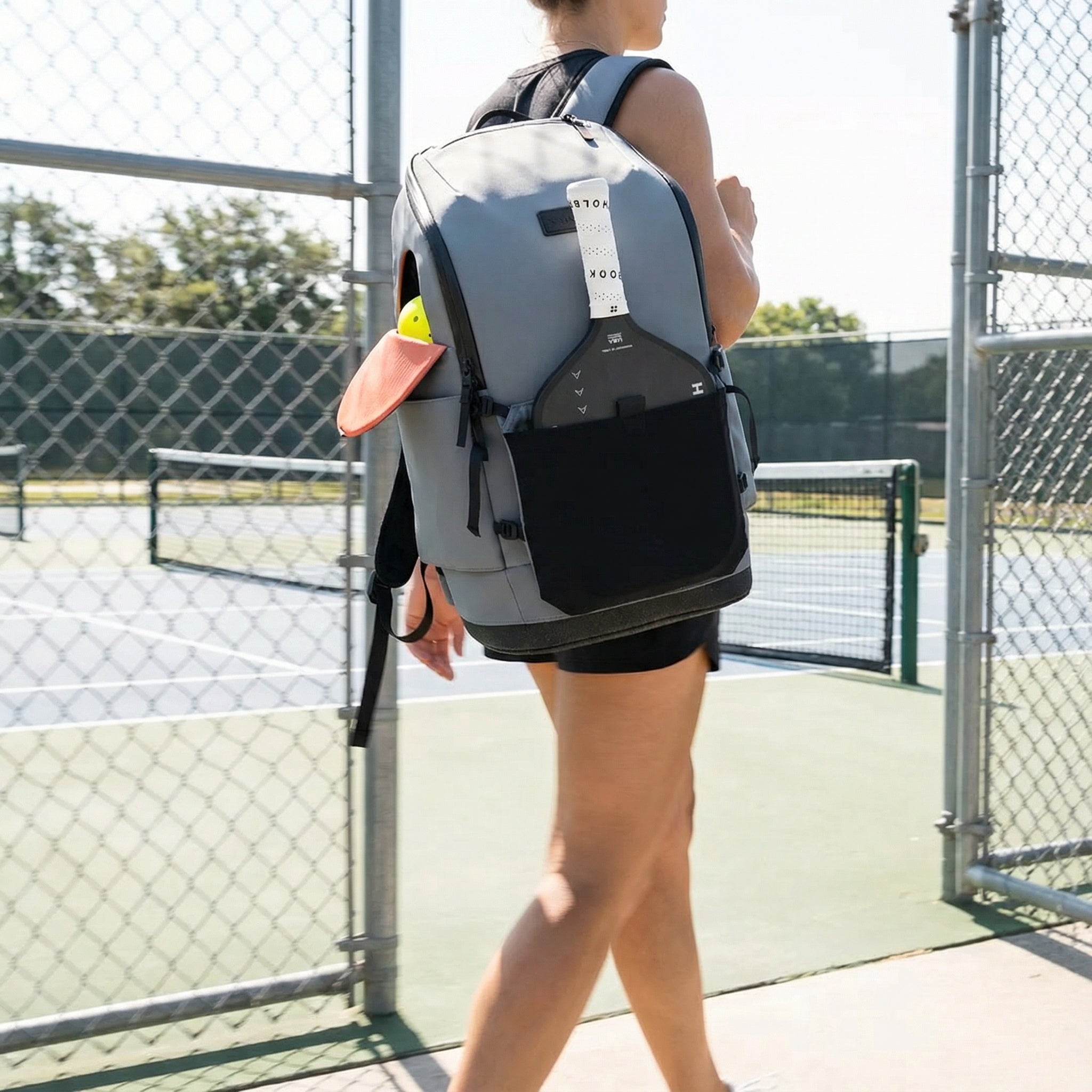
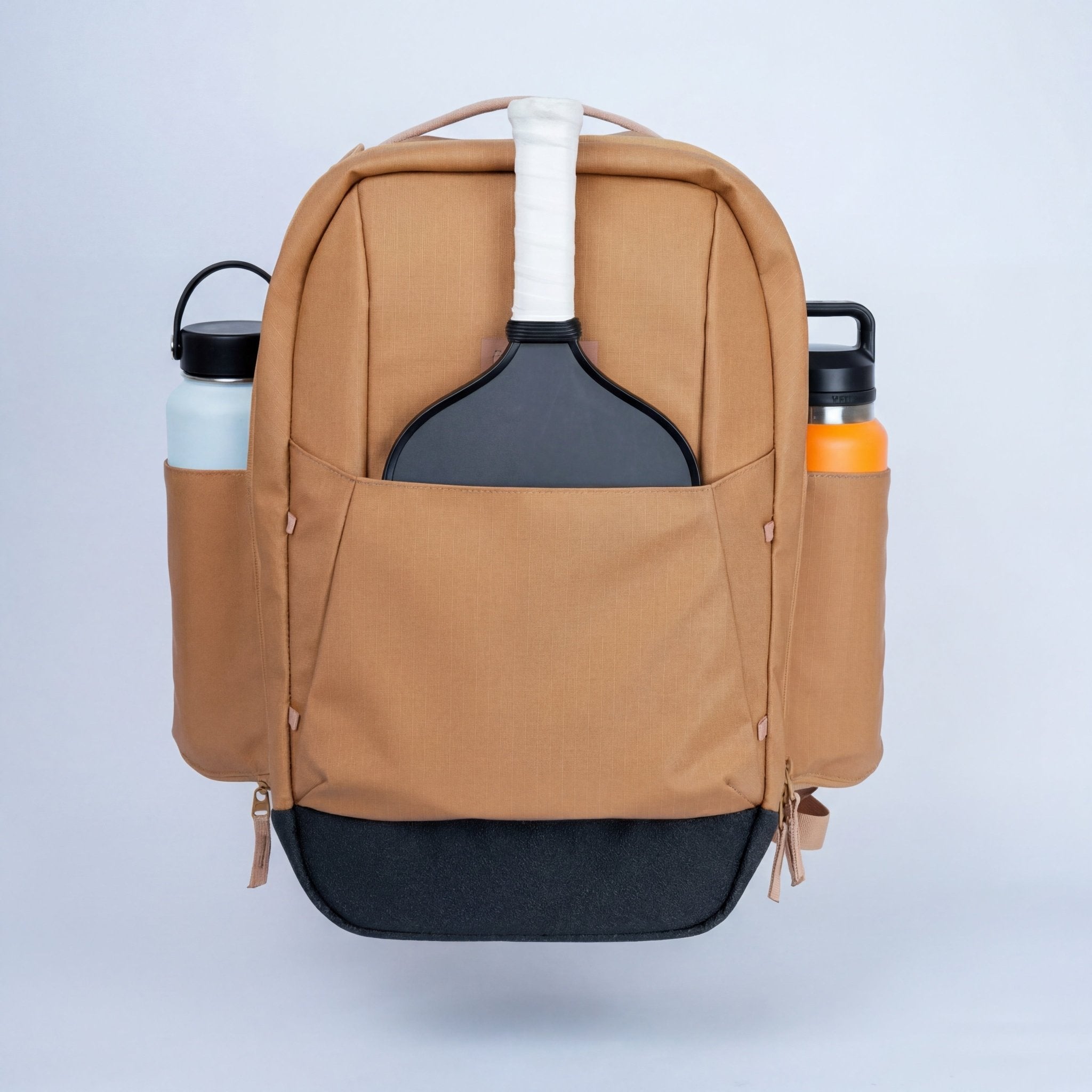
Got your Sports Tutor machine sorted? Make sure you've got a bag that gets everything to the court without two trips. The Court Ranger V2 Backpack carries your paddles, extra balls, and training gear with a 16" padded laptop compartment and YKK AquaGuard weatherproof zippers — built for players who take solo training seriously. At $195, it's the organized carry for the machine owner who's actually showing up.

Common Questions About the Sports Tutor External Battery Pack
How long does the Sports Tutor battery pack last per charge?
Plan for 2–3 hours on standard settings (one ball every 3–4 seconds). Heavy oscillation and fast-feed settings reduce that to around 90 minutes. Light-duty use — slow feeds, minimal spin — can push past 3 hours. A full charge from dead takes 6–8 hours; overnight charging is the practical answer.
Can I use the battery pack in wet or rainy conditions?
No. The battery unit isn't rated for wet-weather operation, and neither is the Pickleball Tutor machine itself. If rain is a real possibility, stay on AC power or reschedule. Keep the battery connection port dry and covered during transport — a simple plastic bag over the port works fine.
Is the Sports Tutor External Battery Pack worth $195?
Yes, if you train outdoors regularly or travel with your machine. No, if you always use a facility with outlet access and train once or twice a week. For players running four or more solo sessions per week at outdoor courts, the battery pays for itself quickly in session quality and consistency. For casual trainers, the AC cord is fine.
Which Sports Tutor machines is this battery compatible with?
The External Battery Pack is built for the Pickleball Tutor Plus and Pickleball Tutor Sport. It doesn't fit older original Pickleball Tutor models. Check your machine's model label before ordering — the model number is printed on a sticker on the machine body. When in doubt, contact Sports Tutor directly.
Does it work with Lobster or other ball machine brands?
No — the Sports Tutor battery uses a proprietary connector specific to their power system. Lobster Elite machines have their own separate battery option at Pickleball Central. Don't cross-use batteries between brands — voltage and connection specs differ and you risk damaging the machine.

Leave a comment
This site is protected by hCaptcha and the hCaptcha Privacy Policy and Terms of Service apply.