

Disclosure: This post contains affiliate links to Pickleball Central. If you purchase through our links, FORWRD earns a small commission at no extra cost to you. We only link to products we'd recommend regardless.
There's one rule that catches every new pickleball player off guard — and it's not the serve, the scoring, or the two-bounce rule. It's the kitchen. That 7-foot zone on each side of the net looks like a normal part of the court, but step into it to hit a volley and you've just given away the point. Nobody tells you this before your first game. This guide tells you everything the courts assume you already know. Last updated: May 2026.
Key Facts
- Pickleball courts are 20 feet wide by 44 feet long — roughly one-quarter the size of a tennis court. You can fit 4 pickleball courts on a single tennis court.
- The kitchen (non-volley zone) extends 7 feet from the net on each side. You cannot volley — hit the ball before it bounces — while standing in or touching the kitchen line.
- Only the serving team scores points in standard (traditional) scoring. If the receiving team wins the rally, they earn the serve back — not a point. Games go to 11, win by 2.
- The two-bounce rule means the serve must bounce before the receiver hits it, and the return must bounce before the serving team hits it — two bounces before anyone can volley.
- USA Pickleball is the official governing body, with over 10,000 registered courts across the U.S. and a 2026 rulebook update that introduced provisional rally scoring at select tournaments.
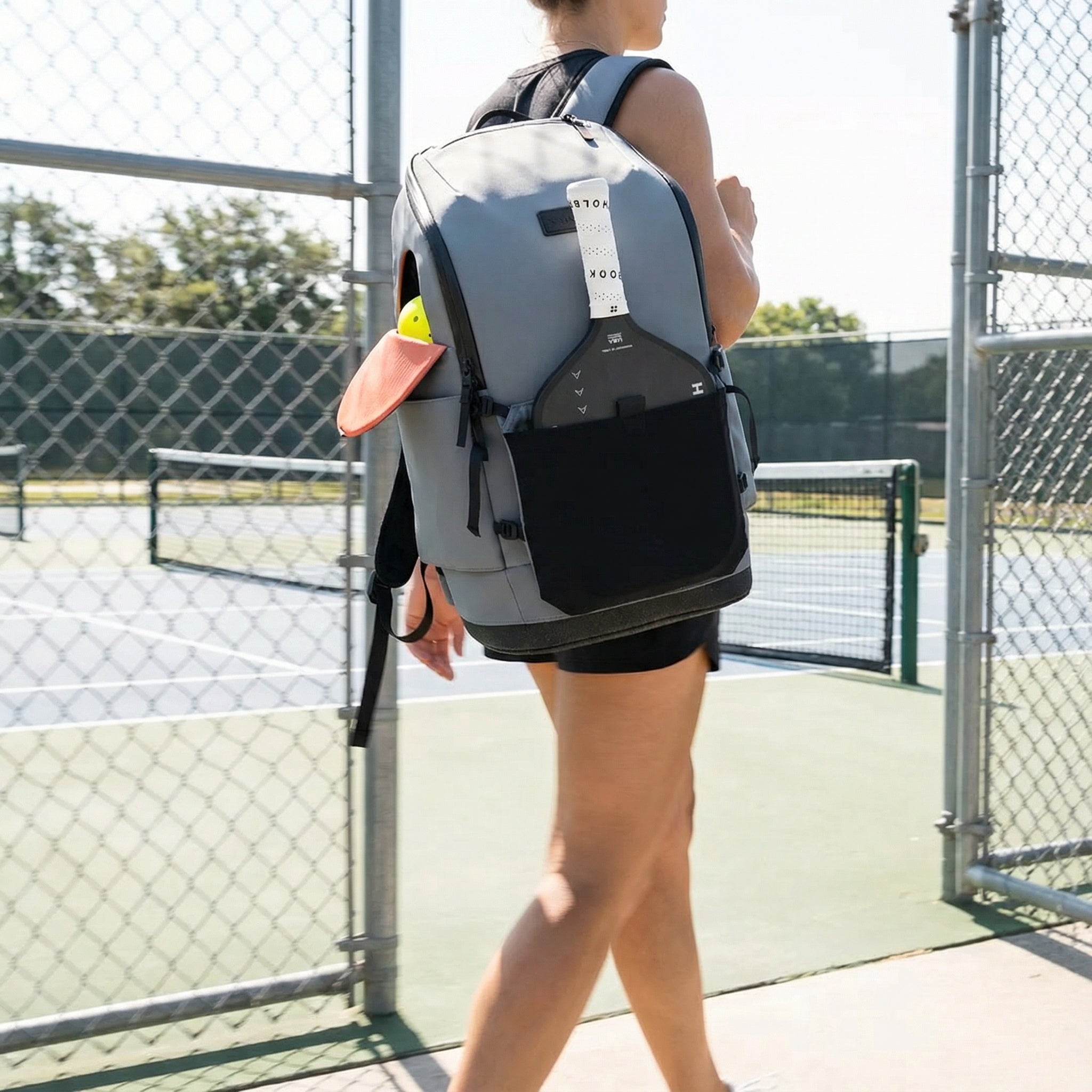
- Beginners can play their first game with under $75 in gear — a starter paddle, a ball, and court shoes. The Court Ranger V2 ($195) is the bag upgrade that makes carrying a full setup effortless once you're going multiple times a week.
- Most open play sessions rotate players in using a paddle queue — you place your paddle on the fence or a designated rack to join the next game. Knowing this before you show up saves a lot of awkward hovering.
"We see it every time we're at open play — new players showing up with a great attitude and a gym bag that's falling apart. The gear barrier to entry in pickleball is genuinely low, but once you're going four times a week, you need a bag that actually holds your stuff. That's the gap we built the Court Ranger V2 to fill."
— Grub, FORWRD Co-founder
What Is Pickleball?
Pickleball is a paddle sport played on a badminton-sized court with a modified tennis net. You hit a perforated plastic ball — like a wiffle ball — using a solid paddle smaller than a tennis racket. It's played as both singles and doubles, though doubles is far more common because the court is small enough that covering it solo gets exhausting fast.
The sport was invented in 1965 on a backyard court in Washington State. It's spent most of its history as a retirement community staple — now it's the fastest-growing organized sport in the U.S. by participation rate, with USA Pickleball registering players from 8 to 80+. The demographic has shifted hard toward 30- and 40-somethings in the last few years. You'll see all of them at open play.
What makes it stick: games are short (15–25 minutes), the learning curve is gentle enough to have fun immediately, but there's enough strategic depth to improve for years. The kitchen — that 7-foot zone we talked about — is the reason the strategic ceiling is high. Once you understand net play, pickleball becomes a chess match.
The Court: What You're Playing On
A pickleball court is 20 feet wide and 44 feet long. The net stands 36 inches at the posts and 34 inches in the middle. Two kitchen (non-volley zone) lines sit 7 feet from the net on each side, creating a 14-foot total no-volley zone spanning the width of the court.
The court is divided into service boxes — left and right on each side of the net. When you serve, you serve diagonally: standing on the right side, you serve to the opponent's left box. Standing on the left, you serve to their right box. This mirrors tennis serving, minus the overhand motion.
Most public parks with pickleball courts are painted directly on existing tennis or basketball courts. Dedicated facilities use permanent pickleball-only lines. The court plays essentially the same either way — but outdoor concrete courts are faster than indoor sport court surfaces, which affects how low your dinks need to be.
Equipment: What You Actually Need
The good news: you don't need much. The slightly less good news: the quality difference between a $30 paddle and a $150 paddle is real and you'll feel it within a few months.
Paddles
Paddles range from $25 (foam core, won't last a season) to $300+ (carbon fiber face, thermoformed core, built for tournament players). For a beginner, the right target is $60–$160:
- Budget pick (~$50–$75): The Franklin X-1000 is a composite paddle with a forgiving sweet spot — what you want when your contact isn't consistent yet. It's durable and won't embarrass you as you improve.
- Mid-range upgrade (~$130–$160): The JOOLA Hyperion CAS 16 has a graphite face and a thicker 16mm core — it's what a lot of players settle on long-term. At this price point, the paddle won't be what's holding your game back.
For a deeper breakdown, see our best beginner pickleball paddles guide.
Balls
Outdoor and indoor balls are different — different hole counts, different hardness, different bounce. Use outdoor balls on concrete and asphalt; use indoor balls on gym floors. The Franklin X-40 is the outdoor standard — it's the official tournament ball and what you'll find at most open play sessions. For gym play, the Franklin X-26 is the indoor equivalent.
Buy a sleeve of 3. They crack — especially outdoor balls on concrete — and you'll want extras when playing with groups.
Shoes
Running shoes are bad for pickleball. They're designed for forward motion, not lateral cuts. Court shoes with a non-marking sole and lateral support are what you need. This actually matters for injury prevention — ankle rolls and knee stress from lateral movement in running shoes are the most common beginner injuries.
The K-Swiss Express Light is the best value court shoe for most players — lightweight, grippy, built for the multidirectional movement pickleball demands. If you want a step up, the ASICS Gel-Resolution X adds gel cushioning for players on hard courts for hours at a time. For a full breakdown of what to look for, see our pickleball shoe guide.
| Gear | Budget Option | Mid-Range Option | What to Look For |
|---|---|---|---|
| Paddle | Franklin X-1000 (~$50) | JOOLA Hyperion CAS 16 (~$150) | Composite or graphite face; 14–16mm core thickness |
| Balls | Franklin X-40 outdoor (~$4/ball) | Onix Pure 2 outdoor | 40-hole outdoor or 26-hole indoor; match official ball at your facility |
| Shoes | K-Swiss Express Light (~$70) | ASICS Gel-Resolution X (~$140) | Non-marking sole; lateral support; not running shoes |
| Bag | Any backpack with paddle sleeve | FORWRD Court Ranger V2 ($195) | Fits 2+ paddles, ball pockets, shoes, water bottle |
When your gym bag stops working, the Court Ranger V2 is the next step.
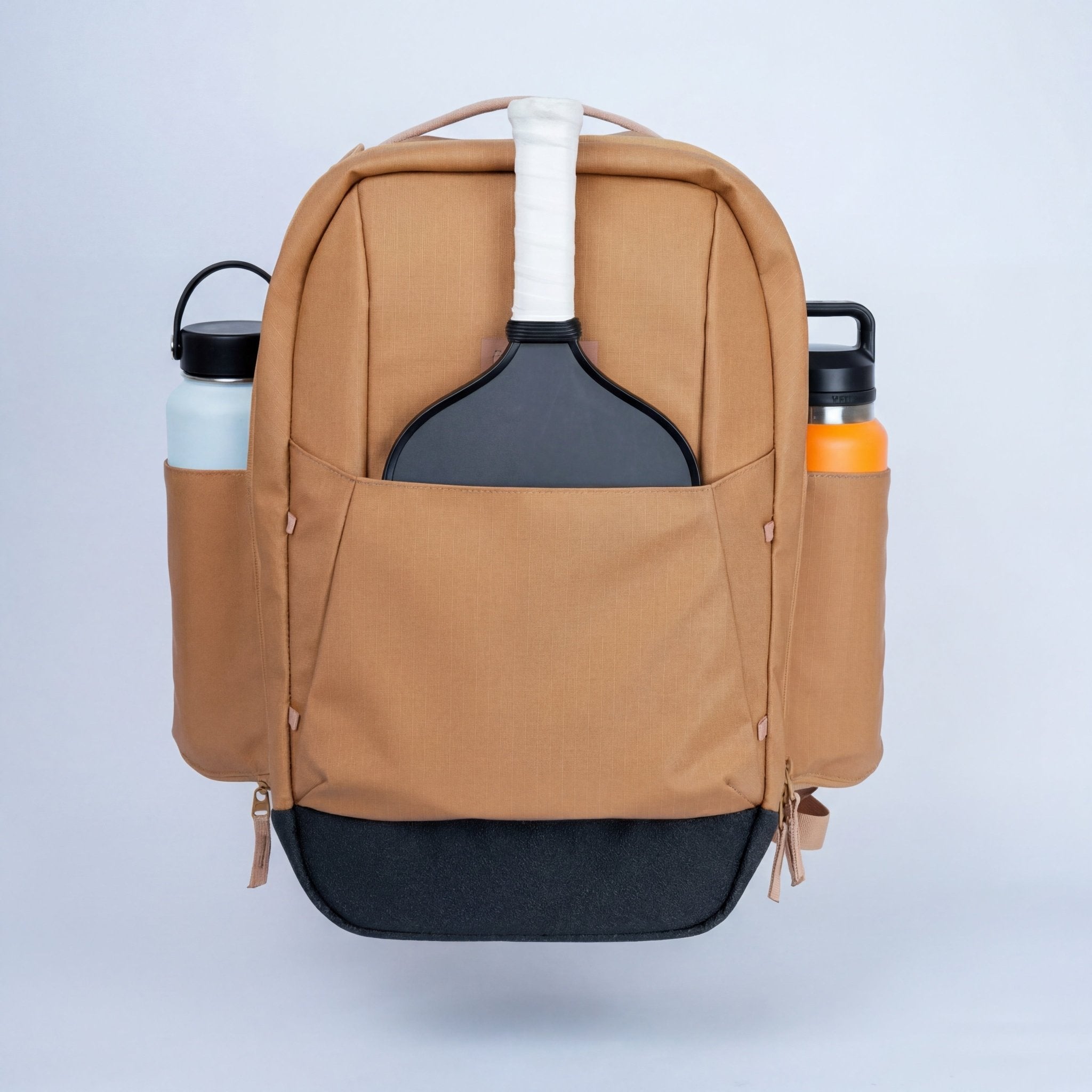
The Court Ranger V2 ($195) fits 2–4 paddles in a modular sleeve, holds a 16" laptop, and has dedicated ball pockets, a wet/dry compartment, and YKK AquaGuard zippers. Designed with 500+ real players. Not a gym bag with a paddle loop — an actual pickleball bag.
The 3 Rules That Catch Every Beginner
There are dozens of pickleball rules — the official USA Pickleball rulebook runs over 100 pages. But three rules account for 90% of faults in beginner games:
Rule 1: The Two-Bounce Rule
After the serve, both teams must let the ball bounce once before volleying. The receiving team must let the serve bounce. The serving team must let the return bounce. After those two bounces — one per side — volleys are legal anywhere outside the kitchen.
Why this matters: it's why you can't rush the net immediately after serving. You have to let the return bounce first. Once it does, you're free to advance. This rule creates the strategic mid-court tension that makes pickleball different from tennis.
Rule 2: The Kitchen / Non-Volley Zone
You cannot volley while standing in the kitchen or touching the kitchen line. Period. Even if your momentum carries you in after a volley — that's a fault. Even if you're just leaning over the line — fault. Even if the ball is above the net and you're just barely in — fault.
You can step into the kitchen to hit a ball that has bounced inside it. The rule only applies to volleys (balls hit before they bounce). We'll cover this in more depth in the kitchen section below.
Rule 3: The Serve Must Be Underhand
The paddle must contact the ball below the waist. The paddle head must be below the wrist at contact. No overhand serves. No "pickleball tennis serve" — it doesn't exist. The serve is underhand, hit diagonally to the opponent's service box, past the kitchen line, and within the sideline and baseline.
How to Serve in Pickleball
Stand behind the baseline, at least partially in the service box you're serving from. Drop the ball and swing upward, making contact below your waist. The ball must clear the net, land past the non-volley zone line (the kitchen), and land within the opposite service box sidelines and baseline.
Two ways to legally serve:
- Volley serve: You toss the ball and hit it before it bounces. Must be underhand, contact below the waist, paddle head below wrist.
- Drop serve: You drop the ball and let it bounce, then hit it after the bounce. No height restriction or paddle position restriction applies — just must land in the correct service box. Beginners often find this easier to control.
In doubles, the serve rotates: the first server of each team serves until they fault, then the second server serves, then side-out and the opponents get both their servers. The exception: at the very start of the game, the first serving team gets only one server (not two) before the first side-out. This is the one rule that trips up experienced beginners who learned from a friend instead of a rulebook.
How Scoring Works in Pickleball
Traditional scoring: only the serving team can score points. If you're receiving and you win the rally, you don't get a point — you get the serve back. Points only go to the team that's serving when they win the rally. First to 11, win by 2. Most tournament formats use best of 3 games.
In doubles, the score is called as three numbers before every serve: serving team's score, receiving team's score, and server number (1 or 2). So "5-3-2" means serving team has 5 points, receiving team has 3, and the second server is currently serving. If you hear "0-0-2" at the start of a game — that's the first server calling their score, with the 2 indicating the team gets only one server before the first side-out (the start-of-game exception).
Rally scoring (2026 provisional): Under USA Pickleball's 2026 provisional format, select tournaments allow rally scoring — every rally gives a point to the winner regardless of who's serving, and a game-winning point can be scored by the receiving team. Rally scoring is not universal; most recreational and club play still uses traditional scoring. If you're showing up to open play, assume traditional scoring unless the host says otherwise.
For a complete breakdown of scoring edge cases, tiebreak formats, and how tournament scoring differs from recreational play, see our pickleball scoring guide.
The Kitchen: Fully Explained
The kitchen — officially called the non-volley zone (NVZ) — is the 7-foot zone on each side of the net. The kitchen line is part of the kitchen: stepping on it while volleying is a fault, same as stepping fully inside.
What you can't do in the kitchen: hit a volley (a ball that hasn't bounced). This includes reaching over the kitchen to hit a ball in the air. If any part of your body is touching the kitchen or kitchen line during or immediately after a volley, it's a fault.
What you can do in the kitchen: stand there whenever you want when you're not volleying. You can let a ball bounce in the kitchen and hit it from inside the kitchen — that's legal. You can stand in the kitchen while your partner volleys from behind the line. You can enter the kitchen after a volley if your momentum doesn't carry you in during the volley motion.
The kitchen is where most of pickleball's strategy lives. Dinking — hitting low, soft shots into the opponent's kitchen from your kitchen line — is the dominant rally pattern at every level above beginner. The goal is to force your opponent to pop a ball up high enough to attack. Mastering the dink is the single biggest skill jump from recreational to competitive play.
Singles vs. Doubles: Which Should Beginners Start With?
Start with doubles. Here's why: the court is identical in size whether you're playing singles or doubles, which means singles players cover the entire 20×44-foot court alone. That's an enormous amount of ground for a beginner still learning to track a plastic ball at varying speeds. You'll spend more time running than actually hitting.
Doubles halves your court coverage and lets you focus on learning the fundamentals — serving, scoring, the two-bounce rule, kitchen awareness — without the added variable of conditioning. Most open play is doubles by default anyway.
Once you're comfortable with the fundamentals and can sustain a 20-ball rally, singles is excellent for conditioning and for exposing weaknesses in your game that doubles lets you hide (weak backhand, slow movement to the left sideline, etc.).
Your First Open Play Session: What to Actually Expect
This is the section most beginner guides skip entirely. Knowing the rules is different from knowing what happens when you walk onto a court at an open play session for the first time. Here's the real picture:
The Paddle Queue
Most open play venues use a paddle queue system. You place your paddle (or a marker, or a numbered chip) on a rack, fence, or designated spot near the courts. When a game finishes, the next four paddles in the queue fill the open court. Put your paddle down immediately when you arrive — the queue is first-come, first-served and fills up fast at popular venues.
Don't just walk onto an active court and wait at the net. Watch from the side, find where paddles are being queued, and join the queue. Someone will usually tell you how it works if you look confused, but knowing in advance saves the embarrassing hovering.
Joining a Court Mid-Session
Sometimes you'll join a court where players already know each other's levels. Don't overthink it. Call the score accurately when it's your turn to serve. Don't apologize for every missed shot — nobody expects you to be Ben Johns on day one. Play your game, communicate with your partner ("mine" or "yours" on close balls), and focus on getting the ball in play.
The Paddle Tap
After the game, walk to the net and tap paddles with everyone — all four players. Both winners and losers. This is the pickleball handshake. Do it every time without exception. If you're not sure whether to compliment specific shots or not: keep it brief, say "good game," move on. Detailed post-game analysis from a stranger is not usually welcome at open play.
Skill Level Honesty
Most open play venues sort by skill level (beginner courts, intermediate courts, etc.). If there's a rating system, play at the level you actually are — not the level you aspire to be. More advanced players at a beginner-only session are genuinely annoying. More advanced players at an intermediate session are usually fine and often help by pointing out tactical opportunities. More beginner players at an advanced session makes the game unfun for everyone.
Don't know your level? You're probably a 2.5 or 3.0. Most people starting out are. Play at the beginner-intermediate courts, see how you measure up, and move up if you're clearly winning everything.
What to Bring to Every Session
You don't need much. This is the working checklist:
- Paddle — obvious, but bring a backup if you have one; paddles crack
- Balls — a sleeve of 3 outdoor (or indoor, depending on venue); courts sometimes run out
- Court shoes — not running shoes; non-marking sole, lateral support
- Water — 32+ oz; you'll sweat more than expected even in cooler weather
- Change of clothes — especially for outdoor summer play
- Towel
Once you're playing 3+ times per week, a real pickleball bag becomes worth it. The Court Ranger V2 ($195) fits everything above plus a 16" laptop — 2–4 paddles in a modular sleeve, dedicated ball pockets, wet/dry compartment for sweaty clothes and shoes, and YKK AquaGuard zippers that handle rain without complaint. It's what players who actually show up consistently use. A gym bag works fine at first — it just becomes a repacking annoyance fast.
How to Get Better Faster
The fastest path to improvement — with evidence from watching hundreds of new players develop over the past few years:
Play in games, not just drills, early on. Game-situation reps teach pattern recognition that drills don't. You need to miss third-shot drops in real rallies before drilling them becomes useful. Play first, drill the specific things you keep getting wrong second.
Learn the dink before anything else. The big swing is not the weapon in pickleball — the dink is. Most beginners spend energy on drives and overhead smashes while the best players in every pickup game are winning through soft, precise dinks that force errors at the net. Get comfortable at the kitchen line first.
Watch one PPA or APP Tour match on YouTube. Seeing how pros manage the kitchen, when they speed up versus when they reset, and how dink rallies turn into attacks will rewire how you think about your own positioning faster than any verbal explanation.
Get a beginner-to-intermediate clinic or lesson. One 90-minute session with an instructor who can watch you hit will identify the specific mechanical issue you're fighting — usually one thing — and give you a drill to fix it. Worth the $50–$75 investment after your first month of open play.
When you're ready to go deeper into the rules, faults, and edge cases: see our complete pickleball rules guide — it covers every rule situation you'll encounter in recreational and tournament play.
FAQ: How to Play Pickleball
How long does it take to learn pickleball?
You can play a real game your first day — the basic rules take 15 minutes to understand. Getting comfortable enough to have sustained rallies and make smart positional decisions takes 3–6 weeks of regular play (2–3 times per week). Moving from recreational to competitive competence (3.5+ DUPR) typically takes 6–18 months of consistent play and deliberate practice.
Do I need special shoes for pickleball?
Yes. Court shoes with lateral support and a non-marking sole are required on most indoor courts and strongly recommended on outdoor courts. Running shoes are designed for forward motion only — the lateral cuts in pickleball put your ankles at risk in running shoes. K-Swiss, ASICS, and JOOLA all make affordable, purpose-built court shoes for pickleball.
Can I step in the kitchen in pickleball?
Yes — you can stand in the kitchen whenever you're not volleying. The rule only prohibits volleys (hitting the ball before it bounces) from inside the kitchen or while touching the kitchen line. You can step into the kitchen to hit a ball that has bounced there, and you can stand there at any other time.
Is pickleball good exercise?
Doubles pickleball provides moderate cardiovascular exercise — comparable to brisk walking, with bursts of higher intensity during fast exchanges. Singles pickleball is significantly more demanding. Most recreational players burn 350–600 calories per hour of doubles play depending on intensity and fitness level. The quick direction changes also build leg strength and improve balance.
How do you keep score in pickleball?
In doubles, call the score before every serve as three numbers: serving team score, receiving team score, server number (1 or 2). Example: "4-2-1" means serving team has 4 points, receiving team has 2, first server is serving. Only the serving team scores points in traditional scoring. Games go to 11, win by 2. See our full scoring guide for rally scoring and tournament formats.
Ready to carry your full setup without the repacking? The Court Ranger V2 ($195) was designed with 500+ real players who show up to the courts more than they go to the gym. Paddles, balls, shoes, a change of clothes, and a 16" laptop — all in one organized backpack with YKK AquaGuard zippers and a modular paddle sleeve. Shop the Court Ranger V2.

Leave a comment
This site is protected by hCaptcha and the hCaptcha Privacy Policy and Terms of Service apply.