

Last updated: July 2026
The minimum lighting for a sanctioned outdoor recreational pickleball court is 30 foot-candles — but that number doesn't prepare you for what bad lighting actually does to your game. I've had sessions where a white ball disappeared into a shadow zone between poles at the worst possible moment, and summer evenings where a west-facing court was genuinely unplayable for 20 minutes because the sun hit exactly wrong. This guide covers what the standards actually say, what they miss, and how to evaluate any court before you show up with your bag.
Why Pickleball Lighting Is More Demanding Than Most Sports
Think about what you're tracking: a 73mm white polymer ball moving at anywhere from 20 mph on a soft dink to 70+ mph on a flat drive. The court is 20×44 feet — small enough that a single shadow zone in the wrong spot affects multiple positions simultaneously. Players don't stop moving; there are lateral steps at the NVZ line, pivots, drops, lobs. The ball is rarely where your eyes last saw it.
Compare this to tennis, where the ball is larger and the court nearly three times the size. Or basketball, where the object is large and brightly colored. Pickleball's combination of small ball, fast speed, and tight court makes lighting failures immediately obvious. A dead zone in the middle of a football field might never affect gameplay — a dead zone between poles on a pickleball court swallows half the third-shot drops in a session.
The other factor: player age. The pickleball demographic skews 40–65 — a population with declining contrast sensitivity and slower pupil adjustment. That gap between "adequate" and "good" lighting matters more here than in almost any youth sport. A 22-year-old recreational player and a 58-year-old competitive player will have completely different experiences of the same court at 45 fc.
USAPA Lighting Requirements: The Three-Category Framework
USA Pickleball defers its technical standards to two sources: the USA Pickleball-endorsed ASBA 2023 Pickleball Courts Construction & Maintenance Manual (Chapter 6 on lighting) and the Illuminating Engineering Society's IES RP-6-24 standard. Here's what those standards actually require:
| Category | Use Case | Avg Horizontal FC | Min FC | Uniformity |
|---|---|---|---|---|
| Category III | Recreational / community | 30 fc | 20 fc | 2.0:1 |
| Category II | Club / competitive | 50 fc | 40 fc | 2.0:1 |
| Category I | Tournament / sanctioned | 75 fc | 60 fc | 1.5:1 |
| Broadcast | Professional / TV | 100+ fc | — | — |
The uniformity ratio is as important as the average. A 2.0:1 ratio means the brightest spot on the court is never more than twice the brightness of the darkest. When you notice hot spots that make you squint and dark corners that swallow the ball, you're on a court with a poor uniformity ratio — even if its average fc is technically compliant.
Color temperature: 4000K–5000K. The 5000K (cool/daylight white) end is preferred for competitive play. Below 4000K drifts yellow and reduces the white ball's visual contrast against court surfaces. If a court looks slightly orange or warm-tinted to you, the fixtures are either old metal halide or low-CCT LEDs — both reduce visibility for fast-moving white balls.
LED vs. Metal Halide: What Actually Matters
If you're evaluating a new venue or planning a backyard install, fixture type is the single most consequential decision. Here's the honest breakdown.
LED (the right answer in 2026): Instant-on with no warm-up time, 50,000–100,000 hour lifespan, consistent color temperature throughout their life, dimmable, and dramatically lower energy cost. Modern LEDs don't flicker at 60Hz the way older technologies do — which matters when you're tracking a 70+ mph drive. A typical 4-pole single-court LED setup runs $3,000–$8,000 in fixtures before installation.
Metal halide (the legacy problem): Takes 15–20 minutes to reach full brightness after power-on. Can't restart immediately after shutoff — the "restrike time" delay runs 5–20 minutes. Color shifts as bulbs age, getting yellower and dimmer. If a venue's courts look dim and orange-tinted compared to a few years ago, you're seeing aged metal halide. Still common in older parks and community facilities. Playable, but noticeably inferior.
Pole height: 20–22 feet (6–7 meters) is the standard residential install. Higher poles spread light more evenly and push the glare source above a player's sightline on lobs — 25–30 feet for tournament-quality venues. Don't let anyone sell you 15-foot poles for a backyard court; you'll have glare on any overhead above shoulder height, and the uniformity will suffer dramatically.
Shadow Problems: How Pole Placement Creates Dead Zones
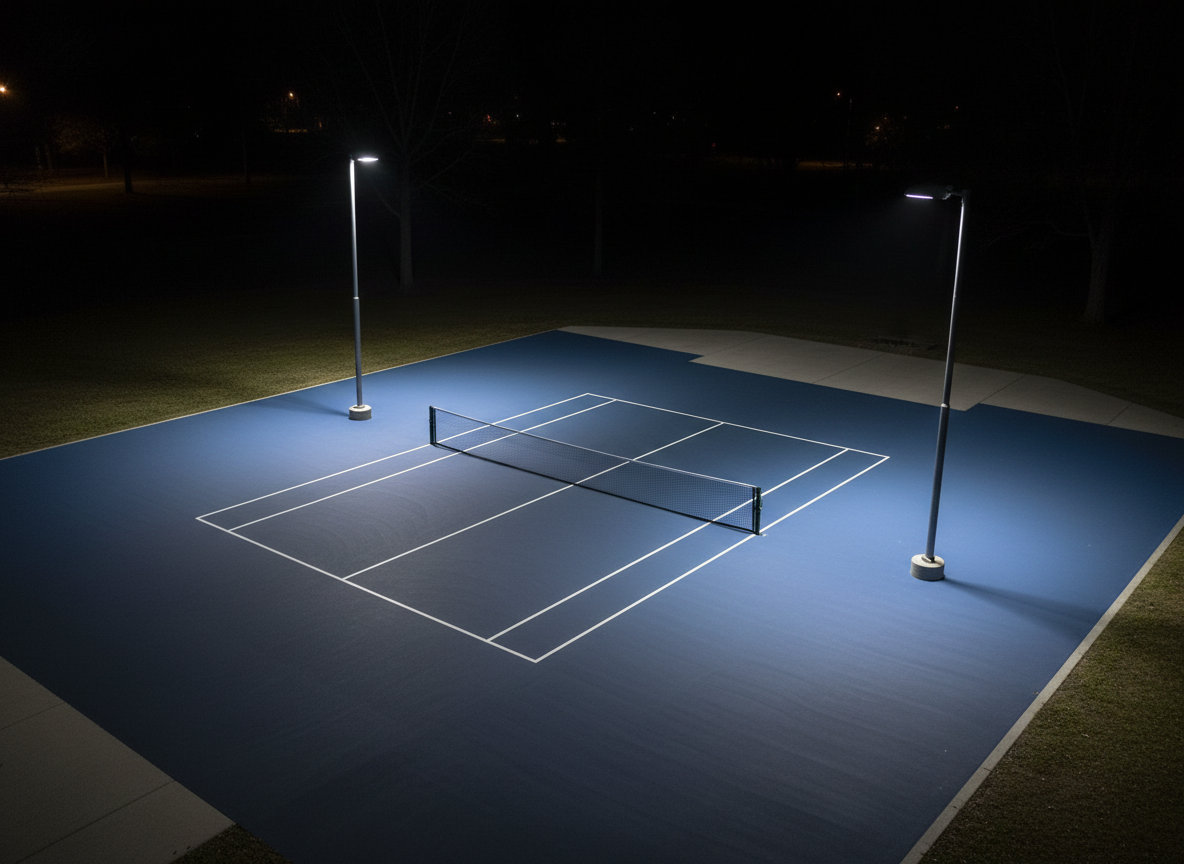
Bad pole placement is the most common cause of chronic shadow zones — and the most common mistake is two poles instead of four.
A two-pole setup — one pole at each end — creates a predictable shadow band across the middle of the court. Both poles aim toward the center, but the overlapping light throw never perfectly cancels out the shadow from each pole's mounting mast. You get a soft dark band right around the transition zone from the NVZ to the service area — exactly where a dink-to-drive transition plays out.
The four-pole standard solves this. Four poles positioned along the sides near each corner, with fixtures aimed cross-court (not straight down), wash each zone from multiple angles. Shadows from one fixture are filled by the opposite fixture. It's why every properly-lit public park and club uses four poles minimum for a single court.
The two problem zones to check in any two-pole or poorly-designed install:
- The center-court shadow band — roughly 8–12 feet from the net on each side. Third shots drop here. Cross-court drives enter here. This is the worst spot for a shadow on a pickleball court.
- The deep corner shadows — behind the baseline at the far corner from the nearest pole. Overheads and lobs landing deep get swallowed here, especially at Category III lighting levels.
If you can see the court in daylight before an evening session: walk the surface and look for areas where the pavement changes tone. Darker patches during the day often correspond to where evening shadows fall. Five minutes of pre-session observation is more reliable than asking the venue what their foot-candle rating is.
Residential Backyard Lighting: Budget Options ($800–$3,000)
Building your own court? Here's the realistic cost spectrum for lighting it properly. (For the full backyard court build process, see our DIY Backyard Pickleball Court Guide.)
$800–$1,500 (two-pole entry level): Two 20-foot steel poles with single-head LED shoebox fixtures. Delivers roughly 25–35 fc — adequate for casual family play, borderline for the Category III recreational standard. The center-court shadow band will be noticeable for 3.0+ players. Fine for two-person household use; not great for regular open play sessions.
$1,500–$2,500 (four-pole mid-tier): Four poles with quality LED heads and cross-court aim, achieving 30–50 fc average. Meets Category III comfortably and approaches Category II. This is the sweet spot for serious recreational players with a private court — good uniformity, no dramatic hot spots, playable at the 3.5–4.0 level.
$2,500–$4,000+ (professional backyard, four-pole premium): Covers Category II (50 fc) for regular club nights or competitive practice sessions. Add $800–$1,500 for a licensed electrician, depending on your area. At this tier you're getting proper photometrics done to verify uniformity before the poles go in the ground.
Permits are almost always required for installed poles — check local building codes before ordering anything. Some municipalities limit residential pole height to 15–20 feet, which constrains your lighting options. Check height restrictions at the same time you check HOA approvals. Skipping this step means pulling permits after install, which occasionally requires pole removal.
Indoor Gym Lighting: What Players Should Actually Look For
Indoor courts have different problems than outdoor. The ceiling is the light source — fluorescent tubes, LED panel arrays, or sport-specific high-bay LEDs. What players experience varies wildly between gyms, even when the posted foot-candle spec looks fine.
Watch for these specific indoor failures:
Flicker: Older fluorescent fixtures and low-quality LEDs can cycle at 60Hz or 120Hz — invisible in normal situations but detectable against a fast-moving object. Some players describe "losing" the ball for a split second at certain moments in certain gyms. If a court feels slightly harder to track than its brightness suggests, flicker is the likely culprit. Modern LEDs with a high Color Rendering Index (CRI 80+) and flicker-free drivers eliminate this problem.
Glare from panel layout: Light panels running parallel to the net create direct eye-strike glare on overheads and lob tracking. The moment you look up to track a high ball, the panel hits your line of sight. Panels perpendicular to the net, or indirect/bounced designs, perform significantly better for overhead-heavy play.
Dead zones near walls: Indoor high-bays center over the court, leaving the area near side walls noticeably dimmer. For courts with tight out-of-bounds space, this creates a visible brightness drop right where sideline shots land and where players track drive-and-follow plays along the line.
The minimum for a quality indoor session is 50 fc and CRI 75+. Below CRI 75, a yellow-green Franklin X-26 indoor ball gets harder to read against the standard blue/green court surface — color accuracy matters in a sport where ball visibility is the whole game.
Glare Management: The Sunset Problem That Ruins Evening Sessions
This is the most overlooked player experience problem in pickleball court lighting. No vendor spec sheet addresses it, because it's not their fault. It's geometry.
A court oriented east-west has its serving end facing west. In summer, sunset across most of the continental US happens between 7:30 and 9:00 PM — exactly when evening leagues and open play sessions run. From roughly 7:00 to 7:45 PM, the low-angle sun directly hits any west-facing server. The LED poles are on and technically the court meets its foot-candle requirement. But a white ball coming at you from the serving end is effectively invisible for 20–40 minutes because the sun sits directly behind the server's release point.
There's no lighting solution for this. No fixture helps. The venue is functionally unplayable in that window regardless of how good the poles are.
"I've shown up to evening open play where the west-facing court was completely unusable for the first 30 minutes — everyone just stood around waiting for the sun to clear the tree line. If you haven't started checking court orientation before you book, make it the first thing you add to your routine." — Grub, FORWRD co-founder
How to check before you book: ask about court orientation or look at a satellite view. North-south is the gold standard for afternoon and evening play — the sun tracks west and stays mostly off the serving axis. East-west courts have the sunset problem. Northeast-southwest and northwest-southeast orientations mitigate it somewhat depending on your latitude.
Venues that handle this honestly post a note about the sunset window. Most don't, and you find out mid-match at 7:15 PM.
The Player's Court Lighting Checklist: 5 Questions Before You Book an Evening Slot
Run this before committing to a new evening venue or evaluating a potential practice court:
- LED or metal halide? LED is consistent, instant-on, and flicker-free. Metal halide takes 15–20 minutes to reach full brightness, yellows with age, and can't restart immediately after a power cycle.
- Two poles or four? A two-pole setup almost always creates a center-court shadow band. Four cross-aimed poles is the minimum standard for consistent play above the recreational level.
- What's the court orientation? North-south avoids the sunset serving problem. East-west means a 30–45 minute unplayable window on summer evenings regardless of how good the poles are.
- What time is sunset vs. your session start? If your session starts within 90 minutes of local sunset on a west-facing court, expect glare issues. Check the exact sunset time for your date and location before you book.
- Can you walk the court before playing? Five minutes on the surface pre-session reveals dark patches and uneven brightness that no spec sheet will disclose. Look for areas where the pavement tone changes — those become shadow zones under artificial lighting.
For official court dimensions, construction standards, and buffer zone requirements, see the Pickleball Court Knowledge Guide →
FAQ: Common Questions About Pickleball Court Lighting
How many lumens do you need to light a pickleball court?
A single pickleball court (20×44 ft of playing surface) typically requires fixtures delivering 15,000–30,000 lumens total across all poles to achieve the Category III 30 fc recreational standard. Tournament-level Category I courts need 40,000–60,000+ lumens for 75+ fc coverage. Raw lumen output is only part of the equation — fixture distribution, pole height, and uniformity ratio all determine whether those lumens land where they need to.
Can you play pickleball at night with regular outdoor lights?
Standard residential lights — security floodlights, porch lights — don't come close to the 20 fc minimum for safe recreational play. A 1,000-lumen floodlight adequately covers roughly 100 square feet; a pickleball court is 880 square feet of playing surface. You'd need 8–12 high-quality flood fixtures for barely-playable conditions, with severe shadow and uniformity problems. Sport-specific LED fixtures on proper poles are the right solution.
What causes shadows on outdoor pickleball courts?
Two main causes: too few poles creating coverage gaps, and fixtures aimed straight down instead of cross-court. A two-pole setup almost always creates a shadow band in the center of the court. Four poles with cross-aimed fixtures solve this by washing each zone from multiple directions — the shadow from one fixture is filled by the throw from the opposite fixture. Pole height matters too: shorter poles create harder, more defined shadows.
How much does it cost to light a pickleball court?
Residential: $800–$1,500 for a basic two-pole LED setup; $1,500–$3,000 for a quality four-pole install. Add $800–$1,500 for an electrician depending on your local market and permit requirements. Professional commercial installs for community or club courts run $8,000–$20,000+ including poles, fixtures, trenching, wiring, and permits. LED dominates in 2026 — the energy savings over metal halide typically pay back the cost premium in 3–5 years.
What is the recommended lighting for a pickleball court?
Per ASBA and USA Pickleball standards: Category III recreational play requires 30 fc average, 20 fc minimum, 2.0:1 uniformity ratio. Category II club/competitive play: 50 fc average, 40 fc minimum. Category I tournament play: 75 fc average, 60 fc minimum, 1.5:1 uniformity. LED fixtures at 4000K–5000K color temperature, 20–22 foot poles, four-pole cross-aimed placement for a single court.
What are the best lights for an outdoor backyard pickleball court?
LED shoebox-style fixtures mounted on 20-foot poles at four corners, aimed cross-court at the playing surface. Look for: 15,000+ lumens per fixture, CRI 75 or higher, color temperature 4000K–5000K, and full-cutoff housing (no upward light spill — important for neighbors and dark-sky ordinances). Budget $400–$800 per quality fixture before installation costs. For single-court residential installs, the four-pole system runs $2,000–$3,500 in materials.
Part of the Pickleball Court Knowledge Guide — FORWRD's complete reference for court dimensions, construction standards, lighting, colors, conversion, and backyard builds.

Leave a comment
This site is protected by hCaptcha and the hCaptcha Privacy Policy and Terms of Service apply.