


Last Updated: August 2026
Disclosure: This post contains affiliate links to Pickleball Central. If you purchase through our links, FORWRD earns a small commission at no extra cost to you. We only link to products we'd recommend regardless.
TL;DR: Professional pickleball in 2026 runs across three distinct tours — the PPA (elite contract tour), the APP (open professional circuit), and MLP (team-based league). Ben Johns and Anna Leigh Waters dominate men's and women's play respectively. Events air on Tennis Channel, ESPN, and streaming via Pickleball.tv. Prize money at top events reaches $90,000 per doubles team at PPA Slams. This guide covers everything: tour structures, top players, rankings, prize money, how to watch, what gear the pros use, and how to use the pro game to level up your own.
Table of Contents
- What Is Professional Pickleball?
- The Three Tours: PPA vs. APP vs. MLP
- The PPA Tour: How the Premier Circuit Works
- Major League Pickleball: Team Pickleball Explained
- The APP Tour: The Open Professional Path
- Top Men's Pros to Know in 2026
- Top Women's Pros to Know in 2026
- How Pro Rankings Work
- Pro Prize Money: What Players Actually Earn
- How to Watch Pro Pickleball in 2026
- Key 2026–2027 PPA Tour Events
- What Gear Do the Pros Use?
- How Watching Pros Improves Your Game
- Frequently Asked Questions
- All Pro Tour Guides
What Is Professional Pickleball?
Pickleball went from retirement communities and gym class to professional television in about a decade — which is either inspiring or disorienting depending on how long you've been playing.
By 2026, the sport has a legitimate professional circuit with contracts, rankings, prize money, and broadcast deals. The top players earn six-figure incomes. Major events sell out. Ben Johns is a household name in the sport the same way Roger Federer was in tennis — dominant, technically near-perfect, and the benchmark everyone else chases.
But unlike tennis, which has one major global tour (ATP/WTA), professional pickleball runs on three separate circuits simultaneously. The PPA Tour. The APP Tour. And Major League Pickleball (MLP). They're all professional. They serve different purposes. And they sometimes compete with each other for players, which creates the kind of drama you don't normally associate with a sport invented in a backyard in Washington state.
Here's what you need to know to follow all of it.
"The pace of pro pickleball has gotten to a point where recreational players who watch a lot of matches actually start anticipating ball trajectories more accurately. There's real value in being a fan of the game you play." — Topher, FORWRD co-founder and 4.5 player
The Three Tours: PPA vs. APP vs. MLP
Plenty of recreational players follow pro pickleball casually without understanding the tour structure. Then they wonder why Anna Leigh Waters appears in both a PPA Slam and an MLP draft. So before we dive into any one tour, here's the 90-second version of how it all fits together.
| Tour | Format | Events/Year | Who Competes | Where to Watch |
|---|---|---|---|---|
| PPA Tour | Traditional tournament — singles, doubles, mixed | 25+ domestic + international | ~120 contracted players (exclusive deals) | Tennis Channel, Pickleball.tv |
| APP Tour | Traditional tournament — open entry for pros and amateurs | 13+ nationally televised + regional events | Open entry — no exclusive contracts | CBS Sports Network, Pickleball.tv |
| MLP | Team league — draft-based, coed teams | 5 events/year | Drafted pros, city franchise teams | ESPN platforms |
The key thing to understand: MLP and PPA are not competing for the same time slots — MLP is a team league that happens a few times a year, while PPA is a weekly-ish individual tournament tour. Many of the same top players appear in both. The APP is a separate circuit with different contracts (or no contracts) that operates more like an open tour.
Read our full breakdown: Pro Pickleball Tours 101: PPA vs. APP vs. MLP Explained →
The PPA Tour: How the Premier Circuit Works

The Carvana PPA Tour is the equivalent of the ATP in tennis — the top-tier individual tournament circuit where the best players in the world compete for the biggest prize money. It's elite-focused, broadcast nationally, and runs on exclusive contracts.
About 120 players are signed to PPA exclusive deals. That means if you're under PPA contract, you can't play APP events. The exclusivity is intentional — PPA wants to control where its marquee players appear, which lets them guarantee a certain level of competition at every event.
PPA Event Formats
Every PPA event runs four brackets: men's singles, women's singles, men's doubles, and mixed doubles. The top tier events — called PPA Slams — are the sport's biggest stages. Winners at Slam events earn $90,000 per doubles team. Singles champions at major events like the Life Time Open take home $50,000.
Rankings on the PPA Tour run on a 52-week rolling system. Points from every event accumulate over the trailing 52 weeks, and the top 8 qualified singles players (and doubles teams) based on those rankings earn automatic qualification to the PPA Finals.
There's also "The Race" — a separate ranking that tracks only the current calendar year, similar to how the ATP Race to Turin works. This creates two simultaneous ranking battles that play out differently throughout the season.
PPA Slam Events
PPA Slams are the major championships — the highest prize money, the biggest crowds, and the most broadcast attention. In 2025-2026, the headliner Slams include the PPA Masters (Palm Springs) and the Veolia Atlanta Pickleball Championships. The PPA Finals have been held at Life Time Rancho San Clemente. These are the events worth clearing your calendar for.
Read the full schedule breakdown: PPA Tour 2026 Schedule: Every Event, Date & Location →
Major League Pickleball: Team Pickleball Explained
MLP is the weirdest and most interesting thing in pro pickleball — and I say that as a compliment.
Rather than individual players competing for individual titles, MLP structures competition around city franchise teams. Think: the Austin Pickleballers vs. the New York Hustlers. Each team has two men and two women. They're assembled through an annual draft, which means you get Anna Leigh Waters and Ben Johns on the same team competing for their franchise — a format that doesn't exist anywhere else in pickleball.
MLP Format: How Matches Work
Team matches follow a fixed bracket: women's doubles first, then men's doubles, then two mixed doubles matches. Each individual match uses rally scoring to 21 (win by 2) — meaning you can score whether you're serving or not, which is faster and more TV-friendly than traditional pickleball scoring. Win the majority of matches (3 of the 4 brackets) and your team wins the overall match.
There are only 5 MLP events per year, which keeps the league concentrated and intense. The championship event is the one worth watching — the stakes and storylines have been building all season by then.
The coed team format does something interesting: it forces strategy around mixed doubles pairings that you don't see in individual tournaments. Coaching decisions matter in a way they don't at PPA events. It's genuinely compelling if you follow it closely.
Full MLP guide: Major League Pickleball: Complete Guide to Teams, Format & How to Follow →
The APP Tour: The Open Professional Path
The APP (Association of Pickleball Players) operates as an alternative professional circuit — no exclusive contracts, lower barriers to entry, and an explicit mission to be more inclusive than PPA. Qualified professionals can enter any APP event. Amateurs compete in their own brackets at the same tournaments, which creates a unique environment where a 4.5 amateur player might be three courts over from a pro match.
The APP's close relationship with USA Pickleball means it follows more traditional sanctioning standards. It runs 13+ nationally televised events and a regional circuit that covers the country. For players trying to break into professional pickleball without a PPA contract, the APP is often the first realistic path.
Deep dive: APP Tour 2026 Guide: The Open Professional Pickleball Circuit Explained →
Top Men's Pros to Know in 2026
Men's professional pickleball in 2026 is Ben Johns and then everyone else — but "everyone else" is genuinely excellent and increasingly competitive.
Ben Johns
Johns is the sport's most dominant player across all three formats: singles, men's doubles, and mixed doubles. His DUPR rating sits above 7.35, a number that's largely theoretical at that level because there aren't enough players who can push him consistently. His technical baseline — anticipation, soft hands at the kitchen, controlled reset ability — set the standard the rest of the field chases. Johns is signed to JOOLA and plays the Perseus Pro series. His actual game is studied obsessively by serious recreational players, and for good reason.
Ben Johns' Paddle: JOOLA Perseus Pro V
His current match paddle — thermoformed carbon fiber, available in 14mm and 16mm. The 14mm version trades some forgiveness for a noticeably more explosive feel at contact.
Shop JOOLA Perseus at Pickleball Central →
Read our full review: joola-perseus-pro-v-review-2026-ben-johnss-signature-paddle-tested">JOOLA Perseus Pro V Review 2026 →
Christopher Haworth
Haworth has emerged as one of the most serious challengers to Johns' men's singles dominance in 2026. His PickleWave ELO ranking has him at #1 in the alternative statistical models that weight match quality over pure tour points accumulation. He's the player the community watches most closely when Johns is in the bracket, because Haworth actually makes Johns play at maximum level — something relatively few players can do.
Federico Staksrud
Staksrud rounds out the top tier of men's singles. An Argentinian player who came up through the app circuit before PPA, he's known for his aggressive baselining and transition zone play — a style that contrasts sharply with Johns' more methodical kitchen-controlling game. Watching their matches is a genuine tactical chess match.
Hunter Johnson
Johnson is among the youngest elite men's players and represents the next wave of players who learned pickleball from scratch (rather than transitioning from tennis or racquetball). His raw athleticism is exceptional, and the community expects his ranking to climb through the 2026-2027 season as his consistency matures.
Full player profile: Ben Johns: Complete Player Profile, Career Stats & Technique Breakdown →
Top Women's Pros to Know in 2026
Women's professional pickleball has a clearer dominant force — and one of the better sports stories in any racket sport right now.
Anna Leigh Waters
Waters became a professional player before she was legally old enough to drive. By 2026, she's the most decorated women's pickleball player ever — with world titles across singles, women's doubles, and mixed doubles. Her mother, Leigh Waters, is her longtime doubles partner, which means the sport's #1 women's player also has a genuinely unusual competitive dynamic (your doubles partner is your parent).
In 2026, Waters made headlines by leaving Paddletek for Franklin, who built the C45 Aurelius specifically around what she requested — a shorter, wider paddle that prioritizes speed. The C45 is what happens when a manufacturer asks a world champion to dictate the design instead of slapping a signature on an existing paddle.
Anna Leigh Waters' Paddle: Franklin C45 Aurelius
Shorter and wider than a standard widebody. Ranges 7.2–8 oz. Built specifically to ALW's speed-first spec — worth testing if you want quicker hands at the kitchen.
Shop Franklin C45 at Pickleball Central →
Read the review: Franklin C45 Aurelius Review 2026 → and her full profile: Anna Leigh Waters: Pickleball's Youngest World No. 1 →
Leigh Waters
Often overlooked as "Anna Leigh's doubles partner", Leigh Waters is an elite player in her own right — and the women's doubles pairing of mother and daughter is arguably the best in the sport's history. She's competitive in singles too, which makes their dynamic even more unusual to watch up close.
Other Rising Stars
The depth of the women's game has grown considerably. Watch players like Callie Smith (aggressive baselining), Catherine Parenteau (exceptional mixed doubles strategy), and Jessie Irvine (crowd-favorite, powerful baseline game) for the matches where the top-ranked players are pushed hardest.
Full player profile: Anna Leigh Waters: Complete Profile, Career Stats & What Makes Her Unbeatable →
How Pro Rankings Work
Pro pickleball rankings are more complicated than they look from the outside, partly because there are multiple ranking systems running simultaneously.
PPA Rankings
The PPA Tour runs two official ranking formats. The 52-Week Ranking is the main one — it accumulates a player's points from every event over the past 52 weeks. This is the ranking that determines Finals qualification. The Race tracks only the current calendar year's points, creating a fresh battle at the start of each season (similar to the ATP Race to Turin).
Rankings are separated by discipline: men's singles, women's singles, men's doubles, and mixed doubles each have their own leaderboard. A player like Ben Johns who dominates all three formats appears near the top of multiple rankings simultaneously.
DUPR: The Universal Rating System
Outside of tour-specific rankings, DUPR (Dynamic Universal Pickleball Rating) has become the sport's closest thing to a universal skill assessment. It ranges from 2.0 to 8.0, with tour-level professionals typically rated 6.0–7.5+. Ben Johns has been rated above 7.35, which is essentially theoretical ceiling territory. For recreational players, DUPR offers a way to compare skill levels across different clubs and regions that doesn't exist in the old USAPA self-rating system.
Full guide: How Professional Pickleball Rankings Work: PPA, DUPR & The Race Explained →
Pro Prize Money: What Players Actually Earn
Professional pickleball prize money has grown dramatically — but it's still not tennis, and the economics of how pros actually make a living are more nuanced than the headline numbers suggest.
Tournament Prize Money
At PPA Slam events, doubles champions earn $90,000 per team — so $45,000 per player per event. Singles champions at major events take home up to $50,000. Standard PPA tournament events offer less; the prize pool scales with event prestige.
The gap between top players and mid-ranked pros is significant. A player ranked 15-25 in men's singles might earn $10,000-$30,000 in tournament prize money annually — not enough to live on in most U.S. cities without additional income sources.
Sponsorships and Contracts
The real money for top pros comes from paddle sponsorships. Manufacturers like JOOLA, Selkirk, Franklin, and CRBN pay signature player contracts that can range from $50,000 to well over $200,000 annually for top-tier players. Ben Johns' JOOLA deal is reported to be among the sport's highest-value contracts. When a pro player puts their name on a paddle, that's typically their primary income source — not tournament winnings.
This is why paddle equipment decisions by top pros are taken so seriously by the community. When Anna Leigh Waters left Paddletek for Franklin, it wasn't just a gear choice — it was a major business transaction that signaled where the sport's economics are heading.
Clinics and coaching also supplement tour earnings for many mid-tier pros. Some players earn more from a weekend clinic than from a regional PPA event, which is worth understanding when you see pros traveling the country.
Full breakdown: Pro Pickleball Prize Money 2026: How Much Do the Pros Actually Earn? →
How to Watch Pro Pickleball in 2026
The broadcast situation for pro pickleball has improved dramatically from the early days of YouTube livestreams with shaky cameras. In 2026, you can follow the sport on legitimate broadcast television and multiple streaming platforms.
PPA Tour Coverage
- Tennis Channel — carries PPA Tour events including Slam coverage. If you have a cable or streaming package that includes Tennis Channel, this is the primary TV option for PPA matches.
- Pickleball.tv — PPA's dedicated streaming platform. Subscription-based, comprehensive coverage including matches Tennis Channel doesn't broadcast. Worth it if you want to follow a specific player across the season.
MLP Coverage
- ESPN platforms — MLP broadcasts live on ESPN's network of channels and ESPN+. This is the most mainstream exposure professional pickleball gets — if you watch SportsCenter, you've probably seen MLP highlights by now.
APP Tour Coverage
- CBS Sports Network — 13+ nationally televised APP events in 2026.
- Pickleball.tv — also carries APP Tour streaming.
YouTube and Social
Both PPA and MLP maintain active YouTube channels with highlights, delayed broadcasts, and documentary content. This is the no-cost way to get exposure to the pro game without a subscription. The PPA's highlight packages are genuinely well-produced and worth following even if you're not a daily viewer.
Full watching guide: How to Watch Pro Pickleball in 2026: TV, Streaming, and Free Options →
Key 2026–2027 PPA Tour Events
The 2026-2027 PPA Tour season is the sport's most ambitious yet — 20 U.S. tournaments plus international events, with new stops in Chicago and Malibu alongside established destinations like Dallas, Mesa, and Las Vegas.
The season kicks off August 31 with the Pickleball National Championships. Major event highlights include:
- PPA Masters (Palm Springs) — Slam-level prize money, one of the season's marquee events
- Veolia Atlanta Pickleball Championships — The late-spring Slam, elite field, premium broadcast treatment
- PPA Finals (Life Time Rancho San Clemente) — Season-ending championship, top 8 per division qualify
- Chicago Stop — New in 2026-2027, signaling the tour's expansion into major Midwest markets
- Malibu Stop — Also new, high-profile California location that'll generate significant media attention
The PPA Challenger Series — which runs 15+ regional events — is where aspiring pros try to earn points toward main tour status. It's worth following if you're a serious competitive amateur, because Challenger events occasionally have open amateur brackets.
Full schedule: PPA Tour 2026-2027 Complete Schedule →
What Gear Do the Pros Use?

Watching professionals is one of the fastest ways to get gear-obsessed, so let's be direct about what the top players are actually using — and what that does (and doesn't) mean for your own game.
Paddles
The pro paddle market in 2026 is dominated by thermoformed carbon fiber construction — manufacturing processes that create stiffer face materials with better spin generation and consistent feel. Signature player paddles from JOOLA, Franklin, Selkirk, CRBN, and Six Zero represent the current top tier.
Key pro paddle affiliations in 2026:
- Ben Johns → JOOLA Perseus Pro V (see our full review)
- Anna Leigh Waters → Franklin C45 Aurelius (see our full review)
- Andre Agassi → JOOLA Agassi Pro V (see our full review)
Important caveat: the signature paddle a pro uses is almost always optimized for their specific physical attributes and playing style. Ben Johns' Perseus is tuned for someone with his hand speed and reset ability. It doesn't automatically make you play like Ben Johns. What it might do is give you better spin generation and touch if your technique is already solid.
Full guide: What Paddles Do the Pros Use? 2026 Edition →
Bags
At the professional tournament level, gear organization matters more than recreational players often realize. Pros carry multiple paddles (in case of damage or grip customization mid-tournament), multiple changes of clothes, shoes, recovery gear, snacks, and sometimes a laptop for reviewing match footage. A cheap sling bag doesn't cut it at a multi-day tournament.
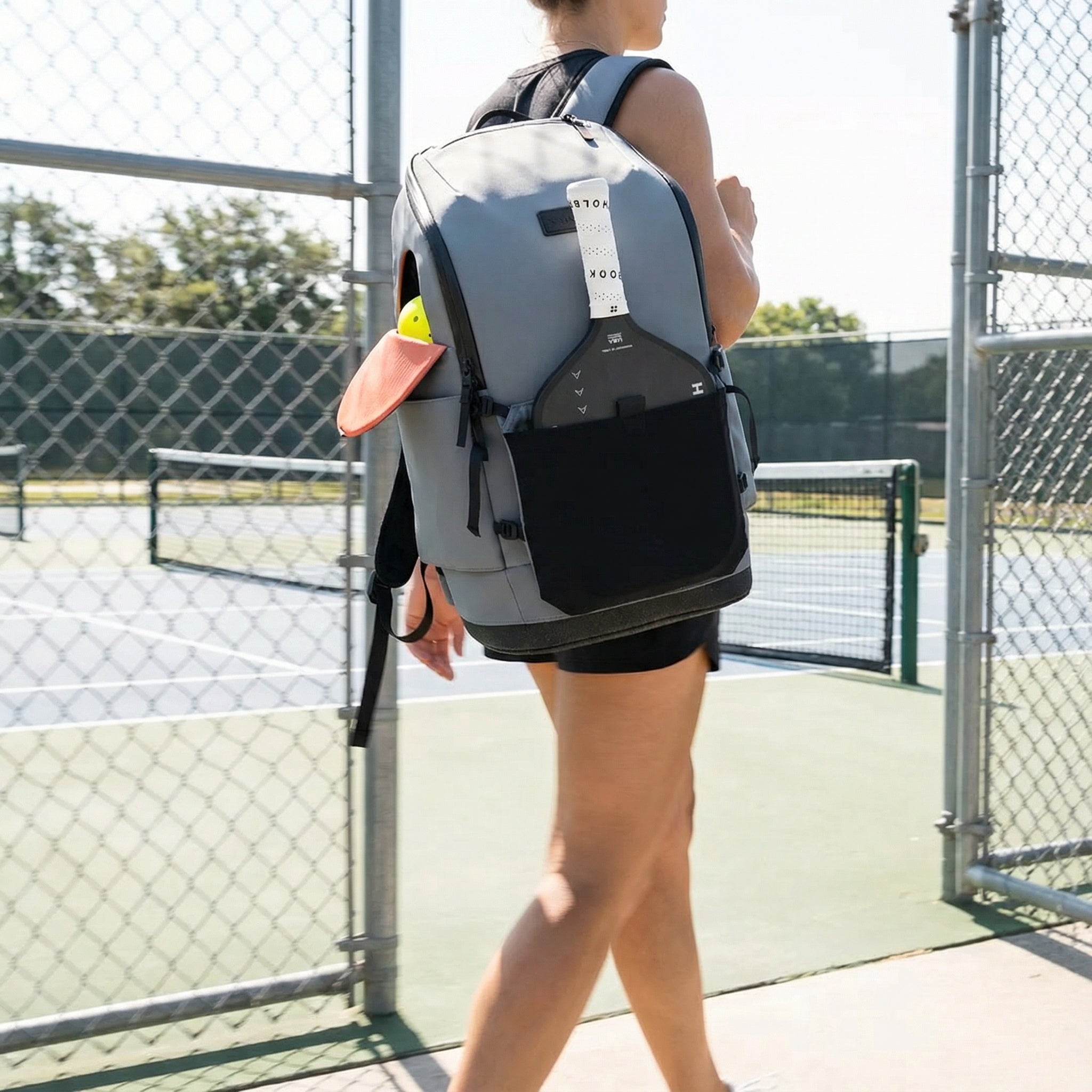
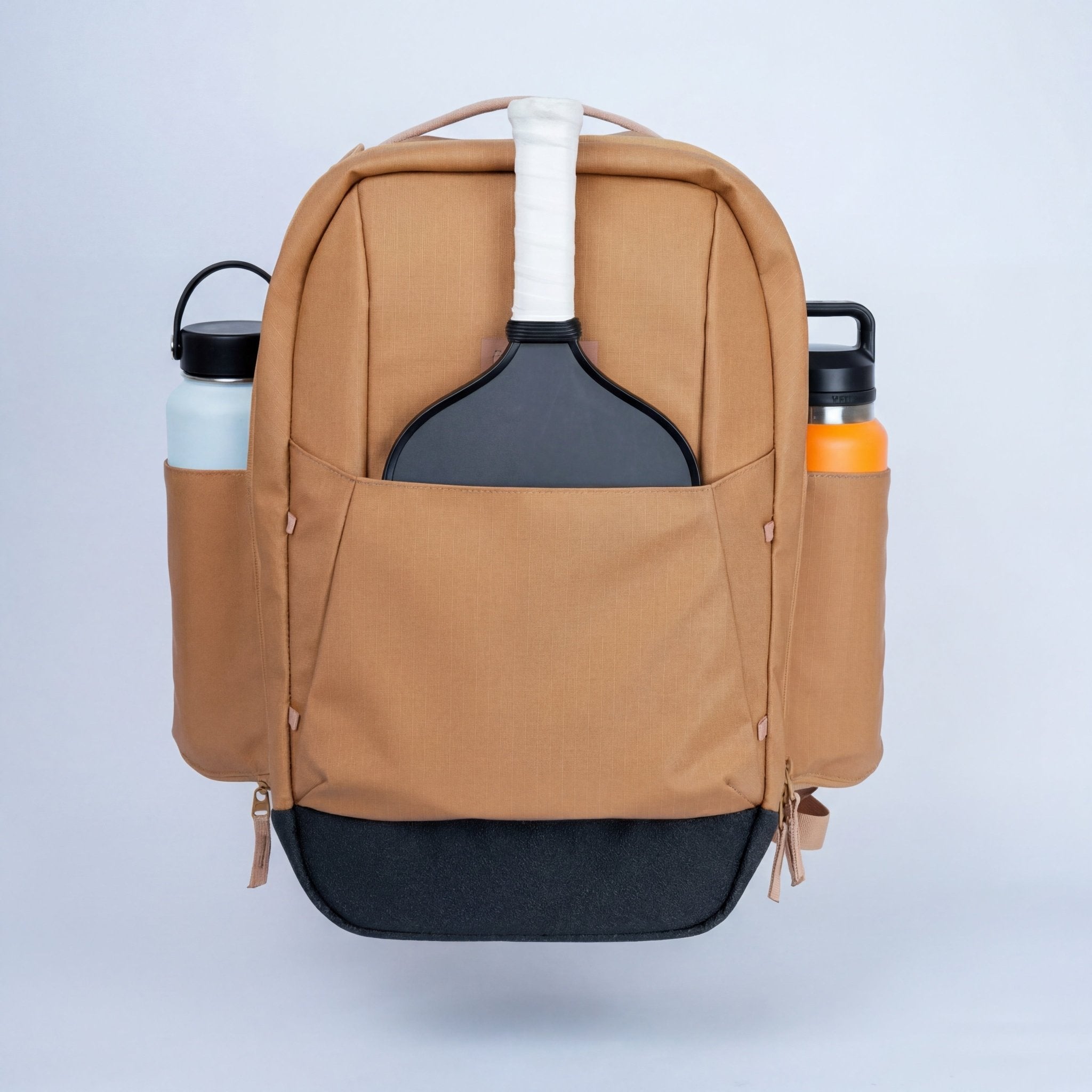
The Court Caddy is built specifically for this kind of serious tournament use — 15" padded laptop sleeve, modular paddle sleeve, YKK AquaGuard weatherproof zippers, and enough internal organization to pack a full tournament kit without chaos. It's what FORWRD designed after talking to 500+ real players about what they actually needed at multi-day events.

For tournament players — amateur or otherwise — the Court Caddy ($325) handles multi-day gear loads without compression, warping, or the zipper failures that cheaper bags develop after a few tournament weekends. The Court Ranger V2 ($195) works for day-trip competitive play when you're not hauling recovery gear and extra equipment.
For the shoes: pros use dedicated pickleball court shoes designed for lateral stability on hard court surfaces — not running shoes, which have the wrong sole pattern for quick directional changes. The difference in ankle support and knee stress over a full tournament day is significant.
Shoe guide: Best Pickleball Shoes 2026: What the Pros Wear and What You Should →
How Watching Pros Improves Your Game
Here's something most recreational players don't do enough of: watching full pro matches, not just highlight reels.
Highlights show you the spectacular plays. Full matches show you the decision-making framework — why a pro player hits a particular third-shot drop rather than driving through the middle, why they hold back at the transition zone when seemingly they could attack, why they choose to reset instead of speed up a ball that looks attackable. Those are the decisions that separate 3.5 players from 4.5 players, and they're invisible in highlight clips.
What to Watch For
Kitchen line positioning. Watch how tightly top pros control their position relative to the non-volley zone line when dinking. They're not casually floating a foot back — they're precisely calibrated. That positioning makes a 2-foot difference in how attackable incoming balls are.
Third-shot decisions. Pay attention to when a pro drives vs. drops on the third shot. The pattern is readable: against a team pushed far back from the kitchen, drive. Against a team already at the kitchen, drop. Watching 20 professional third shots in a row makes this pattern click faster than any drill session.
Reset sequences under pressure. The best pros can reset from an aggressive put-away attempt to a neutral dink rally in 2-3 shots without losing composure. Watch their grip softening on the reset — it's a technique detail you can't get from a description but can see clearly in broadcast footage.
Serve patterns. Professional servers are not just getting the ball in play. They're targeting specific zones based on their opponent's established tendencies. This is high-level play that recreational players almost never implement, but watching it builds pattern recognition that helps even at lower DUPR levels.
Drill guide: Singles Pickleball Drills: Improve Footwork, Accuracy and Match Fitness →
Read more on how to turn pro watching into skill development: How Watching Pro Pickleball Makes You a Better Player →
Frequently Asked Questions
Who is the #1 professional pickleball player in 2026?
Ben Johns holds the top ranking in men's singles and is considered the overall best player in the sport. Anna Leigh Waters is the top women's player across singles, doubles, and mixed doubles. Both have maintained their respective top rankings for multiple consecutive years.
What is the PPA Tour?
The PPA (Professional Pickleball Association) Tour is the premier individual tournament circuit in professional pickleball. It runs 25+ events across domestic and international locations, uses exclusive player contracts, and broadcasts on Tennis Channel and Pickleball.tv. The largest events (called Slams) offer $90,000 per doubles team in prize money.
What's the difference between PPA and APP?
The PPA uses exclusive player contracts that prevent its top players from competing in APP events. The APP (Association of Pickleball Players) has no exclusive contracts and runs an open circuit where any qualified professional can enter. The APP is also more accessible to high-level amateur players, who can compete in their own brackets at the same tournaments.
What is Major League Pickleball?
MLP is a team-based league with city franchise teams that compete in a draft-based season. Each team has 2 men and 2 women, matches use rally scoring to 21, and the format includes women's doubles, men's doubles, and two mixed doubles matches. MLP broadcasts on ESPN platforms and runs 5 events per year.
How do professional pickleball rankings work?
The PPA Tour runs two ranking systems simultaneously: the 52-Week Ranking (cumulative points over the trailing 52 weeks) and The Race (only the current calendar year). Rankings are separate for each discipline: men's singles, women's singles, men's doubles, and mixed doubles. DUPR is a separate universal rating system used across amateur and professional play.
How much do professional pickleball players earn?
Tournament prize money at PPA Slam events reaches $90,000 per doubles team and $50,000 for singles champions. However, the majority of top pro income comes from paddle sponsorship contracts, which can exceed $200,000 annually for elite players like Ben Johns. Mid-ranked pros supplement tournament earnings with clinics and coaching.
Where can I watch professional pickleball?
PPA events air on Tennis Channel and stream on Pickleball.tv. MLP broadcasts on ESPN and ESPN+. APP Tour events air on CBS Sports Network. Both PPA and MLP maintain YouTube channels with highlights and delayed broadcasts at no cost.
How do players qualify for professional pickleball?
There's no single qualification pathway. For the PPA Tour, top players are invited to contract negotiations based on performance. The APP Tour has an open entry system — qualified professionals can enter any event. The PPA Challenger Series is a stepping stone where aspiring professionals earn points toward main tour status.
What paddles do professional pickleball players use?
Top pros use signature series paddles from their sponsors: Ben Johns uses the JOOLA Perseus Pro V, Anna Leigh Waters uses the Franklin C45 Aurelius, and other top players are signed to Selkirk, CRBN, Six Zero, and other manufacturers. These are all high-end thermoformed carbon fiber paddles optimized for elite-level play.
Can I meet professional pickleball players?
Yes — the pro pickleball community is notably accessible compared to most professional sports. Many top players host clinics, post instructional content on social media, and make themselves available at tournament fan areas. PPA events often include pro-am brackets and fan interaction sessions alongside the main draw.
All Pro Tour & Player Guides
This pillar covers the full landscape. Our supporting guides go deep on each piece:
- Anna Leigh Waters: Pickleball's Youngest World No. 1 →
- Ben Johns: Complete Player Profile & Technique Breakdown →
- PPA vs. APP vs. MLP: Complete Tour Comparison →
- Major League Pickleball Guide: Teams, Format & How to Follow →
- APP Tour 2026: The Open Professional Circuit Explained →
- How Pro Pickleball Rankings Work: PPA, DUPR & The Race →
- Pro Pickleball Prize Money 2026: What Players Actually Earn →
- How to Watch Pro Pickleball: TV, Streaming & Free Options →
- PPA Tour 2026–2027 Complete Schedule →
- What Paddles Do the Pros Use? 2026 Edition →
- How to Go Pro in Pickleball: The Real Pathway →
- How Watching Pros Makes You a Better Player →
- Best Pickleball Tournaments to Watch Live in 2026 →
- JOOLA Perseus Pro IV Review 2026 →
- Franklin C45 Aurelius Review 2026 →
- JOOLA Agassi Pro V Review 2026 →
- Singles Pickleball Drills for Competitive Players →
Looking for the right bag for tournament play? The Court Caddy ($325) is built for multi-day competitive use — laptop sleeve, modular paddle organization, weatherproof zippers. It's the tournament bag players graduate to when a sling bag stops cutting it. The Court Ranger V2 ($195) is the daily-driver option for players who want premium organization without the premium price.

Leave a comment
This site is protected by hCaptcha and the hCaptcha Privacy Policy and Terms of Service apply.