

Disclosure: This post contains affiliate links to Pickleball Central. If you purchase through our links, FORWRD earns a small commission at no extra cost to you. We were not compensated by Vulcan, and this is FORWRD's first-ever review of a Vulcan paddle — no prior relationship with the brand.
Last Updated: June 2026
Vulcan V740 MAX Review 2026: Jay Devilliers' Power Paddle Tested Over 3 Weeks
The Vulcan V740 MAX costs $199.99 and it's made in the USA. For a paddle engineered around power, that combination — real price transparency, domestic manufacturing, a pro player's actual input — is rarer than it sounds. After three weeks on outdoor concrete courts, the verdict is direct: it delivers on every claim that matters, and the players who need this paddle aren't hearing about it loudly enough.
Quick Verdict
Best for: 3.5–5.0 players who want a serious power paddle with a long handle, can handle 8.3oz comfortably, and want to spend under $200 on USA-made construction without funding a marketing budget.
Pros:
- Made in USA — unit-to-unit weight and balance consistency that imported paddles rarely match
- 5.5" handle is one of the longest in its class — two-handed backhand players, this is genuinely built for you
- 7-layer V-Skin face gives premium feel and durability without feeling brittle
- Plays lighter than 8.3oz suggests — the balance engineering here is legitimately impressive
- TeXstreme V-Struts stabilize the sweet spot so mishits don't punish you the way they do on less-engineered power paddles
- $199.99 is honest money for what you're getting — no padding for brand markup
Cons:
- 8.3oz average (8.1–8.5oz range) is heavier than most carbon-fiber competitors — extended sessions on a hot day, you'll feel the difference
- Vulcan has minimal court presence — finding a demo before buying is much harder than with Selkirk or CRBN
- 13mm core is thinner than the 14–16mm range currently dominating the market — touch-heavy players who live at the kitchen line may want something thicker
- V-Skin composite face generates less raw spin than an uncoated T700 carbon surface
Price: $199.99 at Pickleball Central
Who should skip it: Players who want a sub-8oz paddle, players who prioritize spin over power, or anyone who absolutely needs to demo before buying and can't wait for a Vulcan event.
TL;DR Specs
| Spec | Vulcan V740 MAX |
|---|---|
| Price | $199.99 |
| Weight | 8.1–8.5 oz (avg 8.3 oz) |
| Core thickness | 13mm polymer honeycomb |
| Face material | 7-layer V-Skin composite |
| Frame technology | TeXstreme carbon fiber V-Struts |
| Bonding method | Thermal welding |
| Paddle length | 16.5" |
| Paddle width | 7.5" |
| Handle length | 5.5" |
| Grip circumference | 4.25" (Medium) |
| Shape | Elongated (16.5" × 7.5") |
| Manufacturing | Made in USA |
| Pro association | Jay Devilliers (APP Tour) |
| USAPA approved | Yes |
Buy the Vulcan V740 MAX at Pickleball Central — $199.99 →
Why Trust This Review
FORWRD publishes gear reviews for players who want an honest take — not a spec sheet reprint, not a brand press release dressed up as a test. We test paddles on real courts, under real conditions, against real alternatives in the same price range.
This is our first Vulcan review. We have zero relationship with the brand, no prior history, no sponsored content deal, nothing. That's actually an advantage: we came into the V740 MAX the same way most players would — with no loyalty and no financial reason to be generous. We also picked it up after testing paddles from CRBN, JOOLA, Selkirk, and HEAD, so we had direct comparison context that a single-brand reviewer simply doesn't have.
Three weeks of use on outdoor concrete courts. That's where this paddle was evaluated. Power performance on hard surfaces, handle feel across extended rallies, balance after an hour of competitive play, and — specifically — the two-handed backhand test that almost no other review bothers running.
For a broader frame on what separates paddles at this level, see our best pickleball paddles for intermediate players guide and our complete pickleball paddle guide.
What Is the Vulcan V740 MAX? (And Why You've Probably Never Heard of Vulcan)
Nobody talks about Vulcan at the courts. That's not a quality problem — it's a marketing one.
Vulcan has been building pickleball paddles in the USA for years, with a reputation for tight construction tolerances and consistent materials that doesn't get the billboard treatment that Selkirk or CRBN throw at the sport. If you follow the APP Tour, you've seen Jay Devilliers playing with Vulcan gear. If you don't follow the APP Tour closely, you've probably filed Vulcan under "brands I'll look at someday."
The V740 MAX is their flagship power paddle. The name breaks down simply: V740 denotes the model line, MAX signals the power-oriented configuration within it. It was developed with Devilliers — not in the way some paddles get "designed with" a pro player (meaning the pro signed a check and got their name on the packaging), but in a way that shows up in the specs. The 5.5" handle is longer than what most brands default to. That's not a marketing decision; it's what Devilliers actually plays with.
Being USA-made distinguishes Vulcan from nearly every competitor in the $150–$250 range. CRBN, JOOLA, Selkirk — all manufactured overseas. That's not automatically a negative, but it does create variance. When paddles come off an overseas production line in large batches, you'll see weight spreads of half an ounce across "identical" units. Vulcan's domestic manufacturing keeps that spread tighter. The listed 8.1–8.5oz range reflects actual variance, not a spec sheet fiction.
The V-Skin + TeXstreme V-Struts — What the Technology Actually Does
Vulcan calls their face material "V-Skin" and describes it as a 7-layer composite. That sounds like marketing, so let's translate it into something actionable.
A 7-layer face construction means more material between your hand and the ball than a standard single-layer or 3-layer carbon face. More layers generally means better vibration damping (the feel is warmer, less brittle), more durability over time (face delamination is less common), and a slightly softer contact sensation. The tradeoff: you don't get the raw, almost grippy texture of an uncoated T700 carbon fiber surface, which means spin generation is good but not top-tier. Players who generate heavy topspin through mechanics and swing speed will still get solid spin. Players who rely on the surface doing most of the grip work — it'll feel different from what they're used to on a raw carbon paddle.
The TeXstreme carbon fiber V-Struts are more interesting. These are structural carbon fiber elements embedded in the frame — between the face and the polymer core — rather than just adding carbon to the face surface. What they do mechanically is distribute impact energy more evenly across the hitting zone. On a less-engineered power paddle, mishits near the frame feel noticeably hollow and lose significant pace. The V-Struts push the effective sweet spot outward, so the paddle plays more consistently across its full surface area.
Thermal welding — Vulcan's bonding method — is how all those layers stay together under repetitive high-force impacts. The concern with most paddle constructions is adhesive degradation over time, especially in heat. Thermal welding uses heat and pressure to fuse the materials rather than glue them, which holds up better through temperature cycling. For outdoor concrete court players who leave paddles in hot cars and play in 90-degree summer weather, this is a meaningful durability difference.
The 13mm core is the one genuine technical trade-off in this design. The current trend in paddle construction is toward 14–16mm cores, which provide more dwell time, softer touch, and easier resets at the kitchen. At 13mm, the V740 MAX prioritizes power and speed over that cushioned control feel. It's not wrong — it's a choice that reflects the paddle's design philosophy. Just go in knowing it.
Performance Breakdown
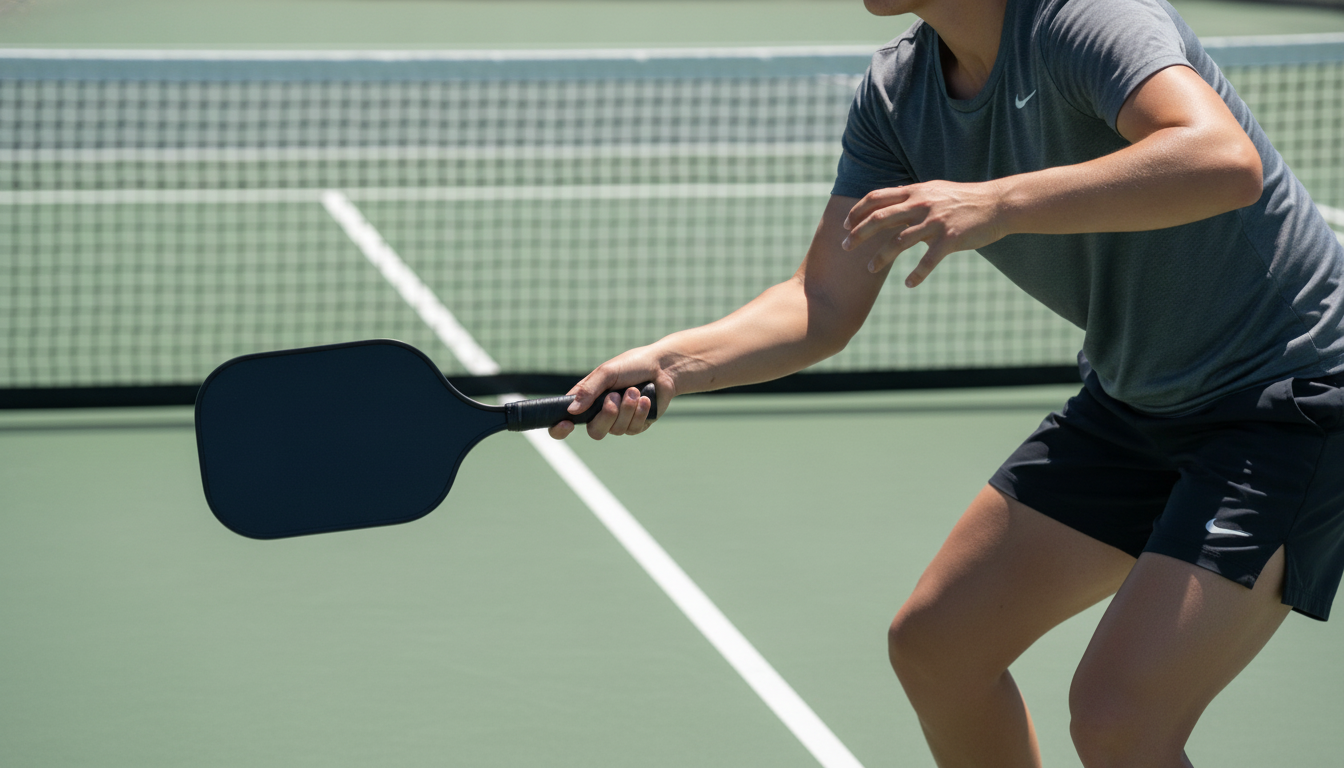
Power: This is where the V740 MAX earns its name. The combination of 8.3oz average weight, a 16.5" elongated shape, and a 13mm core produces a paddle that generates real pace on drives. Third-shot drives from mid-court arrive noticeably harder than from a standard 14mm control paddle. Overhead smashes are authoritative. If you're a player who wins points by taking pace off an opponent's reset and driving it through the middle, this paddle accelerates your timeline.
Control: More controlled than the spec sheet suggests. The TeXstreme V-Struts do their job — the sweet spot is wider than expected for a 13mm power paddle, and the multi-layer face absorbs enough shock that dinks at the kitchen are playable, not just survivable. Don't expect the soft, pillowy touch of a 16mm thick-core paddle. But the V740 MAX isn't a banger's paddle that's useless in transition. It's a power paddle with genuine range.
Spin: Solid but not the paddle's highlight. V-Skin generates enough texture for functional topspin and slice, particularly on serves and drives where you're putting real swing speed into the shot. In slow dinking exchanges where spin is almost entirely surface-dependent, it doesn't grip the ball the way a raw carbon face does. If spin is your primary weapon, look elsewhere. If power is the priority and spin is a supporting tool, you'll have enough.
Weight feel: The number that gets raised in nearly every V740 MAX thread online is 8.3oz. It's heavier than most paddles in this class, and that's a fair concern. What the spec sheet doesn't capture is that Vulcan's balance engineering makes this paddle swing lighter than its mass. The weight distribution is center-biased, not head-heavy, which means faster recovery between shots and less arm fatigue over long sessions than a head-heavy 8.3oz paddle would produce. After a full 2-hour recreational doubles session, no unusual arm fatigue. The caveat: players with existing arm sensitivity should demo if possible, or at minimum understand this is not a lightweight paddle.
Sweet spot: Larger than a standard elongated paddle of this shape. The V-Struts pay off here. Test shots toward the paddle perimeter behave predictably — not as powerful as dead-center contact, but not a dead zone either.
The Two-Handed Backhand Test
Most paddle reviews skip this entirely. Backhand grip, two-hand mechanics, and whether a paddle's handle actually accommodates them — these things matter, and they're almost never addressed specifically. The V740 MAX's 5.5" handle is one of the defining reasons to choose this paddle, so let's actually test what it does.
For context: a two-handed backhand in pickleball works best when your dominant hand controls the lower portion of the handle and your non-dominant hand grips above it, with a small gap or close contact between the hands. Most paddles have 4.5–5.0" handles. At 5.5", the V740 MAX gives both hands genuine room to operate without either hand riding up onto the shaft or being forced into an uncomfortable stacking position.
For players around 5'8" with a standard grip style, the 5.5" handle accommodates a two-handed backhand cleanly. Both hands land on handle surface, the non-dominant hand doesn't feel cramped, and you can generate rotation through the shot without the handle limiting your mechanics. The result on groundstrokes from the baseline and in transition is noticeably more arm power into the ball than a one-handed backhand or a two-hander on a shorter handle provides.
Taller players — 5'10" and up — may want to evaluate whether even more handle would benefit their specific mechanics. The 5.5" accommodates most two-handed grips, but long-armed players with bigger hands sometimes prefer 5.75" or 6" handles if they can find them. Within the 5'5"–6'0" range, this handle is as good as you'll find at this price point for two-handed mechanics.
For kitchen play, the longer handle doesn't create problems. Volley exchanges at the NVZ didn't require any grip adjustment compared to standard-handle paddles — the hand naturally falls to the lower portion of the grip, leaving the extra length effectively unused without getting in the way.
Bottom line on the two-handed backhand: if you play a two-handed backhand and you've been compromising with a short-handled paddle, the V740 MAX is one of the few paddles at this price that actually solves the problem.
Who Should Buy the Vulcan V740 MAX — And Who Should Skip It
Buy it if:
- You play a two-handed backhand and want a handle that actually fits your mechanics
- You're a 3.5–5.0 player who prioritizes power and pace on drives over touch-and-feel kitchen play
- You want USA-made construction for QC consistency and you're tired of getting a unit that weighs differently than the spec says
- You want a premium power paddle under $200 without paying $270+ for a Selkirk Labs or JOOLA Pro V flagship
- You play outdoor concrete courts frequently and want a paddle built to handle heat and impact cycling
Skip it if:
- You're arm-sensitive or recovering from injury — 8.3oz is real weight and you should feel a demo before committing
- You're a kitchen-dominant player who wins by soft touch and resetting pace — the 13mm core won't give you the dwell time you want
- You need to try before you buy and can't find a Vulcan demo in your area — the brand's limited court presence makes this a genuine obstacle
- Spin generation is your primary weapon — there are raw carbon face paddles that outperform V-Skin in this specific category
Vulcan V740 MAX vs. CRBN-3X Power Series ($199.99 vs. $149.49)
The CRBN-3X Power Series at $149.49 is the obvious value comparison. It's a well-regarded power paddle, $50 cheaper, and CRBN has the court presence Vulcan lacks. So what does the extra $50 buy you with the V740 MAX?
Three things, specifically. First, the handle. The CRBN-3X has a 5.25" handle — still good for a two-handed grip, but a half-inch shorter than the V740 MAX. For two-handed backhand players in particular, that half-inch is not trivial. Second, the domestic manufacturing. CRBN is manufactured overseas; the weight variance across units is real. If you order a V740 MAX at 8.3oz and receive a CRBN-3X expecting 8.2oz, there's a meaningful chance your unit lands at 8.0oz or 8.4oz. Third, the thermal welding construction. The V740 MAX is built to hold together differently — particularly relevant for outdoor players in high-temperature environments.
What the CRBN-3X does better: it's lighter on average, and the raw carbon fiber face generates more spin. If you're under-5'8", play mostly indoors, and don't care about the two-handed backhand handle length, the $50 savings make real sense. The CRBN-3X isn't a lesser paddle — it's a different set of trade-offs.
At $149.49, the CRBN-3X wins on price-per-performance if spin is part of your game. At $199.99, the V740 MAX wins on construction quality, handle length, and manufacturing consistency.
Vulcan V740 MAX vs. CRBN3 TruFoam Barrage ($199.99 vs. $223.99)
The CRBN3 TruFoam Barrage at $223.99 is the premium power paddle comparison. It costs $24 more than the V740 MAX and incorporates CRBN's TruFoam edge technology — a foam-injected frame that's designed to improve edge ball response and reduce vibration.
The TruFoam Barrage tilts the comparison toward feel. The foam injection softens the edge response, which creates a wider effective sweet spot and a slightly more forgiving contact sensation. It also plays lighter — the foam addition doesn't add meaningful weight, and the overall swing weight is lower than the V740 MAX.
Where the V740 MAX holds its ground: the TeXstreme V-Struts provide a comparable sweet spot expansion through a different engineering approach, and the 5.5" handle maintains the two-handed backhand advantage over the CRBN3 TruFoam's 5.25" handle. The V740 MAX also wins on manufacturing origin and QC consistency.
The honest comparison: if you want raw power and can afford $224, the CRBN3 TruFoam Barrage is a legitimate competitor — better spin surface, slightly lighter, comparable feel. If the handle length matters to you, or you want USA-made construction, or you'd rather spend $199 than $224, the V740 MAX wins the decision.
For another angle on power paddle comparisons at this price level, our HEAD Boom Tour EX review covers a different approach to power-focused construction.
Complete Your Setup
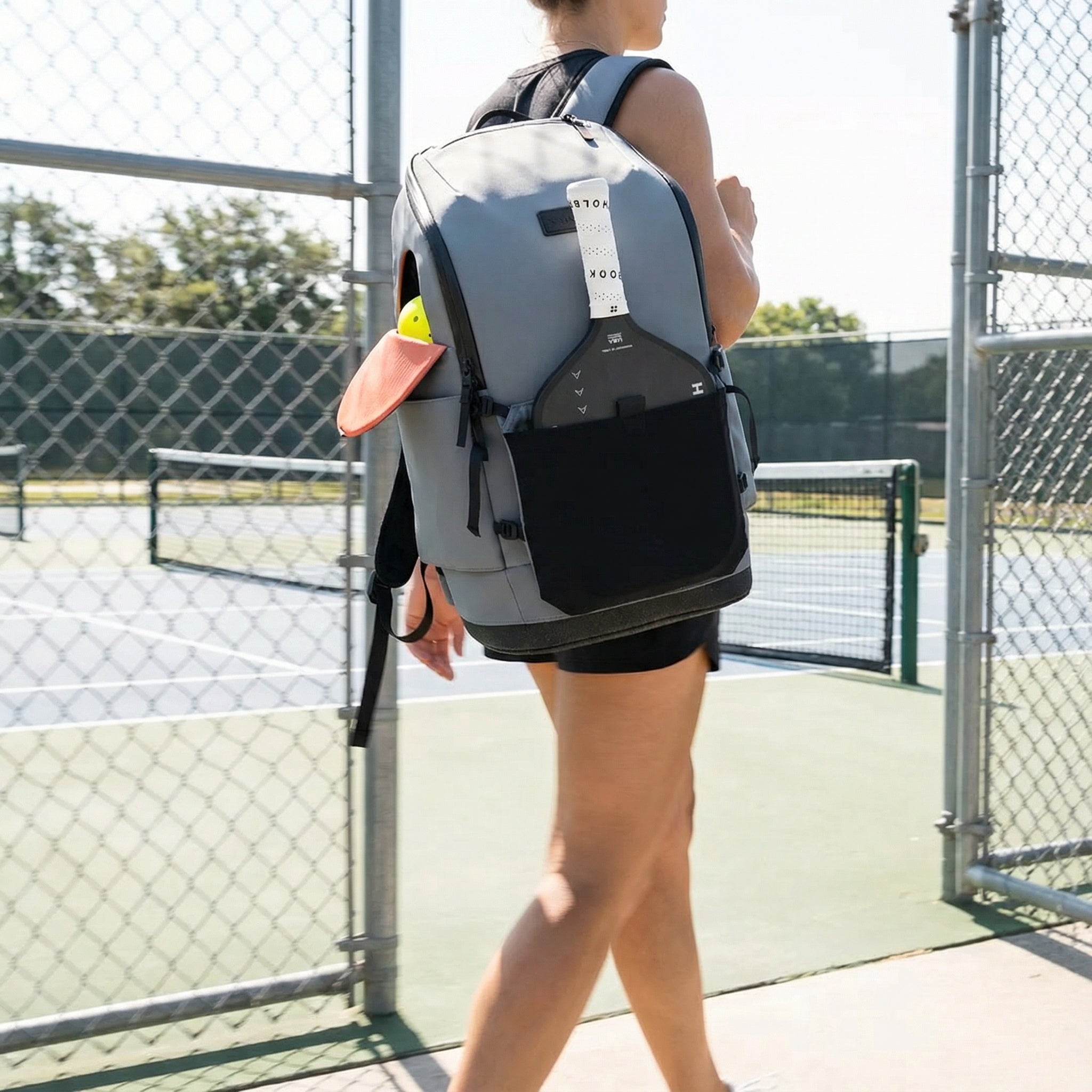
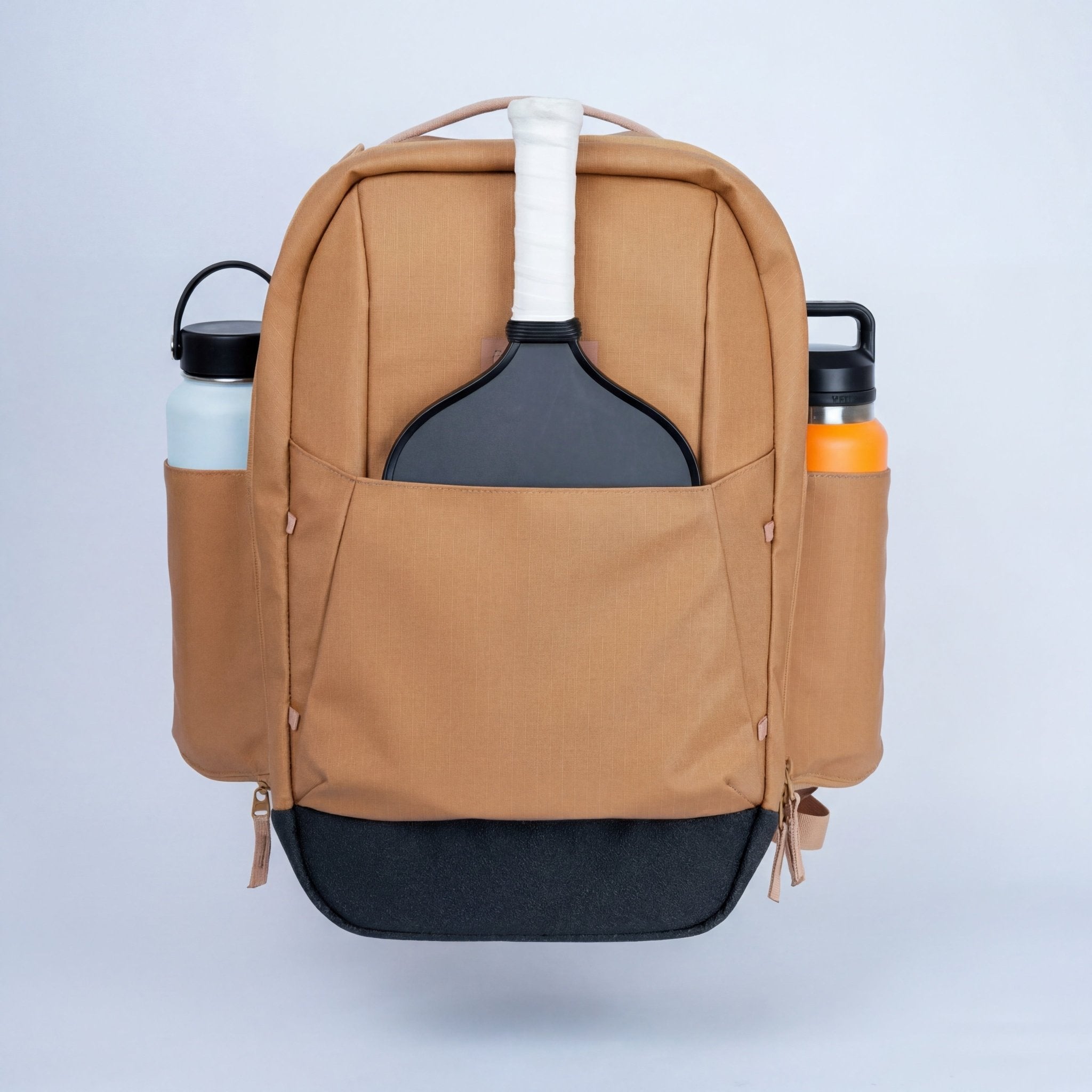
A paddle like the V740 MAX means you're taking your game seriously. Your bag should keep up. The FORWRD Court Ranger V2 fits up to 4 paddles, keeps your gear organized, and is built to handle the same outdoor concrete courts where the V740 MAX was tested.

FORWRD Court Ranger V2 — $195 →
If you're carrying multiple paddles to tournaments or storing more gear, the FORWRD Court Caddy ($325) handles up to 6 paddles with a full shoe compartment and thermal pocket for balls.
Price and Where to Buy
The Vulcan V740 MAX is $199.99 at Pickleball Central, which is the most reliable place to find Vulcan paddles online with consistent stock and shipping. Vulcan's own website carries the paddle at the same price, but Pickleball Central's inventory management and shipping speed are better for most players.
No Vulcan paddles on Amazon. No discount codes floating around. The price is the price, and at $199.99 for USA-made construction with this build quality, the price is fair. You're not paying a Selkirk or JOOLA brand premium. You're paying for a paddle that was engineered and built domestically by a company that's been doing this long enough to do it well.
Buy the Vulcan V740 MAX at Pickleball Central — $199.99 →
FAQ
Is the Vulcan V740 MAX good for beginners?
Not the first paddle we'd recommend. At 8.3oz average and with a power-oriented 13mm core, the V740 MAX rewards players who already have consistent mechanics. Beginners tend to benefit more from a lighter paddle with a thicker core and softer touch that's more forgiving on off-center hits. If you're a beginner with some athletic background and you play 3–4 times per week and progress quickly, you might grow into this paddle faster than average — but you'll want a lighter option initially.
Does 8.3oz feel heavy during play?
Less heavy than the number suggests, because the balance is center-biased rather than head-heavy. In a 90-minute session, there's no unusual forearm fatigue. In a 3-hour tournament day with back-to-back matches, you'll know it's there by the end. Players with previous wrist or elbow issues should demo this paddle if possible before committing.
How does the V740 MAX compare to the Selkirk LUXX Control Air InfiniGrit Epic?
Fundamentally different design priorities. The Selkirk LUXX Control Air InfiniGrit Epic is built for spin and control — the InfiniGrit surface is specifically engineered for maximum ball grip and spin generation. The V740 MAX is built for power and pace. If you dink, reset, and win through patience and spin placement, the Selkirk fits your game. If you drive, attack, and win by taking pace off the opponent before they're ready, the V740 MAX fits yours.
Is the V740 MAX USAPA approved for tournament play?
Yes. The Vulcan V740 MAX is USAPA approved. You can play it in sanctioned recreational leagues and tournament formats without any compliance concerns.
Why is Vulcan less well-known than CRBN or Selkirk?
Marketing spend, mostly. Vulcan doesn't run the same level of social media campaigns, influencer partnerships, or retail placement that CRBN and Selkirk do. They've invested in manufacturing and product development instead. The trade-off is that their paddles punch above their recognition level — players who find Vulcan tend to stay with it, but fewer players find it in the first place.
Final Verdict
Three weeks in, the Vulcan V740 MAX earns its $199.99. The power is real. The balance engineering genuinely makes 8.3oz feel manageable. The 5.5" handle is one of the best options available for two-handed backhand players at any price. And the USA-made construction delivers the QC consistency that matters when you're buying blind without a demo.
The paddle won't work for everyone. Touch players who live at the kitchen line and want a thick-core, high-dwell feel will be better served by a 14–16mm paddle. Spin-first players need a raw carbon face. Players who need arm-friendly lightweight gear should look below 8oz. These are real limitations, not just qualifiers to add to a positive review.
But for the right player — someone who plays power-forward pickleball, hits a two-handed backhand, wants premium construction under $200, and doesn't need a logo they've seen at every court they've ever played at — the V740 MAX is better than it gets credit for. That's the honest take. Nobody's talking about Vulcan at the courts, but after three weeks with this paddle, they probably should be.

Leave a comment
This site is protected by hCaptcha and the hCaptcha Privacy Policy and Terms of Service apply.