

Last updated: October 2026
Here's something counterintuitive: drilling with three players beats drilling with four. You get more touches, more reps per minute, and you can't hide. The 2-on-1 solo defender position creates a kind of pressure that a regular doubles rally just doesn't replicate — and that pressure is where actual improvement happens.
If your group has an odd number and you've been waiting for a fourth before you start, stop waiting. Three is a feature.
This guide covers six drills that work specifically for three-player groups, two rotation systems that make sure nobody stands around watching, and complete 30-minute and 45-minute session plans you can run today.
Disclosure: This post contains affiliate links to Pickleball Central. If you purchase through our links, FORWRD earns a small commission at no extra cost to you. We only link to products we'd recommend regardless.
Table of Contents
- Why Three Players Has a Hidden Efficiency Advantage
- Drill 1: The Feeder Drill
- Drill 2: 2-on-1 Attack and Defend
- Drill 3: Drop, Feed, Attack Pattern
- The 3-Player Framework Pros Use
- How to Rotate So Everyone Gets Equal Reps
- 30-Minute and 45-Minute Session Plans
- When You Drop to Two (or One)
- FAQ
Why Three Players Has a Hidden Efficiency Advantage
In a normal doubles rally with four players, you're touching the ball maybe 10-15 times per minute per person. In a 3-person feeder drill where one person is feeding and two are active? The active players are hitting 25-40 balls per minute. The math isn't close.
But the rep count isn't even the main advantage. The real edge is that three-person formats create positions you can't drill any other way. The solo defender in a 2-on-1 is covering a full court against two players — every middle ball is their decision, every lob is their read, every speed-up comes without a partner to fall back on. That's uncomfortable. It's also exactly the scenario you face when your doubles partner gets caught out of position.
Standard four-person drilling doesn't isolate that. Three-person drilling does — every single rep.
"Some of our most productive practice sessions have been three-person. The solo defender position is where you actually see the whole court differently. Nothing else builds that awareness as fast." — Grub, FORWRD co-founder
One more thing the SERP will not tell you: players who drill in groups of three tend to communicate better. When one person is feeding, the other two have to coordinate coverage, call the middle, and decide who takes what. That's a team skill that game play alone doesn't teach efficiently. For a full breakdown of partner communication patterns, see our doubles teamwork drills guide.
Drill 1: The Feeder Drill
The most adaptable format in three-person drilling. One player feeds, two execute. The feeder controls pace, targets, and the intensity of the session — which means they're also doing real work, not resting.
Basic setup:
- Feeder: at the kitchen line (or baseline, depending on the variation)
- Player A and Player B: both at the kitchen line on the opposite side
Three variations worth knowing:
Dink consistency: Feeder soft-drops a ball to Player A, who dinks cross-court to Player B. Player B dinks back to the feeder's side. Rotate the target every 10 balls. This looks simple. At rep 60 after a hard 2-on-1 block, your backhand dink gets sloppy — that's the point. Run 3-minute sets.
Reset under pressure: Feeder stands at the kitchen and drives hard balls at both players' feet alternately. Both players practice the low, soft reset. Start at 60% pace — if either player misses three in a row, the feeder drops back to 50%. Build speed incrementally. Two-minute sets, then rotate who feeds.
Volley battles: Feeder initiates with a medium-pace feed. Player A and B volley cross-court. Hard rule: everything stays in the kitchen. First to force an error wins the rep. Loser rotates out to feed next.
Rotate the feeder every 10-15 minutes. If one player keeps volunteering to feed because it feels easier — your rotation is broken. Feeding is work. The feeder calls corrections, controls tempo, and tracks rep counts. Treat it that way.
Drill 2: 2-on-1 Attack and Defend
This is the highest-intensity three-person format, and it's the one that produces the fastest skill gains. Play it as a real point — the pair on one side versus the solo defender on the other.
Setup:
- Solo defender: covers their entire half of the court
- Pair: covers the opposite side, plays as a coordinated team
The solo player serves (or the pair serves, depending on which skill you're targeting). Play the point out normally. If the pair wins three consecutive points, a new defender rotates in from the pair.
Two things make this drill work or not work:
First — the solo defender's job is to survive, not to win. Their goal is to stay in the point long enough that someone on the pair makes an error. That's a realistic match scenario. You're in a firefight, you're getting picked on, and you need to reset the rally without getting killed at the kitchen. The defender who tries to end points by attacking loses the educational value of the rep.
Second — the pair should be practicing actual sequences, not just hitting randomly. "Drive at the feet, then lob wide" is a real pattern. "Speed up backhand, then put it down the line" is a real pattern. Random chaos is not. Three-person drilling is wasted if the attacking players aren't rehearsing something specific.
Tracking metric: Count how many points the solo defender saves versus concedes. A 3.5-level player should be holding off the pair roughly 1 out of 5 points. A 4.5-level player should be competitive — winning 2-3 out of every 10. If the defender is winning more than that, the pair needs to step up their attack quality.
Drill 3: Drop, Feed, Attack Pattern
This targets the full third-shot sequence — not just the drop itself, but the entire pattern from the baseline through kitchen arrival. Most players drill the third shot in isolation. This drill runs the whole chain with a live defender.
Setup:
- Player A: starts at the baseline
- Player B: acts as the live returner/defender at the kitchen on the opposite side
- Player C: acts as Player A's partner at the kitchen on A's side
Sequence:
- Player B drops a ball to Player A (simulating a return landing near mid-court)
- Player A hits a third-shot drop toward Player B
- Player B dinks it back — Player A takes one deliberate step forward
- Player C and Player B continue dinking cross-court while A advances
- Play the point out once A reaches the kitchen
The coaching detail that makes this drill valuable: Player A should take half-steps forward on each exchange, not sprint. Rushed kitchen arrivals are what get picked off. The drill should teach measured progression, not speed.
Run 10 reps per person in the baseline role. Track landing percentage on the third shot — anything below 7 out of 10 means Player A is trying to do too much from too far back. Slow the advance, not the shot.

The 3-Player Framework Pros Use
Anna Bright — one of the top players on the PPA Tour — has discussed 3-player structured practice as a core part of professional development. The underlying concept: build deliberate asymmetry into every session so that each player spends time in the positions they're bad at, not the ones they're comfortable in.
Applied to recreational practice, this means rotating the "hard job" systematically. Strong baseliner? You spend more time as the solo defender. Shaky reset? You feed from the kitchen so you watch the reset pattern from the other perspective, and you understand what makes a good reset land vs. float.
The players who improve fastest in three-person drilling are the ones who stay in the uncomfortable role a little longer than feels natural — and resist the urge to rotate out the moment it gets hard. There's no equivalent way to accelerate court awareness faster at the recreational level.
How to Rotate So Everyone Gets Equal Reps
Most three-person groups go wrong here. They rotate ad hoc — "ok, switch after 5 points" — and end up with one person getting 40% of the active reps and two others splitting the rest unevenly. After 45 minutes, one player has genuinely drilled and two have mostly watched.
Two systems that work:
System 1 — Timed rotation (best for feeder drills): Set a timer for 8 minutes. Each player feeds for one complete block, then transitions to active player. Total session: 24 minutes, equal time in every role. No negotiation, no "just five more minutes."
System 2 — Point-based rotation (best for 2-on-1 competitive drills): Solo defender rotates out after 3 consecutive losses. If they win a point, the count resets. This rewards the defender for fighting — and punishes the pair for sloppy play. It naturally extends reps for the player who most needs to develop in that position.
One honest observation from running three-person sessions: the person who needs defensive reps most is usually the first to volunteer to feed. If you recognize that pattern in your group, name it and fix the rotation system before you start, not mid-session.
Heading to a drill session?
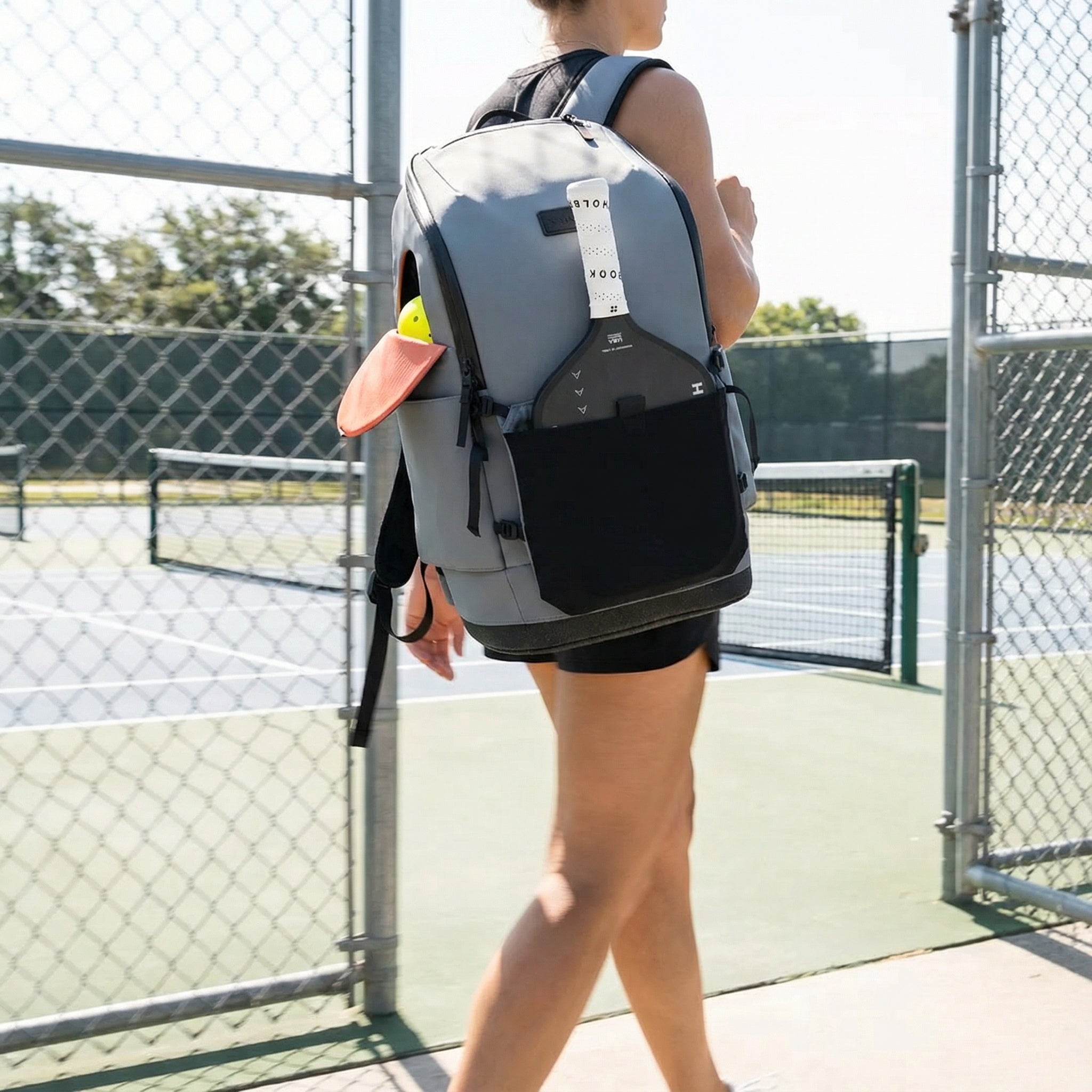
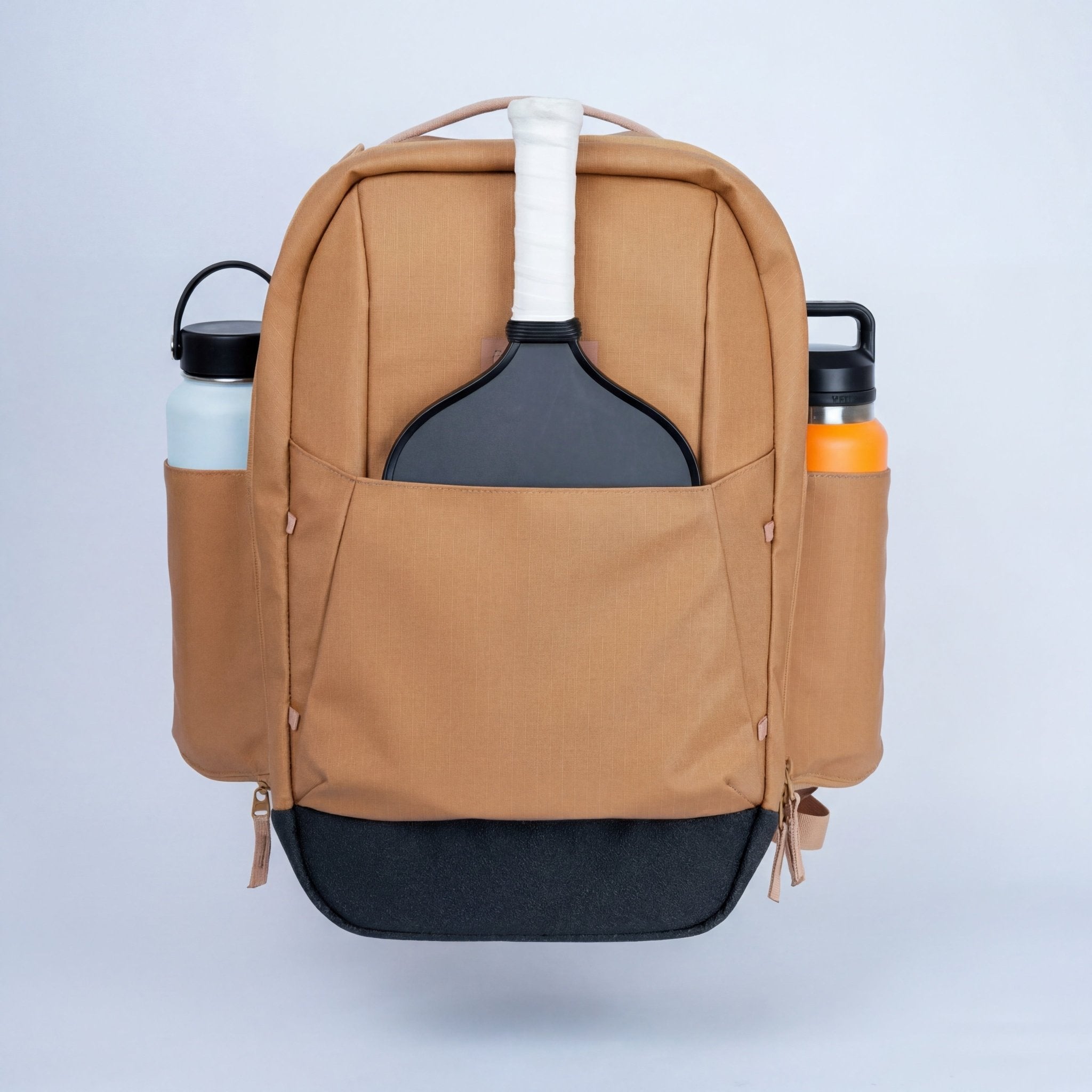
The Court Ranger V2 fits two paddles in its modular sleeve, a 16" laptop, and all your court gear in one organized carry. Built for players who take practice seriously — $195.
30-Minute and 45-Minute Session Plans
The most common question from three-player groups is how to structure the time so everyone feels the session was worth it. Here are two ready-to-run templates.
30-Minute Session Plan
| Minutes | Drill | Focus |
|---|---|---|
| 0–5 | Feeder Drill — Dink Consistency | Warm up, reset hands |
| 5–15 | 2-on-1 Attack and Defend | Pressure defense, survival resets |
| 15–25 | Drop, Feed, Attack Pattern | Third shot → kitchen arrival footwork |
| 25–30 | 2-on-1 Competitive (scored) | Apply under match pressure |
45-Minute Session Plan
| Minutes | Drill | Focus |
|---|---|---|
| 0–7 | Feeder Drill — Dink Consistency | Warm up |
| 7–12 | Feeder Drill — Reset Under Pressure | Foot fire, soft contact on hard balls |
| 12–25 | 2-on-1 Attack and Defend | Full pressure block — timed rotation |
| 25–38 | Drop, Feed, Attack Pattern | Third shot pattern, all three rotate through |
| 38–45 | 2-on-1 Competitive + free dinking | Apply, compete, cool down |
One non-negotiable rule for both plans: don't skip the warm-up dink block. Three-person drilling gets physically demanding fast — the 2-on-1 solo defender position alone taxes your lateral movement. Players who skip the warm-up are pulling something by minute 15.
When You Drop to Two (or One)
Sometimes your third cancels. It doesn't wreck the session — it just changes it.
Two players: Standard partner drilling still covers most of the same ground. Run the Drop, Feed, Attack Pattern with alternating feeder roles. Cross-court dink consistency work. Volley battles from the kitchen. Two players is still productive drilling; you just lose the solo defender pressure and the three-way rotation dynamic.
One player: A ball machine is the honest answer here. You lose the live read entirely — a machine doesn't move or adjust the way a real player does — but you get unlimited targeted repetitions on a specific shot. The Lobster Pickle Two and Pickleball Tutor Plus are available at Pickleball Central and handle the specific oscillation and speed settings you'd use for third shot drop practice — two-line oscillation, medium pace, no spin. We've reviewed both in detail — see our Lobster Pickle Two review and our complete pickleball training equipment guide.
Wall drilling is the zero-cost version. It transfers less to live-ball situations, but twenty minutes of wall dinking — ten from kitchen distance, ten with a step back — builds soft hands faster than most players expect. It's a legitimate substitute when you genuinely have no partner options.
See the full Pickleball Drills & Training Complete Guide 2026 for the broader framework these three-person drills fit into.
FAQ: Pickleball Drills for 3 Players
Can you play real pickleball games with 3 people?
Yes. The most common format is skinny singles: one player covers half the court (one service box and its diagonal return box) against another player covering the same half on the opposite side. Points play out normally. It's competitive and more physically demanding than doubles — good for fitness even when the drilling is done.
How do you rotate fairly in 3-person pickleball drills?
Use timed rotation for feeder drills — 8-minute blocks per role keeps reps equal. For competitive 2-on-1 formats, rotate the solo defender after 3 consecutive losses. Avoid ad hoc switching mid-drill; it creates rep imbalances that leave someone under-trained by the end of the session.
What's the best drill for 3.0–4.0 players with three people?
The 2-on-1 attack and defend. The solo defender builds reset and survival skills under real pressure. The attacking pair rehearses actual pattern sequences. Both roles require focus and generate high-quality reps — which makes it the most efficient drill in the three-person toolkit for that skill range.
How long should a 3-person drill session be?
30–45 minutes of structured drilling beats 90 minutes of loosely organized play. The 30-minute session plan above covers all the core formats. The 45-minute version adds a second feeder block and a longer competitive stretch. Past 45 minutes, technique degrades and players start reinforcing bad habits from fatigue.
Do I need a ball hopper for 3-person drills?
For the feeder drill, yes — a hopper with 40–60 balls keeps the session moving and avoids the dead time of chasing balls. For the 2-on-1 or Drop, Feed, Attack formats, you can work from a small pile at the feeder's feet. Most courts have hoppers available, but if yours doesn't, a basic 72-ball hopper solves the problem.
Do pro players use 3-person drilling formats?
Yes. Players on both the PPA and APP tours use 3-person sessions specifically for the solo defender position — it creates match-condition pressure that standard partner drilling doesn't replicate. The asymmetric format is where court-reading skills develop faster than in any other structured practice setting.
Ready to take your drilling seriously? The Court Ranger V2 — designed with 500+ real players, built for the player who shows up to practice, not just games. $195 at FORWRD.

Leave a comment
This site is protected by hCaptcha and the hCaptcha Privacy Policy and Terms of Service apply.