

Last Updated: October 2026
I spent my first six months playing pickleball torching nearly every forehand I hit. Coming from recreational tennis, my forehand was my "safe" shot — and every time I uncorked that full swing, I'd watch the ball sail long or pop up mid-court for an easy putaway. Took me embarrassingly long to realize the problem: I was playing a 14-foot-court game with a 60-foot-court swing.
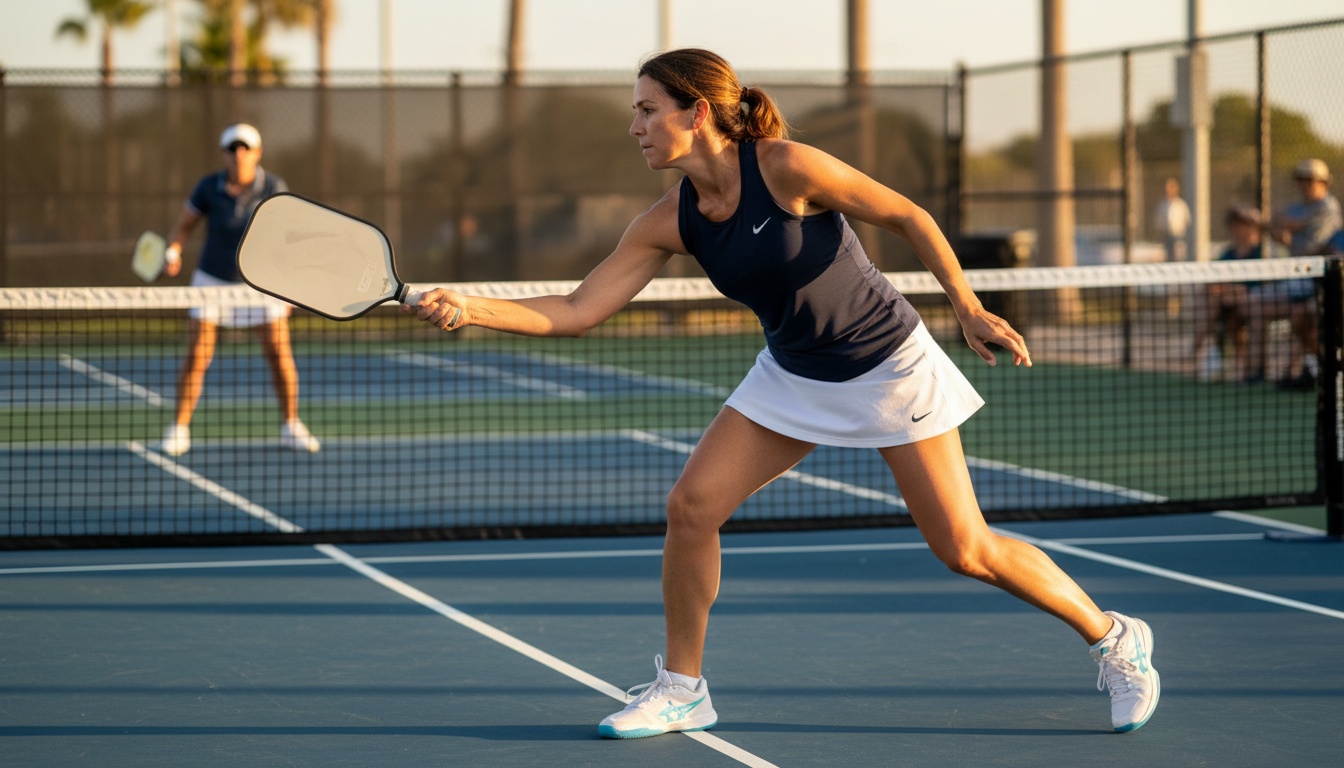
The pickleball forehand is not a scaled-down tennis forehand. It's a different shot — same basic grip orientation, but with a compressed swing arc, different contact zone, and a specific limitation on follow-through that completely changes how you generate pace. Once I understood that, my forehand went from a liability to one of my best weapons at the 3.5 level.
This guide covers the full mechanics: grip, stance, contact point, drive vs dink differences, and a drill progression that works whether you've never touched a tennis racket or you're fighting 20 years of tennis muscle memory.
The Grip Comes First (Continental vs Eastern — Which Works in Pickleball?)
Unlike tennis, where forehand grip choice matters a lot (western for heavy topspin, eastern for flat drives, continental for serve/volley), pickleball's reduced swing arc makes the distinction less dramatic. That said, grip choice still affects your shot:
Continental grip (V-groove of hand on top bevel, like holding a hammer): The default grip for most recreational players. Comfortable for volleys, dinks, and drops because it doesn't require grip changes at the net. For forehand drives, it generates flatter ball flight with limited topspin. Good for beginners and kitchen-focused players.
Eastern forehand grip (palm behind handle, index knuckle on top bevel): More natural forehand position. Allows better topspin on drives without dramatically changing swing mechanics. Better for offensive baseline play. The tradeoff: you may need to slightly adjust grip between forehand drives and kitchen volleys.
The practical recommendation for most 2.5–3.5 players: start with continental. It simplifies net play (no grip changes mid-rally), and you can generate enough pace and spin for recreational-to-competitive recreational play without going eastern. If you're playing at 4.0+ and want to develop more topspin on your drives: shift toward eastern, but be aware of the transition cost at the kitchen.
Grip pressure matters more than type. Aim for 4–5 out of 10 — firm enough to control direction, loose enough to absorb hard shots. Most beginners grip at 8–9 out of 10 and wonder why their forearm is sore after 30 minutes.
Ready Position and Stance (Why Pickleball Isn't Tennis)
In tennis, you have time. After you hit a shot, you recover, set your feet, and wait at the baseline. The court is 78 feet long — you've got a full second or more of flight time on most exchanges.
In pickleball, you don't have that. The court is 44 feet total (20 feet each side), and once you're past the transition zone and into mid-court or the baseline, shot exchanges happen fast. Your ready position needs to reflect that.
Ready position fundamentals:
- Feet shoulder-width apart, weight slightly forward on balls of feet
- Knees bent — not squatting, just athletic. Think "ready to move" not "sitting in a chair"
- Paddle up in front of your body at chest height, face open (roughly perpendicular to net)
- Non-dominant hand lightly touching the paddle throat — this is your balance and direction anchor
The biggest ready-position mistake from tennis converts: standing with the paddle down by your hip. In tennis, you have time to bring it up. In pickleball, you don't — especially at the kitchen line, where reaction time can be under half a second.
For baseline forehand preparation specifically: unit turn (rotate shoulders together, not just swinging the arm) is more important in pickleball than in tennis. The compact swing arc means you need your body to do more of the work, and that starts with a full unit turn that loads the hips before you ever move the paddle.
Contact Zone: Where to Make Contact for Maximum Control
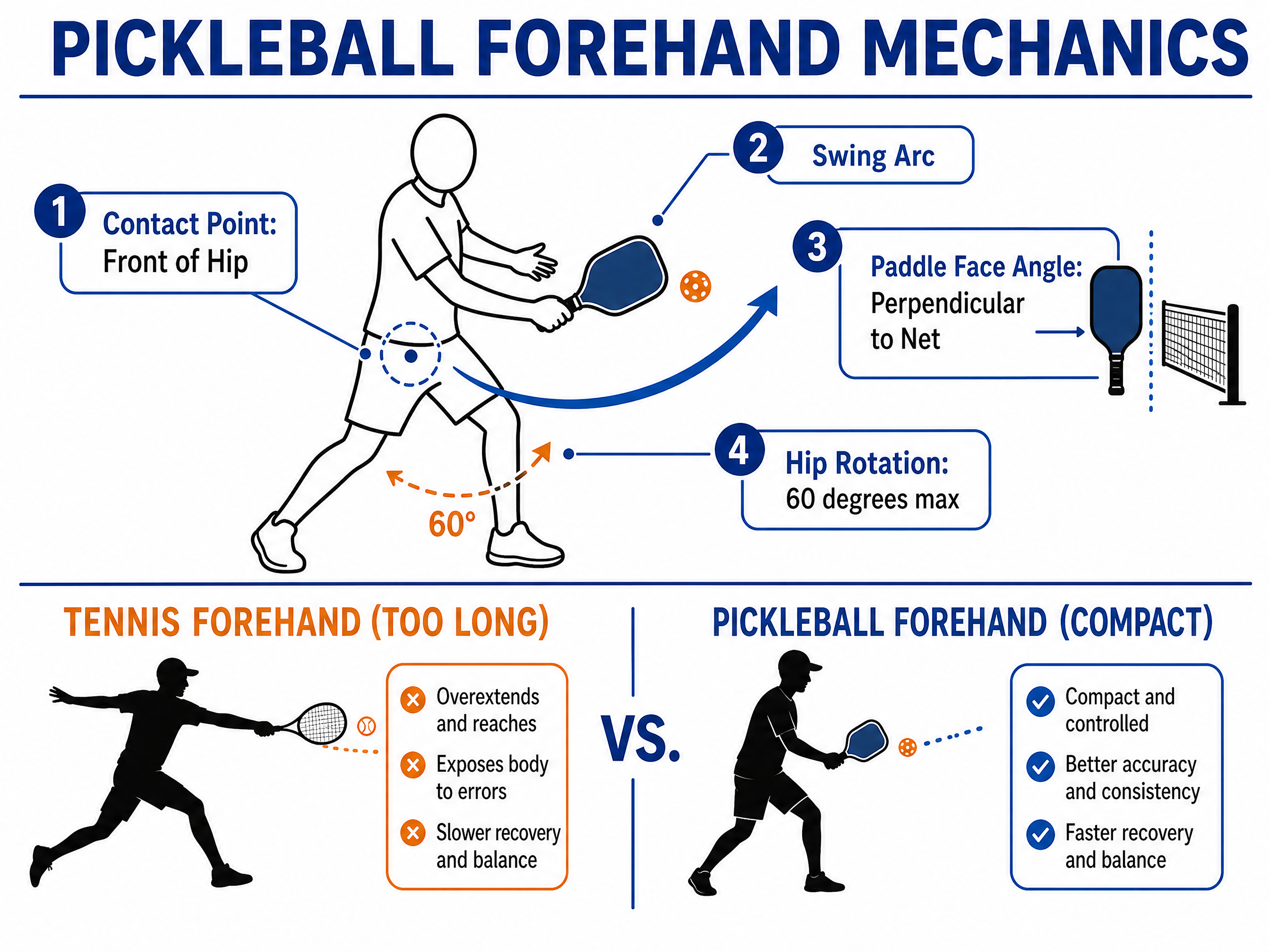
This is where most recreational players get it wrong, and it's the single biggest mechanical fix that improves forehand consistency immediately.
Contact point: in front of your hip, not beside it.
In tennis, you can make decent contact from beside your hip or even slightly behind it because you're generating so much pace that small errors in contact point don't matter. In pickleball, late contact (ball beside or behind your hip) means the paddle face is naturally angling left (for a right-handed player), which sends the ball down the line when you want cross-court — or worse, into the net because your wrist is forced closed.
Drill this specifically: Set up a ball on a court marker or cone at roughly belt-height, slightly in front of your right hip. Hit it. That's the contact zone. It feels early compared to tennis — it should. That's correct.
Ball height relative to net matters too: For a forehand drive, you want contact at between knee height and hip height. Below knee height: the ball is too low to drive aggressively — transition to a lift shot or a reset. Above hip height: harder to control in pickleball's tight space.
Forehand Drive vs Forehand Dink — Different Mechanics, Same Grip
One of pickleball's quirks: you use the same grip for two very different forehand shots. The drive and the dink share the same hand position but have almost nothing else in common.
Forehand Drive — Your offensive weapon from mid-court or baseline. Full unit turn, compact swing arc (roughly 30–40% of a full tennis swing), contact in front of the hip, follow-through that stops at shoulder height (not wrapping around your head). The target contact point for a topspin forehand drive: front of hip, paddle face slightly closed (angled down), swing path low-to-high through the ball.
Forehand Dink — A touch shot from the kitchen line that barely clears the net and lands in the opponent's non-volley zone. Almost no swing — it's a forward extension of the arm with a slight forward tilt of the paddle face. Think "push with precision" rather than "hit." Wrist stays locked. The mistake most players make: they try to dink with too much wrist and generate uncontrolled movement.
The reason both use the same grip: you need to be able to transition between them instantaneously. A dink that comes back high becomes a drive opportunity in half a second — you don't have time to change grip. Practice both shots in the same grip to build the neural pathways for that transition.
If You Came from Tennis: 4 Habits to Unlearn
"Tennis players almost always swing too hard off the forehand side early on. The muscle memory is there for a 60-foot court, and suddenly they're playing 44 feet. It takes about 3–4 weeks of deliberate focus to compress that swing."
— Topher, FORWRD co-founder and former competitive tennis player
1. The Full Swing — You've been rewarded for a complete, high-finish forehand your whole tennis life. In pickleball, the full finish (paddle wrapping behind your head) generates pace you can't control in a tight court. Consciously cap your follow-through at shoulder height. Set a physical cue — reach out and tap an imaginary wall at shoulder height on your finish. Do it 50 times in a warm-up until the shortened follow-through feels natural.
2. Making Contact Late — Tennis can forgive late contact because pace is pace. Pickleball rewards early contact because the ball needs to go somewhere specific within 14 feet of you. This is the hardest habit to break — it requires changing your footwork approach and setting up further in front of the ball than feels natural from tennis.
3. Generating Pace with Arm Speed, Not Body — In tennis, arm speed (especially on topspin forehands) is a primary pace generator. In pickleball, the compact swing means too much arm speed gives you unpredictable direction control. More rotation, less arm. The body drives the shot; the arm delivers it.
4. Hitting Through Every Ball — Tennis rewards aggression on most balls above the net height. Pickleball punishes it. A ball below knee height gets hit aggressively in tennis — it gets reset in pickleball. Learning to recognize "this is a drive" vs "this is a reset" is the tactical evolution that separates 3.0 from 3.5 players. For more on this decision framework, see our pickleball shot selection guide.
Forehand Drills: 3 Progressions to Build Muscle Memory
Drill 1: Shadow Swing + Wall Check (Solo)
Stand in front of a wall, about arm's length plus paddle head away. Go through your forehand swing in slow motion — unit turn, forward swing, contact point in front of hip, follow-through stops at shoulder height (paddle face should tap the wall lightly at your stopping point). Do this 30 times dry, feeling the compact finish. Then 30 more with the wall contact check. No ball needed. Pure mechanics calibration.
Drill 2: Drop-Feed Forehand Drive (Partner or Solo with Feed)
Partner drop-feeds balls from the kitchen line to your mid-court forehand side. Focus only on contact point — the ball should meet the paddle consistently in front of your hip. Don't try to do anything fancy with direction yet. Just groove the contact zone. Aim for 50 drives with correct mechanics before worrying about placement accuracy. Track your miss rate: drives hitting the net mean contact is too late; drives going long mean the swing is too full.
Drill 3: Cross-Court Forehand Drive to Backhand Corner (Live Rally)
Two players, both at mid-court. One player drives cross-court from forehand to the other player's backhand corner; the other player resets and drives back. Purpose: practice the drive in context (against live shots with variable height and speed) while targeting a specific zone. The cross-court target adds margin of safety (more net clearance diagonally) and builds directional control.
One useful paddle note for this drill: if you're on a composite paddle and noticing drives lack spin to stay in-bounds, a carbon fiber face paddle gives you significantly more spin capability at contact. The CRBN-3 X-Series is a reasonable entry into carbon fiber without flagship pricing. For a full breakdown of which paddle surface suits your game, see our 2026 pickleball paddle guide.
FAQ: Pickleball Forehand Technique Questions
Continental or eastern grip at 4–5/10 grip pressure, unit turn to load hips, contact point clearly in front of the hip, compact swing arc finishing at shoulder height. The biggest difference from tennis: shorter swing arc and earlier contact point relative to your body.
Load with a full unit turn, step forward on your dominant side foot as you swing, make contact with the ball in front of your hip rather than beside it, and cap your follow-through at shoulder height. Generate pace through hip rotation and body movement, not arm swing speed.
Continental is simpler — no grip changes needed at the net — and works well through 3.5 level play. Eastern generates more natural topspin on drives but requires grip awareness at the kitchen line. Start with continental and shift only when you're actively developing topspin drive consistency.
Forehand drive: full unit turn, compact swing, contact in front of hip, follow-through to shoulder height — generates pace for offensive play. Forehand dink: no backswing, paddle extends forward with slight tilt, wrist locked, short push motion toward target. Same grip for both; you need to transition between them instantly in live play.
For tennis converts: full swing follow-through (should stop at shoulder height), late contact (ball too far beside the hip), and arm-generated pace instead of body rotation. For beginners: gripping too tight (aim for 4–5/10) and trying to drive balls below knee height (those should be reset).
Focus on contact point first. Use the shadow swing drill to build the compact swing path without the ball, then add the drop-feed drill to groove the contact zone, then take it to live cross-court rally drills. Give mechanics 3–4 weeks of deliberate focus before expecting results in match play.
Take Your Game Seriously — Complete Your Court Setup
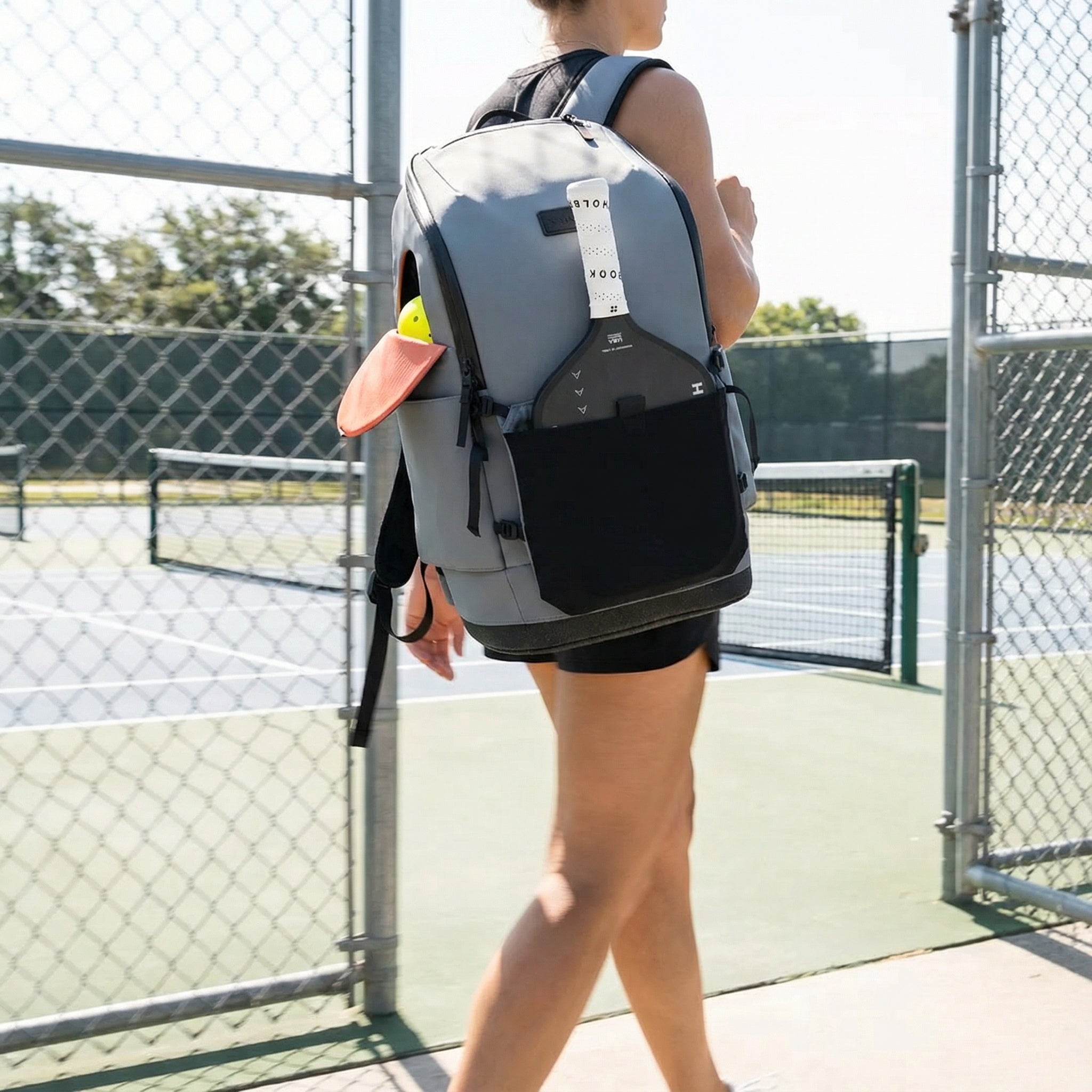
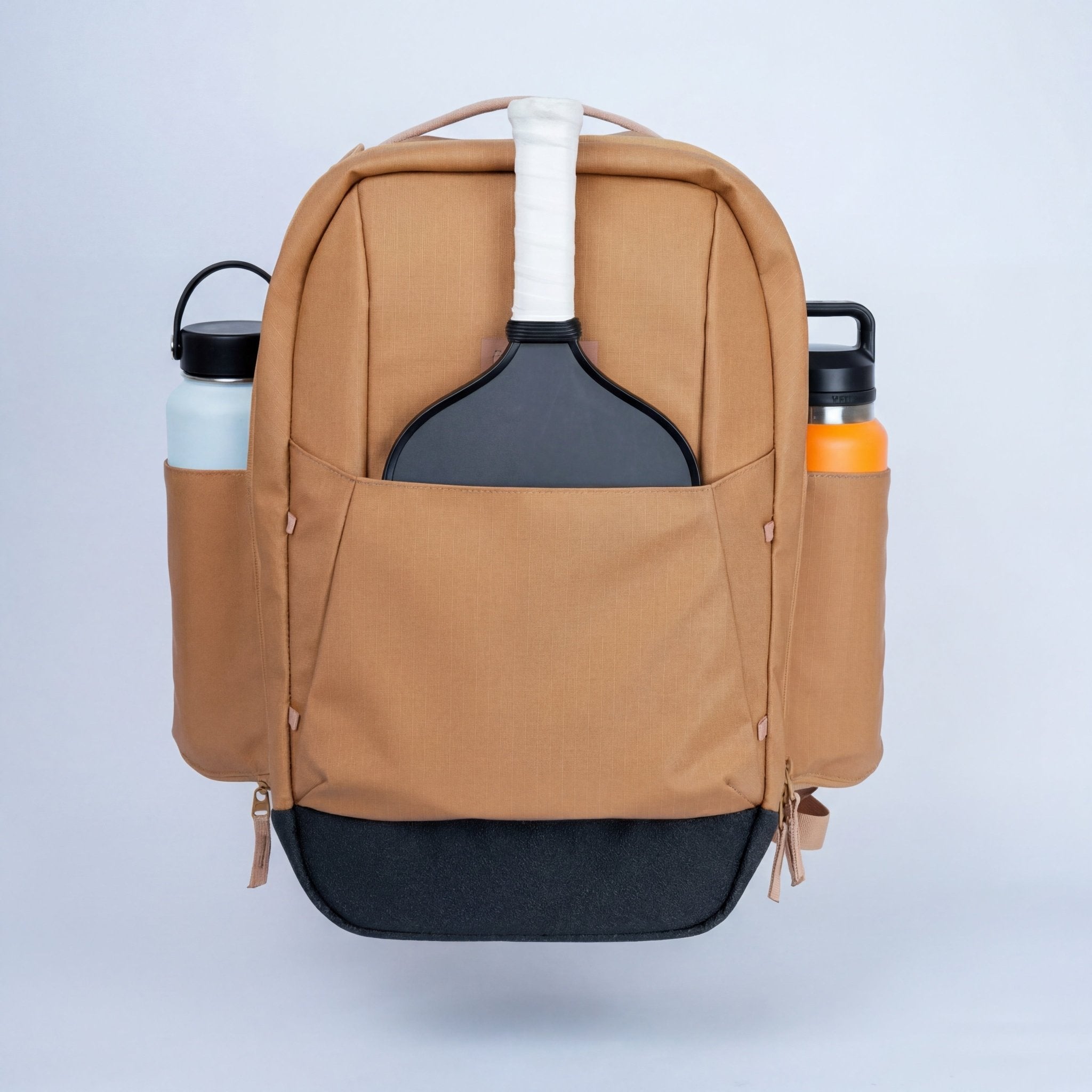
Players who invest in their technique tend to invest in their gear. If you're doing drills 3 days a week, you need a bag that makes getting to the court as frictionless as possible — not one where you're fishing for your paddle between a water bottle and a pile of random stuff.
FORWRD Court Ranger V2 — $195
Dedicated paddle sleeve, 16" laptop compartment, YKK AquaGuard zippers. Built for players who take pickleball seriously — designed with feedback from 500+ real players.

For players carrying more gear — extra paddles, a change of clothes, a laptop for post-work sessions — the Court Caddy Backpack ($325) fits up to 4 paddles in its modular sleeve and has a 15" padded laptop compartment. Both bags are featured in The Dink and The Kitchen.
Related guides: Pickleball Backhand Guide 2026 (the companion piece for your weaker side) and our Pickleball Shot Selection Strategy (when to drive, when to dink, when to reset).
Ready to carry your training gear right? Shop the Court Ranger V2 Backpack — built for players who show up 3 days a week and mean it.

Leave a comment
This site is protected by hCaptcha and the hCaptcha Privacy Policy and Terms of Service apply.