


The worst doubles point I ever played was at 10-8, third set, against a team we'd beaten twice before. Middle ball — clear seam, plenty of time. My partner and I both froze. Neither of us had agreed on who owned that shot. It landed between us for the easiest winner the other team would score all night. We lost the game, and I was annoyed at my partner (and myself) for the rest of the afternoon. We never actually talked about what happened.
That moment reveals an uncomfortable truth: most doubles teams play with half a system. They call "mine" when they remember to, expect their partner to read their mind the rest of the time, and wonder why they keep losing the close game.
This guide gives you the complete system — three essential verbal calls, a 5-signal hand system you can run in 60 seconds before your first serve, the middle-ball decision rule that ends the freeze, and the part nobody writes about: how to give your partner feedback between points without wrecking the chemistry.
If you're building the rest of your doubles foundation alongside this, start with the Pickleball Doubles Strategy guide — this is the communication companion to that one.
Last updated: October 2026
Table of Contents
- The 3 Calls Every Doubles Team Needs
- Who Takes the Middle Ball: The Decision Rule That Works Every Time
- Hand Signals Before the Serve: A Simple 5-Signal System
- How to Stack and Communicate the Switch
- Partner Feedback That Doesn't Wreck the Vibe
- Communication Drills: Practice These Before Your Next Competitive Match
- Taking This System to Tournament Play
- FAQ
The 3 Calls Every Doubles Team Needs (And When to Use Each)
Most recreational doubles teams use two calls: "mine" and "yours." They think that covers it. It doesn't.
You need three call categories — ownership calls, trust calls, and switch calls. Each serves a different function, and mixing them up costs you points in completely different ways.
Ownership calls ("mine" / "you"): The most important category. Call early — before the ball crosses the net, ideally as you read the trajectory off your opponent's paddle. A late "mine" is almost useless; by then the hesitation has already happened. Volume matters: say it loud enough to be heard over ambient court noise, not loud enough to startle your partner.
Trust calls ("bounce" / "leave it" / "out"): These are the difference-makers at 3.5 and above. "Bounce" and "leave it" both mean the same thing — don't hit it, I think it's going out. Both require your partner to trust your line-read instantly. That trust only exists if you've established these calls before the match, not mid-rally. One missed "leave it" late in a close game can cost you everything.
Switch calls ("switch" / "stay"): When the net player poaches across to take a shot, "switch" tells their partner to cover the vacated side. "Stay" means the net player is coming back — no coverage shift needed. Without these, you end up with two players defending the same half of the court and a wide-open lane on the other side.
The rule that ties all three together: short, early, loud. Two syllables maximum. The goal isn't elaborate communication — it's eliminating the half-second hesitation that costs you a step and a point.
Who Takes the Middle Ball: The Decision Rule That Works Every Time
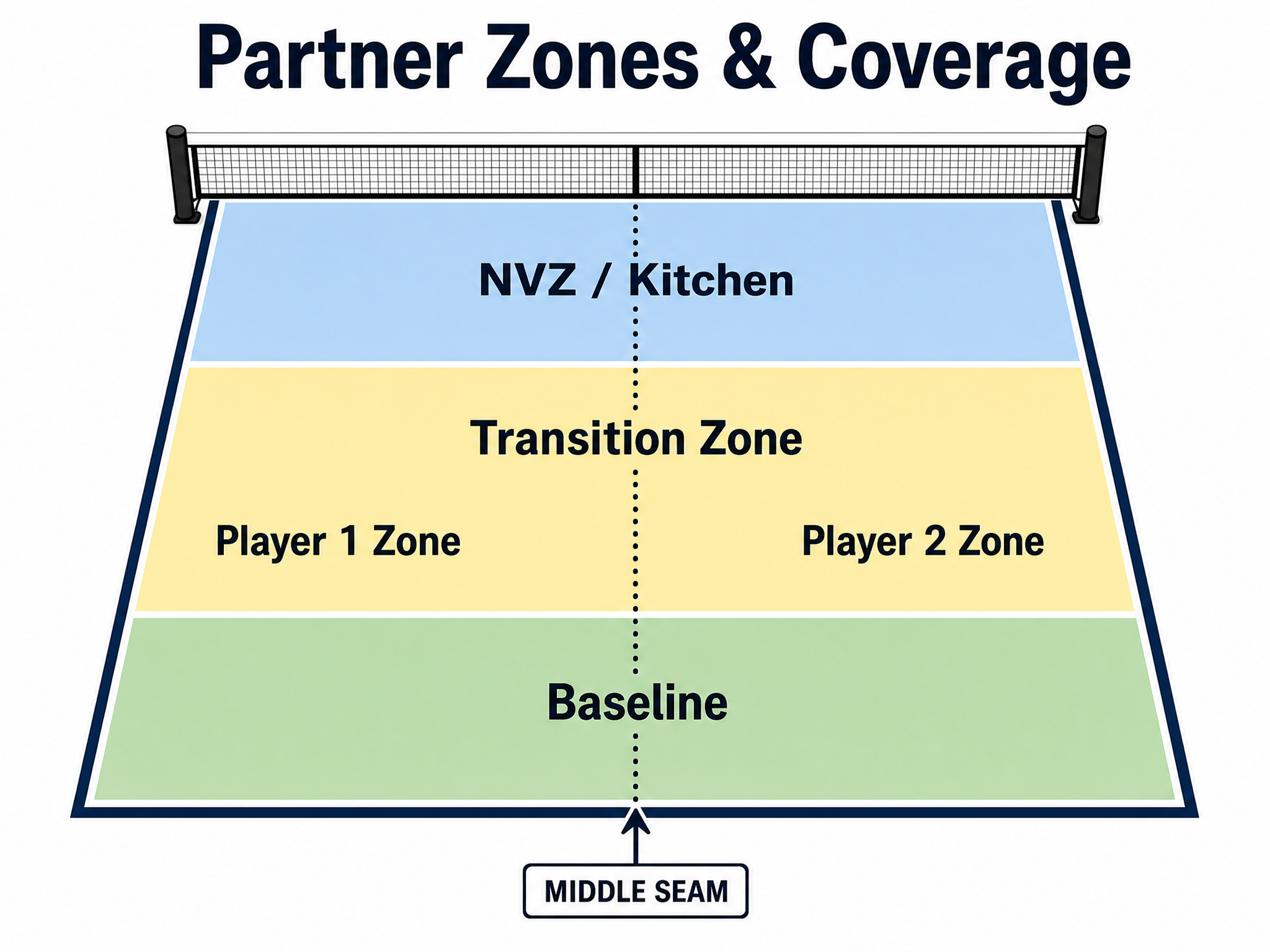
The middle ball is the single biggest source of doubles confusion at every level from 2.5 pickup games to 4.0 league play. Here's the rule that ends it:
Whoever has their forehand toward the center takes it.
In a right-right partnership, that's usually the left-court player on cross-court exchanges. In a mixed partnership — or any time one player is left-handed — work this out before point one. It's a 20-second conversation that pays dividends all season.
Three situations where the forehand rule gets complicated:
- A backhand punch is sometimes faster. At the kitchen line, a backhand block at body height can beat a partner's forehand crossover on pure reaction time. If this comes up in your partnership, a quick "I'll punch the seam backhands at the NVZ" conversation before the first serve eliminates the confusion permanently.
- The "mover" rule for stacking teams. When you're stacking, the player already moving toward center court takes middle balls — not the player recovering from the baseline. Whoever's closest to center wins the seam.
- Verbal call wins every time, regardless of position. Whoever calls first gets the ball. Train yourself to say "mine" before you consciously process your footwork. First call = ball ownership, no exceptions.
One phrase worth repeating in warm-ups: if in doubt, call it out. A call from the "wrong" player that results in a clean hit beats a silent freeze every single time.
Hand Signals Before the Serve: A Simple 5-Signal System
This is where doubles communication goes from reactive to intentional.
Before each serve, the net player flashes a signal behind their back to their partner — the server. The server sees it, confirms with a nod, and both players enter the rally with a shared plan. The whole exchange takes two seconds. Opponents see hands moving but can't read what's being communicated.
Here's the 5-signal system to start with:
| Signal | Meaning |
|---|---|
| 1 finger (pointer up) | I'm poaching — cover my vacated side after I move |
| Closed fist | Staying in position — play standard, no coverage change |
| Open palm (all 5 fingers) | I take any middle ball this rally |
| 2 fingers (peace sign) | You take any middle ball this rally |
| Thumbs up | Aggressive mode — speed up on first opportunity |
Keep these signals consistent match to match. The specific hand shapes matter less than having the conversation at all. Teams that flash signals before serves are teams that are thinking about the next point before it starts — that habit alone accounts for 2-3 extra points per match in close games.
Reference card (screenshot this):
1 finger  → I'm poaching, cover my side
Fist      → Staying put, play standard
Palm      → I own any middle ball
2 fingers → You own any middle ball
Thumbs up → Aggressive mode, attack first chance
Run through all five during your pre-match warmup — right after groundstroke practice, before the first competitive serve. Takes 60 seconds. The teams that skip this step are the ones calling "mine" at the same time on the first contested middle ball of the match.
For more on when to pull the trigger in aggressive mode, the Pickleball Shot Selection guide covers attack vs. reset vs. dink in detail.
How to Stack and Communicate the Switch
Stacking is where communication failures multiply fast. (It's 100% legal — USAPA official rules place no restriction on where players start behind the baseline or which side they play from.)
The basic setup: both players start on the same side of the court behind the baseline. The designated-side player slides into position after the serve is hit. Without clear calls, you can end up with two players chasing the same coverage zone — the exact problem stacking is supposed to prevent.
Two calls that prevent most stacking disasters:
- "I'm sliding right" (or left): The stacking player announces their direction during the server's wind-up. Short, specific, audible. Don't wait until you're already mid-slide.
- "Mine left" or "Mine right": Instead of just "mine," add the direction. It tells your partner not just that you're taking the shot, but where you're recovering from — and which half of the court needs covering.
For advanced stacking partnerships, integrate with your pre-serve signals: closed fist = play straight, open palm = stacking this point. Pick the convention that works for your team and stay consistent.
One rule covers almost everything on mid-rally switches: call "switch" the moment you poach, not after you've hit. Your partner needs to start moving as you do — not once you're already across the court. "Switch" before contact is almost always right. "Switch" after the ball is away is almost always too late.
For mixed doubles stacking logic — where you're often coordinating around a strong forehand side — Pickleball Mixed Doubles Tips covers the positioning framework in detail.
Partner Feedback That Doesn't Wreck the Vibe (What to Say Between Points)
Here's the section that doesn't show up in coaching videos: how to actually talk to your partner between points without destroying the momentum you've built.
Bad feedback: "You should have had that." "That was yours." "Why didn't you poach?" Every version of this puts your partner on the defensive. They play the next point tentative. You win the argument and lose the rally — and probably the next three along with it.
Good feedback: "Next time a ball lands in that seam, I'll call it first — that was on me." "What if you take everything down the middle for a few points and see what happens?" "That switch call was perfect, keep doing that."
"The 3.5 players I play with aren't better than 3.0 players because of their strokes. Usually it's that they stay positive with their partner after a mistake. That confidence is contagious — it compounds over a match in a way that technique alone can't." — Grub, FORWRD co-founder
Three ground rules worth agreeing on before competitive play:
- One observation per side change, maximum. Not per point. The game moves faster than your commentary can keep up with, and constant feedback creates constant second-guessing.
- Suggestions, not corrections. "I think we could..." lands differently than "you need to..." Even when the content is identical, the framing matters. One opens a conversation; the other closes it.
- Positive call-outs are free. "That leave-it call was perfect" costs zero energy and creates a decision loop that repeats good calls. Use it without restraint.
Your partner's confidence is part of your team's performance. The individual side of this — managing your own pressure at 10-8 — is covered in Pickleball Mental Game: Stay Calm, Reset Fast, and Win More Points.
Communication Drills: Practice These Before Your Next Competitive Match
Three progressions, in order of difficulty:
Drill 1: Mandatory Call (Beginner–Intermediate)
Every ball in every rally must be verbally called before contact. "Mine." "Yours." "Mine again." If a ball lands with no call, the rally stops. Start at half-court, then expand to full court. Run this for 10-15 minutes. The goal is making verbal calling automatic — so that silence in a competitive rally feels wrong, not normal. Most teams skip this drill because it feels too basic. It isn't.
Drill 2: Signal Warmup (All levels — 10 minutes before every competitive match)
Stand at the kitchen line with your partner. Net player flashes each of the five signals in sequence; server confirms each with a nod or verbal echo. Then play 3-4 short points using the signals — one poach scenario, one "both stay" point, one aggressive mode point. Ten minutes before your first competitive serve. Do this every week and the signals become reflex by your third match of the season. Teams that do this look like they're telepathic. They're not — they just had the conversation.
Drill 3: Contested Middle Ball (Intermediate–Advanced)
A feeder stands opposite and feeds balls into the seam between the two defending players. Rule: both players can't call "mine" simultaneously — whoever calls first owns the ball. If they call at the same time, the feeder wins the point. Run 15 reps. This is uncomfortable the first few times. That's by design. You want to feel the discomfort of bad communication in practice, not at 10-8 in a match that matters.
Run all three in sequence during a single dedicated practice session — roughly 30-35 minutes. One session of all three does more for your doubles communication than a full season of "figuring it out as you go."
Taking This System to Tournament Play
The doubles teams that look telepathic at tournament play aren't naturally gifted communicators — they've put in deliberate reps before competition, not during it. Everything in this guide applies directly to DUPR-rated events and serious league play, but you need to set it up in advance.
Run the Signal Warmup during your warmup period before your first round. Five minutes. Every signal confirmed. Don't assume your partner remembers the system from two weeks ago — run through it before point one, every time. The teams that skip this spend the first three games improvising. You don't have to.
One more thing that matters at tournaments: showing up organized. When you're managing match schedules, scorecards, court assignments, and gear across a full day of play, the logistics create mental noise. Keep it simple. Have your paddles accessible, water ready, and gear in a bag that doesn't require a archaeology expedition to find your towel at 10-8.
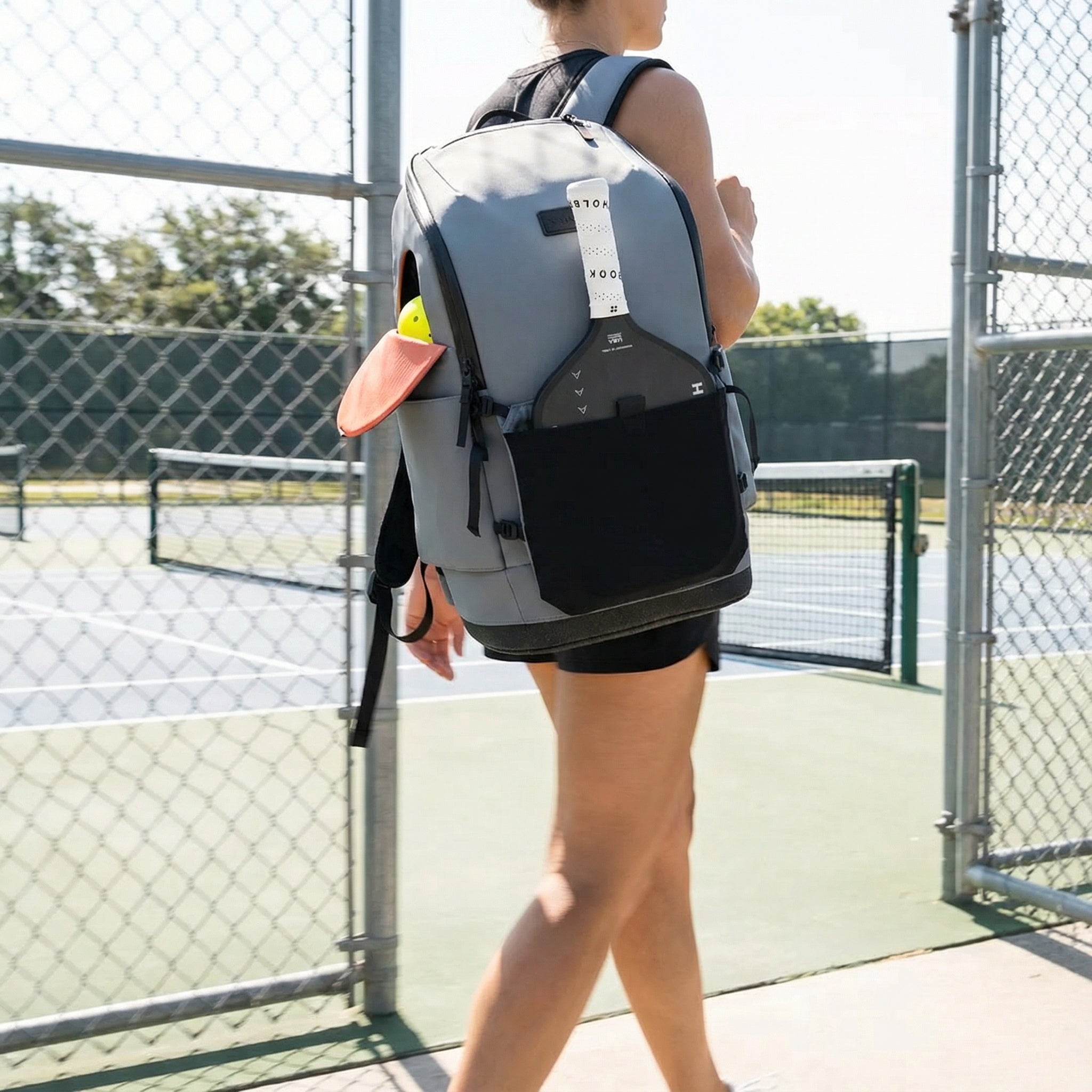
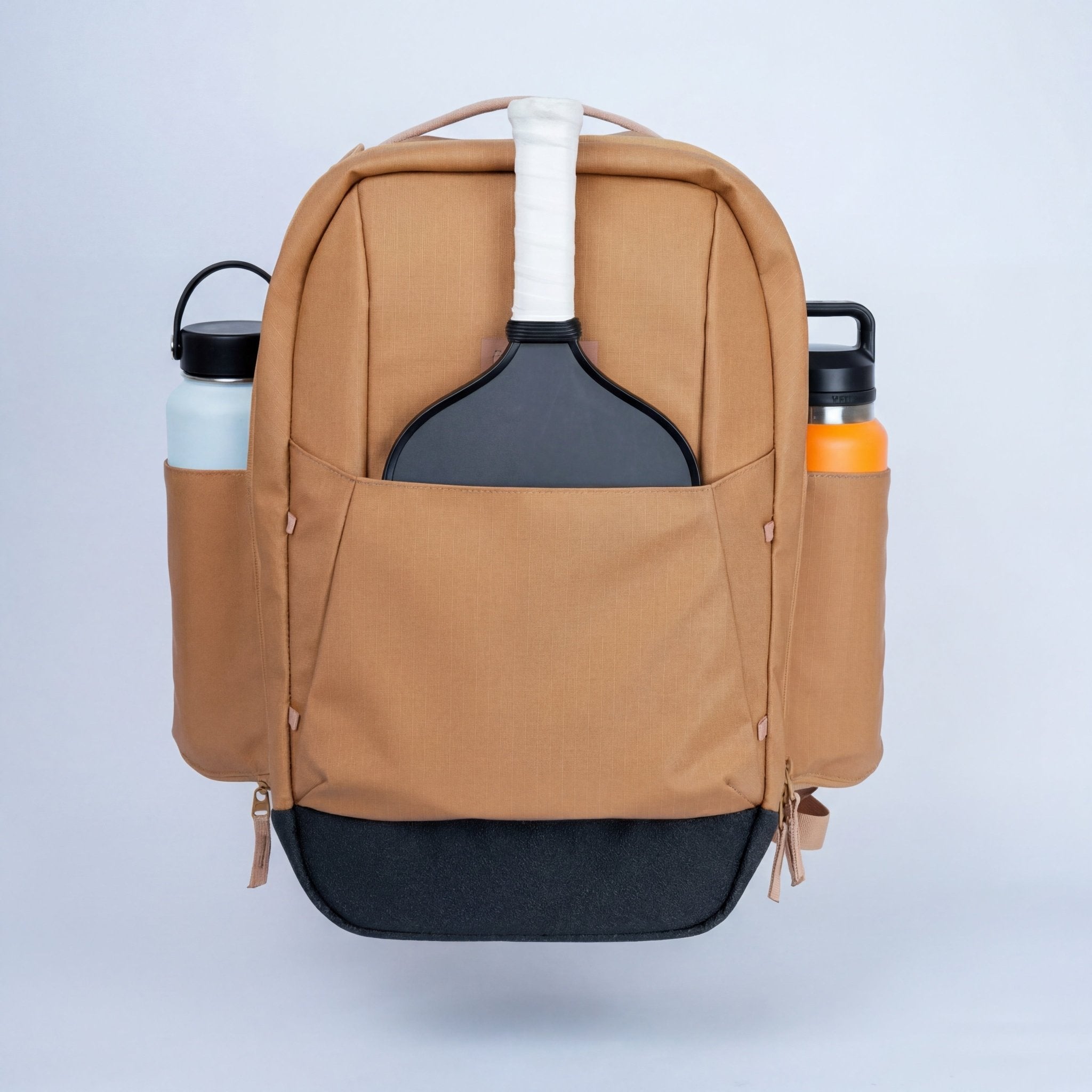
The FORWRD Court Caddy Backpack was designed specifically for this kind of play — dedicated modular paddle sleeve, separate compartments for balls and accessories, 15" padded laptop sleeve for players who go from courtside to work between rounds. Designed with 500+ real players and featured in The Dink. Small detail, but arriving organized changes your pre-match headspace.
Complete Your Setup: FORWRD Court Caddy
Modular paddle sleeve, 15" laptop compartment, YKK AquaGuard zippers. Built for players who take their game seriously — on and off the court.
FAQ: Pickleball Doubles Communication Questions
Who takes the middle ball in pickleball doubles?
Default rule: the player whose forehand faces the center takes it. For most right-right partnerships, that's the left-court player on cross-court exchanges. Pre-agree before the first point so that a verbal "mine" call becomes the tiebreaker — not the first attempt at communication between you.
What do you call in pickleball to avoid collisions?
"Mine" (I'm taking it) and "bounce" or "leave it" (don't hit it — I think it's going out) are the two most critical calls. Add "switch" when the net player crosses and "stay" when they're coming back. Four calls, consistently used, prevent the vast majority of collision situations at any level.
How do you communicate with your pickleball partner?
Two layers: verbal calls during rallies (mine, switch, leave it) and pre-serve hand signals between points. Running both systems together — verbal for reaction, signals for strategy — is what separates a functional doubles pair from a coordinated one. The signals system takes 60 seconds to run before the first serve.
What is stacking in pickleball and how do you signal it?
Stacking means both players start on the same side of the court so a specific player stays on their preferred side each rally. Signal it pre-serve with an open palm: net player's open hand means "we're stacking this point." During the rally, the stacking player calls their slide direction as the serve goes up.
How do you give feedback to your pickleball partner without ruining the game?
One observation per side change, maximum — not per point. Frame everything as a suggestion ("what if we...") not a correction ("you should have..."). Positive call-outs cost nothing and compound across a match. The goal is a partner walking into the next point feeling confident, not defensive about their last one.
What hand signals do pickleball players use?
The most common system: 1 finger = poach (cover my vacated side), closed fist = stay standard, open palm = I own the middle, 2 fingers = you own the middle, thumbs up = aggressive mode. Flash behind the back before each serve so opponents can't read it. Run through all five in warmup before the first competitive point.
What should you pack for a competitive pickleball doubles tournament?
Minimum kit for a doubles tournament day: 2-4 paddles (double-check your backup isn't cracked before you leave home), extra balls in case the venue runs short, water, grip tape for mid-match replacements, and a towel. Use a bag with separate compartments so paddles aren't scratching against keys and snack wrappers. The FORWRD Court Caddy has a dedicated modular paddle sleeve built for exactly this — paddles stay separated and protected through a full day of play.
Ready to upgrade your court setup? Shop the Court Caddy Backpack — built with 500+ real players, designed for competitive play.

Leave a comment
This site is protected by hCaptcha and the hCaptcha Privacy Policy and Terms of Service apply.