


Last updated: June 2026
Mixed doubles isn't harder than regular doubles — it's just different in ways most pairs never talk through before the first serve. The teams that consistently win mixed events aren't always the ones with two elite players. They're the ones who made four specific decisions before they walked on court: who covers the middle, who calls for poaches, what the stacking signal is, and what happens when the opponent targets the weaker partner. Get those four things settled and your results improve immediately, regardless of your rating.
This guide covers the two positioning systems, how to solve the middle ball problem for good, and the pre-match conversation that separates organized pairs from chaotic ones.
What Makes Mixed Doubles Different From Traditional Doubles
The rulebook is identical. Same serve rotation, same scoring, same kitchen rules — USA Pickleball doesn't carve out separate rules for mixed play beyond the gender pairing requirement in sanctioned events. What changes is the strategic reality of playing with a partner who almost never matches your exact skill level.
In traditional same-gender doubles, teams often have interchangeable roles. Both players cover similar zones, attack at comparable rates, and opponents rarely have a clear targeting advantage. Mixed doubles breaks that symmetry. Opponents almost always identify the weaker player early and attack that side relentlessly — it's sound strategy, not poor sportsmanship.
Here's the thing that trips up recreational mixed doubles pairs: the stronger player's instinct is to cover more court to compensate. That instinct is wrong, and it costs points. When the stronger player abandons their zone to cover the weaker player's side, they leave their own half exposed AND signal to the opponents exactly where the vulnerability is. It's a double loss — you're weaker on both sides simultaneously.
The real difference in mixed doubles isn't skill level — it's whether both players have made explicit decisions about their roles before the match starts. Teams that win aren't necessarily better players. They've just had the five-minute conversation their opponents skipped.
Court Positioning: The Two Systems and Which One Wins More Points
There are two foundational positioning systems in mixed doubles, and understanding the tradeoff between them matters more than any single shot improvement.
System 1: Split Court (Side-by-Side)
Each player owns their half of the court. Simple, low communication burden, and natural for most recreational players. The stronger player typically takes the side where their forehand covers the middle — for right-handed players, that's usually the left side of the court. Both players stay in their lane, call their own shots, and don't reach across.
Works well when: both players have similar defensive capabilities, or when you're playing with a new partner and haven't built positioning chemistry yet. The low coordination cost makes it reliable even under pressure.
The weakness is predictable: middle balls. Any shot hit down the center becomes a decision problem. Without a prior agreement, both players hesitate — or both swing — and you lose the point to ambiguity, not to the opponent's skill.
System 2: Stack and Shift
Both players start on the same side after the serve or return, then shift into coverage position as the point develops. The goal: keep the stronger player's forehand covering the center, protect the weaker player's backhand, or optimize court coverage based on who's in the better attack position.
Stacking is standard at the pro level and increasingly common at 4.0+ recreational play. It's more complex — it requires explicit pre-match agreement on how the shift works, and both players need to have practiced the movement — but the coverage advantages are real when executed correctly.
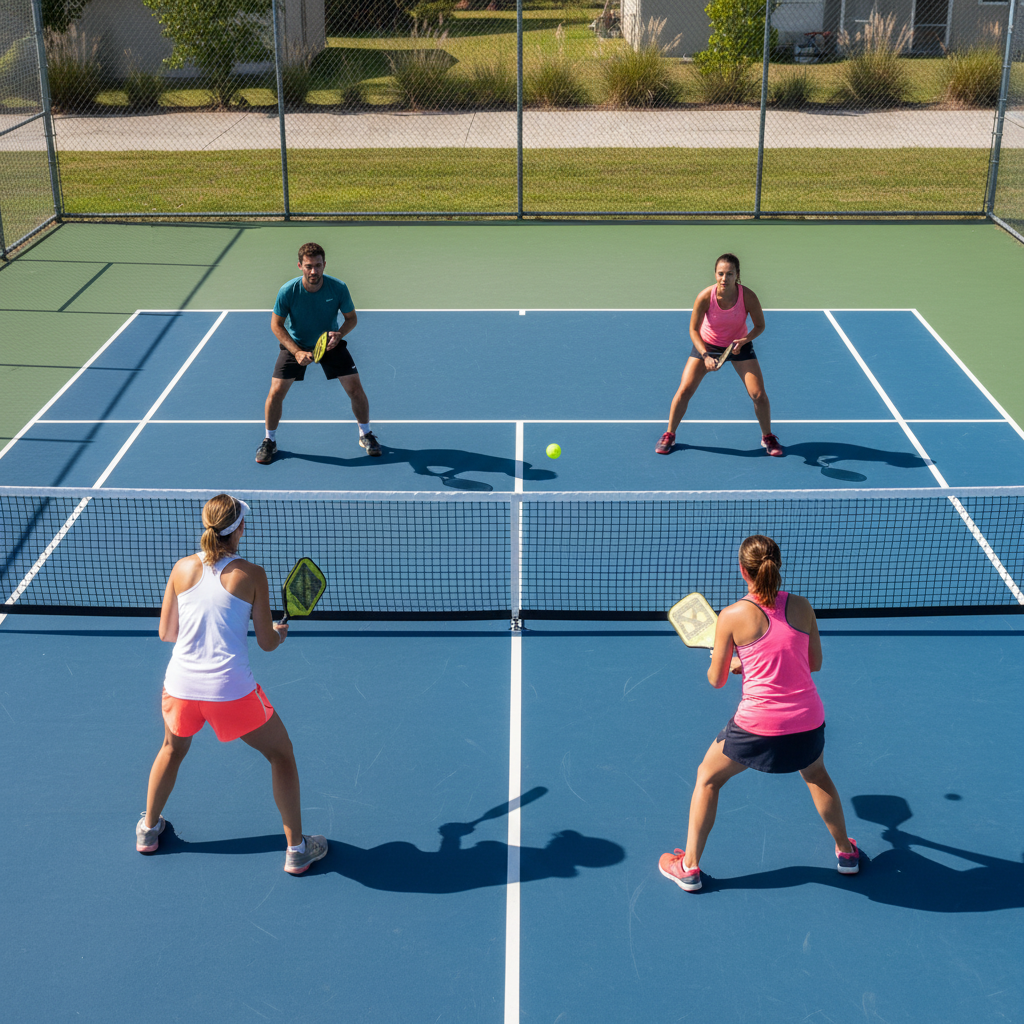
Which wins more points? At recreational levels, split court is perfectly solid if you have a clear middle ball rule. Stack-and-shift pays off meaningfully when there's a pronounced skill gap between partners — but only if both players have practiced the transition. An improperly executed stack creates more gaps than the problem it was trying to solve. Don't add complexity without drilling it first.
The Middle Ball Problem: Who Takes It and How to Decide Before the Rally
Ask any club-level mixed doubles player about their most frustrating shots. The middle ball comes up every single time. Not because it's technically hard to execute — but because it's ambiguous. Both players have a reasonable claim, both hesitate for a fraction of a second, and the ball drops. The opponents didn't win that point; you gave it away.
The solution is boring and completely effective: make the rule before you play, not during the rally.
Pick one of these three rules and commit to it before you walk onto court:
- Forehand rule: Whoever has a forehand on the middle ball takes it, no discussion.
- Stronger player rule: The stronger player takes all middle balls, period.
- Left-side player rule: The player on the left side of the court owns the middle (useful when positioning rotates frequently).
For most recreational mixed doubles pairs, the stronger player rule works best — it centralizes decisions with the player more likely to execute under pressure and protects the weaker player from difficult positioning reads mid-rally. The specific rule matters less than picking one and committing to it.
"Mixed doubles works when both players are clear on their roles. The teams that lose mixed events aren't losing because one player is weaker — they're losing because they never settled who covers the middle."
— Grub, FORWRD co-founder
The Pre-Match Roles Conversation: 4 Decisions Before Point One
This is the section most mixed doubles guides skip entirely. They tell you to "communicate" without specifying what to actually decide. Here are the four questions to answer before the first serve:
- Who covers the middle on ambiguous balls? Pick one rule from above — don't leave it open to real-time negotiation.
- Who serves first? Usually the stronger player, but decide explicitly so there's no fumbling at the start of a match.
- Who calls for poaches? Typically the stronger player initiates poaches — the other player clears the path but doesn't start unsolicited ones.
- What's the signal when the stronger player needs to shift coverage? A verbal "switch," a paddle tap, a head nod — something agreed on so coverage shifts are clean, not chaotic.
Five minutes before you step on court. Four decisions. Teams that skip this lose points before they've even served.
Serve and Return Strategy: Using Your Strengths to Control the Point
Mixed doubles serve strategy is simpler than it looks: serve deep to the weaker player's backhand whenever possible, and use the serve to set up your third shot rather than trying to win the point outright on the serve itself.
Depth is the key variable. A serve landing 3 feet from the baseline forces the returner to hit upward, which limits their return angles and makes your third shot more manageable. A short serve does the opposite — the opponent attacks downward and you're immediately on defense before you've established position.
One underused serve target: directly at the returner's hip. It's harder to handle than a clean backhand or forehand because the returner has to make a split-second read on which side to use. That hesitation produces errors at every level.
On the return side, the goal is to neutralize the server's advantage and get both partners moving toward the kitchen together. Return crosscourt to the deeper server, advance as a unit toward the NVZ, and resist the urge to slam a return winner. Points are rarely won on the return — but they're often lost there. Check our pickleball tournament strategy guide for a deeper look at how serve and return patterns compound over a full match.
Communication and Signals: How Good Partnerships Talk Without Breaking Focus
Good mixed doubles pairs are actually quiet during rallies. Not because they're ignoring each other — because they made all the big decisions before the point started and don't need to renegotiate in real time.
During rallies, the vocabulary is minimal: "Mine." "Yours." "Switch." "Back." Those four words handle 90% of in-rally communication needs. Anything more breaks focus and slows reaction time.
Between points is where the actual partnership communication happens. Walk together. Talk about what you observed. Reset your positioning intention for the next serve. Thirty seconds of deliberate communication between points compounds significantly over a 15-point game — especially in close matches where small adjustments determine the outcome.
Non-verbal signals matter more than most recreational players realize. A paddle tap behind your back for a poach signal. A quick hand signal for a stacking start position. A head nod indicating zone coverage. Develop two or three clear signals with your partner specifically for the scenarios you know will come up — particularly if you're playing in a loud environment where verbal signals get lost.
For full doubles partnership strategy including communication systems, see our pickleball doubles strategy guide.
The Five Most Common Mixed Doubles Mistakes (and the Fix)
1. The stronger player tries to cover the whole court. Instinctively understandable, strategically disastrous. When one player abandons their zone to compensate for the partner, they open angles on their own side AND telegraph the vulnerability to every observant opponent. Fix: trust your partner, play your zone, and use pre-agreed coverage shifts — not panic movement.
2. No middle ball rule. Already covered in detail above, but it's common enough to warrant emphasis here. The hesitation on middle balls is a systems failure, not a skill failure. Fix: have the conversation before you play. Two minutes of decision-making eliminates a recurring problem permanently.
3. Targeting the wrong player. This sounds counterintuitive, but recreational players sometimes avoid targeting the weaker player out of a misguided sense of sportsmanship — especially in social club play. Your opponents are not extending you the same courtesy. If the opponent pair has a clear weaker player, targeting their backhand early is correct strategy. Establish that pattern early, force the stronger player to overcompensate and break their own positioning, and you've created an advantage that compounds.
4. Failing to stack when it would clearly help. If both partners have strong forehands or there's a pronounced handedness mismatch, stacking could be worth the practice time. Most recreational pairs dismiss it because it looks complicated. It isn't — if you drill the shift movement twice in practice before playing it in a match. Fix: spend 20 minutes on stacking transitions before your next match, not during it.
5. No recovery plan after a weak return. Your weaker player gets targeted and pops the ball up. What happens next? Most teams freeze, improvise, and lose the point. Fix: decide in advance — if the weaker player gets caught by an aggressive attack, the stronger player crashes the center while the weaker player resets to the baseline. One scripted response to a high-probability scenario is more valuable than improvised creativity under pressure.
FAQ: Pickleball Mixed Doubles Questions
What are the rules for mixed doubles in pickleball?
Mixed doubles follows the same official rules as all pickleball doubles — two-bounce rule, serve rotation from even/odd sides, kitchen violations, standard scoring. In sanctioned events, teams must consist of one male and one female player. There are no additional mixed-specific rules beyond gender pairing. See the USA Pickleball official site for the complete rulebook.
Where should the stronger player stand in mixed doubles pickleball?
The stronger player typically takes the side where their forehand naturally covers the center of the court — for right-handed players, that's the left side. More importantly, they should not abandon their assigned zone to cover the weaker player's side. Position both players optimally and use pre-agreed coverage signals to shift when needed, rather than reactive panic movement that opens larger gaps.
How do you communicate with your partner in mixed doubles?
Keep in-rally communication to four words: "mine," "yours," "switch," and "back." Use between-point conversations for actual strategy — reset positioning, call out what you saw, agree on the next serve situation. Develop two or three non-verbal signals for poaches and stacking shifts before the match. The pre-match roles conversation (four decisions, five minutes) eliminates most in-rally communication needs entirely.
What is the best strategy for mixed doubles pickleball?
Establish a middle ball rule, serve deep to the weaker player's backhand, and advance together to the kitchen on every return opportunity. Use the stronger player's forehand to anchor the center. Most importantly, make all positioning and coverage decisions explicitly before the first point — not during rallies when reaction time is the priority.
How is mixed doubles different from regular doubles in pickleball?
The rules are identical. The strategic difference is that mixed doubles almost always involves a skill disparity between partners that opponents will exploit by targeting the weaker player. This requires explicit pre-match coverage decisions, a clear middle ball rule, and positioning systems that protect the weaker player without the stronger player abandoning their own zone.
Who should take the middle ball in mixed doubles pickleball?
Decide before you play — the "stronger player takes the middle" rule works well for most recreational pairs because it puts the higher-probability player on ambiguous shots. Pick any clear rule (forehand player, stronger player, left-side player) and commit to it. The specific rule matters less than consistency. Hesitation loses points; a standing rule eliminates hesitation.
For everything you need for a full tournament day, check our complete pickleball tournament guide.
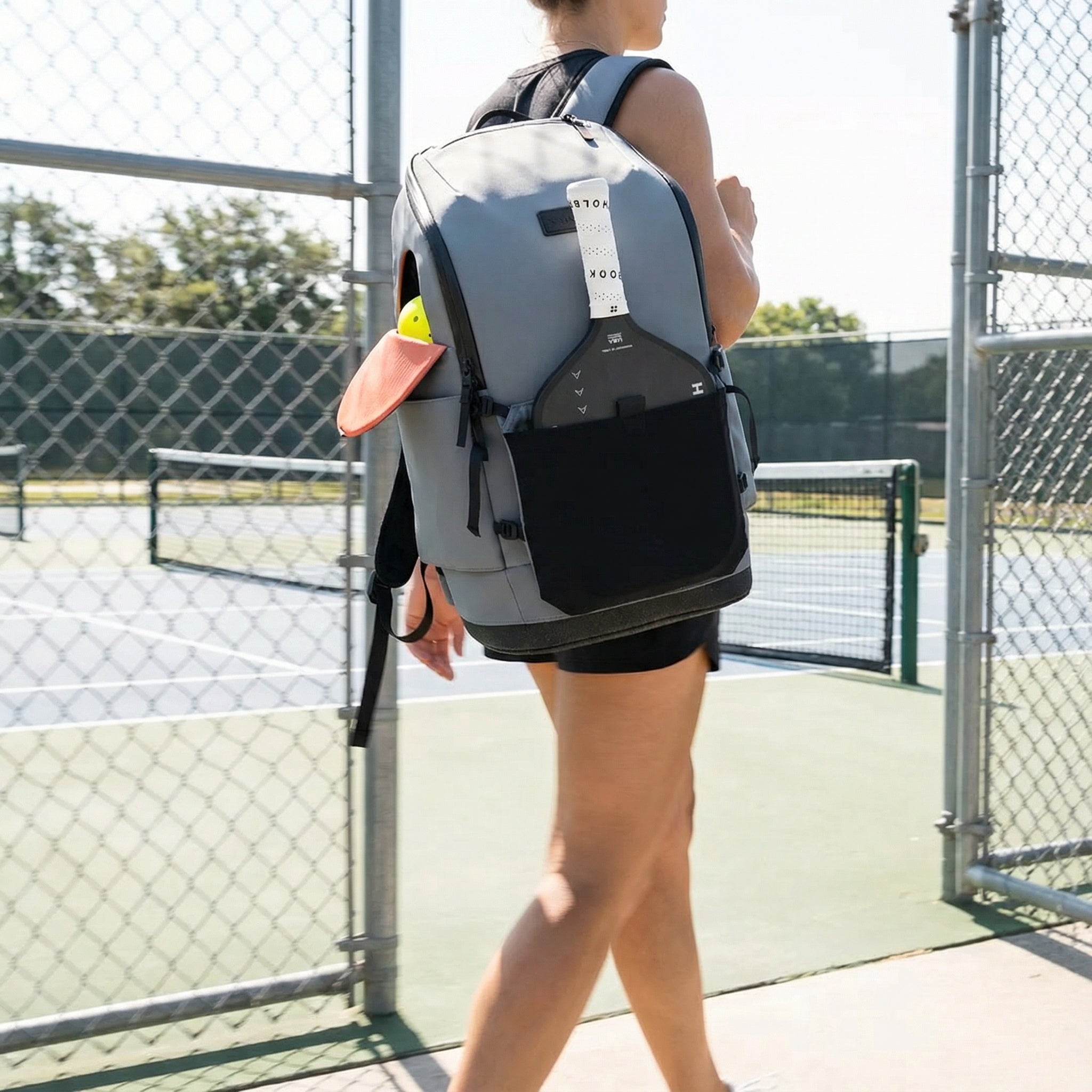
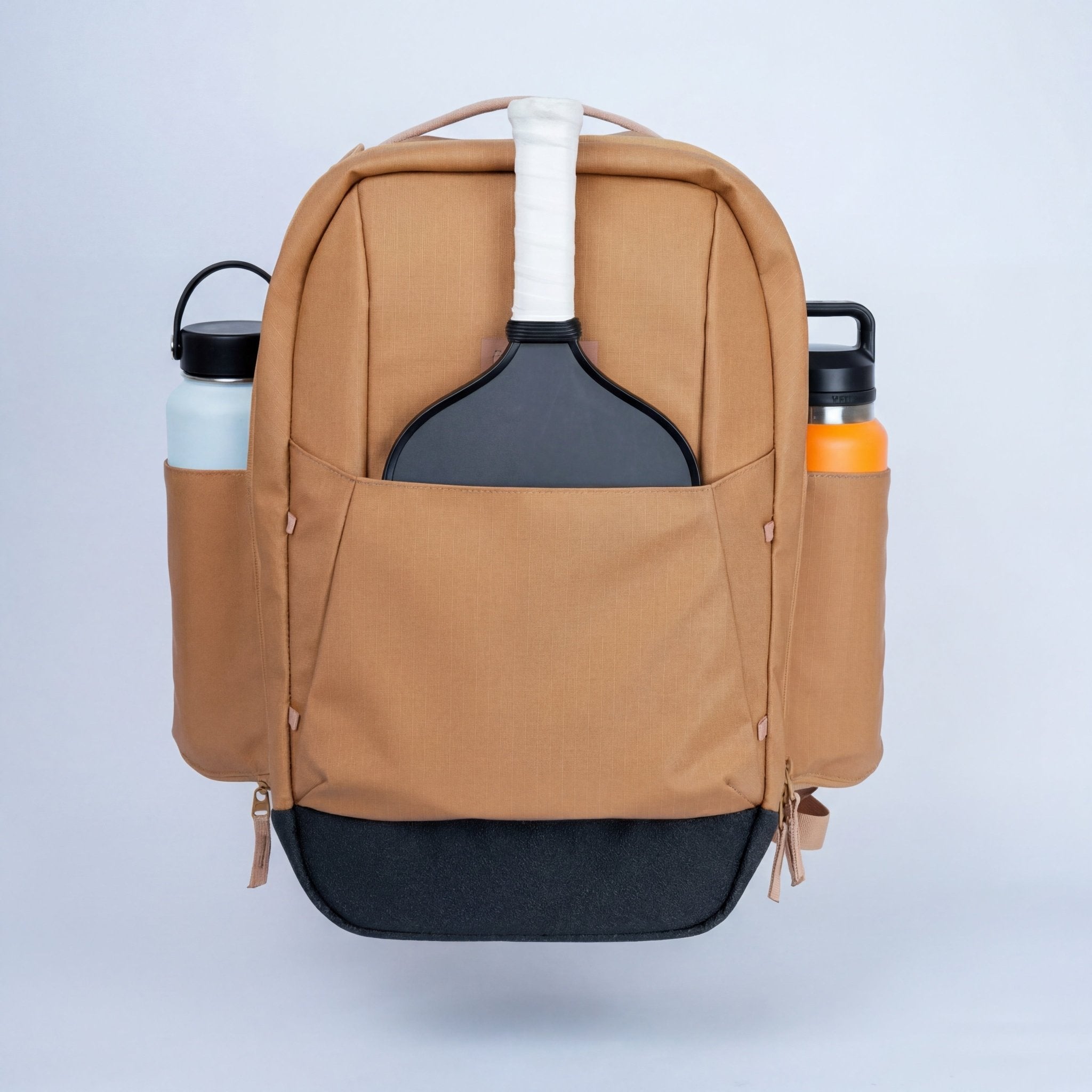
Playing a full mixed doubles tournament day means 4–6 matches, several hours on court, and a bag that needs to carry paddles, nutrition, recovery gear, and everything in between. When you're managing game plans between matches, the last thing you want is a disorganized bag.

The Court Caddy Backpack ($325) is built for exactly that kind of day — modular paddle sleeve for up to four paddles, 15" padded laptop sleeve, and YKK AquaGuard weatherproof zippers that hold up through outdoor summer tournament conditions. If you want more sleeve room for a larger laptop, the Court Ranger V2 ($195) has a 16" sleeve and the same core organization. Both designed with feedback from 500+ real players and featured in The Dink and The Kitchen. Ready to upgrade your game-day setup? Shop the Court Caddy — built to last.

Leave a comment
This site is protected by hCaptcha and the hCaptcha Privacy Policy and Terms of Service apply.