

Disclosure: This post contains affiliate links to Pickleball Central. If you purchase through our links, FORWRD earns a small commission at no extra cost to you. We only link to products we'd recommend regardless.
Quick Summary
Tournament pickleball is a fundamentally different experience than rec play — and once you've competed, you won't want to go back. This guide covers everything: getting your DUPR rating, picking the right bracket, registering on the right platform, what to pack, a 60-minute pre-match warm-up protocol, match strategy, mental game, and the major 2026 events worth chasing. Whether it's your first 3.0 round-robin or a PPA qualifier circuit event, start with the Table of Contents and jump to what you need most.
Last Updated: June 2026
Table of Contents
- Why Tournament Pickleball Is Different
- Get Your DUPR Rating First
- How to Choose the Right Tournament
- Picking the Right Skill Bracket
- How to Register: Step by Step
- Tournament Formats Explained
- Singles vs. Doubles: Which to Enter First
- How to Find a Doubles Partner
- What to Pack for Tournament Day
- The Pre-Match Warm-Up Protocol
- On-Court Strategy for Competitive Play
- The Mental Game
- Major Pickleball Tournaments in 2026
- Tournament Etiquette Every Player Must Know
Why Tournament Pickleball Is Different
You can play rec pickleball for years — and plenty of people do, happily, with no interest in competing. But if you've ever finished a match and thought I want to see how I'd do when it actually matters, that feeling is telling you something.
Tournament pickleball changes the game in three specific ways that rec play simply doesn't prepare you for.
First: no mercy games. In rec play, if someone's having an off day, you rally a little longer to be kind. In a tournament, the score resets after every game and your opponent is actively trying to expose your weakest shot. The kitchen calls are real. The serves are strategic. The person across the net isn't your Tuesday morning regular.
Second: the waiting game. You'll show up, warm up, then sit for 90 minutes before your first match. Tournament brackets run behind. Courts get tied up. You'll need to manage your energy and focus across an 8-hour day — or two days at bigger events — in ways that five 90-minute sessions at your local club don't teach you.
Third: the mirror moment. You discover exactly which shots you trust under pressure and which ones disappear. Most players find they're better at some things and worse at others than they thought. A tournament is the fastest feedback you'll ever get on your actual level.
That feedback is the whole point. Players who compete regularly improve significantly faster than those who don't. There's no substitute for real stakes — even small ones.
Here's the thing: your first tournament will probably not go the way you expect. You might win every match, you might get bounced in round one. Either way, you'll walk off the court wanting to get better in ways you didn't before. That's worth every awkward registration form and pre-match nerve spiral.
Step 1: Get Your DUPR Rating (and What the Numbers Actually Mean)
Before you register for anything, understand the rating system you'll be competing under. DUPR — Dynamic Universal Pickleball Rating — is the dominant rating system in competitive pickleball as of 2026. USA Pickleball uses it. PPA uses it. Most major app-based tournament platforms use it. You'll want a DUPR before you register for your first sanctioned tournament.
How to get a DUPR rating: Create a free account at mydupr.com. If you've played in any logged matches — rec leagues, round robins, or previous tournaments — your DUPR may already exist from match data entered by others. If you're starting from zero, you'll receive an "unverified" starting rating based on self-assessment. Play in logged matches or a sanctioned tournament to get your first verified score.
The DUPR scale runs from 2.000 to 8.000, though no amateur player has cracked 7.00. Here's a practical breakdown of what the numbers mean:
| DUPR Range | Skill Level | What It Looks Like |
|---|---|---|
| 2.0–2.9 | Beginner | Still learning rules, rallies short, high unforced errors |
| 3.0–3.4 | Intermediate beginner | Consistent serve and return, knows the kitchen, dinking inconsistently |
| 3.5–3.9 | Intermediate | Third shot drop developing, dinking reliable, some strategic intent |
| 4.0–4.4 | Competitive | Consistent at the kitchen line, attacks with purpose, reset under pressure |
| 4.5–4.9 | Advanced | Tournament-hardened, high hands in transition, stacking comfortably |
| 5.0+ | Elite amateur / pro level | Playing for prize money, coaching for income, or both |
DUPR updates your rating after every logged match — win or lose. That dynamic scoring is why it's more accurate than the old self-select systems. A player who beats a 4.2 gets more credit than one who beats a 3.1. The math is public and updated in real time.
One thing worth knowing: DUPR and the USA Pickleball skill rating system (2.5–5.0) are different scales. Many local and regional tournaments still use USAPA skill ratings. The table above maps reasonably well, but if you're unsure, enter one bracket lower than you think you belong in for your first event. Sandbagging loses matches for your partner; entering too high just means a tough day.
Read the full rating guide: Master Your Pickleball Rating →
How to Choose the Right Tournament
For your first tournament: local, one day, sanctioned. That's it. Don't chase a multi-day national open before you've played a round-robin at your community sports complex. The logistics of a bigger event — hotel, travel, 12-hour days, deeper brackets — will overwhelm whatever lessons you're trying to learn.
Where to find tournaments:
- Pickleheads (pickleheads.com) — the most comprehensive tournament finder in the US, covers both USAPA and independent events
- USA Pickleball (usapickleball.org/tournaments) — official sanctioned events, required for national rankings and golden ticket qualifying
- DUPR (mydupr.com) — find events that log DUPR scores, often recreational leagues as well as tournaments
- PlayPickleball.com — strong regional coverage, especially in growth markets
Sanctioned vs. unsanctioned: for your first tournament, it doesn't need to be USAPA-sanctioned. A local unsanctioned round-robin still teaches you everything you need. Go sanctioned when you want your DUPR updated, when you're chasing national ranking points, or when you want to qualify for Nationals.
One practical thing many first-timers overlook: read the refund/cancellation policy before you register. Some tournaments are non-refundable 2 weeks out. Others offer credits. Partner drops happen — knowing the terms matters.
See the full 2026 tournament calendar →
Picking the Right Skill Bracket
This is the most uncomfortable decision you'll make before your first tournament. And most people get it wrong in the same direction: they enter higher than they should, get crushed, and blame the format instead of the bracket selection.
The honest framework: enter at the level you consistently beat in rec play, not the level you aspire to reach. If you rec-play at 3.5 and occasionally beat 4.0s on good days, you're a 3.5. Enter 3.5. Winning in the 3.0 bracket teaches you nothing. Getting swept at 4.0 is demoralizing, expensive, and usually a one-day event.
A few bracket-specific notes:
Age-group divisions: Most tournaments offer age brackets — 35+, 50+, 60+, 65+, 70+. Playing in an age group doesn't preclude playing in an open skill division too. Many players register in both. It's double the matches, double the entry fees — and double the competitive reps.
Women's vs. mixed divisions: If you're playing doubles, you can often register in both a same-gender bracket and a mixed bracket with a partner of the other gender. Mixed doubles at tournaments tends to be a different tactical game (typically the woman at the net, the man defending from back), which is worth experiencing separately from same-gender play.
What about Pro/Elite/Senior Pro? These are labeled differently at every event, but the concept is the same: they're open-level brackets for players competing for prize money or national ranking points. If your DUPR is below 5.0, there's no reason to enter these unless you specifically want the exposure to elite players.
How to Register: Step by Step
The registration process is less confusing than it looks, but the flow varies by platform. Here's the typical sequence:
1. Create your account on the tournament platform (Pickleheads, USA Pickleball, or the host club's site). You'll need your DUPR profile linked if it's a DUPR-rated event.
2. Search for the event by date, location, and format. Filter to your skill level and age group.
3. Select your division. Doubles: you typically register individually and list your partner's name/email. They'll receive a confirmation request. If you don't have a confirmed partner yet, some events let you register as "partner needed" and get matched during the seeding process.
4. Pay entry fees. Single-day local events typically run $25–$50 per person per division. Regional events: $50–$100. National-level events (US Open, USAPA Nationals): $100–$200+. Playing two divisions doubles your cost — budget accordingly.
5. Watch for confirmation emails with bracket assignments, court schedules, and facility details. These typically arrive 3–7 days before the event. Check your spam folder — they land there more often than they should.
One thing to know: bracket sizes determine your match count. In a round-robin with 8 teams, you might play 7 matches. In a double-elimination bracket of 16 teams, you play 2 before you're eliminated — or up to 8 if you run the bracket. Ask the tournament director for expected match counts before you register.
Tournament Formats Explained: Round Robin, Double Elimination, Pool Play
Knowing which format you're playing before your first match matters more than most players realize. Each format changes your strategy, your energy management, and how much a single bad game affects your overall result.
Round Robin
Every team plays every other team in the bracket. Your finish is determined by wins, then point differential as a tiebreaker. This is the most beginner-friendly format — you're guaranteed multiple matches regardless of performance, and a single bad game won't knock you out. Downsides: it can take a long time if the bracket is large (8-team round robin = 28 total matches), and scheduling gaps between your own matches can run 60-90 minutes.
Double Elimination
Two losses and you're done. Lose once and you drop into the consolation bracket; lose again and you're out. This is the most common format at competitive and advanced brackets. It's efficient, it rewards consistency, and it gives you a second chance after one bad match. Strategically, your first match is critical — winning puts you in the winners bracket where scheduling is typically lighter.
Pool Play + Single Elimination
Larger events use this to ensure everyone plays a baseline number of matches before the elimination round. Example: 32 teams split into 4 pools of 8, play round-robin within each pool, then top 2 teams per pool advance to a 8-team single-elimination playoff. This is common at regional and national events.
The practical question you should ask before your first tournament: what format is this event using, and how many matches am I guaranteed? A good tournament director will answer this on the event page or at registration.
| Format | Best for | Guaranteed matches | Time commitment |
|---|---|---|---|
| Round Robin | Beginners, rec events | All teams play all (n-1) | Long — plan 6-8 hrs |
| Double Elimination | 3.5+ competitive | Minimum 2 | Variable: 2-8 matches |
| Pool Play + Elim | Regional+ events, 4.0+ | Pool play rounds | Usually 2 days |
Singles vs. Doubles: Which to Enter First
Start with doubles. Doubles is what most recreational pickleball looks like, it's what your skill level was likely built around, and it distributes the physical demand more evenly across a long tournament day.
Singles pickleball is brutal. You cover the entire court by yourself, every point demands explosive lateral movement, and there's no partner to fill in when you're out of position. The game is also tactically different from doubles — big serves matter more, the kitchen game matters less (relatively), and fitness becomes a primary differentiator at higher brackets. If you haven't specifically been training for singles, your doubles skills won't transfer cleanly.
That said, singles is enormously useful for developing court awareness, footwork, and self-reliance. Once you've played a few doubles tournaments and know what your game looks like under pressure, adding a singles bracket is worth the physical punishment. Many serious players compete in both.
Mixed doubles deserves its own mention. It's the most social and fastest-growing format, especially at amateur events. The tactical dynamic is distinct — positions and "poaching" rules tend to differ between mixed and same-gender doubles. For your first tournament, stick to one format and do it well. Add a second division once you know what you're doing.
How to Find (and Vet) a Doubles Partner
Your doubles partner will make or break your tournament experience far more than your own play does. A technically weaker player who communicates well and stays calm will outperform a technically superior partner who goes silent after three errors.
Here's a simple five-question framework for vetting a potential tournament partner before you commit:
- Do they have a similar preferred position? If you both want to play the right side (odd points), you'll fight for the same space at the kitchen. Ideally, one of you genuinely prefers left, one prefers right.
- How do they handle errors — yours and theirs? Watch them in rec play. Do they shake it off in two seconds or silently stew? A slow recovery after errors is a drain on your focus too.
- What's their game style? Power-and-attack players pair well with reset-and-defense players. Two attackers often break down against patient teams that wait for the error. Two defenders often lose to teams that apply sustained pressure. Complementary styles win more than mirror pairs.
- Have you played together under pressure? Social games are different from competitive games. Try a few rec sessions with explicit competitive intent — full scoring, serve-and-return discipline — before committing to a tournament together.
- Are they available for the same event and division? This sounds obvious, but schedule conflicts are the #1 reason partnerships dissolve before they start. Confirm availability before you sign up.
Where to find a partner if you don't have one: your local club or YMCA is the first stop. Most club directors know who's looking for tournament partners. Pickleheads has a partner-matching feature. Facebook groups for your regional pickleball community (search "[your city] pickleball") are active and responsive. DUPR also connects players for rated matches, which sometimes evolves into tournament partnerships.
What to Pack for Tournament Day: The Real Gear List
Every "what to bring" list for tournaments has the same problem: it tells you to pack sunscreen without telling you which gear actually matters and which gear you can leave in the car. Here's the honest version, built around a long tournament day.
The Bag
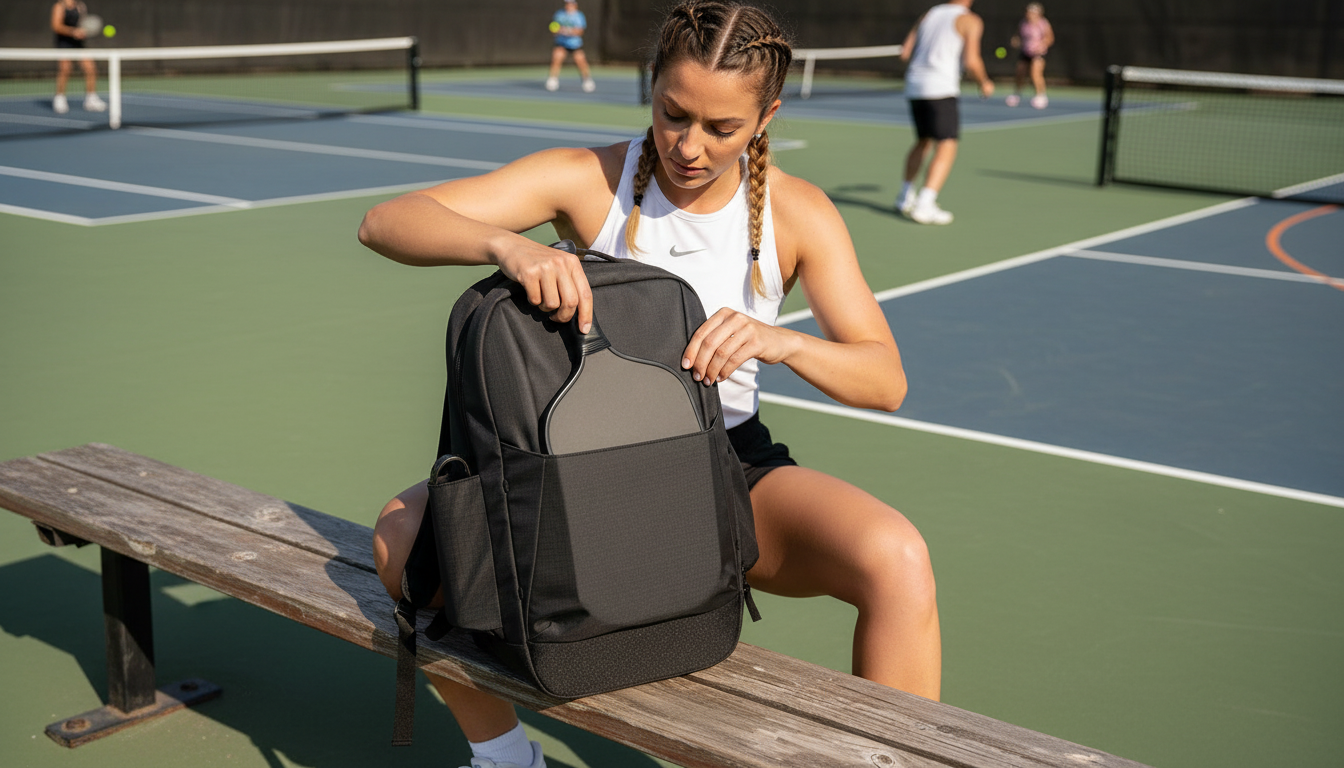
Tournament players carry more gear than recreational players, full stop. Two paddles minimum. A change of clothes if it's a multi-match day. A full hydration setup. Snacks. Weather gear. Tournament balls (your event may require you to bring approved balls, especially at smaller events). A bag that doesn't hold all of this means you're making parking lot trips between matches — which means wasted energy and missed warm-up time.

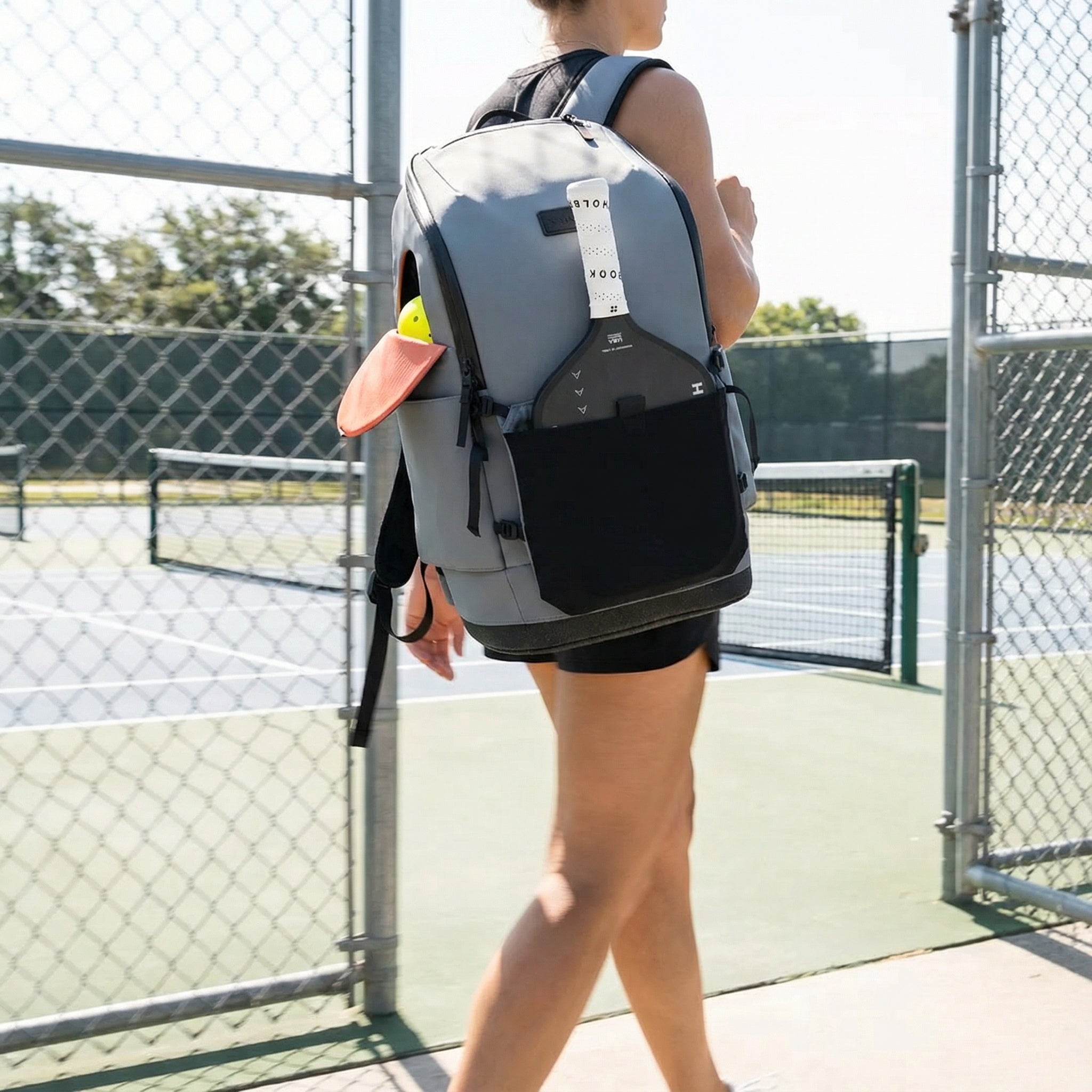
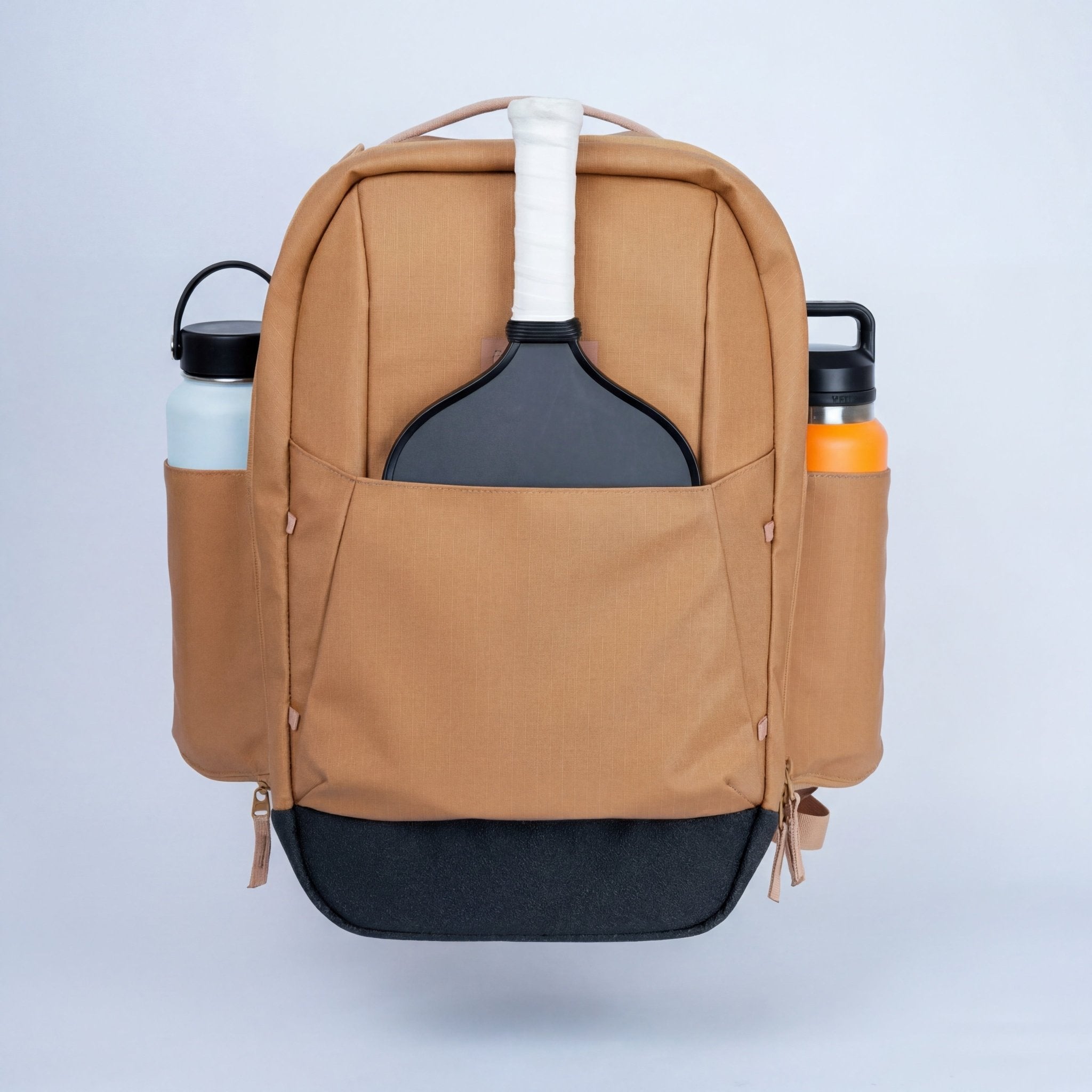
For serious tournament players — 4.0+, multi-day events, the players traveling to compete — the FORWRD Court Caddy ($325) is the bag built for this. Dedicated paddle sleeve (holds 4 paddles), 15" laptop sleeve for streaming or post-match video review, YKK AquaGuard waterproof zippers, and modular attachment system for a Shoe Cube that keeps court shoes separate from everything else. Designed with input from 500+ real players — a lot of whom play competitively. Featured in The Dink and The Kitchen specifically for the tournament-ready design.
First tournament on a tighter budget? The Court Ranger V2 ($195) holds two paddles, fits a 16" laptop, and has enough organization for a full tournament kit. It's where a lot of players start before they're ready to justify the Court Caddy investment.
Paddles
Two minimum. One match-ready paddle breaks at least once per season in tournament play — cracked faces, broken grips, handle separation. Some events replace damaged paddles during a match; most don't. Having a backup isn't optional. Your backup should be a paddle you've actually played with — pulling an unknown stick out of the bag mid-match is worse than playing with a slightly damaged familiar one.
For tournament-level play, carbon fiber paddles dominate — they offer more spin generation and punch than composite or graphite at the competitive price range. The CRBN 1 ($179.99) and CRBN-1 X-Series ($169.99) are consistently in tournament bags at the 4.0+ level.
Tournament Balls
Outdoor tournament balls play significantly differently than indoor or practice balls — harder surface, tighter bounce, faster pace. The two most common balls at sanctioned outdoor events are the Franklin X-40 and the Dura Fast-40. Know which ball your tournament is using before you show up — practice with that ball in the days leading up to the event. The difference in pace and spin behavior is real enough to affect your return game.
Court Shoes (Non-Negotiable)
Running shoes on a pickleball court are a liability, especially in long lateral rallies on hard courts. Court shoes — tennis or pickleball-specific — have lateral support that running shoes don't. At a tournament, where you might play 8+ matches, the difference between court shoes and running shoes isn't just comfort, it's injury prevention. Look at K-Swiss, ASICS, or HEAD for a starting point: K-Swiss Express Light ($115) are a solid mid-range option that a lot of competitive recreational players use.
The Rest of the Kit
Bring a change of athletic clothes — you'll sweat more in one tournament than a week of rec play. Electrolyte drinks (not just water — sodium depletion is real on long hot days). A small cooler bag with 2-3 high-carb snacks (banana, trail mix, energy bar) for between matches. Sunscreen. Hat or visor for outdoor events. A sharpie to mark your balls so you know which ones are yours on the court.
See the complete gear checklist with exact products →
The Pre-Match Warm-Up Protocol: 60 Minutes Out to First Serve
This is the section nobody covers — and it's the one that separates prepared players from players who hit their best shots in the warm-up and their worst in game one.
The goal of a tournament warm-up isn't to feel good. It's to arrive at first serve with your body activated, your shots calibrated to the specific conditions of this court on this day, and your mind focused on the process ahead instead of the result.
Here's a 60-minute protocol that works:
T-minus 60 to 45 minutes: Physical activation. Dynamic stretching, not static. Hip circles, leg swings, lateral shuffles, wrist rotation. 5 minutes of light jogging around the facility perimeter if space allows. Get your heart rate above resting. The biggest mistake first-timers make is starting cold — stiff lateral movements and slow reaction times in the first two games are almost always a warm-up failure, not a skill problem.
T-minus 45 to 30 minutes: Ball feed or cooperative rallying. If you have a partner, soft cooperative rallying — not competition mode. The goal here isn't winning exchanges, it's calibrating the ball. How is it bouncing on this surface? Is it playing faster or slower than you expected? What's the wind doing to your serve? Get your strokes loosened up with low-pressure exchanges: groundstrokes, cross-court dinks, a few soft resets from the transition zone.
T-minus 30 to 15 minutes: Kitchen game and thirds. Move to the kitchen line and spend 15 minutes exclusively on the shots that win matches. Extended dink rallies (50 in a row is a good benchmark — if you can't get there, your dink consistency is the issue to address before your first match). Third-shot drops: a few from each side of the court, landing in the kitchen. Lob defense. Reset from the feet. These are the shots that disappear under pressure. Practice them until they feel comfortable.
T-minus 15 to 0 minutes: Serve, return, and visualization. Hit 10 serves from each side. Hit 10 returns from each side. Then stop. Walk away from the court, drink some water, and spend 2-3 minutes with your eyes closed visualizing your first three points — not the score, just the movement. Where are you on the court after the serve? After the return? What does your partner do when you're pulled wide? Mental rehearsal for specific scenarios (not generic "play well" thoughts) measurably improves first-match performance.
One more thing: if you get to warm-up and your third shot drop is completely offline, don't panic and start experimenting. That's how you arrive at first serve having confused yourself with 12 different grip adjustments. Stay with your most reliable shot pattern and adjust after the first match when you know how the courts are actually playing.
On-Court Tournament Strategy: How to Win Matches
The biggest tactical error in amateur tournament play: players try to win by hitting winners instead of forcing errors. Against players at the same level or above, that's a losing strategy 80% of the time. Here's what actually works.
Scout during warm-up. When you're at the kitchen for cooperative warm-up, you're getting free data. Watch how your opponent moves laterally — are they slow left or slow right? Do they drop their paddle head on backhand side? Do they attack from both wings or only one? Opponents won't tell you their weaknesses, but they'll show you. File it.
Control the kitchen first, win matches second. At every skill level below 5.0, the team that wins the kitchen line dinking battle wins the majority of matches. This isn't a style preference — it's what the data from tournament results shows consistently. Your first tactical priority should always be getting to the kitchen line and staying there. Most points don't end in spectacular speed-up attacks; they end when one team is pulled out of position, creates a floating ball, and the other team attacks it.
Exploit the weaker side systematically. If you've identified that your opponent's backhand isn't as reliable, feed it early and often — not just when the score is close. Build a pattern. Opponents adjust, but patterns established early in a match are hard to fully shake by game's end.
Serve-and-return discipline is table stakes. Every double fault is a free point to your opponent. Every weak return that sits up in the air is a reset problem. Tournament players don't think of the serve as offense — they think of it as a guaranteed neutral start. Depth on serve, depth on return, then compete from there.
Communicate with your partner between points. "Mine" on overhead. "Switch" when you've crossed. "Yours" when the ball is clearly on their side and you're not sure they've tracked it. This sounds obvious, but 40% of points lost to confusion in doubles come from communication breakdowns, not shot failures. Develop a between-point ritual with your partner — bump paddles, say one-word feedback, reset.
Go deeper: The Complete Pickleball Strategy & Tactics Guide →
The Mental Game: Competing Without Choking
"The hardest adjustment for rec players going to tournaments is trusting their game when they can feel the stakes. The players who improve fastest are the ones who compete before they feel ready." — Topher, FORWRD co-founder
Tournament nerves hit everyone. The difference between players who perform and players who choke is not the presence of nerves — it's what they do with them.
A few tactics that work:
Focus on process metrics, not score. "Get the ball in the kitchen on my next third shot" is a process goal. "Win this game" is an outcome goal. When you're nervous, outcome focus amplifies pressure; process focus gives your brain a specific task to execute. The score takes care of itself when you're executing the right processes.
Reset between every point. Develop a physical ritual — bouncing the ball twice before serving, spinning your paddle once, something proprioceptive. It signals to your nervous system that the last point is over and this point hasn't started yet. Sounds like sports psychology fluff until the first time it keeps you from steam-rolling into the next serve after a bad call.
Down 5-10 in a game? Change something small, not everything. Players who are down big tend to start gambling — going for more pace, attacking balls they'd normally reset, abandoning their third shot game. This rarely works. A better response: change one specific thing (serve location, return depth, starting position) while keeping everything else the same. Give the change 5 points to show results before changing something else.
Bad line calls happen. Your reaction is the only thing you control. If you genuinely think a call was wrong, you can ask to have it reviewed (and in sanctioned events with referees, you can appeal). What you can't do is let it consume your next three points. The players who recover fastest from bad calls are the ones who've decided in advance that bad calls are part of the game, not a personal attack.
First-tournament reality check: you'll probably play worse in your tournament matches than you do in rec play, at least the first few times. That's not failure — it's your body and brain adapting to a new competitive context. The adaptation happens fast. Your second tournament will feel different. Your fifth will feel almost normal.
Major Pickleball Tournaments in 2026: The Events Worth Tracking
The 2026 calendar is the deepest in pickleball's history. Whether you're watching pro play for strategy education or chasing your own qualifying path, here's where the competitive calendar sits:
US Open Pickleball Championships — The most recognized amateur and pro event in the country, held annually in Naples, FL. The 2026 edition ran April 11–18. More divisions than any other event, the strongest amateur fields, and the best place to play alongside and watch pro players. If you're going to one national event, this is it.
Major League Pickleball (MLP) — The team-based pro league runs May through August, with regular season events and a full playoff structure. Nine regular season events in 2026 plus the Mid-Season Tournament and an expanded Playoffs in late summer. MLP is great to watch for tactical education — the team format creates match situations you don't see in individual events.
PPA and APP Tours — The two main individual pro tours run events year-round across the country. APP events tend to be more accessible for serious amateurs — many include amateur brackets alongside the pro draws. PPA events focus exclusively on top professional players. The distinction matters if you're thinking about eventually chasing a pro ranking.
USAPA Nationals — Held in November, the Nationals require qualification through golden-ticket events. Win gold in a qualifying USAPA-sanctioned tournament, and you earn pre-registration for Nationals. This is the competitive aspirational ladder for amateur players in the US. The bracket is competitive and the organizational experience is polished.
Minor League Pickleball (MiLP) — The amateur-to-pro development pathway, structured with drafts and team competition at the regional level. Worth following if you're 4.5+ and interested in the team-competition format without the pro skill requirement.
Full 2026 tournament schedule and event finder →
Tournament Etiquette: The Unwritten Rules Every Competitor Must Know
Tournament etiquette matters more than rec etiquette because there are consequences — games can be forfeited, players can be penalized by officials, and poor conduct follows you within a community that's smaller than it looks.
Line calls are honor-based — call what's on your side. You make calls only on your side of the court. Your opponent makes calls on theirs. If a ball is out on your side and you call it in, that's a fault on you. If a ball clips the line, it's in. If you're genuinely unsure and can't call it out cleanly, the ball is in. The "benefit of the doubt goes to the receiver" rule exists because an uncertain "out" call that's wrong is a gift point, not a judgment call.
Announce the score before every serve — out loud, both numbers. Server score first, receiver score second. In singles: "3-2, 2nd serve." In doubles: "3-2-2." This isn't optional courtesy; it's a rule. Missing it is a fault in sanctioned play.
No coaching from the sidelines during play. Coaches and partners watching from outside the court cannot communicate strategy to players between or during points in most tournament formats. In team events (MLP-style), there are specific coaching timeout protocols. Know the rules for your specific event.
Mark your tournament balls. In many events, players bring their own balls and supply the balls for points they serve. If your ball leaves the court and mixes with another court's balls, you need to identify yours. Use a sharpie with a consistent mark before the tournament starts.
Don't distract adjacent courts. Running to retrieve an out-of-play ball through an adjacent court mid-point is disruptive. Wait for a stoppage if possible. If you must retrieve, move quickly and quietly.
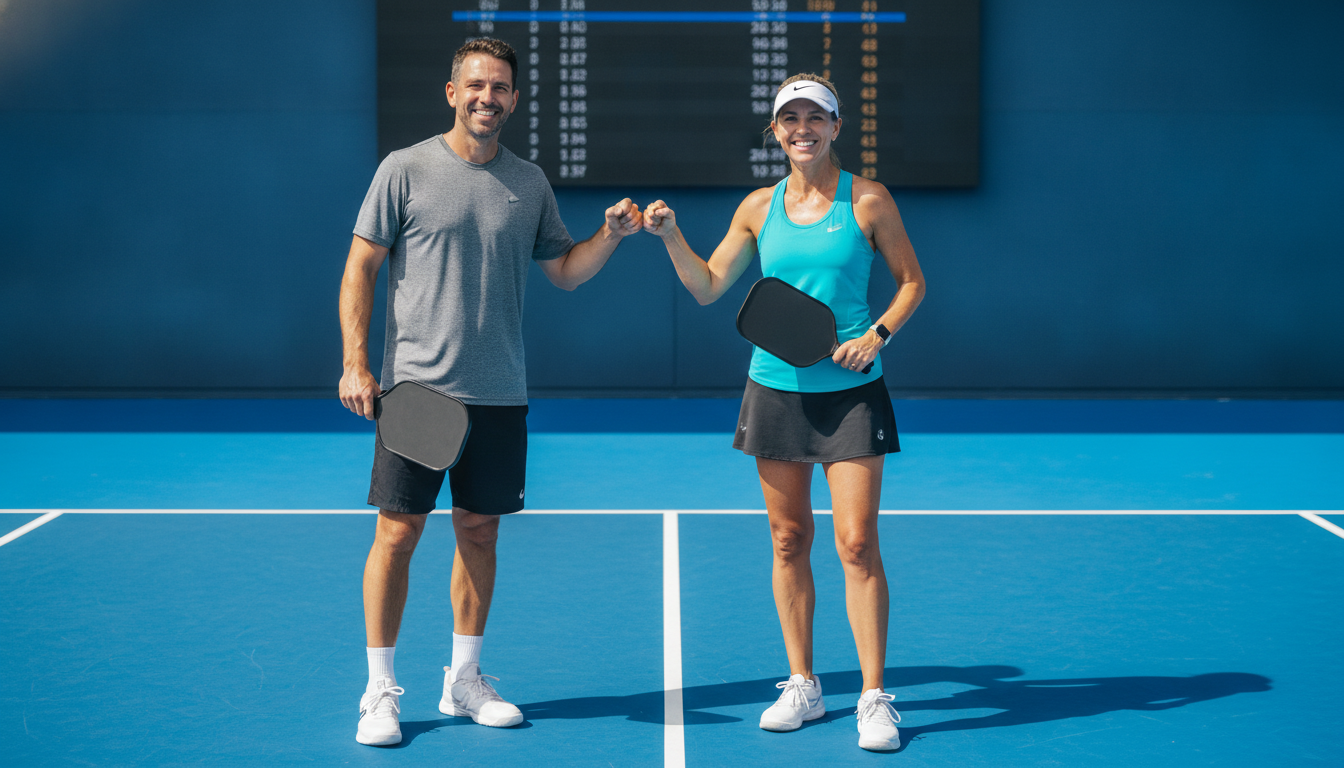
Paddle tapping is the universal post-match gesture. Touch paddles — not hands — at the net after each match with both opponents and your partner. It's the closest thing to a handshake in pickleball culture, and skipping it reads poorly. Do it after wins and losses, even when the match was frustrating.
After the Tournament: Rate, Review, Improve
The most underused part of tournament play is the debrief.
Within 24 hours of your last match — while the specifics are still fresh — write down three things: the shot or situation that cost you the most points, the moment you felt most in control, and the specific game pattern your opponents used most effectively against you. Not a vague "I need to work on my dinking." A specific note: "I gave up six errors in a row trying to speed up the rally when they'd established dinking control — need to reset earlier before attacking."
That specificity is what separates players who steadily improve from players who plateau. Your DUPR will reflect the aggregate result. Your notebook should reflect why.
For your next tournament, target one thing to improve based on that debrief. One thing — not six. Pick the highest-leverage gap and drill it specifically before the next event. Players who cycle through tournament → debrief → targeted practice → tournament improve their DUPR rating twice as fast as players who just play more.
And register for the next tournament before the competitive feeling fades. That 48-hour window after a tournament is when you're most motivated to improve. Use it.
The Tournament Bag for Serious Players: FORWRD Court Caddy
Two-paddle sleeve, 15" laptop compartment, YKK AquaGuard zippers, modular Shoe Cube attachment — designed to hold everything a tournament player needs, all day. Used by players at every level from club tournaments to PPA qualifiers.
Frequently Asked Questions
Do I need a DUPR rating to enter a pickleball tournament?
Not always, but it depends on the event. Many local and regional tournaments use USAPA skill ratings (2.5–5.0) rather than DUPR, and you self-select your bracket. USA Pickleball–sanctioned events and most app-based platforms (Pickleheads, DUPR) will ask for or require a verified DUPR rating. If you don't have one yet, register for a DUPR account and create an unverified starter rating. Your verified score develops as you log matches.
What skill level should I enter for my first tournament?
Enter one bracket level lower than where you consistently play in recreational pickleball. If you regularly beat 3.5-level players in rec play, enter the 3.0 division for your first tournament. You want competitive matches, not blowouts in either direction. Your first tournament goal should be experiencing the format, not winning the gold medal.
How much does it cost to enter a pickleball tournament?
Entry fees vary significantly by event scale. Local 1-day events typically cost $25–$50 per person per division. Regional events run $50–$100. Major national events like the US Open or USAPA Nationals range from $100–$200+ per division. If you're registering in multiple divisions (open + age group, or singles + doubles), multiply accordingly. Travel and lodging are separate for away events.
What is the difference between a USAPA-sanctioned tournament and an unsanctioned one?
USAPA-sanctioned events follow official USA Pickleball rules, use certified referees, and count toward national rankings and golden-ticket qualification for Nationals. Unsanctioned events are typically local or club-run, may use modified rules or formats, and don't affect national ranking. For first-time competitors, unsanctioned events are perfectly valid and often less stressful. Go sanctioned when national ranking and Nationals qualification matter to you.
Can I compete in a tournament without a partner?
Yes. Many tournaments offer "partner needed" registration, where the tournament director matches you with another solo registrant at a similar skill level. The quality of the matching varies — sometimes you get a great partner you'll use again, sometimes it's a complete mismatch. If possible, enter with a known partner for your first few events so you can build on an established foundation instead of navigating both the tournament and a stranger relationship simultaneously.
What's the difference between round robin and double elimination formats?
Round robin means every team plays every other team in the bracket — you're guaranteed multiple matches. Final placement is based on win-loss record, then point differential. Double elimination means you can lose one match and stay in the competition (dropping to a consolation bracket); lose twice and you're out. For first-timers, round robin is more forgiving because a single bad match doesn't define your result. Double elimination is more common at competitive brackets (3.5+).
How do I qualify for USAPA Nationals?
To compete at USAPA Nationals, you must earn a "golden ticket" by winning gold in an eligible skill division at a USAPA-sanctioned tournament. Golden-ticket events are designated on the USA Pickleball tournament calendar. Once you win gold, you receive exclusive early registration for Nationals in your division before it opens to the general qualified pool. Nationals typically takes place in November.
Should I use the same paddle I use in rec play for tournaments?
Yes — and bring a backup of the same or similar paddle. Tournament situations are not the time for new equipment. If you're thinking about switching paddles, do it at least 3 weeks before a tournament so you've had genuine practice time with the new stick. Your tournament paddle should be the one you've played hundreds of hours with. Consistency under pressure beats novelty every time.
Related Articles — The Full Pickleball Tournament Cluster
- Pickleball Tournament Gear Guide: Everything to Pack in 2026
- Summer Tournament Gear 2026: The Full Checklist for Outdoor Play
- What to Bring to a Pickleball Tournament: The 2026 Checklist
- Best Pickleball Bags for Tournament Players: 2026 Guide
- Best Pickleball Tournament Bag 2026: Court-Tested Picks
- FORWRD Court Ranger V2 Review: Tested for Tournament Play
- Master Your Pickleball Rating: Skill Levels and Progression Guide
- Top Pickleball Tournaments in 2026: How to Find, Register, and Compete
- How to Organize a Pickleball Tournament
- Pickleball Packing List 2026: Everything You Need for Tournaments and Rec Play
- JOOLA Heleus Pickleballs Review: The Tournament Ball Worth the Price Debate
- The Complete Pickleball Strategy & Tactics Guide (2026)
- Pickleball for Beginners: The Complete Guide

Leave a comment
This site is protected by hCaptcha and the hCaptcha Privacy Policy and Terms of Service apply.