

Disclosure: This post contains affiliate links to Pickleball Central. If you purchase through our links, FORWRD earns a small commission at no extra cost to you. We only link to products we'd recommend regardless.
What is pickleball for beginners? Pickleball is a paddle sport combining elements of tennis, badminton, and ping-pong, played on a 20×44-foot court with a 34-inch-high net at center. Two or four players use solid paddles to rally a perforated plastic ball, scoring points only while serving, with games played to 11 (win by 2). The defining rule is the kitchen: a 7-foot non-volley zone on each side of the net where volleying is prohibited.
Last Updated: June 2026
Key Facts: Pickleball for Beginners
- Court size: 20 feet wide × 44 feet long — the same footprint as a doubles badminton court, or roughly one-fourth of a tennis court.
- Net height: 36 inches at the sidelines, 34 inches at the center post.
- The kitchen: A 7-foot non-volley zone on each side of the net. Volleying from inside the kitchen (or while your momentum carries you in) is a fault.
- Scoring: Side-out scoring only — you score points only when your team is serving. Games are typically played to 11, win by 2. Tournament formats may use 15 or 21.
- Serve rule: The serve must be hit underhand, with the paddle head below the wrist at contact, aimed diagonally cross-court into the opposite service box.
- Two-bounce rule: After the serve, both sides must let the ball bounce once before volleying. This prevents net-rushing and forces longer rallies.
- Cost to start: $40–$90 for a decent beginner paddle, $10–$15 for balls, $70–$130 for court shoes. Total: under $200 to get properly equipped.
- Fastest-growing sport in America: USA Pickleball reported 13.6 million players as of 2025, up from 4.8 million in 2021 — nearly tripling in four years.
What Is Pickleball?
Pickleball was invented in 1965 on Bainbridge Island, Washington, by three dads — Joel Pritchard, Bill Bell, and Barney McCallum — who were trying to keep their kids entertained with whatever equipment they had: ping-pong paddles, a perforated plastic ball, and a badminton court with its net lowered. The rules they cobbled together that afternoon have barely changed.
What makes pickleball uniquely addictive is how quickly you go from complete beginner to "actually fun to play." The basic rules take about 15 minutes to learn. Within a few sessions you're having real rallies. The learning curve isn't steep — it's friendly enough that grandparents and grandkids can play against each other competitively, which is exactly why the sport has grown from 4.8 million U.S. players in 2021 to 13.6 million by 2025.
The sport combines the lateral movement and net play of tennis, the quick wrist game of ping-pong, and the smaller court footprint of badminton. The result is a sport that's easier on the body than tennis (shorter court, less running), more social than golf (four players on a court the size of a parking space), and far more strategic than it looks from the outside.
The perforated plastic ball — similar to a wiffle ball but heavier and stiffer — travels slower than a tennis ball, which gives players more time to react. That slower pace is deceptive: at higher levels, pickleball involves rapid-fire exchanges at the net (called "dinking") and fast attacking "speed-up" shots that require split-second reflexes.
One thing nobody warns beginners about: once you start, it's hard to stop. The community is aggressively welcoming. Show up at an open play session and strangers will teach you, play with you, and invite you back. That social engine is a big part of why this sport is taking over park rec centers, country clubs, and tennis courts from coast to coast.
Read the full no-fluff play guide →
The Court: Dimensions, Zones, and Lines
Understanding the court is step one. The good news: it's simple.
Overall dimensions: 20 feet wide × 44 feet long. If you've played badminton, you already know the footprint. For tennis players: the pickleball court is roughly one-quarter the area of a standard singles tennis court.
The net: 36 inches high at the sidelines, 34 inches at the center. That 2-inch sag in the middle matters — most shots are aimed toward the center of the net where it's lowest.
Service areas: Each side is divided into a left service court and a right service court by a center line. Serves are hit diagonally cross-court into the opposite service court.
The Kitchen (Non-Volley Zone): A 7-foot-deep zone extending from the net on each side, bounded by the kitchen line (also called the NVZ line). This is the defining feature of pickleball strategy. You cannot volley (hit the ball before it bounces) while standing in the kitchen or with your momentum carrying you into it. We cover this in detail in the Kitchen section below.
Baseline: The back line of the court. Serves originate from behind the baseline.
One common misconception: you can stand inside the kitchen any time you want. You just cannot hit the ball out of the air while inside it. Ground strokes from the kitchen (after the ball bounces) are completely legal. Understanding this distinction prevents most kitchen rule violations.
Full court dimensions and layout guide →
Equipment Every Beginner Needs (And What to Skip)
You need three things to play pickleball: a paddle, a ball, and court shoes. That's it. Here's how to buy each without overthinking it.
Pickleball Paddle
The single most important piece of equipment. Paddles range from $7.99 wood beaters to $250 professional carbon-fiber setups. For your first year, you want to be in the $40–$90 range: composite or graphite face, polymer (honeycomb) core, weight between 7.3 and 8.3 ounces.
Why not cheaper? Sub-$30 wood paddles have no pop and inconsistent feel — they'll frustrate you before you learn whether you actually like the sport. Why not more expensive? The $150–$250 paddles reward technique you don't have yet. You'll want to upgrade after six months anyway once you know your preferences (control vs. power, elongated vs. standard shape).
Good beginner options available now:
- PickleballCentral Rally Control — $45.99 — a perennial favorite for new players, composite face with good control
- HEAD Extreme Elite — $49.99 — familiar brand, graphite face, a common first-paddle recommendation at rec centers
- Engage Encore Pro V2.0 — $41.99 — heavier composite, forgiving sweet spot, good for beginners who want more power
Grip size matters more than most people realize. If your grip is too small, you'll over-grip and fatigue your forearm. If too large, you lose wrist snap. The standard sizing: measure from the middle crease of your palm to the tip of your ring finger — that length in inches is your grip size. Most adult women play with 4¼", most adult men with 4⅜" or 4½". When in doubt, go smaller — you can add an overgrip to thicken it, but you can't thin a handle.
Best beginner paddles full review →
Complete paddle grip size guide →
Pickleball Balls
Outdoor and indoor pickleballs are different — don't use one interchangeably if you can help it. Outdoor balls are heavier with smaller, stiffer holes (designed to handle wind). Indoor balls are lighter with larger holes and a softer feel.
Most beginners play at recreation centers with indoor courts or on outdoor hard courts. Ask where you'll be playing most before buying:
- Indoor: Franklin X-26 Indoor Pickleballs — $35.99 for a pack — the official ball of many amateur tournaments
- Outdoor: Engage Tour 2.0 Outdoor — $10.99/pack — durable, consistent bounce, high visibility neon
Shoes
Do not play pickleball in running shoes. Running shoes are built for forward motion, not the lateral cuts and quick stops that pickleball demands. The risk of ankle rolls and knee stress in running shoes is real.
You want court shoes: flat sole, low to the ground, reinforced lateral support. Tennis shoes work fine for pickleball. Dedicated pickleball shoes are also available — the K-Swiss Express Light ($115) is one of the few true pickleball-specific options currently in stock. Budget option: any tennis shoe from your local sporting goods store in the $60–$90 range works perfectly well.
Full pickleball shoe buying guide →
Bag
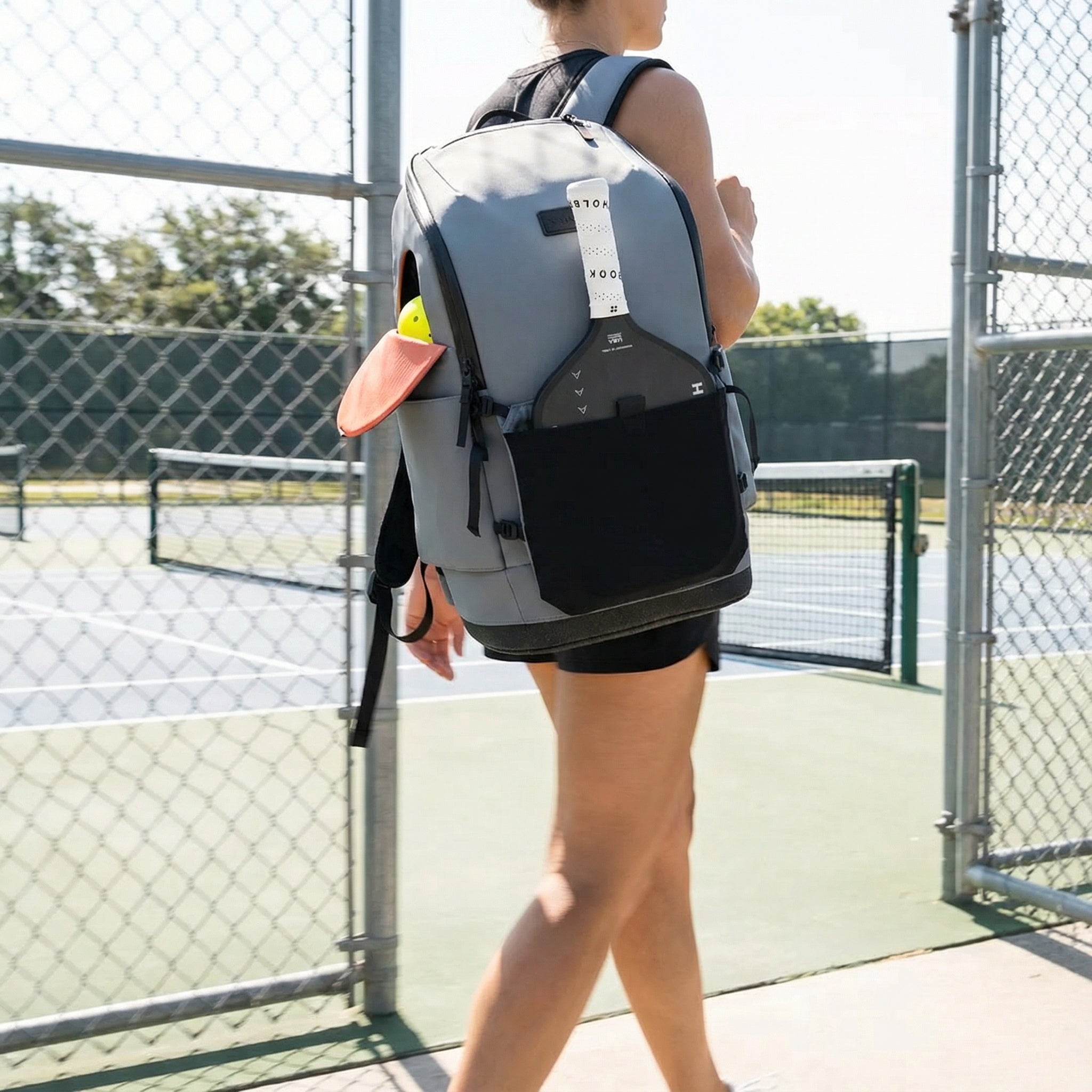
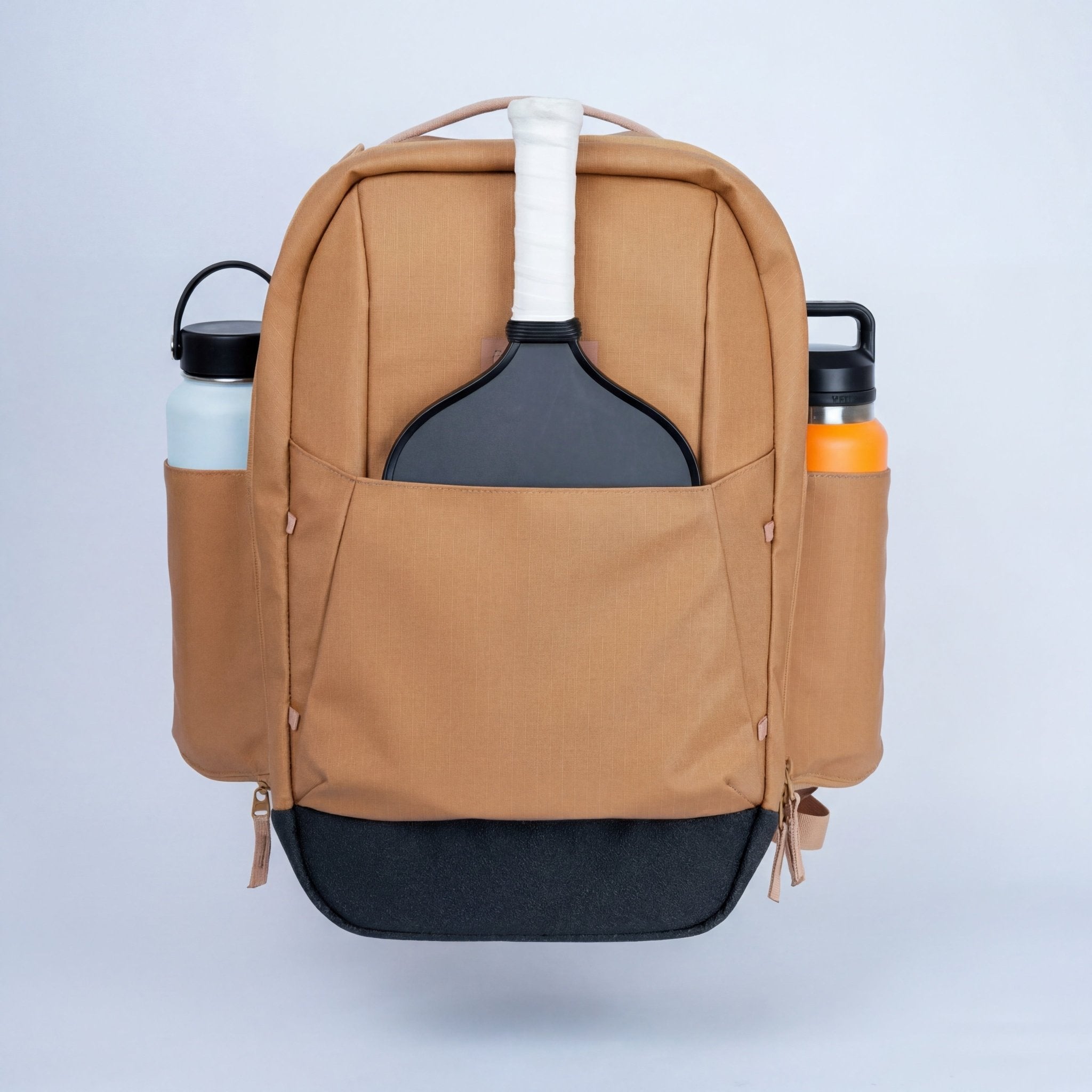
Not strictly required for your first session, but once you're playing regularly you'll need somewhere to carry a paddle, two to four balls, water, and whatever else you drag to the court. A dedicated pickleball bag keeps everything organized so you're not fishing for stuff in a gym duffel.
For new players, the FORWRD Court Ranger V2 ($195) is a practical choice: 16" laptop sleeve (most courts are near offices or schools), dedicated paddle compartment with modular sleeve that holds up to 3 paddles with covers on, and YKK AquaGuard zippers that hold up in the rain. It's designed to work as both a daily bag and a court bag — one bag instead of two. We built it based on feedback from 500+ real players, and it shows.
Best pickleball bags for beginners →
"The number one gear mistake new players make is buying a $200 paddle before they've played ten sessions. Spend $50 on a composite, spend the rest on shoes — ankle stability on a pickleball court matters a lot more than a pro-grade paddle before your technique is there."
— Topher Lake, FORWRD Co-founder
The 7 Core Rules Every Beginner Must Know
Pickleball's full rulebook is 100+ pages, but you need exactly seven rules to play a legitimate game. Learn these and everything else can wait.
- Serve underhand, diagonally cross-court. The serve must clear the kitchen and land in the diagonal service box. Serve from behind your baseline.
- Two-bounce rule (double-bounce rule). After the serve, the receiving team must let it bounce. After the return, the serving team must also let it bounce. After those two bounces, both teams may volley freely (except from the kitchen).
- No volleying in the kitchen. You cannot hit a ball in the air while standing in the 7-foot non-volley zone or while your momentum carries you into it after a shot.
- Serve must clear the kitchen. The served ball must land beyond the kitchen line (in the service court). Landing in the kitchen on a serve is a fault.
- Side-out scoring. Only the serving side can score. When the serving side faults, a side-out occurs: if both players on the serving team have served, service passes to the opposing team.
- Ball in bounds if it lands on or inside any line — except during a serve, where landing on the kitchen line is a fault.
- Let serves are played. If your serve hits the net and still lands in the correct service box, it is played — not a re-serve. (USA Pickleball changed this rule in 2021; there are no more let re-serves.)
Complete pickleball rules guide for 2026 →
The most commonly misunderstood pickleball rules →
2026 USA Pickleball rule changes →
How to Serve in Pickleball
The serve is the only shot in pickleball you control 100%. Use it with intent.
Legal serve requirements (all three must be met):
- Contact made below the waist (the navel is the standard reference point)
- Paddle head must be below the wrist at the moment of contact
- Upward arc: the swing must travel in an upward motion at contact (no sidearm slapping)
The two main serve types are the volley serve (dropping the ball and hitting it before it bounces) and the drop serve (bouncing the ball and hitting it after the bounce). Both are legal. Most beginners find the drop serve more consistent — gravity does the work.
Where to serve: Always diagonally cross-court. Right service court to opponent's right service court; left to left. You call the score before every serve (see scoring section below).
Serving rotation in doubles: At the start of a game, the first serving team only gets one server (called "Server 1"). Every subsequent service sequence, each player on the serving team gets to serve before a side-out. Server 1 serves first, Server 2 serves second — when both fault, service passes to the other team.
Beginner serve strategy: Deep and to the backhand wins more points than power. Most beginners have a weaker backhand return. A consistent deep serve to the opponent's backhand corner, aimed 2–3 feet inside the baseline, is worth far more than a risky power serve that goes into the net.
How to Keep Score in Pickleball
Pickleball scoring trips up almost every beginner. Here's why: the score is called out as three numbers in doubles (two numbers in singles) before every serve, and the numbers change meaning depending on who's serving.
Doubles score format: Serving team's score – Receiving team's score – Server number (1 or 2)
Example: "5-3-2" means the serving team has 5 points, the receiving team has 3, and the player currently serving is Server 2 on the serving team.
Starting a game: The first service sequence of any game begins with the score "0-0-2." This is intentional: it forces an immediate side-out on any fault, preventing the first team to serve from having a disproportionate advantage.
Only the serving team scores. When the serving team wins a rally, they score a point. When the receiving team wins a rally, a side-out occurs — no point scored, service changes. This is different from rally scoring (used in some competitive formats where every rally produces a point regardless of who served).
Win condition: First to 11, win by 2. If it's 10-10, play continues until one team leads by 2. Tournament formats sometimes use 15 or 21.
Singles score format: Just two numbers — "serving score – receiving score." No server number needed since there's only one player per side.
The easiest mental model: think of the score like a server announcing their status. "I have 5 points. They have 3. I'm Server 2. Play."
Complete pickleball scoring guide →
The Kitchen (Non-Volley Zone): The Rule That Changes Everything
The kitchen is the most important concept in pickleball. Master it and you'll avoid 80% of the faults beginners make in their first month.
The rule, plainly: You cannot volley (hit the ball in the air) while standing in the kitchen, or if your momentum carries you into the kitchen after a volley. This applies even if you step in and immediately step back out before hitting.
What's legal in the kitchen: You can stand in the kitchen any time you want. You can hit the ball from the kitchen after it bounces (a groundstroke). Walking through the kitchen is fine. You just cannot volley from inside it.
The momentum rule: This is the part people get wrong. If you volley and your follow-through carries your foot into the kitchen — even after the ball is hit — that's a fault. So stay behind the kitchen line when you're at the net and volleying.
Why the kitchen exists: Without the non-volley zone, tall athletic players could stand at the net and smash everything. The kitchen forces a softer, more technical game at the net — which is why the dinking game (soft cross-court shots into the kitchen) is central to high-level pickleball strategy.
Beginner's kitchen mistake to avoid: Rushing to the kitchen line and standing with your toes on it while trying to volley. Either get your feet clearly behind the line, or take one more step back. The NVZ violation call is based on foot position at the moment of the volley — not where you are when the ball bounces.
Complete kitchen rules guide →
5 Essential Shots for New Players
You don't need a full shot repertoire to play competent pickleball. You need five shots, and one of them (the dink) will take you furthest fastest.
1. The Serve
Covered above. Consistency first, depth second, placement third. Don't chase power until you have the first three dialed in.
2. Return of Serve
The most underrated shot for beginners. Hit it deep — within 2–3 feet of the baseline — and then move toward the kitchen line. A deep return gives you time to advance. A short return lets the server dominate from mid-court. Hit it crosscourt with enough margin over the net (aim 2 feet above the tape for safety), and get moving.
3. Third Shot Drop
The single most important shot in pickleball strategy. After the serving team's third shot (serve, return, now the serving team hits), the standard play is a soft arc into the kitchen that forces the opposing team to hit upward. This allows the serving team to advance to the kitchen line safely. It's a difficult shot that takes months to master — but understanding why it exists helps even beginners make smarter decisions about when to attack vs. reset.
4. The Dink
A soft, controlled shot from near the kitchen line into the opponent's kitchen. It's not a power shot — it's a finesse shot designed to keep the ball low and force your opponents to hit upward (giving you an attackable ball). Dinking patience is what separates intermediate players from beginners: beginners want to attack every ball, intermediates know when to wait for the right one.
Practice drill: stand at the kitchen line with a partner, both in the kitchen. Rally softly cross-court for 3 minutes without letting the ball bounce outside the kitchen on either side. This is the foundation of the net game.
5. The Volley
Hitting the ball in the air from behind the kitchen line. Short, compact punch — not a full swing. Keep your elbow in front of your body. Beginners who swing big at volleys miss more than they make. Think "block" or "redirect," not "swing." The smaller the swing, the faster your recovery for the next shot.
Complete pickleball shots guide →
5 beginner techniques to master →
Doubles vs. Singles: Which Should Beginners Start With?
Start with doubles.} Period.
Doubles (4 players, 2 per side) is how 90% of recreational pickleball is played. The court is shared between two players, which means you cover less ground — critical when your footwork isn't there yet. Singles requires you to cover the full 20×44-foot court alone, which is aerobically demanding and technically punishing for new players.
Doubles also teaches positioning and partnership faster. The central skill in doubles is stacking — a positioning technique where both players on a team position to keep stronger players on their preferred side — but you don't need to know that yet. For beginners, doubles means: stand on your side, let your partner take middle shots that they can reach, communicate on balls down the center, and move together toward or away from the net in sync.
The center of the net is the highest-value target in doubles: balls aimed at your opponents' feet in the center force difficult decisions about who takes the shot. That's a more productive mental model than "hit it away from them" for most new players.
Complete doubles rules and strategy guide →
Pickleball Etiquette Every Beginner Should Know
This is the section nobody else writes, so we will. Pickleball has an unwritten code. Violate it as a new player and you'll be tolerated; learn it and you'll be welcomed back everywhere.
Call the score before every serve. It's required by the rules, but more importantly it prevents disputes. Loud enough for both sides to hear. If your opponent didn't hear the score and asks, call it again without attitude.
Call your own faults. Pickleball is largely self-officiated in recreational play. If your foot touched the kitchen on a volley, call it on yourself. If your shot was clearly out but your opponent didn't see it, call it out. The sport's social culture depends on honest calls — players who consistently call close balls in their own favor develop a reputation fast.
Line calls belong to the side the ball lands on. Your opponent calls the line on their side; you call lines on your side. Don't challenge their calls (unless you have a strong view and ask politely). Don't make a big show of calling balls out on your side — a simple "out" is enough.
Open play rotation. At most rec centers and parks, open play works on a paddle queue. Paddles go up on the fence or in a paddle holder when you want to play next. When a court opens, the next 2–4 paddles in the queue take the court. Don't skip the queue. Don't hold spots for friends who aren't present. After your game, paddles go back in the queue if you want to play again.
Don't coach strangers (especially during play). Unless someone explicitly asks for feedback, keep your technique observations to yourself during open play. If you're playing with a beginner who's struggling, a quiet encouraging word after the game is welcome. Unsolicited commentary mid-rally is not.
Never slam the ball in frustration. Hitting a ball away in anger is a fault and considered unsportsmanlike. Retrieve errant balls calmly — and send balls back to the adjacent court by hand or gentle roll, not a cross-court smash.
When retrieving from adjacent courts: Wait for play to stop before walking behind an active court to retrieve a ball. Make eye contact or say "ball" to let them know. Don't dart behind a rally — you'll catch a paddle in the face.
Introduce yourself. At open play, it's customary to introduce yourself to whoever you're about to play with or against. A simple "hey, I'm [name], this is my [second/third/tenth] time playing" goes a long way. The community is good about calibrating play to the weakest person on the court when appropriate.
How Much Does It Cost to Start Playing Pickleball?
No other beginner guide does a real cost breakdown. Here it is.
| Item | Budget Option | Mid-Range | Premium |
|---|---|---|---|
| Paddle | $20–$40 (composite) | $50–$90 (graphite) | $100–$250 (carbon) |
| Balls (pack of 3–6) | $10–$15 | $15–$25 | $25–$36 |
| Court shoes | $60–$80 (tennis shoes) | $90–$120 | $120–$160 |
| Bag | $0 (gym bag you own) | $60–$120 | $195–$325 (FORWRD) |
| Court fees | $0 (public parks) | $5–$10/session (rec center) | $20–$40/hr (private club) |
| Lessons | $0 (YouTube + open play) | $20–$40 (group clinic) | $60–$120/hr (private) |
| Total (first session) | $90–$130 | $155–$245 | $340–$660+ |
FORWRD's recommendation for year-one beginners: Spend $50 on a composite paddle. Buy a pack of Franklin X-26 indoor balls or Engage Tour outdoor balls for $10–$35. Use court shoes you already own if they have lateral support. Skip the bag for your first month. Total first-session spend: under $100.
After you've played 20 sessions and you're hooked (you will be), then invest in better shoes (the biggest performance upgrade for most players) and a proper bag. Save the $150+ paddle upgrade for month 6+ when you've developed a playing style and know whether you want more control or more power.
Court fees: Most U.S. cities with any population density have free public pickleball courts at parks. Rec centers charge $5–$15 per session or offer monthly memberships. Private pickleball clubs run $40–$100/month. Start free — use Places to Play on the USA Pickleball website or the Pickleheads court finder to locate public courts near you before spending anything on court fees.
How to Find a Pickleball Court Near You
The good news: there are over 50,000 registered pickleball courts in the United States as of 2026. The better news: most of them are free.
Best tools for finding courts:
- Pickleheads.com/courts — the most comprehensive court database, searchable by zip code with court photos, surface type, indoor/outdoor filter, and whether open play is available
- USA Pickleball Places to Play — usapickleball.org/places-to-play — the official database, slightly less current than Pickleheads but authoritative for registered venues
- Local Facebook groups — search "[your city] pickleball" — these are often where open play schedules are actually posted, since they update faster than databases
- Your city parks & rec website — many cities now dedicate specific court times to pickleball or have converted tennis courts with permanent pickleball lines
Types of venues:
- Public parks: Usually outdoor, hard court (asphalt or concrete), free. Lines may be shared with tennis courts (look for the shorter court with the lower net).
- Recreation centers: Indoor, controlled temperature, open play sessions on a schedule. Often the best place for beginners — fellow players are typically welcoming and the community is established.
- Dedicated pickleball clubs: Purpose-built facilities, membership fees, lessons available. Worth it once you're playing 3+ times per week.
- Country clubs and tennis clubs: Many have converted courts. May require membership or guest fees.
Tip for beginners: Show up to an open play session at a rec center on a weekday morning if your schedule allows. That's where the most patient, experienced players tend to be — and they've taught hundreds of beginners. Weekday evenings and weekend mornings are typically more competitive.
Your First 90 Days: A Realistic Progression Plan
Most beginner guides give you a 30-day plan. Ninety days is more honest — it's how long it actually takes to go from "figuring out the rules" to "genuinely useful teammate at open play."
Days 1–14: Learn the Game
- Goal: Understand all seven core rules, serve consistently (in bounds, 7 out of 10 attempts), and keep score correctly without help.
- How: 2–3 sessions of open play with an explanatory YouTube session or beginners' clinic. Don't be embarrassed to ask questions — pickleball players love teaching the sport.
- What to focus on: Where to stand (both on the serve and after), how the two-bounce rule works in practice, and kitchen awareness. Let your partner take balls down the middle when uncertain.
- Ignore for now: Third shot drops, stacking, ATP shots, spin serves. That's month 3+ material.
Days 15–45: Build Consistency
- Goal: Return of serve goes deep 7 out of 10 times. You can sustain a 10-shot dinking rally without hitting it in the net or popping it up. You're moving to the kitchen after your return without being told.
- How: 2–4 sessions per week. Add 15 minutes of dedicated dinking practice at the start of each session before moving to open play. If you can find a consistent partner, drill the return-of-serve→move-to-NVZ sequence repeatedly.
- What to work on: Compact volley punch (no big backswings), keeping the ball down in dinking exchanges, reading when to attack vs. reset.
- Progress marker: You're being asked back to play by the same people who played with you.
Days 46–90: Develop Your Game
- Goal: Reliable third shot drop attempt (doesn't have to be perfect — just intentional). Understanding of when to speed up a dink vs. continue the exchange. You can sustain 20+ shot rallies without forcing errors.
- How: Consider one group clinic or semi-private lesson with a 3.5–4.0 rated player or coach to address your biggest mechanical flaw (everybody has one by this point — it's usually the backhand or the reset volley). Continue 3–4 sessions per week.
- What to work on: Third shot drop mechanics, improving your weakest shot type, developing a consistent serve with depth and placement intent.
- Progress marker: You're rating yourself around 2.5–3.0 on the USA Pickleball rating scale. You understand why you lost each point, even when you're losing.
At 90 days of consistent play, you'll understand roughly 80% of the strategic decisions happening in any recreational game you join. The remaining 20% (stacking, transition zone play, erne shots, advanced spin) takes years. Enjoy the 80% — that's where most of the fun lives.
5 techniques to master in your first months →
What No One Tells Beginners
These are the things you'd know after 50 sessions that no beginner guide leads with — but should.
Dinking patience is a skill you practice, not a personality trait. Every beginner wants to speed up the ball at the net because slow dinking feels passive. It's not. Dinking is about waiting for the ball above net height — that's when you attack. A dink below net height forces you upward, which means your opponent attacks. Train yourself to see the height of the ball as an on/off switch: ball above net tape = attack opportunity. Ball below net tape = reset and wait.
The return of serve is worth more practice time than the serve. Your serve is the only shot where you're in complete control — you'll develop it naturally. The return is reactive and sets the entire point up. A deep, cross-court return that buys you time to advance to the NVZ line wins more points at the recreational level than any other single improvement.
Move to the kitchen line after your return. This is the most common positioning error in beginner play. After hitting your return of serve, keep moving forward until you're about one step behind the kitchen line. Don't stop at mid-court. Mid-court is the worst place to be in pickleball — you're too close for a controlled dink and too far for a sharp volley.
Compact swings recover faster than big swings. When an opponent speeds up the ball at you and your instinct is to swing hard, shrink the swing instead. A compact, blocked punch gives you a reasonable return AND positions you for the next shot. A full swing that works is great; a full swing that misses leaves you completely out of position.
You're allowed to stand in the kitchen. People learn "don't step in the kitchen" and over-correct to never stand there. You can stand in the kitchen. You can even camp there. You just can't volley. After a groundstroke from the kitchen, you can stay in the kitchen. This matters for poaching at the net and for positioning when the ball is slow and low.
Watch your opponents' paddle face, not the ball. The paddle face tells you where the ball is going 0.2 seconds before the ball gets there. Once you start reading paddle angles instead of tracking the ball, your reaction time doubles.
Open play etiquette: arrive early, introduce yourself, watch before you join. At most venues, open play means whoever's there jumps in on a rotation. If you arrive mid-session, watch a point, figure out the rotation system, and get your paddle in the queue. Don't cut in. Don't explain your skill level unprompted. Play a game and it'll be apparent.
Frequently Asked Questions
How long does it take to learn pickleball?
Most people can play a functional game within one afternoon. The basic rules — serve, two-bounce rule, scoring, kitchen — are learnable in 15–20 minutes. Playing well enough to not frustrate experienced partners typically takes 5–10 sessions. Being genuinely competitive at recreational open play takes 30–90 days of consistent practice (3+ sessions per week).
Is pickleball hard on your knees and joints?
It depends on the surface and your footwork. Concrete courts are harder on joints than dedicated pickleball flooring or sport tiles. Proper court shoes (not running shoes) with lateral support significantly reduce knee and ankle stress. Most players 50+ report pickleball is far easier on their bodies than tennis due to the smaller court — less running, less explosive lateral movement required. The main injury risks are ankle rolls from improper shoes and elbow strain from poor technique.
What's the difference between indoor and outdoor pickleball?
The balls are different. Indoor balls are lighter with larger holes for a softer feel on wood or sport court surfaces. Outdoor balls are heavier with smaller holes to handle wind on asphalt or concrete. The game rules are identical; the paddles work for both. If you're playing on an indoor wood gymnasium floor, bring indoor balls. Everything else: outdoor.
Can I use a tennis racket for pickleball?
No. Pickleball requires a solid paddle (no strings). A tennis racket is strung and produces completely different ball physics — it's also too large for proper pickleball play. Get an actual pickleball paddle; the cheapest composite option works better than the best tennis racket.
What is the kitchen in pickleball?
The kitchen is the non-volley zone: a 7-foot-deep area on each side of the net. You cannot volley (hit the ball before it bounces) while standing in the kitchen or while your momentum carries you into it after a shot. It's named "the kitchen" because "if you can't stand the heat, stay out of the kitchen" — though the phrase is used loosely in the sport.
How is pickleball scored?
Standard recreational scoring: side-out scoring to 11 (win by 2). Only the serving team scores points. In doubles, the score is announced as three numbers before each serve: serving team score – receiving team score – server number (1 or 2). The game starts at "0-0-2," which forces a single-server start for the first team to serve.
What size pickleball paddle should I use?
Standard paddles are about 15–16 inches long and 7–8 inches wide. Elongated paddles (up to 17 inches long) offer more reach and leverage but a smaller sweet spot. For beginners, a standard-size paddle with a mid-sized sweet spot is forgiving enough to cover technique errors. Focus on grip size (how the handle fits your hand) over face shape for your first paddle.
Do I need special shoes for pickleball?
Yes — court shoes with flat soles and lateral support, not running shoes. Running shoes are built for forward motion; the lateral cuts in pickleball stress the ankle differently. Tennis shoes are the most common substitute. Dedicated pickleball shoes (like the K-Swiss Express Light) are specifically designed for the sport's movement patterns if you want the optimal option.
What's the two-bounce rule in pickleball?
After the serve, the receiving team must let the ball bounce once before hitting it. After the receiving team's return, the serving team must also let the ball bounce before hitting it. Once those two bounces have occurred (one on each side), both teams may volley freely — except from the kitchen. The rule prevents serve-and-volley domination and extends rallies.
Is pickleball good for seniors?
It's excellent for seniors — which is why it became a national phenomenon starting in retirement communities. The court is small (less running than tennis), the rules are simple, the ball moves slowly enough to react, and the social culture is welcoming. Many players start pickleball in their 60s and 70s and become highly competitive. The main consideration for older beginners: invest in good court shoes for ankle support and consider a lighter paddle (under 7.5 oz) to reduce forearm strain.
Related Articles: The Pickleball for Beginners Cluster
Every article below goes deeper on a sub-topic from this guide. Bookmark the ones that match where you are in your progression.
- How to Play Pickleball: A No-Fluff Guide for New Players (2026)
- Pickleball Rules: The Complete Guide for 2026
- Pickleball Scoring: Complete Guide
- Pickleball Court Dimensions and Layout Guide
- Essential Kitchen Rules Every Player Should Know
- Commonly Misunderstood Pickleball Rules
- 2026 USA Pickleball Rule Changes
- The 7 Best Pickleball Paddles for Beginners
- Best Pickleball Paddles for Beginners (2025–2026)
- Pickleball Paddle Grip Size Guide
- Complete Pickleball Shot Types Guide
- 5 Techniques Every Beginning Player Should Master
- Pickleball Grip Techniques Guide
- Complete Doubles Pickleball Rules
- Pickleball Shoe Buying Guide
- Essential Pickleball Packing List
- Best Pickleball Bags for Beginners
- Pickleball Tournament Packing List (when you're ready)
Ready for your first session?
The only thing left to do is show up. Grab a $50 composite paddle, a pack of balls, and head to your nearest open play session. The community will do the rest.
When you're ready for a bag that keeps up with how serious you're getting: the FORWRD Court Ranger V2 ($195) was designed for players who are done improvising with gym bags — dedicated paddle compartment, 16" laptop sleeve, YKK AquaGuard zippers, and a lifetime warranty.
Shop Court Ranger V2 →
Leave a comment
This site is protected by hCaptcha and the hCaptcha Privacy Policy and Terms of Service apply.