

Why Your Knees Hurt After Pickleball (And What to Do About It)
Last updated: July 2026
Pickleball knee pain most often comes from one of three biomechanical patterns: patellar tendinopathy from quad-tendon overload, lateral knee stress from uncontrolled direction changes, or valgus knee collapse during split-step landings. All three are preventable with targeted strengthening. This guide covers the actual cause chain, a prevention protocol, shoe selection principles, and a return-to-play timeline for players already dealing with pain.
Table of Contents
- Why Pickleball Is Hard on Knees (and When It Isn't)
- The Three Most Common Knee Injury Patterns
- The Patellar Tendinopathy Trap
- Prevention: The Quad/Glute/Hip Protocol
- Shoe Selection for Knee Protection
- When to Rest vs. Push Through
- Recovery Protocol for Active Knee Pain
- FAQ: Pickleball Knee Pain
Why Pickleball Is Hard on Knees (and When It Isn't)
The short answer: pickleball isn't inherently dangerous to knees. Most court sports create similar demands. What makes pickleball knee stress distinctive is the combination of factors that hit at once — and they tend to hit hardest on players who came in without much court conditioning.
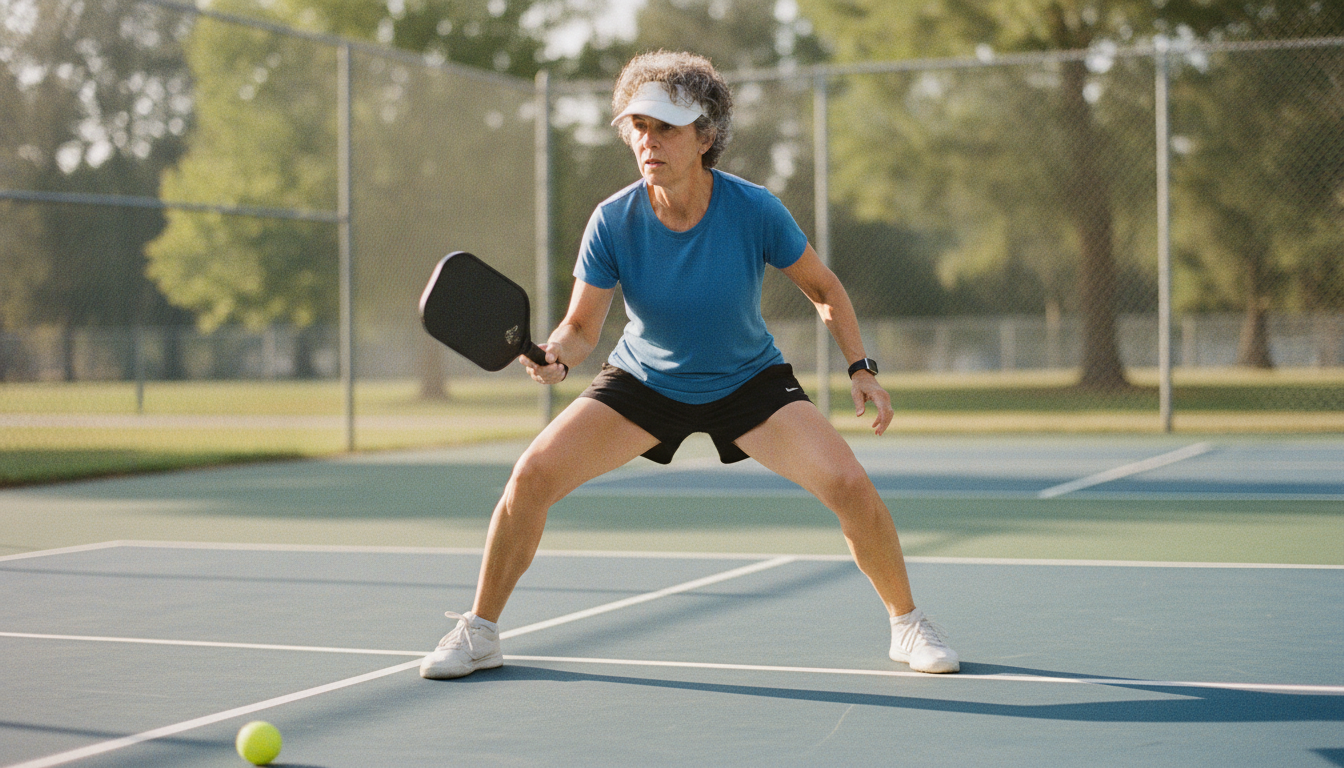
Here's the actual load profile. You're making rapid lateral shuffles, planting and pushing off hard surfaces, dropping into a low ready position for extended dinking rallies, and doing all of this at a high heart rate for 2–3 hours with minimal rest between games. On asphalt or concrete — where the majority of recreational pickleball happens — you're getting almost no ground compliance compared to clay or cushioned indoor courts.
The timing problem compounds it. The median age of a recreational pickleball player skews higher than most sports, and quad strength and tendon elasticity both decline naturally after 50. If your off-court conditioning hasn't kept pace with your court hours, your knees end up absorbing load that your muscles should be handling.
The knee isn't the problem — it's the symptom. That's what most knee pain guides miss. The joint itself is rarely the origin of the issue; it's where compensation shows up when the surrounding structures can't handle the demand.
When it's NOT hard on knees: players who cross-train consistently (2x/week off-court quad and glute work), play on cushioned indoor surfaces, and manage their weekly court volume relative to their conditioning base experience very low knee injury rates. The sport itself is not the problem.
The Three Most Common Knee Injury Patterns in Pickleball
Three patterns come up consistently across the clinical literature and community discussions. Each has a different cause chain — and a different fix.
1. Patellar tendinopathy — pain at the front of the knee, just below the kneecap. Caused by cumulative overload on the patellar tendon when quad strength hasn't kept pace with court volume. This is the most common chronic knee issue in pickleball. It's also the sneakiest — more on that below.
2. Lateral knee stress (IT band syndrome) — pain on the outside of the knee where the iliotibial band crosses the lateral femoral condyle. Caused by weak hip abductors that fail to control inward knee tracking during direction changes. You'll feel it during long rallies and when moving downhill after a session.
3. Valgus knee collapse — the knee caving inward during split-step landings or hard pivots. This isn't a specific injury; it's a movement fault that creates acute risk (ACL stress, meniscus loading) and chronic wear over time. Weak glutes are almost always the underlying cause.
All three respond to the same general approach: targeted strengthening of the quad, glute, and hip abductor chain. The difference is in which specific exercises to prioritize and the timeline to expect results.
The Patellar Tendinopathy Trap (The Most Common Chronic Pattern)
This one deserves its own section because it's consistently misunderstood — and because the window for easy intervention is narrow.
The patellar tendon connects your quadriceps to your tibia. Every split-step, every low-position dinking exchange, every explosive lateral push loads it. Under normal conditions with adequate conditioning, the tendon adapts and stays healthy. The problem is progressive overload — too much volume, too fast, without the strength base to support it.
Here's the trap: you don't feel it until you're already 6–8 weeks into a load-management failure. By the time you notice pain in the front of your knee going downstairs or during your first steps in the morning, you're not dealing with something that just started. You're dealing with an established tendinopathy that's been quietly developing for weeks. Most players try to play through it. That makes it worse.
"I spent two months ignoring the stiffness in my right knee at the top of the stairs before I finally took a week off the court. That week plus slow eccentrics bought me another two years of pain-free play. I wish I'd done it two months earlier." — Grub, FORWRD co-founder
The classic mismanagement is treating tendinopathy with rest alone. Rest reduces pain — but it doesn't fix the underlying tendon weakness. When you return to court, the problem comes right back. The actual treatment is structured eccentric loading: slow, controlled lowering movements that force the tendon to adapt and strengthen under tension. Details are in the prevention protocol below.
Watch for these signals:
- Morning stiffness in the front of the knee (below the kneecap) that loosens after a few minutes of walking
- Pain going downstairs that isn't present going up
- Tenderness when you press directly on the tendon below your kneecap
- Pain that shows up after 45+ minutes of play and gets progressively worse — not present at the start
If you're checking two or more of these boxes, get off the court for 1–2 weeks and start the recovery protocol. The earlier you catch it, the faster you bounce back.
Prevention: The Quad/Glute/Hip Protocol
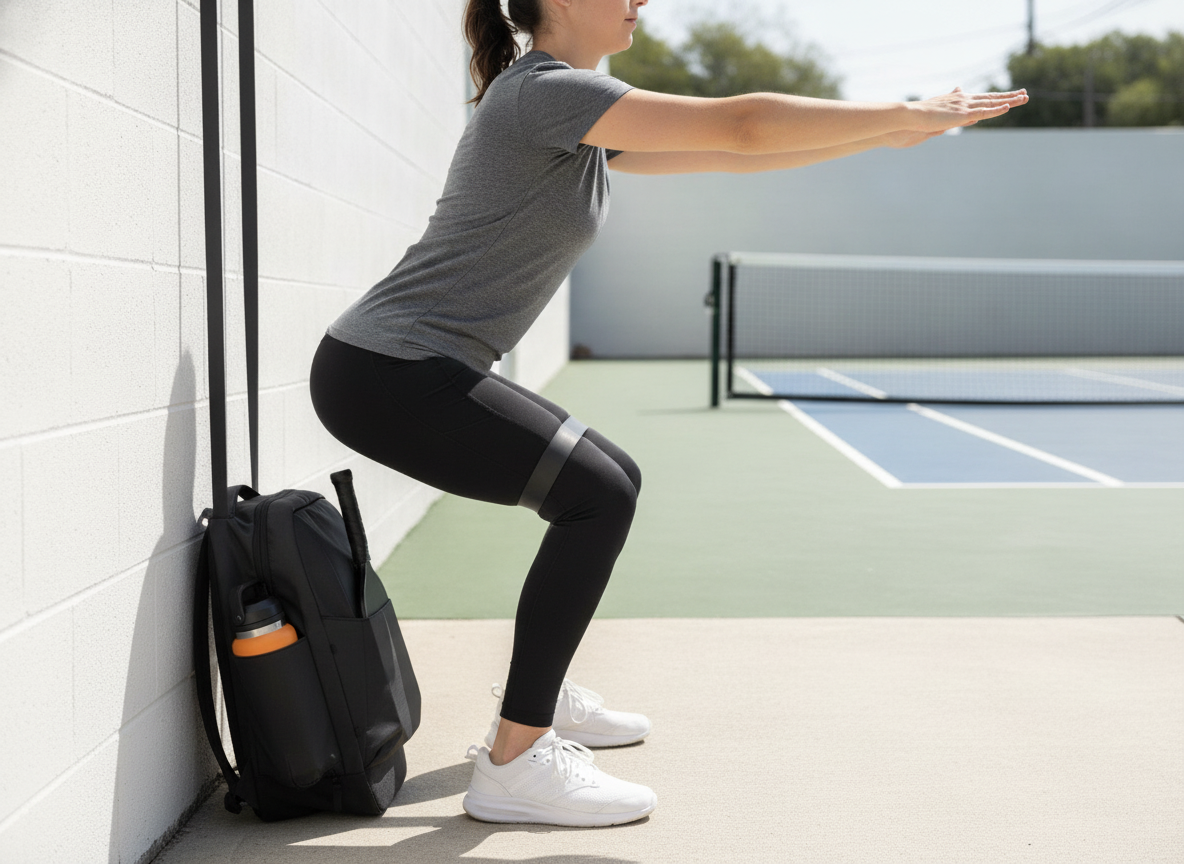
Three exercises. Two sessions per week, year-round. This isn't a short-term rehab program — it's baseline maintenance for anyone who plays pickleball more than twice a week.
Exercise 1: Spanish Squat or Decline Squat (slow eccentric loading)
Sets/reps: 3 × 15 with a 3-second lowering phase.
Why it works: Eccentric loading — the slow lowering phase — is the single most evidence-backed intervention for patellar tendon health. A decline board targets the tendon more directly than a flat-surface squat. Without one, use a wall to keep shins vertical and focus on the slow lowering phase. The USA Pickleball-endorsed sports medicine guidance consistently points to eccentric quad loading as the primary tendon-protection strategy for court sport athletes.
Exercise 2: Single-Leg Romanian Deadlift
Sets/reps: 3 × 8 per side with a light dumbbell or kettlebell.
Why it works: Catches quad and hip strength asymmetries that drive valgus collapse and lateral knee stress. Most players have a meaningfully weaker side — this format makes that imbalance obvious and forces it to close. Keep the standing knee slightly soft (never locked), hinge from the hip, and lower until you feel your hamstring engage. Stop before the lower back rounds.
Exercise 3: Hip Abductor Work (Band Walks or Clamshells)
Sets/reps: 3 × 15 per side.
Why it works: Weak hip abductors are the primary driver of inward knee tracking during direction changes — the root cause of both valgus collapse and IT band stress. Side-lying clamshells with a resistance band or lateral band walks both work. This is the exercise most rec players skip because it "doesn't feel like enough." It's also the one that does the most work to protect your knees over the long run.
For a broader conditioning framework — including how to structure these exercises with your court schedule, progressive overload principles, and recovery timing — see the FORWRD Pickleball Health & Fitness Guide.
Shoe Selection for Knee Protection
The link between footwear and knee stress is more direct than most players realize. And the key factor isn't cushioning — it's lateral stability.
A running shoe has excellent forward cushioning but poor lateral stability. The midsole is designed to flex with heel-to-toe movement, not to resist the rotational forces of a hard lateral direction change. When you make a quick cut in a running shoe, rotational force travels through the ankle and up to the knee instead of being absorbed by the shoe structure. Court shoes are designed specifically to handle this.
Three things to prioritize when selecting shoes for knee health:
- Reinforced medial and lateral midfoot — look for external TPU supports or a stiffer medial post. These limit excessive inward foot roll (overpronation) that places rotational stress on the knee.
- Heel drop of 8–12mm — lower drops (the minimalist trend pushed many shoes below 6mm) increase Achilles and calf loading, which migrates toward the knee with pickleball's direction-change pattern. Stay in the 8–12mm range for court sports.
- Surface-matched grip — over-grip on your surface creates excessive rotational resistance during pivots. That force has to go somewhere, and often it goes to the knee.
For a full breakdown of court shoes ranked by play style, surface, and foot type, see the FORWRD Pickleball Shoe Guide.
When to Rest vs. Push Through
The honest framework: most soreness is not a warning sign. Most pain during play is.
Play through these:
- General muscle soreness (DOMS) that peaks 24–48 hours post-play and improves with movement
- Stiffness that loosens within 5–10 minutes of warming up and doesn't return during the session
- Mild fatigue after long sessions with no localized pain at any specific joint
Stop and rest when you have:
- Pain that starts during play and worsens as the session continues
- Swelling around the knee joint — even mild puffiness — that appears after play
- A locking, clicking, or catching sensation inside the knee (possible meniscus involvement — see a clinician)
- Pain going downstairs 24+ hours after your last session (patellar tendon stress signal)
- Pain that wakes you at night
If you're 55 or older, apply one additional rule: when in doubt, rest one session. Missing a game costs you nothing. Playing through an acute flare can set you back 6–8 weeks.
The same framework applies to upper-body injuries. For shoulder pain, see the shoulder injury prevention guide. For elbow and forearm issues, see the elbow injury prevention exercises.
Recovery Protocol for Active Knee Pain
If you're already dealing with knee pain, here's a return-to-play framework. It's not a substitute for seeing a sports medicine clinician — but it's consistent with the protocols most commonly recommended for recreational athletes with patellar tendinopathy and lateral knee stress.
Phase 1 (Weeks 1–2): Full court rest + isometrics
No lateral movement. No split-steps. Start isometric quad work: wall sits at a comfortable angle (not deep), leg press holds, straight-leg raises. Isometrics don't load the tendon under dynamic tension, so they build strength without aggravating pain. Ice 15–20 minutes after sessions. Anti-inflammatory protocol if your doctor approves.
Phase 2 (Weeks 3–4): Introduce slow eccentrics at reduced range
Begin the eccentric squat protocol at half range — stop at 45° of knee flexion. Two sessions per week, not three. Continue isometrics. Light walking on flat surfaces is fine. Pain should stay under 3/10 during exercise; if it's higher, reduce range or hold at Phase 1 longer.
Phase 3 (Weeks 5–6): Add lateral movement drills
Progress eccentrics toward fuller range. Add controlled lateral shuffle drills without a ball — 50% effort, no explosive push-off. Monitor for 24-hour pain response after each session. A pain increase of 1–2 points the next morning is acceptable; more means you moved too fast.
Phase 4 (Weeks 7–8): Return to court at reduced intensity
First two sessions back: 50% of normal duration, no aggressive overhead play, minimize running down wide lobs. Complete two clean sessions with no pain flare, then gradually resume normal play over the following two weeks.
For players 55 and older: extend each phase by one additional week. Tendon healing is slower with age — not because older tendons can't adapt, but because the adaptation timeline is longer. The protocol works; it just requires more patience. For age-specific fitness guidance, see the pickleball fitness guide for 50+ players.
FAQ: Pickleball Knee Pain
Is pickleball bad for your knees?
Pickleball isn't inherently bad for your knees, but it creates specific demands — rapid direction changes, hard surfaces, high repetition volume — that stress underconditioned knees. Players who maintain quad, glute, and hip strength off-court experience far fewer knee issues than those who only play without cross-training.
What causes knee pain when playing pickleball?
The three main causes are patellar tendinopathy (quad-tendon overload), lateral knee stress from weak hip abductors, and valgus knee collapse during split-step landings. In most cases, one or more reflects a strength deficiency in the muscles that should absorb court load before it reaches the joint.
What exercises help with pickleball knee pain?
Slow eccentric squats (Spanish squats or decline squats with a 3-second lowering tempo), single-leg Romanian deadlifts, and hip abductor exercises (clamshells or band walks). These three exercises address the main drivers of pickleball knee pain: patellar tendon weakness, leg strength asymmetry, and hip abductor deficiency that causes poor knee tracking.
How long does it take to recover from pickleball knee pain?
For mild patellar tendinopathy, an 8-week graduated return-to-play protocol is typical. Players 55+ should plan 10 weeks. Lateral knee stress often responds faster — 4–6 weeks with consistent hip abductor strengthening. Acute injuries (meniscus, ligament involvement) require clinical evaluation and individual timelines that can vary widely.
What pickleball shoes are best for knee problems?
Look for a court shoe (not a running shoe) with strong lateral stability, a heel drop of 8–12mm, and a reinforced medial post. Running shoes flex laterally in ways that put rotational stress on the knee during direction changes. Court-specific construction absorbs that force in the shoe structure rather than passing it up the chain to the knee.
Should I stop playing pickleball if my knees hurt?
If pain starts during play and worsens, if there's swelling, a locking or catching sensation, or pain persists on the stairs 24 hours later — stop and rest. Mild soreness after long sessions or stiffness that loosens with warm-up is generally manageable. When in doubt, skip one session. Missing a game costs you nothing; playing through an acute flare can cost you weeks.
Does playing pickleball on concrete cause more knee pain than other surfaces?
Yes. Hard surfaces like asphalt and concrete offer no ground compliance, so all impact force is absorbed by the body (foot, ankle, knee, hip chain). Clay and cushioned indoor courts reduce this load. If you play primarily on hard outdoor courts, prioritizing off-court quad and glute conditioning becomes more important — better shoes help, but they don't eliminate surface impact.

Leave a comment
This site is protected by hCaptcha and the hCaptcha Privacy Policy and Terms of Service apply.