

Last updated: July 2026
Pickleball creates predictable injuries in predictable players. Three months into regular play, your posterior chain gets weak relative to your quads. Six months in, your dominant shoulder starts pulling forward. A year in, your hips can't find neutral, your lower back picks up the slack, and you're suddenly "taking a few weeks off." None of this is inevitable — it's the result of playing a one-sided, forward-dominant sport without addressing what it breaks down off the court.
This 3-day program targets exactly those gaps: the posterior chain deficit, the shoulder imbalance, the grip/forearm overuse, and the hip flexor shortening that kitchen stance creates. It's built around the biomechanical reality of pickleball, not a generic gym routine. Equipment requirements are minimal: resistance bands, a pair of dumbbells, and a mat.
Part of the FORWRD Pickleball Health & Fitness Guide 2026 — the full resource for training smarter, playing longer, and staying off the injured list.
The Muscle Gaps Pickleball Creates (and Why They Become Injuries)
Most sports create muscle imbalances. Basketball players get tight hip flexors from explosive acceleration. Swimmers develop rounded shoulders from thousands of forward-pulling strokes. Pickleball has its own signature pattern — and understanding it is the only way to actually fix it instead of just "stretching more" and hoping.
When we reviewed movement and injury feedback from 500+ players during our bag and gear design research, the pattern was striking: the players who stopped showing up weren't quitting because they lost interest. They were sidelined. The same injuries, over and over. Here's what pickleball specifically does to your body:
Posterior chain deficit. Pickleball movement is almost entirely anterior-dominant — you're leaning forward, loading your quads, driving through your hip flexors on every split-step and drive. The posterior chain (hamstrings, glutes, lower back extensors) does comparatively little work during a normal game. Over weeks and months, that anterior-posterior imbalance grows. When you finally ask your posterior chain to fire explosively on a hard drive return or a scramble to the baseline, it's not ready. That's when hamstring strains and lower back pain show up.
Rotational shoulder imbalance. Every overhead shot, drive, and serve fires your dominant arm through the same internal rotation pattern — thousands of repetitions per week. The opposing musculature (posterior rotator cuff, external rotators, lower trapezius) gets almost no comparable load. That imbalance gradually pulls the humeral head forward in the glenoid, reducing the subacromial space. That's the anatomical setup for shoulder impingement and bicep tendinopathy. The shoulder injury prevention guide covers the specific patterns and the mobility protocol that addresses them.
Grip and forearm overuse. Continuous gripping and wrist-snap shots chronically overload the forearm flexors. The extensors — which provide the counterbalancing pull — stay comparatively weak. That's the direct precursor to lateral epicondylitis. For the rehabilitation side, the pickleball elbow prevention guide covers it specifically; the program below handles prevention.
Hip flexor shortening. The athletic stance at the kitchen — knees bent, weight forward, slightly crouched — keeps the hip flexors in partial contraction for every rally. That's fine for one session. Over 3–4 sessions per week for months, the psoas and rectus femoris adapt by shortening. Shortened hip flexors pull the anterior pelvis down, creating lumbar extension and anterior pelvic tilt. Most players call this "back pain." It's actually hip flexor-driven lumbar compensation — and it responds directly to hip flexor lengthening and posterior chain loading.
Thoracic extension deficit. Overhead returns, high volleys, and any above-shoulder shot requires thoracic rotation and extension. The kitchen stance and general posture of pickleball push the thoracic spine into flexion. When thoracic extension is limited and you attempt an overhead shot, the shoulder compensates with additional subacromial elevation. That's exactly the wrong movement for a joint already under stress — and it's why thoracic mobility work protects the shoulder while also improving every overhead you hit.
The program below addresses all five of these patterns. Three days per week. Each session takes 30–40 minutes.
The 3-Day Program Overview
Three focused sessions per week. At least one rest day between each. No gym required.
- Day A (Monday or Tuesday): Posterior chain emphasis — Romanian deadlifts, Nordic curls, glute bridges, lateral band work
- Day B (Wednesday or Thursday): Core stability and shoulder balance — dead bugs, Pallof press, face pulls, rows, wall slides
- Day C (Friday or Saturday): Hip mobility, thoracic work, grip and forearm conditioning
Don't cherry-pick. The three sessions are designed as a system. Running only Days A and B while skipping Day C is roughly equivalent to doing all your pickleball serves without ever working the external rotators — you'll build the very imbalance you were trying to fix. Each session is 30–40 minutes. The entire weekly time cost is roughly equal to one extra court session.
If you're simultaneously dealing with knee pain, the knee pain prevention guide covers the quad-to-glute ratio work that complements Day A's posterior chain loading.
Day A: The Posterior Chain Session
This is the highest-priority session — the one most pickleball players need most urgently and have most neglected. Focus on controlled, deliberate movement. Posterior chain strength is built through full range of motion and eccentric load, not speed.
Rest 60–90 seconds between sets. Complete all sets of one exercise before moving to the next.
| Exercise | Sets | Reps | Progression |
|---|---|---|---|
| Romanian Deadlift (dumbbells) | 3 | 8–10 | Add 5 lbs every 2 weeks |
| Nordic Hamstring Curl (eccentric) | 3 | 4–6 slow negatives | Add 1 rep/week; use band for assistance early on |
| Single-Leg Romanian Deadlift | 3 | 8 per side | Add load when 10 reps per side feel controlled |
| Glute Bridge with 3-sec hold (band around knees) | 3 | 12 | Elevate feet on bench; progress to single-leg |
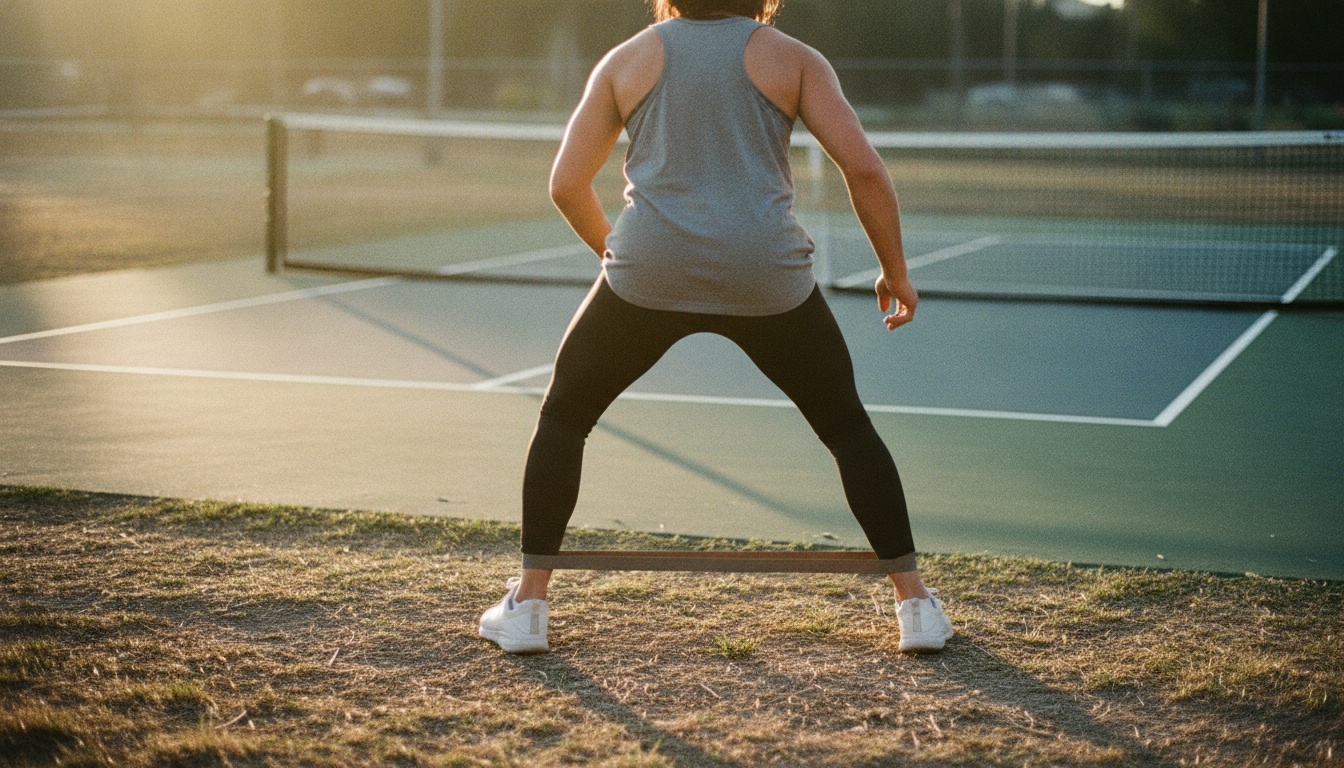
| Lateral Band Walk (kitchen-depth stance) | 3 | 15 steps each direction | Increase resistance band; hold the low stance throughout |
| Eccentric Calf Raise | 3 | 10–12 | Single-leg when 12 double-leg feel easy |
A note on Nordic hamstring curls: the first time you try these, you'll either fall face-first into the floor or realize how weak your hamstrings actually are in the eccentric phase. That weakness is exactly what causes hamstring pulls on hard drives. Four to six slow negatives per set — lowering yourself toward the floor over 3–4 seconds — is more effective than any number of walking lunges. Use a resistance band looped under your arms as an assist until you can handle the full movement.
Lateral band walks deserve a specific note. Do them in kitchen stance — knees bent, weight slightly forward, the same athletic position you hold at the NVZ. You're training glute medius under the exact loading pattern you'll need on court. Going upright and standing tall defeats the purpose entirely.
Day B: Core Stability Work That Actually Transfers
Most pickleball players who do core work do crunches and static planks. Those are fine — they're just missing the point. Pickleball asks your core to do three things simultaneously: prevent rotation (holding position against a hard drive), create rotation (loading a forehand), and rapidly sequence both within a single rally. Static planks don't train any of that.
This session prioritizes anti-rotation (Pallof press, dead bug) and pulling strength to counterbalance the dominant-arm push patterns of the sport.
| Exercise | Sets | Reps/Duration | Progression |
|---|---|---|---|
| Dead Bug (arm + opposite leg) | 3 | 5 per side, slow | Add light dumbbell in extended arm |
| Pallof Press (band or cable, perpendicular anchor) | 3 | 10 per side | Increase resistance; move further from anchor |
| Band Face Pull (shoulder height) | 3 | 15 | Increase resistance; pause 1 sec at peak retraction |
| Single-Arm Dumbbell Row | 3 | 10 per side | Add load when form holds through all reps |
| Wall Slide (arms at 90°, slide overhead) | 3 | 10 | Add resistance band around forearms |
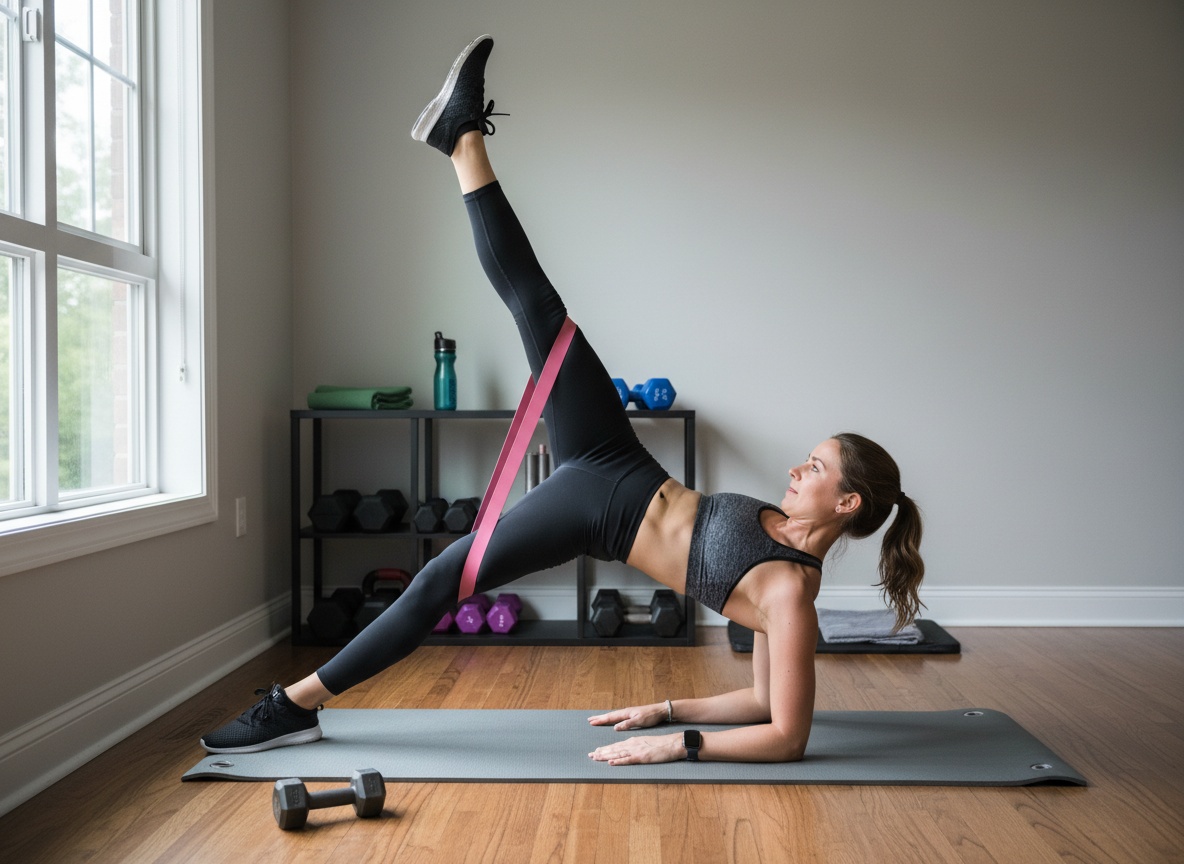
| Side Plank with Hip Abduction | 3 | 30 sec hold + 10 abductions | Increase hold time; add resistance band above knees |
Face pulls are the single most important exercise in this table for shoulder health. High repetition, consistent week-over-week, moderate resistance. They directly load the posterior rotator cuff and external rotators — exactly the musculature that keeps the humeral head centered and prevents the impingement pattern. If you only add one exercise from this entire program, make it face pulls. Three sets of 15, every Day B session, indefinitely.
The wall slide is worth demonstrating to yourself: stand with your back flat against a wall, elbows bent 90°, upper arms parallel to the floor. Now slide your arms overhead while keeping your entire back, arms, and wrists in contact with the wall. Most pickleball players can't do this without arching their lumbar or losing contact somewhere. That limitation is thoracic extension restriction in action. The wall slide both diagnoses and corrects it — the same movement, repeated.
"The players who've been playing with us since we started FORWRD — four, five years straight — they all have something in common. They do work like this off the court. Not complicated, not a lot of time. But they're consistent about it. The ones who burned out or got hurt? Almost all of them just played and never addressed what playing was doing to them."
Day C: Grip, Forearm & Hip Mobility
This is the session most players want to skip — because it doesn't feel like "real" training. No heavy loads. You won't be sore tomorrow. But Day C is doing two things at once: rebuilding the forearm extensor-flexor balance that prevents pickleball elbow, and undoing the hip flexor and thoracic compression that kitchen stance accumulates over weeks of play.
| Exercise | Sets | Reps/Duration | Progression |
|---|---|---|---|
| 90/90 Hip Stretch (passive hold) | 2 | 60 sec per side | Active 90/90 with internal rotation; add overhead reach |
| Thoracic Extension over Foam Roller | 2 | 60 sec at 3 spinal segments | Segmental extension with 10 active reps per segment |
| Turkish Get-Up (5–15 lbs) | 3 | 3 per side | Add 5 lbs when form is clean through all reps |
| Wrist Extension with Band (elbow straight, arm supported) | 3 | 15 | Increase resistance band; add 1-sec pause at top |
| Reverse Wrist Curl (light dumbbell) | 3 | 12 | Add 2.5 lbs when 12 reps feel fully controlled |
| Farmer's Carry (heavy dumbbells) | 3 | 30 yards | Increase weight; offset carry (uneven weights) for core demand |
The Turkish Get-Up earns its place here because it does something nothing else in this program does: it loads the shoulder through a full overhead range of motion while simultaneously challenging thoracic rotation, hip mobility, and single-leg stability — all in one continuous movement. Start with a water bottle. Learn the pattern before adding load. It looks complicated but the movement itself will show you exactly where your mobility restrictions are.
For the wrist extension work: the movement range is small, the resistance should feel almost too light, and that's correct. This is corrective work, not strength work — the goal is balance between forearm flexors and extensors. Doing these three times per week produces measurable forearm strength symmetry improvements within 6–8 weeks. If you want to support your drilling sessions with the right training aids, the pickleball training equipment guide covers the tools worth owning.
How to Integrate This With Your Court Schedule
Realistic question: how does a 3-day strength program fit with 3–4 court sessions per week without becoming a second job?
Short answer — this program replaces rest days, not court days. Three sessions at 30–40 minutes each adds roughly 2 hours per week. Here's a sustainable template for a player who plays Monday, Wednesday, and Friday:
| Day | Activity |
|---|---|
| Monday | Court play (1–2 hrs) |
| Tuesday | Day A — Posterior Chain (35 min) |
| Wednesday | Court play (1–2 hrs) |
| Thursday | Day B — Core + Shoulder Balance (35 min) |
| Friday | Court play (1–2 hrs) |
| Saturday | Day C — Grip + Hip Mobility (30 min) |
| Sunday | Rest |
If you're playing four or five days a week, cut the strength sessions to twice weekly. Keep Day A (posterior chain) and Day B (shoulder balance) as your priorities — those address the two highest-injury-risk imbalances. Day C compresses into a 15-minute mobility circuit used as a court warm-up.
One realistic warning: the first two weeks will feel like a lot. Your posterior chain will be sore after Day A. Your forearms will feel oddly fatigued after Day C. Push through the first two weeks — those symptoms resolve as adaptation kicks in. The soreness is your body responding to demands it hasn't faced before, not a sign you're overdoing it.
According to PPA Tour research on pickleball and strength training, players who maintain consistent off-court strength work sustain significantly fewer overuse injuries than those who rely on court play alone. That tracks directly with what we see across long-term player feedback. The body adapts to what you ask of it — and pickleball without off-court work asks your weakest links to hold indefinitely.
For the full framework on training periodization and how to build a complete weekly schedule around tournament prep, the Pickleball Health & Fitness Guide 2026 goes deeper on the planning side.
FAQ: Off-Court Strength Training for Pickleball
How many days a week should pickleball players strength train?
Three days per week is optimal for most recreational players — enough training stimulus to build strength and correct imbalances without interfering with court recovery. Players with 4+ court sessions per week can reduce to 2 strength sessions and prioritize posterior chain and shoulder balance work.
Do I need a gym for this pickleball strength program?
No. Every exercise works with resistance bands and a pair of dumbbells — a 15 lb and 25 lb set covers most players. Add a foam roller for thoracic work and a mat, and the entire setup costs under $100. All of it fits in a bag.
How long until off-court training improves my performance on court?
Most players notice improved stability and reduced joint fatigue within 3–4 weeks. More significant strength gains — especially in the posterior chain — show up at the 6–8 week mark. Injury prevention benefits accumulate over months: the goal is building reserves before demand exceeds capacity, not treating pain after it starts.
I already have shoulder pain. Should I start this program?
If you have acute shoulder pain, see a physical therapist before adding any new loading. The Day B shoulder balance work (face pulls, wall slides, rows) is generally appropriate for mild chronic tightness, but active impingement or rotator cuff pathology needs clinical assessment first. The shoulder mobility guide covers the specific mechanics.
Is this program appropriate for pickleball players over 60?
Yes — players over 60 often see the largest benefit. The program's emphasis on eccentric loading and mobility directly addresses the muscle quality changes that accelerate with age. The progressions are conservative: start light, focus on movement quality, build load over weeks. Nothing in this program requires heavy barbell work or high-impact movement.
Why doesn't a generic gym program work as well for pickleball players?
Generic athletic programs target symmetric bilateral strength. Pickleball creates specific asymmetric imbalances: unilateral shoulder overload, anterior-chain dominance from kitchen stance, and grip/forearm extensor-flexor imbalance from paddle mechanics. This program targets those exact patterns — which is why a generic program can leave you stronger overall but still vulnerable to the exact injuries pickleball causes.

Leave a comment
This site is protected by hCaptcha and the hCaptcha Privacy Policy and Terms of Service apply.