

Pickleball is the fastest-growing sport in America. You already know that. What's less talked about is why — beyond the social angle — people who start playing tend to stay playing three, four, five sessions a week for years. The answer is that pickleball is a genuinely excellent workout at almost every age and fitness level, low-impact enough to sustain for decades, and competitive enough to keep you pushing.
But there's a real gap between playing pickleball and training for pickleball. Most recreational players fill that gap with chronic nagging injuries, stalled improvement, and eventually burnout. This guide closes it. Whether you're two weeks in or a 4.5-rated competitor building a serious training program, you'll find what you need here.
Last Updated: July 2026
Is Pickleball Actually Good Exercise? The Data Settles It
Short answer: yes, significantly more than most people expect. The caveat is that "good exercise" depends on what you're doing with those two hours on the court — and whether you're treating it like an athlete or like a social hour with occasional sprinting.
The Cleveland Clinic ranks pickleball as a legitimate moderate-to-vigorous intensity workout. Harvard Health calls it "a boon for older adults looking for a sustainable, fun way to stay fit." Research published in the Journal of Aging and Physical Activity tracked adults over 50 and found they spent 70% of their total court time in the moderate-to-vigorous heart rate zone — the range where cardiovascular adaptation actually happens.
That's not trivial. For context, most gym-goers don't hit that threshold in a standard workout.
Where people undersell pickleball is by comparing it to tennis or running. It isn't tennis. Smaller court, slower ball, more strategic deceleration built into the kitchen game. That's not a weakness — it's what makes pickleball sustainable at 60, 70, and 80 in ways that running and tennis aren't. You can play two hours of competitive doubles and your knees won't revolt the next morning. Try that with 90 minutes of tennis.
The other underappreciated aspect: pickleball's fitness return compounds. Players who play consistently three times a week for six months develop real cardiovascular improvements — lower resting heart rate, improved cholesterol profiles, measurable bone density gains. This isn't light exercise with rackets. It's a genuine aerobic and anaerobic training stimulus when you're actually competing.
For a full comparison of pickleball vs. other activities across health markers: FORWRD's complete pickleball health benefits breakdown. For how the sport specifically supports weight loss goals: Pickleball for Fitness and Weight Loss: The 2026 Guide.
What Pickleball Does to Your Cardiovascular System
Here's what's happening inside your chest during a session:
Pickleball's training pattern is interval-based by nature. Each rally is a burst of high-intensity movement — quick shuffles, explosive reaches, split-steps and recoveries — lasting 3 to 20 seconds. Then a brief pause between points. Then another burst. For 60 to 90 minutes.
That structure — short high-intensity efforts with brief recovery — is exactly what produces cardiovascular adaptation. It's the same architecture as HIIT training, without the psychological misery of box jumps in a gym. Your heart rate fluctuates between 120 and 165 bpm depending on session intensity, meaning you're doing genuine aerobic AND anaerobic work simultaneously.
Long-term effects documented in cardiological research: lower resting heart rate, improved VO2 max, better blood pressure, and improved cholesterol profile. Players who consistently play at least 3 days per week show statistically significant improvements in all four metrics within 6 weeks of starting. That's not a slow process — it's remarkably fast adaptation for adults over 50.
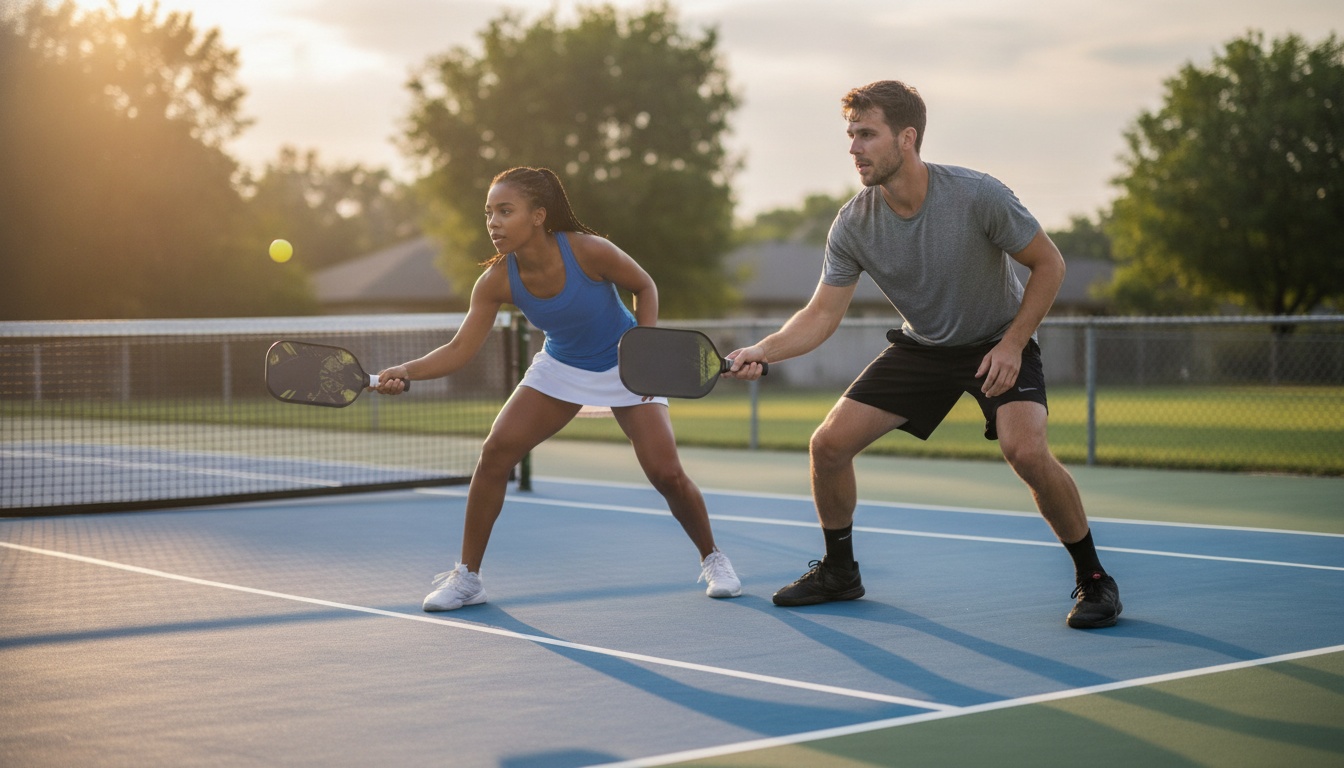
Doubles vs. singles matters. In doubles you cover half the court — rallies are longer, there are more brief rests. Average heart rate: 125–145 bpm, which is the moderate aerobic zone. Singles consistently pushes players to 145–165+ bpm — full vigorous-intensity cardio. If your primary goal is cardiovascular training, singles is a stronger stimulus. If the goal is sustainable long-term play with lower injury risk, doubles wins. Most serious players do both: structured singles or skinny singles for conditioning days, doubles for longer sessions and match play.
How Many Calories Does Pickleball Burn?
The honest range, adjusted for body weight and intensity:
- Recreational doubles (casual open play): 250–350 calories/hour for a 150-lb player
- Competitive doubles (league or tournament effort): 350–450 calories/hour
- Recreational singles: 400–500 calories/hour
- Competitive singles (max effort): 500–650 calories/hour
Body weight scales this significantly — a 200-lb player burns roughly 30–35% more calories in the same session. And here's a counterintuitive fact: as you get better at pickleball, the same casual session burns fewer calories, because a more efficient cardiovascular system needs less effort to sustain the same output. That's why improving players need to progressively increase session intensity or add singles play to maintain the training stimulus.
For reference: walking burns 250–300 calories/hour for a 150-lb person. Recreational doubles beats that almost every session. Vigorous pickleball is broadly comparable to cycling, swimming laps, or a steady jog. Not equivalent to high-intensity running — but not the glorified ping-pong dismissals suggest.
One clear-eyed note on calories and weight loss: pickleball is effective for maintaining a healthy weight and losing it gradually, especially for people who'd otherwise be sedentary. It's not a turbo-charged fat-loss protocol. If weight loss is the primary driver, pair pickleball with caloric awareness and some off-court strength work. The combination produces materially better results than either alone.
The Muscles Pickleball Works — and the Ones It Doesn't
Pickleball is full-body in the sense that no major muscle group completely checks out. But "full-body" can be misleading — here's what's actually happening.
Heavily loaded muscles:
- Quadriceps and glutes — every split-step, every lateral shuffle, every deep dink position demands these muscles to absorb and produce force
- Calves and ankles — constant push-off and quick direction changes
- Rotator cuff and shoulder girdle — every overhead, every drive, every third-shot drop
- Forearm flexors and extensors — paddle control, spin generation, dinking precision
- Core (obliques especially) — rotational stability on every single shot
Underworked muscles (where imbalances develop):
- Posterior chain (hamstrings, glutes in hip extension) — pickleball movement is forward-dominant, not posterior-dominant
- Hip flexors — chronically shortened from the bent-knee athletic stance
- Non-dominant arm and shoulder — significant bilateral imbalance develops without off-court correction
- Upper back and rhomboids — thoracic extension is underloaded; players who only play tend to develop forward head posture and rounded shoulders over years
These imbalances aren't cosmetic. They're where chronic injuries originate. Tight hip flexors lead to lower back pain. Weak posterior chain leads to knee strain. Underdeveloped upper back leads to rotator cuff impingement. Addressing these with targeted off-court work isn't optional for players who want to play for decades — it's the thing that separates players who play at 75 from those who stop at 58 due to chronic injury.
Pickleball for Seniors: Why 50+ Players Are Getting the Best Workout in the Building
Let's address the obvious: yes, pickleball skews older. The USAPA reports the median player age is in the mid-40s, with the highest participation growth in the 55–75 bracket. That's not a demographic weakness — it's the clearest signal that pickleball solves a real problem this age group faces.
Adults over 50 face specific fitness challenges that most exercise programs handle poorly: impact sensitivity (aging joints can't sustain the pounding of running), isolation (gym culture is often solo and impersonal), motivation sustainability (people stop going to the gym; they don't stop showing up to pickleball), and the risk calculus of contact sports.
Pickleball addresses all of these simultaneously.
On impact: the smaller court means less total distance per point. The plastic ball requires less violent striking mechanics than a tennis ball. The kitchen-game strategic structure creates natural deceleration — you're not sprinting all-out every rally. For knees that can't handle running, this is the difference between being active and being sidelined.
On bone density: moderate-impact loading — which pickleball delivers through lateral movement, quick direction changes, and ground reaction forces — builds and maintains bone density better than pure low-impact activity like swimming or cycling. Controlled impact stimulus is a feature, not a flaw. For adults worried about osteoporosis, the distinction matters.
Then there's the mental health data. A 2022 study in Leisure Sciences found pickleball players showed significantly lower rates of depression than tennis players and other exercisers — attributed specifically to the sport's social structure (open play rotations create consistent new social contact, the culture is unusually welcoming, and post-game socializing is genuinely common). That's not incidental. Depression and social isolation are among the leading contributors to cognitive decline and premature mortality in adults over 65. A sport that keeps people both physically active and socially connected is doing double duty that no gym machine can replicate.
The Warm-Up Protocol That Prevents Most Pickleball Injuries
Most pickleball injuries aren't bad luck. They're predictable outcomes of cold muscles being asked for explosive lateral movement from the first point.
The fix isn't complicated. The research across racket sports is consistent: a structured 10–15 minute warm-up reduces injury risk by 30–40%. You're not trying to become a gymnast. You're getting your joints lubricated, your muscles activated, and your neuromuscular system primed to respond at full speed without tearing something in the first set.
Three-phase structure that works:
Phase 1 — Light Cardio (3 minutes). Walking briskly, easy jogging, or light rope jumping. Target: heart rate at 100–110 bpm. Don't skip this and jump straight to stretching — stretching cold muscles is counterproductive and can cause micro-tears on its own.
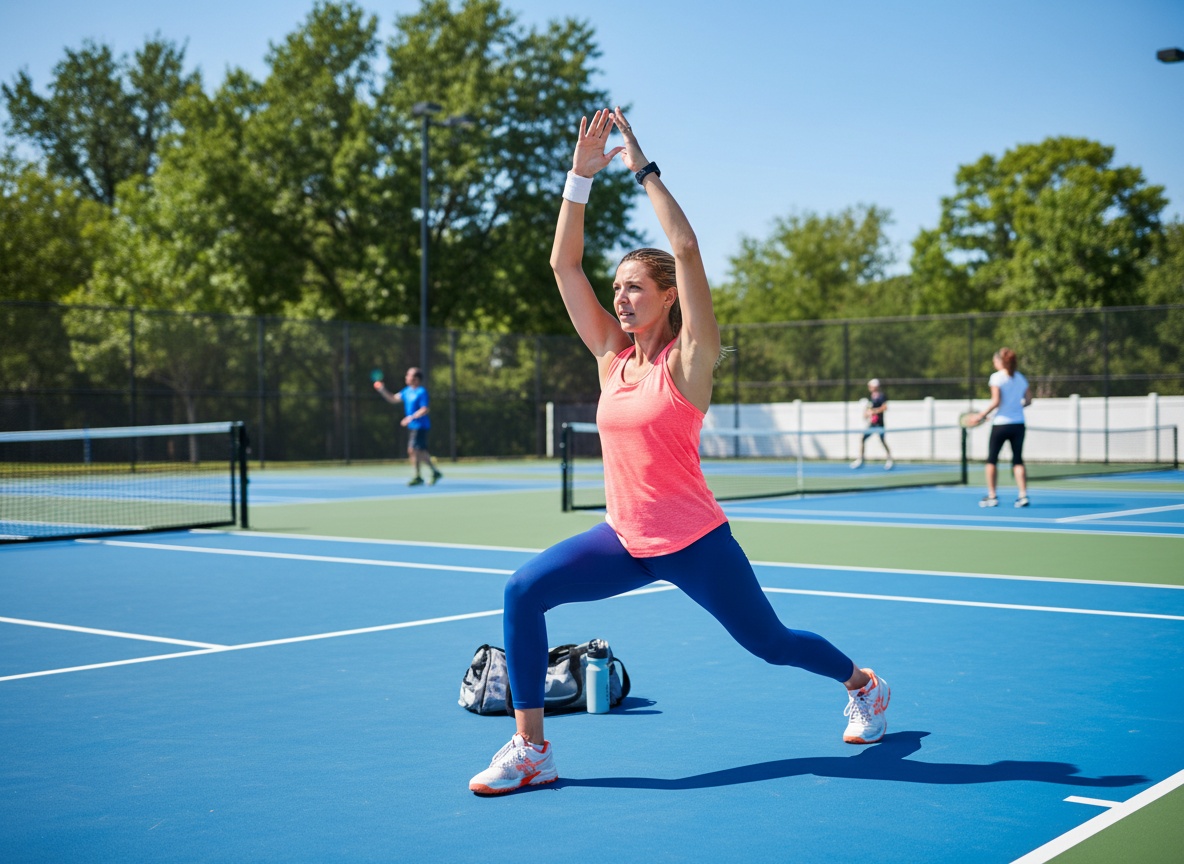
Phase 2 — Dynamic Mobility (7 minutes). Leg swings front/back and lateral, hip circles, arm circles, thoracic rotations, walking lunges with a rotation, high-knee walks, ankle circles. Move through full range of motion under control. This is where you prepare the specific joints pickleball loads most — hips, shoulders, ankles, thoracic spine.
Phase 3 — Sport-Specific Activation (5 minutes). Lateral shuffles at half speed, a few split-step reps, soft dinking rallies to warm up the forearm and shoulder. Ease into competitive intensity over the first 5–10 minutes of actual play before going full effort.
For the complete 15-minute warm-up sequence with specific exercises, modifications for common joint issues, and a printable reference card: FORWRD's full pre-game warm-up guide →
The 5 Most Common Pickleball Injuries (And How to Avoid All of Them)
U.S. emergency rooms treated an estimated 19,000+ pickleball-related injuries in 2023 — up from roughly 9,000 in 2020. The injury curve tracks the participation curve almost perfectly, which means the problem isn't the sport. It's players skipping basics. Here are the five injuries you'll see in every club:
1. Pickleball Elbow (Lateral Epicondylitis)
The most common. Technically identical to tennis elbow — inflammation at the lateral epicondyle from repetitive wrist extension and forearm supination. It shows up as outer elbow pain that worsens during backhand drives. Prevention: strengthen forearm extensors off-court, use a paddle with enough weight to reduce vibration loading, and warm up forearms before every session. Full prevention protocol with specific exercises: Pickleball Elbow Prevention Exercises.
2. Shoulder Impingement
Second most common, and often misdiagnosed. The rotator cuff isn't the source — the shoulder blade stabilizers (serratus anterior, lower trapezius) are underactive, causing the humerus to impinge on the acromion during the overhead motion. Thousands of serves and drives without addressing this becomes a structural problem. Prevention: scapular stability exercises, improving thoracic extension, and a hard rule: don't play through shoulder pain. Three-phase prevention plan: Stop Pickleball Shoulder Injuries.
3. Knee Pain (Patellar Tendinopathy)
Persistent knee pain in pickleball is almost always a load management failure — too much court time, ramped up too fast, without adequate quad and glute strength to absorb repetitive impact. Prevention: strengthen quads and glutes off-court, use proper knee-bend mechanics (hips back, weight centered, not valgus collapse), and — critically — don't play through acute knee pain hoping it resolves on its own. It compounds.
4. Ankle Sprains
The most acutely sudden injury in pickleball — rolling an ankle on a quick direction change. Prevention: proprioceptive training (single-leg balance work, bosu-ball drills), playing in shoes with real lateral support (running shoes are designed for forward motion; they're the wrong tool for a multidirectional sport), and strengthening the peroneals. Gear that matters for prevention: Pickleball Injury Prevention Gear Breakdown. Players with chronic tennis elbow should also see: Best Pickleball Paddle for Tennis Elbow — paddle selection matters more than most people realize.
5. Lower Back Strain
Most back pain in pickleball comes from the constant bent-knee, forward-lean stance. That posture tightens hip flexors, which anterior-tilts the pelvis, which compresses the lumbar spine. Over 90 minutes, hundreds of times a week, it accumulates. Prevention: hip flexor stretching post-match (not pre-match), posterior chain strengthening (hip hinges, deadlifts), and load distribution off the court — specifically, carrying bags that evenly distribute weight across both shoulders. A sling bag throwing load to one side makes the imbalance worse every session. For players with chronic back pain, we've put together a specific bag comparison: Best Pickleball Bag for Back Pain.
Recovery Is Training Too — What to Do After Every Match
Here's what most recreational players do post-session: pack their bag, chat for five minutes, drink water in the car. That's it.
That's also why most recreational players have chronic tightness they can never quite shake.
Recovery isn't passive waiting. The 20 minutes immediately after a match is the most productive window for flexibility work — muscles are warm, blood flow is high, and tissues respond to stretching much more readily than they do cold. Static stretching (hold for 30–60 seconds) is what works post-match, not dynamic. Target: hip flexors, hamstrings, calves, chest, and thoracic spine. Five minutes on these specific areas post-match does more than 20 minutes of pre-session stretching attempts.
Hydration math: a 90-minute outdoor session in summer heat generates 1.5–2 liters of sweat. Plain water replaces volume; electrolytes replace the minerals. For sessions over 60 minutes in warm weather, sodium and potassium replacement matters more than pure water volume. That's what prevents next-day fatigue and the cramping that shows up in sessions three and four of the week.
Sleep is the recovery variable most players completely ignore. Growth hormone release during deep sleep drives muscle repair and adaptation. Players who consistently get 7–8 hours recover faster, have lower injury rates, and improve their game faster than those who don't — regardless of how good their stretching or nutrition is. Sleep isn't optional recovery. It's mandatory physiology.
Complete recovery protocol with specific stretching sequences, nutrition timing, and sleep optimization: FORWRD's Pickleball Recovery Guide →
Off-Court Training That Makes You a Better Pickleball Player
Playing more pickleball makes you better at pickleball. But there are fitness qualities the sport doesn't train efficiently — and gaps in those areas cap your ceiling.
Lateral agility and deceleration. Court movement in pickleball is explosive, lateral, and multi-directional. The gym work that transfers: lateral band walks, skater hops, lateral shuffles with controlled deceleration, agility ladder work. These build the specific neuromuscular patterns pickleball uses that linear running never develops.
Core stability (not strength). The core training that transfers to pickleball isn't crunches. It's anti-rotation and anti-extension — the ability to resist force while transmitting it through your kinetic chain. Pallof press, plank variations, dead bugs. These directly improve shot stability and reduce lumbar stress on every drive and dink.
Grip strength. Paddle control lives in your forearm and hand. Targeted grip work — dead hangs, farmer carries, rice bucket exercises — directly reduces elbow injury risk AND improves touch on delicate volleys. It's one of the highest-ROI training investments a pickleball player can make.
Hip mobility. Tight hips are the root cause of most low back pain in pickleball players. Not tight hamstrings — tight hip flexors and limited hip internal rotation. The 90/90 stretch, pigeon pose variations, and couch stretches performed consistently 3 times per week address this specifically. It's not stretching for the sake of stretching; it's maintenance for a sport-specific structural limitation.
For tournament players building a serious off-court program: How to Train for a Pickleball Tournament: 8-Week Plan. For training equipment that supports structured drilling and conditioning: Best Pickleball Training Equipment 2026.
Building Fitness Through Pickleball Itself
Off-court training is valuable. But some of the best pickleball-specific conditioning comes from how you play, not where.
Skinny singles as conditioning work. Play the full court with half the width — each player uses just their diagonal half. It dramatically increases movement demands while keeping the tactical element alive. It's exhausting in the best way and produces real cardiovascular adaptation. If your open play sessions feel comfortable, add skinny singles. Full protocol: Skinny Singles: 45-Minute Drill Session Guide.
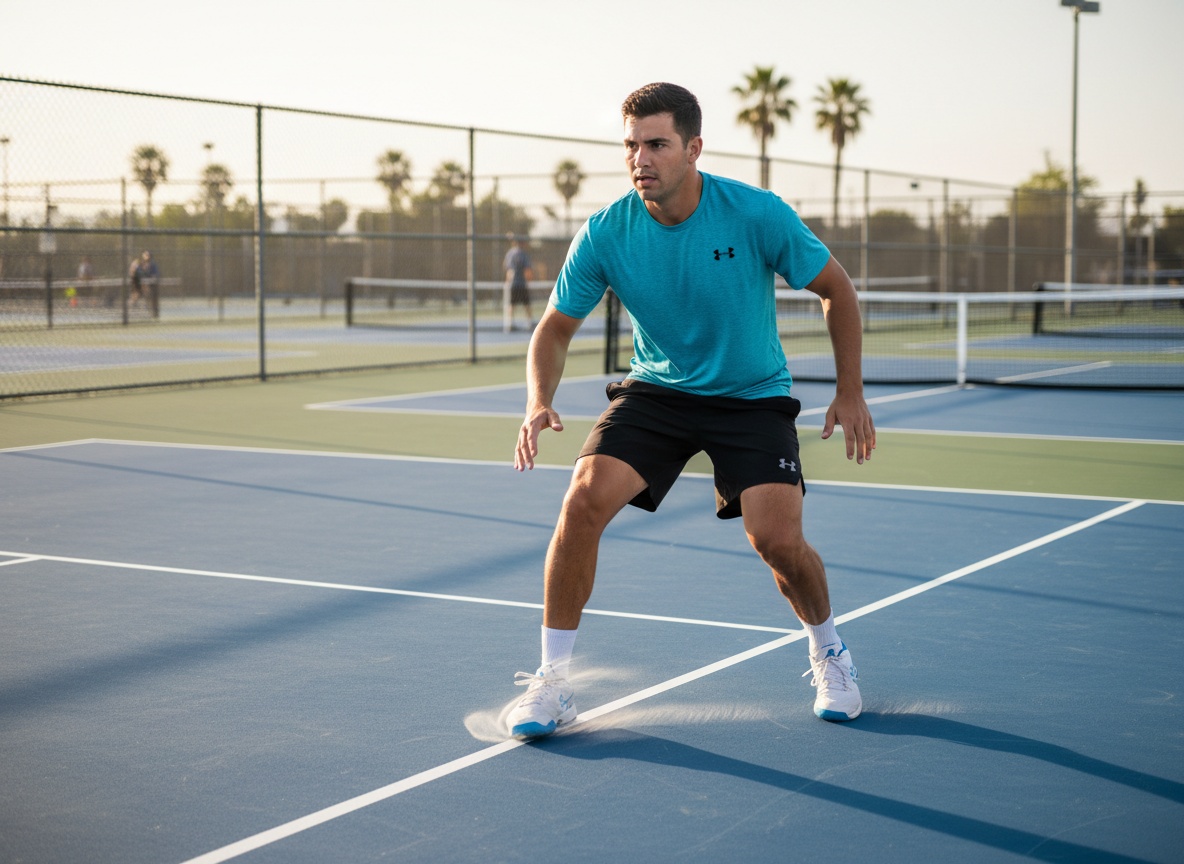
Athletic intent on every shot. Most recreational players coast between points. Reset your ready stance aggressively after every point. Move with purpose. Decelerate under control rather than coasting into position. This sounds minor. Over 90 minutes, it's the difference between a moderate social workout and a serious one.
Structured drilling over casual rallying. Twenty minutes of intentional drilling — third-shot drop sequences, kitchen dink patterns, reset drills — produces more improvement and more conditioning than an hour of casual open play. Drilling demands higher concentration and creates more repetitions of high-difficulty shots. For a structured drilling protocol from beginner through intermediate: Pickleball Drills for Beginners: The 12-Week Progression.
Footwork quality ties all of this together. Players who move athletically — split-stepping before each shot, shuffling rather than crossing feet, decelerating intentionally into position — work significantly harder in the same match than players who drift and reach. Better footwork is better fitness. Both together: Why Your Pickleball Errors Start With Your Feet.
The Mental Health Benefits Nobody Talks About
The physical benefits get all the coverage. The mental health case for pickleball is at least as strong — and arguably more differentiating.
That 2022 Leisure Sciences study found something specific: among exercisers matched for intensity level, pickleball players showed the lowest rates of depressive symptoms. Not swimmers, not tennis players, not gym-goers — pickleball players specifically. The researchers attributed this to three structural features almost unique to the sport: consistent new social contact through open play rotations, clear week-over-week mastery feedback, and natural team bonding in low-stakes competitive settings.
Cognitive benefits are documented separately. The rapid decision-making pickleball demands — read the opponent, predict trajectory, move to position, select the response, execute under pressure, all in under a second — is genuine cognitive training. High-cognitive-demand sports are associated with reduced dementia risk in multiple large-scale longitudinal studies. You're not just exercising your heart; you're training your brain.
The social dimension can't be overstated. Pickleball has an unusually inclusive culture — open play welcomes skill disparities, post-game socializing is genuinely common, and the rotational format means you meet new people constantly. For adults who've seen social circles shrink post-career, that community isn't a side effect of pickleball. It's a primary health outcome. Social isolation is a stronger mortality predictor than smoking. A sport that reliably combats it is doing something that gym equipment, supplements, and most fitness apps fundamentally can't.
More on managing the mental performance side: Pickleball Mental Game: Stay Calm, Reset Fast, and Win More Points →
Your Weekly Pickleball Fitness Schedule
Here are two actual training weeks — one for a player building consistency, one for a competitive player optimizing. Adjust based on your recovery, life schedule, and how your body responds.
3 Days/Week (Building Consistency)
- Monday: 90 min recreational doubles open play | Full warm-up protocol | 15 min static stretch post-play
- Wednesday: 45 min structured drilling (serve mechanics, third-shot drops, kitchen game) | 20 min off-court hip mobility work
- Saturday: 2-hour session — 60 min drilling, 60 min competitive play | Full warm-up pre-play, full stretch post-play
- Off days: Active recovery only — walking, easy cycling, or yoga. Keep blood moving; avoid full rest days until Sunday.
5 Days/Week (Competitive Player)
- Monday: 75 min competitive open play (high intensity) | 20 min static stretch
- Tuesday: 30 min off-court training — lateral agility, core stability, grip work. No court play.
- Wednesday: 90 min — 45 min drilling, 45 min competitive play
- Thursday: Active recovery + 30 min hip flexor and thoracic mobility
- Friday: 60 min singles or skinny singles — highest conditioning stimulus of the week
- Saturday: League play or tournament — full competitive effort
- Sunday: Full rest. Non-negotiable. Adaptation happens during rest, not during play.
Both schedules share one hard constraint: no more than two consecutive high-intensity days. Two hard sessions back-to-back is the fastest route to overuse injuries. More training isn't always more improvement — when it's not paired with adequate recovery, it's often less.
Frequently Asked Questions
Is pickleball good exercise for weight loss?
Yes, with realistic expectations. Recreational doubles burns 250–450 calories/hour depending on intensity and body weight. That's meaningful — comparable to cycling or casual swimming. For steady weight loss, pair it with dietary awareness. Pickleball alone without addressing nutrition will maintain your weight; combining it with a modest caloric deficit produces real results. The consistency advantage is huge: people actually show up to pickleball multiple times a week. Sporadic gym sessions have better per-session calorie burn but far worse long-term adherence.
How many times per week should I play?
Three times per week is the sweet spot for most recreational players — enough frequency to see real cardiovascular and skill improvement without accumulating injury risk from insufficient recovery. Competitive players can go 4–5 times with proper periodization (varying intensity, building in off-court work, taking one full rest day weekly). Playing every day without structured recovery is how chronic overuse injuries develop.
Is pickleball safe for people with bad knees?
Generally yes, with modifications. The smaller court, slower ball, and shorter match duration make pickleball far more knee-friendly than tennis, basketball, or running. Common sense adjustments: strengthen your quads and glutes off-court to improve joint support, use proper knee-bend mechanics (hips back, no knee-over-toe collapse), wear supportive court shoes, and avoid playing on hard courts if you're in an acute flare. Playing through sharp knee pain is never smart — it compounds.
What's the best way to prevent pickleball elbow?
Three things, in order of impact: strengthen your forearm extensors off-court (eccentric wrist curls and reverse curls 3x/week), choose a paddle with adequate weight for your arm strength (paddles that are too light create higher vibration loading, counterintuitively), and warm up your forearm properly before every session with wrist circles and gentle resistance work. Most pickleball elbow cases develop gradually — players ignore early warning signs until it becomes debilitating.
Can pickleball replace going to the gym?
Partially, not fully. For cardiovascular health, balance, coordination, and general aerobic conditioning: pickleball is excellent and competes well with gym alternatives. What it doesn't do is produce significant muscle mass gain, posterior chain strength, or anti-rotation core stability — all of which require resistance training. For most recreational players, pickleball + basic off-court mobility and strength work (2 days/week) produces better overall fitness than gym-only programs, with dramatically better adherence.
How does doubles vs. singles compare for fitness benefits?
Singles is harder. More court to cover, higher average heart rate (145–165+ bpm vs. 125–145 bpm in doubles), more total movement per point. Singles is closer to vigorous-intensity exercise by standard cardio metrics. Doubles is moderate-intensity. Both produce cardiovascular adaptations when played consistently. If pure fitness is the goal, rotate between both formats — doubles for longer sustainable sessions, singles or skinny singles for higher-intensity conditioning days.
Is pickleball safe for seniors?
It's arguably the best exercise option for adults over 60. The combination of cardiovascular benefits, bone density stimulus (from controlled impact), balance and coordination development, and social engagement makes it uniquely well-suited to the 60–80 demographic. The main risk is the same as any sport: jumping in too quickly without adequate warm-up or physical conditioning. Start at recreational pace, use proper footwear, and build intensity over weeks rather than days.
What should I eat before playing pickleball?
Timing matters more than the specific food. A light carbohydrate-based meal or snack 60–90 minutes before play works well for most players — a banana, toast, or a small portion of oatmeal. Heavy protein or fat before play slows digestion and can cause side stitches during explosive movement. For sessions over 90 minutes, bring a carbohydrate source (sports drink, banana) for mid-session energy. Post-play: protein within 30–45 minutes supports muscle repair.
How long does it take to get fit playing pickleball?
Most players notice meaningful cardiovascular improvements within 4–6 weeks of consistent play (3x/week). Resting heart rate drops, endurance improves, recovery between intense rallies gets faster. Full body composition changes take 3–6 months. Skill improvement tends to outpace fitness improvement in the first several months — the fitness is happening underneath the skill development even when it's not obvious. Stay consistent.
Do I need off-court training if I play pickleball regularly?
Not to play — but yes, to play without chronic injury. Pickleball creates systematic imbalances (dominant-side overload, hip flexor tightening, posterior chain underuse) that accumulate into injury if unaddressed. 2–3 days per week of targeted mobility and strength work fills the gaps the sport creates. It doesn't need to be complicated: hip flexor stretches, single-leg balance work, band pull-aparts, and grip training cover most of what the game misses.
"Most players we talk to train for pickleball the wrong way — they play more, hurt themselves, rest, repeat. The players who actually improve and stay healthy treat the time off the court as part of the training. Warm-up, recovery, strength work. That's what separates players who play for decades from players who play for two years before their shoulder gives out."
— Topher, Co-founder, FORWRD
The Right Gear for Serious Training

Your gear setup affects your training directly. A bag that throws load to one side, doesn't organize your gear efficiently, or forces you to dig through a mess before every session adds friction to the training habit you're trying to build.
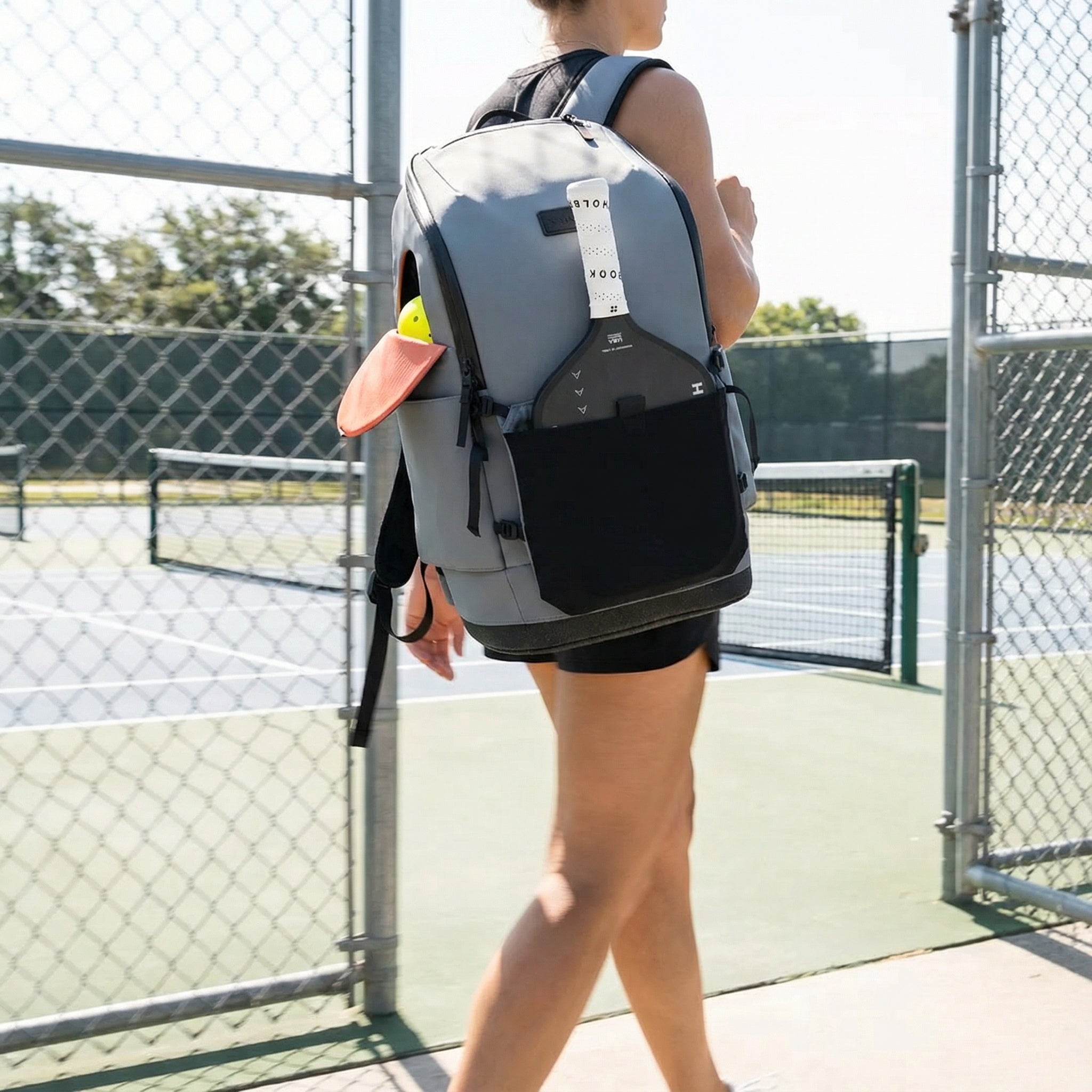
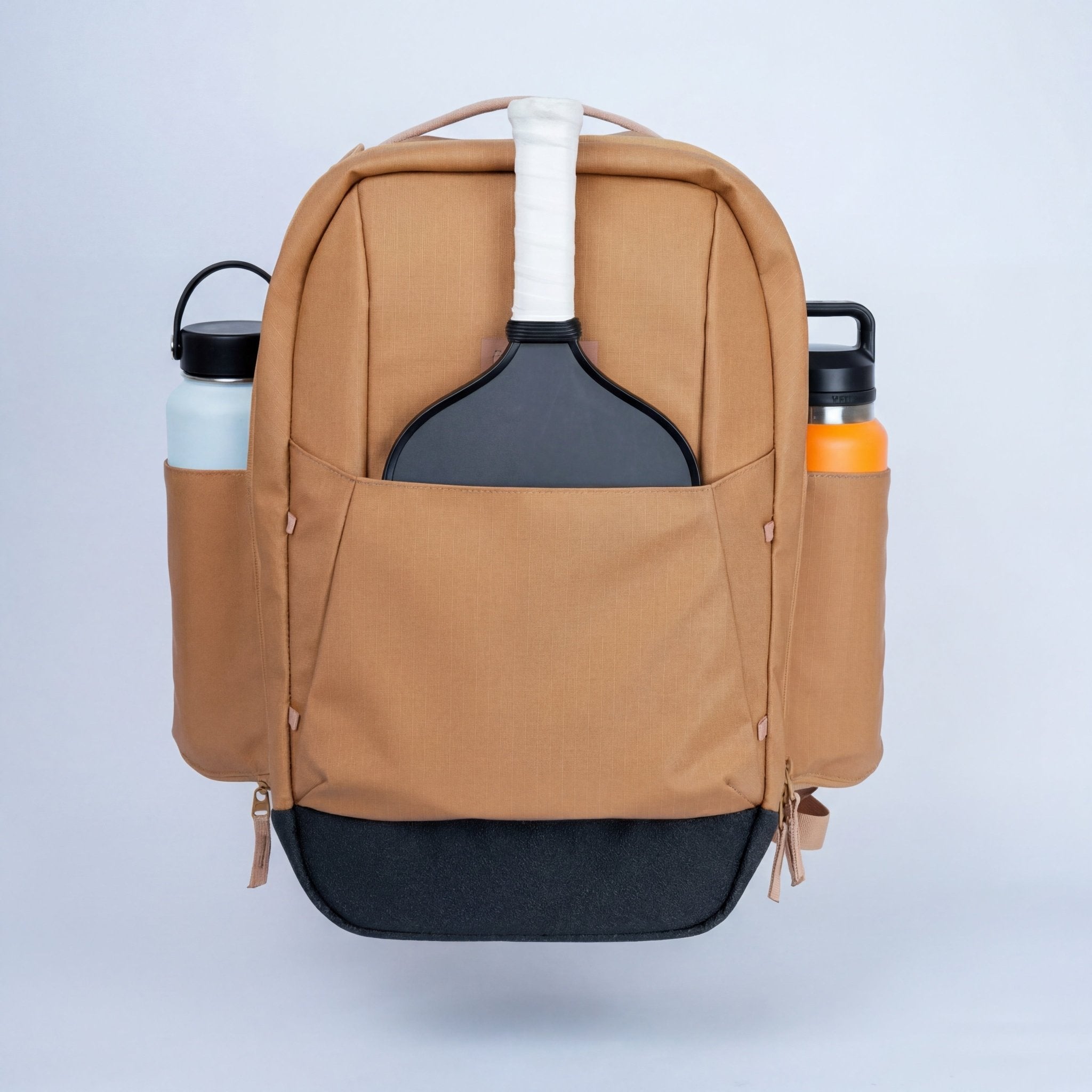
The Court Ranger V2 ($195) was designed around the player who trains seriously: dual-shoulder harness system for balanced load distribution (relevant for back pain prevention), modular paddle sleeve to protect your paddle between sessions, and 16" laptop sleeve for those training plans. It's designed with feedback from 500+ players who told us what breaks down in cheaper bags after six months of regular use.
Related Articles — The Pickleball Health & Fitness Cluster
Each article below goes deep on one aspect of the broader health and fitness topic covered in this guide.
- Discover the Top Pickleball Health Benefits for an Active Lifestyle
- Pickleball for Fitness and Weight Loss: The 2026 Guide
- How to Warm Up Before Pickleball: The 15-Minute Court Protocol
- Pickleball Elbow Prevention Exercises: 2026 Guide
- Stop Pickleball Shoulder Injuries: The 3-Phase Plan
- Pickleball Injury Prevention Gear 2026: Honest Breakdown
- Best Pickleball Paddle for Tennis Elbow: Top Picks
- Essential Tips for Effective Pickleball Recovery After Every Match
- How to Train for a Pickleball Tournament: 8-Week Plan
- Best Pickleball Training Equipment 2026: What Actually Works
- Why Your Pickleball Errors Start With Your Feet
- Skinny Singles Pickleball: 45-Minute Drill Session Guide
- Pickleball Drills for Beginners 2026: The 12-Week Progression
- Pickleball Mental Game: Stay Calm, Reset Fast, and Win More Points
- Best Pickleball Bag for Back Pain: Ergonomic Bags Ranked

Leave a comment
This site is protected by hCaptcha and the hCaptcha Privacy Policy and Terms of Service apply.