

Last updated: May 2026
Singles pickleball is a different game from doubles — not just tactically, but physically and mentally. You're covering the full court alone. There's no partner to bail out your weak side. The kitchen rush that anchors doubles play becomes a liability in singles if you time it wrong. Most players who struggle in singles aren't making technique errors — they're applying doubles strategy to a game that punishes it.
This guide breaks down how to cover the court, structure your serve patterns, build winning point sequences, and stop giving away free points. It's built around what actually changes at 3.5+ competitive singles play — not generic tips that apply to any racket sport.
Singles vs. Doubles: What Changes and Why It Matters
The court dimensions are identical — 44 feet by 20 feet, same kitchen, same baseline. But singles removes the doubles-alley awareness and replaces it with full-court exposure. Your partner in doubles effectively cuts the court in half. In singles, you're responsible for all of it.
The tactical implications are significant:
Kitchen rushing is riskier. In doubles, rushing the net after a third shot drop puts two players at the kitchen — your partner covers one side, you cover the other. In singles, rushing the net exposes your entire court width. A well-placed passing shot down the line or a deep lob catches you mid-rush with no recovery angle. Singles players at 4.0+ generally stay back or mid-court far more often than doubles players at the same level.
Serve depth matters more. In doubles, a short serve is embarrassing but your partner can compensate. In singles, a short serve that the returner can step into aggressively gives them a dominant starting position they can exploit all rally long. Deep serves into the corners are the foundation of singles offense.
Stamina is a real factor. You're covering ground every point. Singles players burn 40–60% more calories per hour than doubles players at similar intensity levels — this is simply from the additional lateral and forward-back movement. Build your game plan around energy management, not just tactics.
The 3-ball reset window is narrower. In doubles, if your third shot lands a bit short, your partner might still cover you while you close. In singles, a weak third shot that doesn't fully neutralize your opponent gives them an attack window you have to defend alone. Shot selection at the third ball is more critical than in doubles.
Court Coverage in Singles: Positioning for Every Situation
This is where most 3.0–3.5 singles players lose the most points — not from errors but from being in the wrong spot before the point starts. Here's the positional framework that works at 3.5+ play:
Returning serve: Stand 2–3 feet behind the baseline, centered or slightly biased toward your backhand side (where most servers will target). Don't hug the baseline — you want room to read the serve before committing. After the return, your default is to retreat to 6–8 feet behind the baseline, not rush the net.
During a baseline-to-baseline rally: Center yourself after every shot — return to the midpoint of the likely angle range for the next ball. If you just hit a cross-court backhand from your left side, the highest-probability return is either back cross-court or down the line to your right. Position at the center of that arc (roughly 1–2 feet toward center court) before they contact the ball.
When you hit a deep, penetrating ball: Move forward 3–4 steps into mid-court. This is your transition zone. Don't rush all the way to the kitchen — that exposes you to the lob. But don't stay at the baseline either, or you invite them to angle you off the court with a drop shot.
When you hit a weak, short ball: Don't advance. Hold your baseline position or retreat slightly. A defensive shot that lands mid-court gives your opponent an attack angle — move forward into a ball they're about to drive is a recipe for getting burned.
Court coverage decision tree:
- Ball is deep to their corner → they'll likely go cross-court or down the line → center yourself between those two angles, step 2–3 feet inside baseline
- Ball is in their mid-court (they have time) → stay near baseline, expect a driving attack, be prepared to defend wide
- Ball is at their feet (bouncing up below net height) → they MUST lift it → step forward, expect a floating ball, be ready to attack
- You're out of position wide → aim your recovery shot down the middle, buy time to reset to center, don't go for a winner from wide
Ben Johns, who dominated singles play on the APP and PPA Tour before focusing on doubles, was known for rarely being caught in the wrong spot — not because he was fast, but because his positioning after every shot was efficient. He rarely needed to sprint because he was almost never starting from the wrong place.
Serving Strategy: How to Build Points From the Start
The serve in singles is a weapon. Not because it's inherently harder to return — it's the same court — but because there are no doubles partners to cover the angles the serve creates. You can realistically serve your opponent off the court in singles; in doubles, the returner's partner helps cover the exposed side.
Target the corners, not the center. A serve to the center of the baseline gives the returner a comfortable contact point with no positioning stress. A serve to the backhand corner pulls them wide, shortening the return angle and forcing a cross-court ball that often pops up. A serve to the forehand corner of the ad side forces a short recovery angle back to center.
Vary depth more than spin. At the 3.0–3.5 level, extreme spin serves are often mis-hit rather than defensively countered — the returner simply frames it. At 4.0+, consistent 18-inch depth variation (not just "deep" vs. "medium") creates real positioning uncertainty. A deep serve followed by a medium-depth serve to the same corner forces a different contact point on their return.
The USA Pickleball official rules cover singles-specific serving rotations and side-switching conventions — worth a quick read before your first competitive singles match if you've only played doubles.
Serve to their weaker side consistently. Unlike doubles where servers might mix patterns for surprise, singles rewards consistency to the weakness. If their backhand return consistently goes cross-court and short, serve their backhand 70% of the time and build your third-shot plan around the cross-court short ball you expect.
Serve-return pattern planning: Know before you serve what you'll do with a cross-court return (drive it down the line), a down-the-line return (go cross-court), and a short return (attack it into the open court). Having the answer ready before the return arrives is what separates players who win serve games from players who react.
The 3-Shot Pattern That Wins Most Singles Exchanges
The most reliable point-building sequence in competitive singles — verified across APP and club-level play — isn't the serve-and-volley or the kitchen rush. It's this:
- Deep serve to a corner. Pull them wide, reduce their return angle options.
- Drive the return down the open line. When they return cross-court (which they will most often from that corner), the open court is down the line. Drive it there — not an all-out winner, but a penetrating shot to the deep corner that keeps them running.
- Attack the short ball. The running return from the corner is rarely deep. Their recovery shot is often mid-court or slightly short. Attack it into the other corner — usually cross-court now because the line is covered.
This pattern doesn't require outlier speed or power. It's geometry. A deep ball to a corner creates a recovery run. The recovery run creates a weak return. The weak return creates an attack window. Repeat.
The variation that beats players who read this pattern early: after step 2, instead of attacking step 3, drop shot to the near corner. If they've been running away from the net expecting the deep ball, a well-placed drop shot lands before they can recover.
Anna Leigh Waters runs a version of this pattern on the women's APP Tour singles events — her serve placement to the backhand corner followed by an aggressive cross-court forehand drive is predictable, and it still works at the professional level because the execution leaves no margin for the returner to counter.
Defensive Resets: How to Survive When You're Out of Position
Being out of position in singles isn't a mistake — it happens in every rally. The mistake is trying to win points from a defensive position. Here's how to reset rather than compound the problem:
When you're pulled wide: Don't go for the line. The temptation when you're stretched wide is to try to pass them down the line — it's the shorter distance. But it's also the highest-risk angle from that position. Go cross-court to the deeper corner, buy time, and recover center.
When you're pushed deep: A lob is your friend. Not a defensive lob floated anywhere — a deep, directional lob to a corner that buys you 3–4 seconds of recovery time while they chase it. A well-placed lob from deep baseline to the far backhand corner is genuinely difficult to attack and usually produces either a neutral reset or a setup for your next shot.
When the pace is too high: Block it, don't drive it. Trying to out-drive a player who's already set up for pace-on-pace exchange is low-percentage. Block the ball back down the middle — it's a higher-margin target (net is lowest in the center), it buys recovery time, and it resets the rally to neutral. A neutral rally beats a lost point every time.
Stop going for winners when you're losing the rally. This sounds obvious but it's the #1 habit error at 3.0–3.5. When players are out of position, they try to end points fast because they feel rushed. That's when errors happen — wide shots, long shots, shots into the net. The best singles players are remarkably patient in defense. They grind out neutral balls until the point is genuinely winable, then attack.
Common Singles Mistakes That Give Away Free Points
Rushing the net after the third shot. Effective in doubles. Dangerous in singles unless your third shot was truly excellent and you're closing against a player at the same level or below. Half-speed net rushes that get you caught mid-court are the source of the most avoidable points in singles play.
Serving short. A short serve in singles is an invitation. Even at 3.0 level, a short serve that the returner can step into changes their entire return position and confidence. Deep serves are non-negotiable. If your serve consistently lands mid-service box, you're starting every point in a deficit.
Neglecting the middle of the court. In singles, the ball to the middle of the court (at the net strap, lowest point of the net) is underused. There's no doubles partner split to exploit the middle — but the middle is still the safest shot selection when you're in trouble, and many singles players simply never develop the middle-court groundstroke.
Not recovering center after wide shots. Hitting a ball and watching where it goes instead of immediately moving back toward center is probably the single most common positioning error at the 3.0–3.5 level. Hit and move. Always.
Trying to play doubles singles. Taking 4–6 step forward rushes to the kitchen on every third shot, expecting a partner-covered safety net — these players get passed and lobbed repeatedly and can't figure out why. Singles rewards patience at the baseline, tactical net approach, and geometric shot selection far more than it rewards aggression for its own sake.
FAQ: Pickleball Singles Strategy Questions
How is singles pickleball different from doubles?
Singles requires full court coverage with no partner, making positioning after every shot critical. Kitchen rushing is riskier because you expose the entire court width. Serve depth matters more since there's no partner to compensate for a weak serve. Stamina and recovery efficiency are also significantly more important than in doubles play.
Where should you stand in singles pickleball?
Return serve from 2–3 feet behind the baseline. After each groundstroke, recover to the center of the probable return angle — roughly court center, 6–8 feet behind the baseline during baseline rallies. Move into mid-court (3–4 steps forward) only after a deep, penetrating ball you controlled. Don't rush the net unless your approach shot was truly excellent.
What is the best strategy for pickleball singles?
Serve to corners consistently, drive returns to the open court, and attack short balls rather than forcing low-percentage winners. Recover to center after every shot. Use lobs and middle-court resets when out of position. Build points through geometric consistency rather than outright power — the player who positions well and makes fewer errors wins most singles matches at the 3.0–4.0 level.
How do you serve effectively in singles pickleball?
Target the backhand corner of the service box on the ad side — it's the most common weak side and creates the smallest return angle. Mix serve depth more than spin: alternating 18–24 inches of depth on the same target corner creates positioning uncertainty. Know before you serve what you'll do with the most likely return pattern.
Is singles pickleball harder than doubles?
Singles is more physically demanding — you cover twice the court with no partner. Tactically, it's not harder, but it requires different skills: better positional discipline, more patient baseline play, and stronger serve strategy. Players who've only played doubles often struggle initially in singles because the net-rush tactics and partner-dependent coverage don't transfer.
Singles is where your positioning habits, serve consistency, and rally patience get tested without a safety net. The players who improve fastest in singles are the ones who stop trying to apply doubles instincts and start treating it as a genuinely different game — which it is.
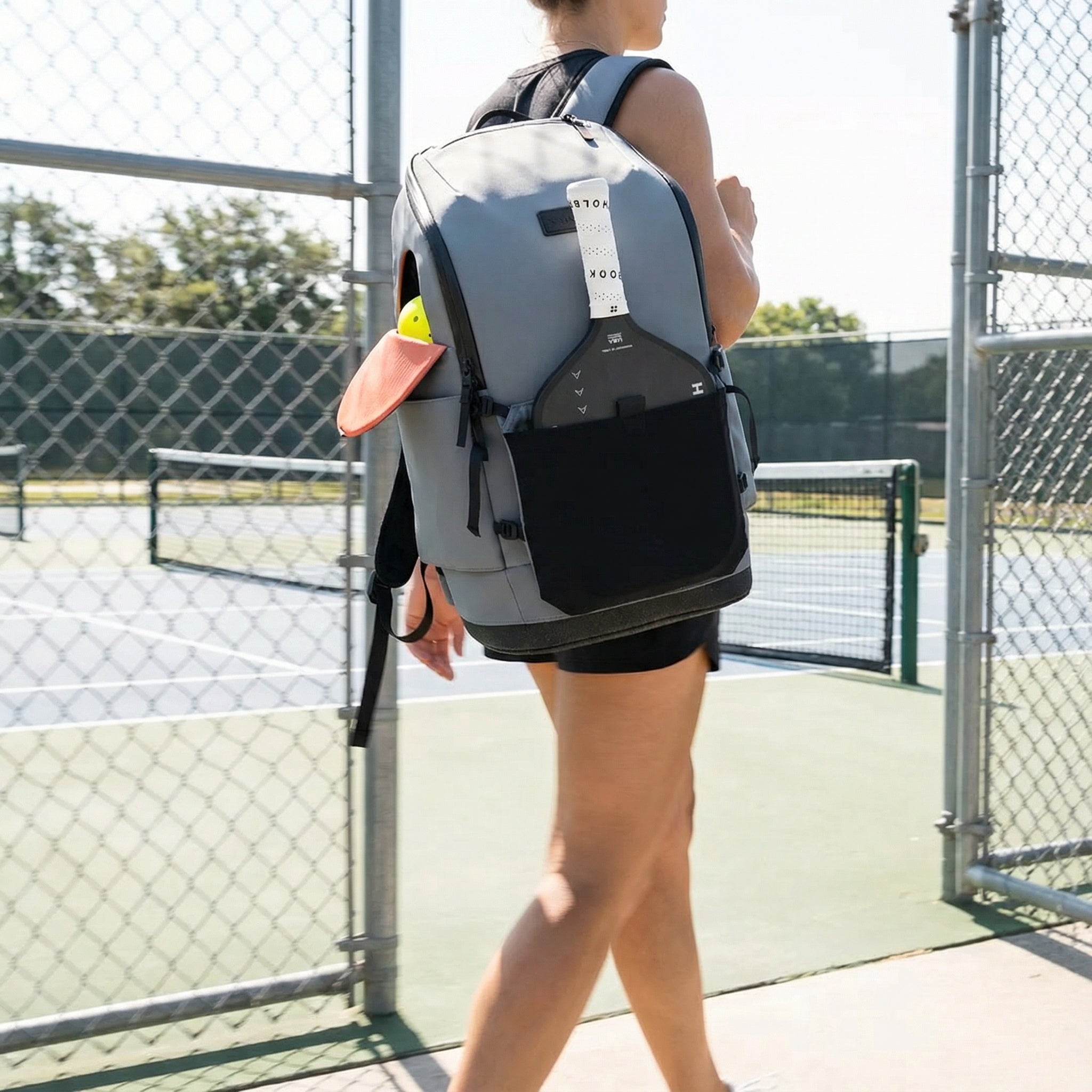
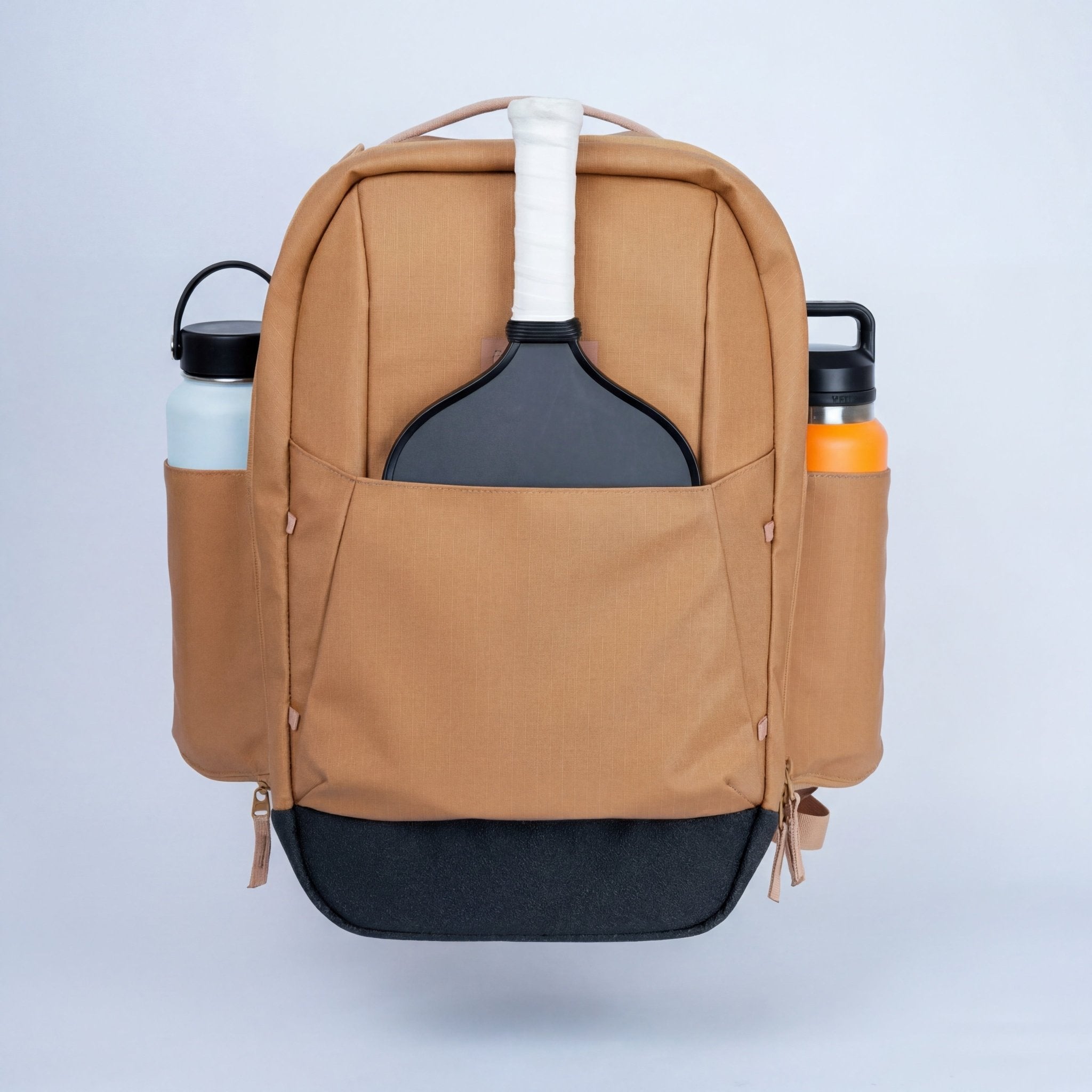
If you're playing singles regularly, you're also putting your gear through more per session. The Court Ranger V2 ($195) carries two paddles, water, extra balls, and a change of clothes in a modular paddle sleeve system built for players who practice hard. Light enough to bring to a solo session without thinking about it — and built to hold up through the kind of weekly mileage serious singles play demands.

For the full foundation — court layout, scoring, serving rules, and doubles strategy — read our Pickleball Beginner's Guide alongside this one. And if the third shot drop is the piece of your singles game holding you back, our Third Shot Drop Guide covers the mechanics and drills in full.

Leave a comment
This site is protected by hCaptcha and the hCaptcha Privacy Policy and Terms of Service apply.