



Stacking in pickleball means both doubles partners line up on the same side of the court before the serve or return, then shift to their preferred sides immediately after ball contact. It's 100% legal under USAPA rules, and when both players know the communication protocol, it's one of the most reliable ways to keep your team's strongest shots in play every single rally.
Most stacking guides explain what it is. This one explains when to actually use it, which hand signals prevent mid-court collisions, and the half-stack variation that most resources skip entirely — including a decision matrix no other stacking guide has published.
Last updated: June 2026
Table of Contents
- What Stacking Is (And Why Teams Use It)
- The Two Stacking Formations: Standard and Half-Stack
- When to Stack: The 4 Situations That Make It Worth It
- How to Execute the Stack Without Telegraphing It
- Stacking at Different Skill Levels: 3.5, 4.0, 4.5+
- FAQ: Pickleball Stacking Questions
What Stacking Is (And Why Teams Use It)
In conventional doubles, your court position rotates with the score. The server has to serve from the correct box — even side for even scores, odd side for odd — and both players end up wherever the previous rally left them. Fine, in theory.
In practice? That rotation creates a systematic problem for a lot of partnerships. Classic example: a right-handed player paired with a left-handed player. Without stacking, both backhands sit in the middle on every other rotation. That's a repeatable weakness that good opponents will find and exploit by game 2.
Stacking solves it. Both players line up on the same side before contact, the ball gets hit, and then each player moves to their preferred side. Done right, both forehands face the center — every point, regardless of score or who's serving.
Handedness is the most common reason teams stack, but it's not the only one. Teams also use stacking when:
- One player has a significantly stronger forehand and should always control the center
- One player is faster and needs to stay in the middle to handle more balls
- One player's backhand is a genuine liability — not just weaker, but one opponents are actively targeting
The real advantage isn't just positioning — it's consistency. When you're not guessing which side you'll end up on each rally, your shot selection becomes automatic. At 4.0 and above, that automatic readiness translates directly to better attack opportunities and fewer unforced errors.
The Two Stacking Formations: Standard and Half-Stack
Standard stack means stacking on both the serve and the return of serve.
On the serve: Both players start on the same side of the court. The server steps into the correct service box (required — USAPA rules have no flexibility here), hits the serve, and immediately moves toward their preferred side. The partner is already positioned near that preferred side and gives the server room by shifting out.
On the return: Same principle. The returner steps to make the return from the correct position. The non-returner is already shaded toward the preferred side. After the return, the returner shifts across. Both players end up where they want to be — ideally before the third shot lands.
Half-stack is the variation most guides skip. It means stacking only on the serve, playing conventional on return-of-serve points.
Why bother? Because return-side stacking is significantly harder to execute cleanly. The returner is already under pressure reading the serve — adding a formation shift on top of that is a lot to manage. Half-stack lets your team get the positional benefit on your service games without the added cognitive load on return games.
For players learning stacking, this is the right entry point. Half-stack the serves. Get clean at the signals and the movement. Then add return-side stacking once the mechanics are automatic.
When to Stack: The 4 Situations That Make It Worth It
Stacking isn't a universal upgrade. It's a tool that works in specific situations — and a liability when those situations don't apply.
1. You have a lefty-righty partnership. This is the clearest case. Without stacking, you have two forehands facing out and two backhands meeting in the middle on alternating points. Stack correctly and both forehands point center every rally. Ben Johns and his partners have made this a centerpiece of their mixed doubles strategy at the PPA Tour level.
2. One player is significantly more aggressive or faster. In mixed doubles especially, keeping the more athletic player in the center changes the team's attack profile. They intercept more balls, create more put-away opportunities, and free the other player to handle their side without cross-court pressure.
3. One player's backhand is being actively targeted. Not just weaker — a real liability that opponents have identified and are exploiting. Stacking removes that target from a predictable position.
4. You're playing opponents who have a targeting system. Some teams run a play: they always go to the backhand of whoever just served. Stacking disrupts their predictability. They have to recalibrate, which costs them half a step in shot preparation. That half step adds up in a tight third game.
There's also a clear "when NOT to stack": if you and your partner struggle with communication under pressure. The positional benefit of stacking is exactly zero if you end up colliding mid-court in a key rally. Conventional positioning with clear communication beats stacking with bad communication every time.
When stacking is working, it opens more offensive opportunities. A forehand positioned in the center creates better contact angles for the speed-up attack — two tactics that compound when both partners have them automatic.
How to Execute the Stack Without Telegraphing It
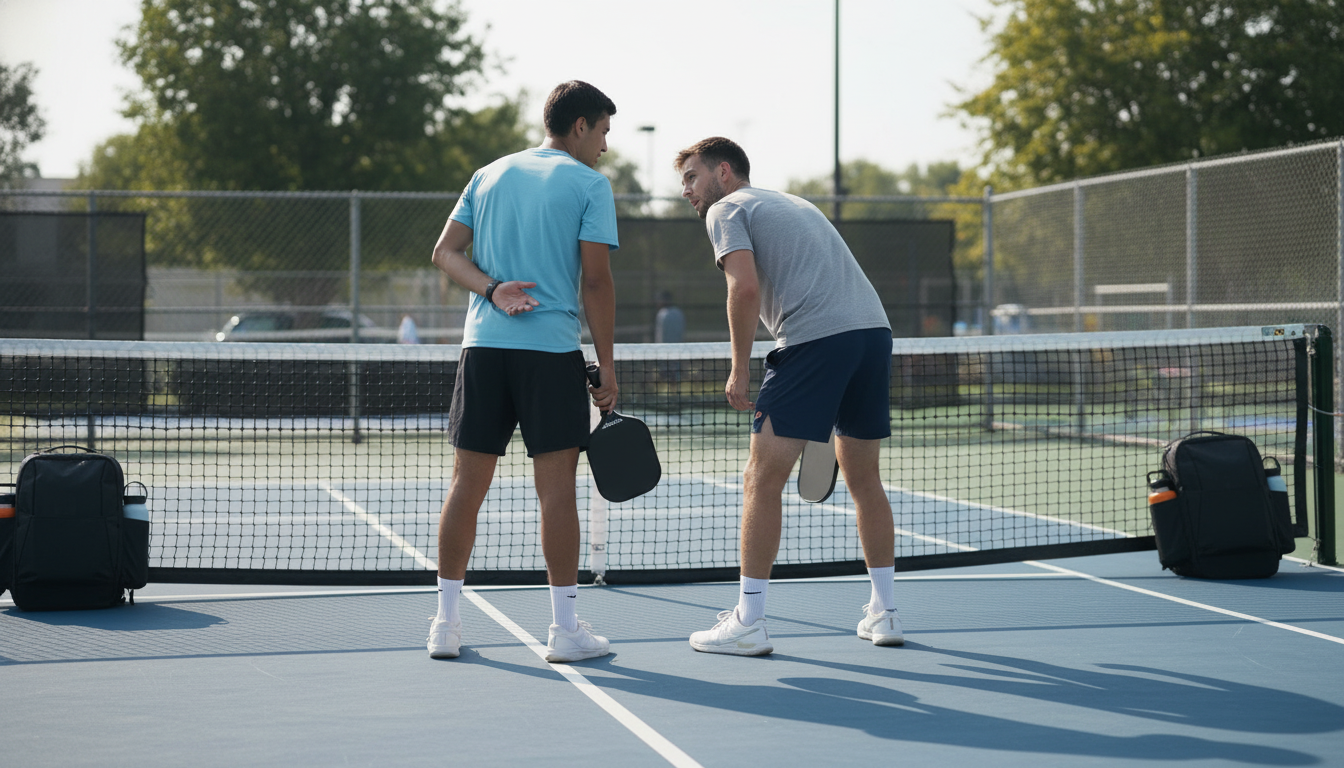
Here's where most stacking guides leave you hanging: they explain the formations but not the communication protocol — the specific signals and movement rules that make stacking work on a live ball at 12 feet from the net.
This is the part that actually determines whether stacking helps or hurts your team.
The Stacking Decision Matrix
| Signal | Server / Returner | Partner | What Breaks Down |
|---|---|---|---|
| Open hand (behind back, pointing to preferred side) | Hit and shift to preferred side | Read signal, move to opposite side | Partner moves same direction — collision mid-transition |
| Closed fist (behind back — no stack this point) | Hit and stay conventional | Stay conventional | One player stacks anyway — positional mismatch |
| Verbal "switch" called behind the back pre-serve | Serve and shift | Move to their side | Called too late — partner can't adjust in time |
The signal comes before contact — not after. Most beginners signal after hitting the ball. By then, their partner has already started moving and can't redirect. The pre-contact signal is the whole game.
Three rules that fix 90% of stacking execution errors:
- Signal early. Show the hand signal at least 1–2 seconds before you step into the service box or make contact on return. Give your partner enough time to process and set.
- Move decisively. Once the signal is set, both players commit to their direction. Hesitation causes collisions. If you see a bad ball coming mid-transition — call it out and deal with it, but don't freeze your movement.
- Middle balls belong to the player moving toward center. Middle-ball coverage during a stack shift is the single most common breakdown. Agree on this in advance: whoever is transitioning toward the center owns the middle.
"The most common stack mistake we see at club play isn't the wrong formation — it's the signal coming after the serve. By the time your partner sees it, they've already taken a step. That step is hard to undo." — Grub, FORWRD
For teams that have the stacking signal locked in, pairing it with a varied offensive toolkit pays dividends. The lob strategy guide covers when pulling opponents back off the kitchen line is the right call — a tactic that works especially well once your net positioning is already controlled by a consistent stack.
Stacking at Different Skill Levels: 3.5, 4.0, 4.5+
At 3.5 — stacking is a learning exercise, not a tactical weapon.
Most 3.5 players try stacking before they've developed consistent communication with their partner — and it backfires. The transition movement during the serve disrupts shot quality. The positional benefit doesn't compensate for the added mental overhead. You end up thinking about the stack instead of thinking about the next ball.
That said, 3.5 is a legitimate time to practice stacking in rec play where the stakes are low. Start with half-stack on serve only. Get the signal clean and the movement automatic before adding return-side complexity.
At 4.0 — stacking starts paying off.
This is where the calculus changes. At 4.0, players are consistent enough that the transition movement doesn't tank shot quality. The positional benefit compounds: keeping your forehand in the middle more often means more attacking opportunities. More attacks at 4.0 means more won rallies.
One clean, reliable stacking formation beats two half-managed ones. Pick standard stack or half-stack. Run it consistently. Don't try to mix signals mid-match until it's automatic.
At 4.5+ — stacking is assumed.
Competitive teams at 4.5 and above almost always stack. The question isn't whether to stack — it's how to read opponents who are also stacking, how to vary formations to prevent opponents from predicting your positioning, and whether to run a fake stack (set up the signal, don't execute) to freeze teams who've learned to adjust. Layer in a solid third shot decision framework — by 4.5+, both should be automatic reads. This is where stacking gets genuinely interesting — it becomes part of a broader formation strategy, not just a positional fix.
FAQ: Pickleball Stacking Questions
What is stacking in pickleball?
Stacking means both doubles partners position on the same side of the court before the serve or return, then move to their preferred sides immediately after ball contact. It's a positioning strategy that lets teams override the normal score-based court rotation to keep each player's strongest side consistently in play.
Is stacking legal in pickleball?
Yes — completely legal under USAPA rules. The only requirement is that the server must serve from the correct service box based on the score (even score = right/even side, odd score = left/odd side). Where the non-serving players stand anywhere else on the court before contact is unrestricted.
When should you use stacking in doubles?
Stacking works best for lefty-righty partnerships, for teams where one player is significantly faster or more attack-oriented, or when one player's backhand is being actively targeted by opponents. It pays off most at 4.0+ where players are consistent enough that the formation shift doesn't hurt shot quality.
How do you call a stack in pickleball?
Most teams use a hand signal given behind the back while opponents watch the ball: open hand means "we're stacking this point," closed fist means "play conventional." The signal must be set before contact — typically 1–2 seconds before the server steps into the box or the returner makes contact. Verbal signals work too but are harder to hide from attentive opponents.
What's the difference between stacking and conventional doubles positioning?
In conventional positioning, each player stays on whichever side they land in after the previous rally — rotation is determined by the score. Stacking lets teams override that rotation to keep preferred sides constant throughout the match. The trade-off: stacking requires communication discipline and movement precision that conventional positioning doesn't demand.
The strategy's straightforward once both players commit to the protocol. The part teams underestimate is the between-point mental load — tracking signals, confirming switches, and staying focused on execution while also managing timeouts, hydration, and gear.
If you're playing tournament-level doubles and finding the between-point overhead adds up, having gear that's organized and accessible helps. The Court Ranger V2 keeps everything in reach so your sideline focus stays on strategy — not digging through your bag at 6-5 in the third.


Leave a comment
This site is protected by hCaptcha and the hCaptcha Privacy Policy and Terms of Service apply.