

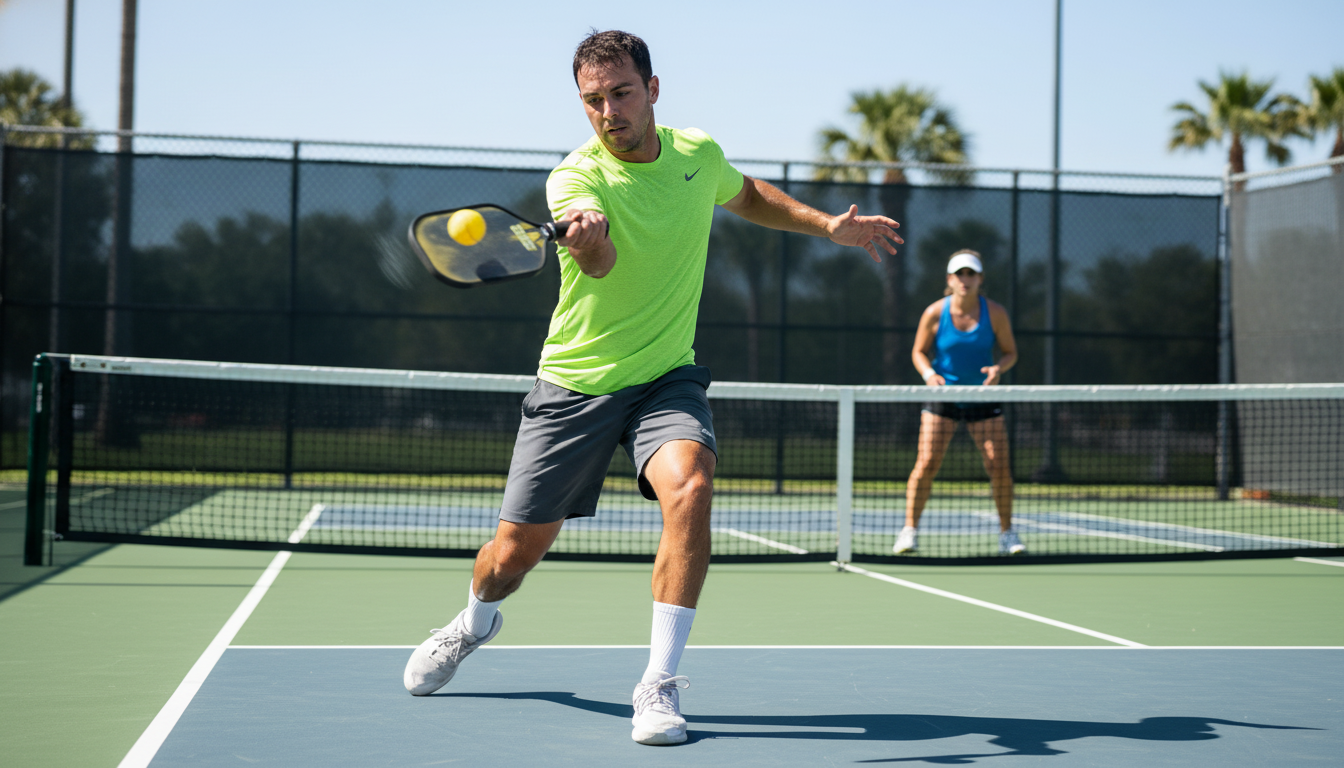
The third shot drive works — but only when you've read the situation correctly. Drive when the return is short and sitting up, when your opponent hasn't locked in at the kitchen, or when you've spotted a backhand that keeps giving them trouble. Drop when the return is deep, you're pinned at the baseline, and they're already set with paddles up. The choice isn't a preference — it's a read. This guide maps that decision into a framework you can run automatically.
Last updated: June 2026
Third Shot Drive vs Third Shot Drop: The Real Decision
Most pickleball instruction frames the drive-vs-drop debate as a skill question: "Are you good enough to drop, or do you default to driving?" That framing is wrong — and it's the reason players waste energy trying to drop balls that should absolutely be attacked.
The real framework is situational. The third shot drop exists because when you're pinned deep at the baseline against opponents who are set at the kitchen line, driving gives them a comfortable ball at chest height to put away. Floating a soft drop into the NVZ neutralizes their position and lets you advance. That logic holds — but it only applies when you're actually in that defensive situation.
Drive when the geometry favors you. Drop when it doesn't. Neither shot is inherently superior — they solve different problems. Getting locked into one default is exactly how predictable players get picked apart at the 4.0 level and above, where opponents have already seen your tendencies by game two.
There's also a third option most guides treat as two separate topics: the drive-to-drop sequence. Hit a hard drive to put your opponents on defense, then drop on the following exchange when they're scrambling. At 4.5+ play, this two-shot pattern often works better than either shot used in isolation. More on that in the Decision Matrix section.
When the Third Shot Drive Is the Right Call
Five specific situations favor the drive over the drop:
1. Short return landing in the transition zone. If the return bounces inside the baseline — especially toward the service box — you're already in a geometrically strong position. The drive is shorter, faster, and your opponents have less time to react. Drop attempts from a short ball often sit up because the angles get awkward when you're too close to the net to arc it in comfortably.
2. Opponent caught transitioning or standing deep. Watch the returner's partner. If they haven't reached the kitchen yet — or if both opponents are stuck in no-man's land — a well-placed drive exploits that gap directly. You're not trying to end the point outright; you're forcing a defensive return that lets you advance two to three steps while they scramble.
3. A backhand that keeps giving errors. Once you've identified that your opponent struggles with fast balls to their backhand (and most recreational players do, at least early in a match), the third shot drive becomes a targeting weapon — not a "couldn't drop it" fallback. Drive to that backhand and make them prove they've fixed the problem before you stop exploiting it.
4. Underspin returns. Slice returns are tricky to drop because underspin causes the ball to shoot through the paddle face. Driving from an underspin return generates natural topspin as you flatten the ball out. That topspin dips the drive sharply at your opponent's feet — hard to attack cleanly compared to a floated-up drive from a topspin return.
5. Significant wind on outdoor courts. The drop requires touch and arc control. In a 15-mph headwind, your carefully weighted drop gets pushed long. In a tailwind, it goes into the net. On windy days, flatter drives are more repeatable than touch shots — the ball doesn't drift as dramatically.
How to Execute the Third Shot Drive (Mechanics)
A third shot drive that doesn't land is worse than a weak drop — it sits up and turns your opponents into attackers. Five mechanics close the margin of error:
Split step timing. Your split step should land at the same moment the opponent's paddle contacts the ball for the return. Land, absorb, then push into the drive. Players who hit flat-footed use only arm swing — no body weight, no pace behind it.
Contact point in front of your hip. Late contact — ball passing your hip before you swing — means you're dragging the paddle through the shot. Ball goes wide or long. Contact just after peak bounce, with your arm extended slightly in front of your leading hip.
Cross-court by default. The cross-court drive has three geometric advantages over down-the-line: more court to work with, lower over the center strap, and you're driving toward your opponent's backhand side if they're right-handed. Down-the-line drives are lower percentage — save them for the fourth shot when you've moved up and spotted a gap.
Add topspin. A flat, chest-high drive is easy to put away. Brush up through the back of the ball so it carries topspin — the ball dips at your opponent's feet and forces a defensive dig instead of an attack. Don't just swing flat through the ball; finish with your paddle face rotating up and over.
"The drive isn't the problem shot — it's the drive with no leverage. If you're buried at the baseline on a deep return and you swing away, you're gambling. If the return is short and they're not at the kitchen, driving is the obvious call." — Grub, FORWRD
Plan the next shot before you hit this one. Drive to the backhand → be ready to volley the open-court reply. Cross-court drive → follow the ball and set for a potential down-the-line return. Third shot drive players who don't think ahead end up stationary and reactive on the fourth shot — which is where the drive advantage evaporates.
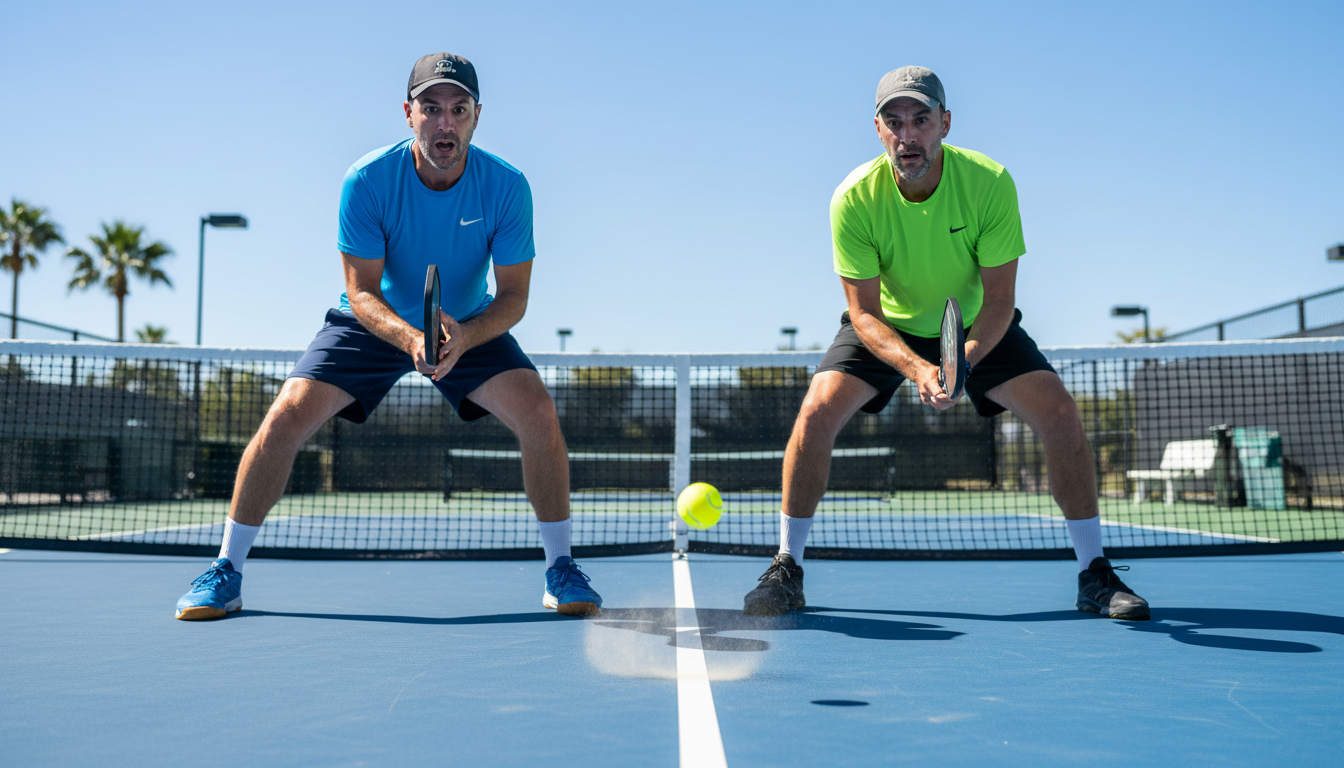
The Third Shot Drive Decision Matrix
No other pickleball guide has mapped this decision into a scannable grid. Here's the four-variable read you're doing in the half-second between bounce and swing:
| Return Depth | Opponent Position | Best Target | Call |
|---|---|---|---|
| Short (transition zone) | One or both transitioning | Backhand + open court | DRIVE |
| Short (transition zone) | Both set at kitchen | Backhand side | DRIVE or DROP |
| Mid-court bounce | Either | Backhand or open court | DRIVE |
| Deep (at/past baseline) | One transitioning | At transitioning player | DRIVE-TO-DROP |
| Deep (at/past baseline) | Both set at kitchen | Any | DROP |
The drive-to-drop sequence in practice: You hit a hard drive to a player who's still transitioning. They dig a defensive reply — maybe a floated ball or a short dink attempt. You're already two steps closer to the kitchen. Now you drop softly into the NVZ on the fourth shot. You've manufactured the favorable position the drop usually needs to be executed on the third shot — just on the fourth instead. This is how 4.5+ players use the drive: not as a replacement for the drop, but as the setup for it.
One more variable the matrix doesn't fully capture: mixed doubles positioning. In mixed doubles, driving at the female player (typically positioned on the ad/left side) is a documented tactical choice in competitive play — not because of skill disparity, but because the mixed doubles scoring format puts specific pressure on one player to cover a harder angle. Forcing that player to hit the more difficult ball is positional strategy, not targeting.
According to USA Pickleball, there are no shot-selection restrictions — you play the geometry, and the geometry often points cross-court to the ad-side player in mixed doubles when the drive is on.
Common Third Shot Drive Mistakes
The fastest way to lose a point from the baseline is a bad third shot drive. Here's what causes them:
Driving a deep return from the baseline. This is the cardinal error. The ball is at your feet six feet behind the baseline, and you full-swing it back against two opponents who are already set at the kitchen with paddles up. They have two full seconds to read the ball and put it away. If the return is deep and they're set — drop it. No exception.
Half-speed drives. A slow drive is the worst of both worlds: not enough pace to threaten, not enough arc to land in the kitchen. Either drive with intent — 70%+ pace, topspin, targeted to a specific spot — or drop. The medium floater gets crushed.
Down-the-line when you haven't earned it. Lowest-percentage drive in pickleball. No margin on the sideline, you're hitting into your opponent's forehand, and you're not creating a cross-court angle that forces movement. Drive cross-court 90% of the time. Down-the-line only when you've spotted a specific gap at the post.
Standing still after the drive. Players who drive and then wait at the baseline give up the advantage they just created. A well-placed drive forces a defensive reply — use that split-second to move up two or three steps. You should be in the transition zone when their response arrives, not still at the baseline.
Being predictable. Three drives in a row to the same spot tells your opponent exactly where to stand. Mix a drive to the other side, or throw in a drop to disrupt the read. The drive is most effective — by far — when your opponent isn't sure whether it's coming.
For a deeper look at what to do after you've advanced to the transition zone, the reset shot guide covers how to neutralize from no-man's land before you make it to the kitchen.
FAQ: Third Shot Drive Questions
What is the third shot drive in pickleball?
The third shot drive is an aggressive flat or topspin groundstroke hit by the serving team on the third shot of the rally. Instead of floating a drop into the kitchen, you drive through the ball with pace — typically cross-court — to force a defensive reply from opponents at or near the net.
When should you drive instead of drop on the third shot?
Drive when the return is short (transition zone or shorter), when your opponent is still moving toward the kitchen rather than set there, or when you've identified a backhand weakness to exploit. Drop when the return is deep and you're pinned at the baseline against set opponents.
How do you hit a powerful third shot drive?
The power comes from your split step timing and weight transfer — not just arm swing. Contact the ball in front of your hip just after peak bounce, drive cross-court for maximum margin, and add topspin so the ball dips at your opponent's feet rather than sitting up at a comfortable height.
Is the third shot drive better than the third shot drop?
Neither is universally better — they solve different problems. The drive wins when geometry favors you: short return, opponent transitioning, or identifiable weakness. The drop wins when you're pinned deep against set opponents. Players who default to one shot become predictable; mixing both makes you difficult to read.
What skill level should use the third shot drive?
The drive is usable at all skill levels — but the criteria that makes it smart changes as you advance. At 3.0–3.5, drive on short returns. At 4.0+, drive as a tactical weapon to target specific weaknesses, exploit opponent positioning gaps, and set up the drive-to-drop two-shot sequence.
For the full picture of how the third shot fits into point construction, see FORWRD's doubles strategy guide and the complete 2026 strategy pillar.

Leave a comment
This site is protected by hCaptcha and the hCaptcha Privacy Policy and Terms of Service apply.