


Last updated: July 2026
Disclosure: This post contains affiliate links to Pickleball Central. If you purchase through our links, FORWRD earns a small commission at no extra cost to you. We only link to products we'd recommend regardless.
For beginners, the right pickleball paddle weighs between 7.5 and 8.2 oz, has a wide-body shape for maximum sweet spot, and uses a polymer core at 16mm thickness. That combination prioritizes control — which is exactly what you need before adding power to your shots.
Here's what I wish someone had said to me before my first purchase: I went straight for a foam-core 13mm paddle a guy at my local courts called "the power paddle." Twelve weeks later, I was hitting balls three feet long on every forehand and had no idea why. My third-shot drop was nonexistent. My dinks sailed more than they died. When I switched to a 16mm polymer core, wide-body paddle — a cheaper paddle, as it turned out — my game got measurably better within two weeks. Not magic. That second paddle just stopped punishing every small error I was still making as a beginner.
This isn't a list of the best beginner paddles. It's the decision framework I wish I'd had before that first purchase — the four variables that actually matter, with none of the marketing noise.
What Actually Matters in a Paddle (and What Doesn't) for Beginners
Paddle marketing is designed to confuse you. "16K weave carbon fiber face." "Hyperfoam core." "Maximum spin texture." For a beginner, almost none of that matters — not because quality doesn't exist, but because those specs optimize for skills you haven't developed yet.
Here's what actually moves the needle in your first 12 months of play:
- Weight — affects reaction speed and arm fatigue over a session
- Core thickness — determines how much the ball "pops" versus how much control you generate
- Body shape — determines the size of your sweet spot
- Grip size — affects wrist mechanics and injury risk
Surface material (graphite vs. carbon vs. fiberglass) matters at the 4.0+ level, when you're deliberately generating topspin and can feel texture differences on contact. Elongated vs. standard paddle length matters once you're developing court coverage — not while you're still sorting out where the ball is going. Don't let those specs drive your decision now.
Paddle Weight: The Variable Most Beginners Get Wrong
Ask most beginner players why they chose their paddle and you'll hear one of two answers: "it felt solid" or "the guy at the shop said it had good power." Both are the wrong criteria — and "good power" is the trap that bit me.
Heavier paddles feel serious. Swing one, and the ball goes far. That's genuinely satisfying in a hitting session. On an actual court, though, you need your paddle to move fast — at the kitchen line, blocking a speed-up, reacting to a drive at your body. A heavy paddle slows that reaction. And every beginner mistake gets amplified: too much power, not enough control over ball placement.
The sweet zone for beginners: 7.5 to 8.2 oz. That range gives you enough stability to feel solid on contact while keeping the paddle light enough to control at the net. Above 8.5 oz tends to cause arm fatigue for players who are building their court time from scratch.
Two exceptions worth noting: if you have existing arm or shoulder issues, go lighter — 7.3 to 7.6 oz. If you're coming from tennis and lighter paddles feel hollow, 8.0 to 8.4 oz gives you more stability without the full drawbacks of a heavy paddle. For most beginners, starting around 7.8 oz is the right call.
The counter-intuitive truth: a lighter, more controlled paddle doesn't mean you hit weaker. It means your mechanics drive power rather than your equipment — and that forces you to develop proper technique faster. Players who start on heavy "power" paddles often plateau earlier because the paddle is doing sloppy work their mechanics haven't learned to do correctly.
"When beginners feel that solid pop from a heavier paddle, they think that's power. What they're actually feeling is the ball staying on the face longer — which is also why they can't place it. A lighter paddle with a thick polymer core gives you the control to build real technique first." — Grub, FORWRD
This connects directly to the bigger debate between power and control — our paddle power vs. control guide goes deeper on that once you're ready for it.
Sweet Spot Explained: Why Wide-Body Paddles Win for Beginners
The sweet spot is the area of the paddle face that produces clean, predictable contact. Hit it and the ball goes where you want. Miss it — toward the frame, the throat, or the outer edge — and the ball wobbles, dies short, or sails. Every paddle has one. For beginners, the goal is to have the biggest sweet spot possible.
Wide-body paddles (typically around 8 inches wide) have a larger, more centered sweet spot than elongated paddles. Elongated shapes give you extra reach — they're longer from tip to handle — but the hitting zone is narrower and punishes off-center contact more harshly. That's a trade-off favoring players who already make reliable center contact.
The math is simple: beginners don't have the consistency yet to reliably hit the center of a narrow paddle face. A wide-body shape forgives the slightly off-center contact that would frame-out on a narrower shape. More usable hits. More rallies. Faster skill development because you're actually practicing technique — not chasing mishits.
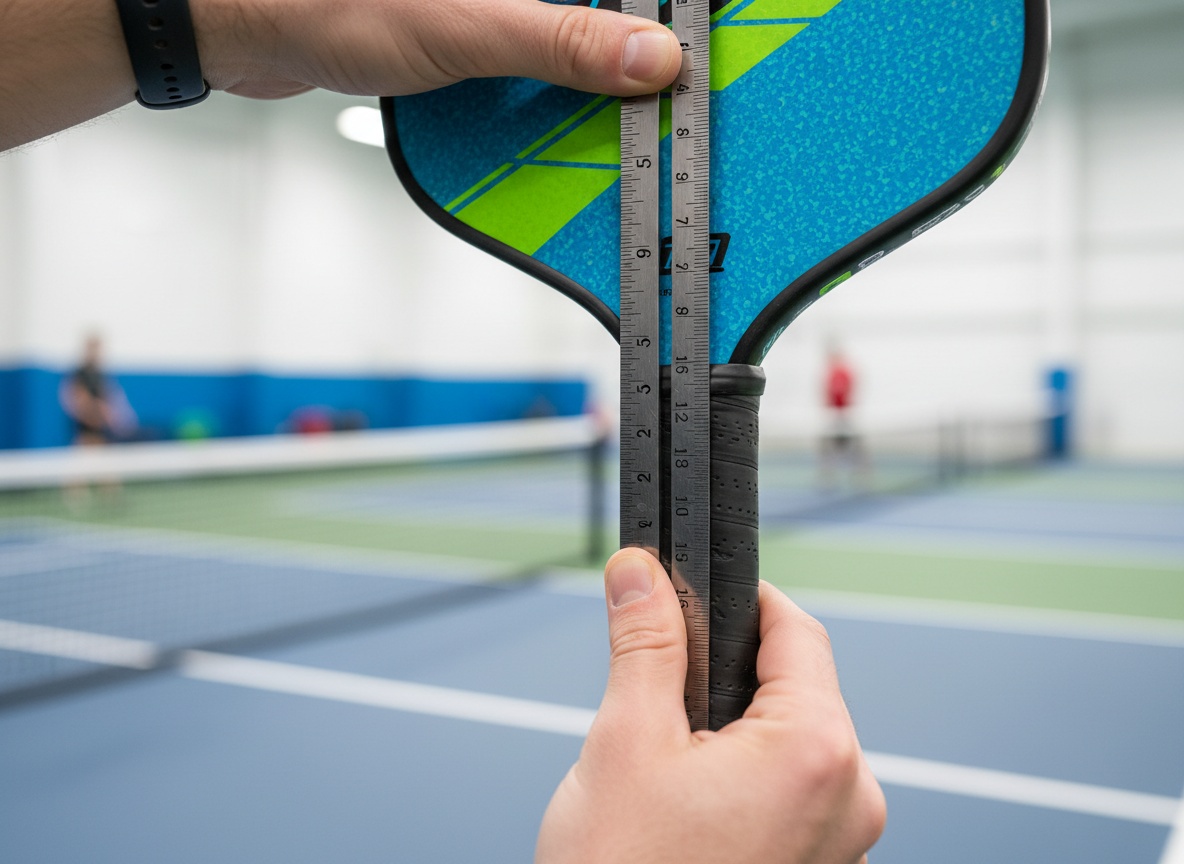
Wide-body paddles from brands like Selkirk and JOOLA in the $60–$120 range typically hit all these specs. You don't need to spend more than that to get a beginner-appropriate shape — that's a later problem.
Materials Breakdown: Polymer Core vs Foam Core (and Why It Matters for Your Skill Level)
Pickleball paddle cores are either polymer (polypropylene honeycomb) or foam. There's a third option — nomex honeycomb — but it's an older material found mostly on dated or cheap paddles. Skip it.
Polymer core is the standard, and for beginners it's the right call. It's quieter (important at noise-restricted facilities), absorbs pace consistently, and gives you reliable feel that doesn't shift much with temperature. At 16mm thickness, a polymer core paddle actively softens contact — the ball doesn't pop off the face, it settles. That translates to better placement on dinks and reset shots.
Foam core paddles are newer and some genuinely deliver a strong combination of power and feel. But foam cores have more "punch" off the face and less predictable feedback on soft shots — the performance also degrades faster as the foam compresses with use. For a beginner still developing touch, that extra punch amplifies errors the same way a heavy paddle does. Learn with polymer first. Experiment with foam once you're at 3.5+.
Core thickness, simplified:
- 16mm — most beginner-friendly; softens contact, maximizes control, gives the most forgiving sweet spot feel
- 14mm — faster and snappier, starts punishing off-center contact; better fit from 3.5 onward
- 13mm or thinner — for players with established mechanics who want to generate pace; not for beginners
If you can only see one number in the store or online listing, find "16mm" and "polymer core." Those two specs outperform any amount of marketing language about carbon fiber weave or spin-generating surfaces for someone who's still learning the game.
Grip Size: How to Measure Yours in 30 Seconds
Grip size affects how your wrist moves through contact — and getting it wrong creates real injury risk over time. Too small and you squeeze harder than you should, which leads to elbow issues. Too large and you lose wrist flexibility, slowing reaction time at the kitchen line.
The 30-second measurement (no chart required):
- Hold your dominant hand flat, fingers together, palm facing you
- Measure from the middle crease of your palm (the horizontal fold in the middle of your hand) to the tip of your ring finger
- That measurement in inches is your grip circumference
Sizing guide:
- Under 4.0" → Small (4.0" grip)
- 4.0" to 4.25" → Standard (4.25" grip)
- 4.25" to 4.5" → Medium-Large (4.5" grip)
When you're between sizes, go smaller. You can wrap an overgrip over the base grip to add roughly 1/16" of circumference — but you can't shrink a handle that's already too large. An overgrip also improves feel and sweat management regardless of size; most regular players use one from day one. Our overgrip buying guide covers which types work best and when to replace them.
How Much Should You Spend? The Honest Budget Breakdown
Three real price tiers for beginner paddles. One of them is a mistake.
Under $40 — skip it. At this price you're typically getting aluminum frames or non-standard core construction — and paddles that often aren't USA Pickleball approved. They play inconsistently, wear out fast, and you'll be buying a replacement within a season. That's not savings, it's deferred investment.
$60–$100 — the right zone for most beginners. You get proper polymer core construction, a genuine wide-body shape, and USA Pickleball approval (required for most recreational leagues and organized play). Pickleball Central's beginner paddle section has solid options throughout this range. Expect to use a paddle at this tier for 12–18 months before you outgrow it.
$120–$180 — worth it if you're already committed. At this price, surface materials and construction consistency improve meaningfully. You're buying a paddle that will still be appropriate for your game at 3.5+. If you're playing four or more times a week and you know you're sticking with the sport, this tier pays off over time.
Over $200 — not yet. Premium paddles optimize for spin generation, swing-weight tuning, and power-to-control ratios that require a year or more of play to actually utilize. Spending $250 on a first paddle is like buying racing slicks for someone who's still practicing parallel parking.
Run this self-assessment: if three or more of these describe your first few months of play, your paddle may be contributing to the problem:
- Popping balls up into easy-smash position when you try to play soft
- Forehand placement is inconsistent even when the contact feels centered
- Your arm fatigues before your legs do after a long session
- Hard drives feel impossible to redirect cleanly — not just difficult, but unpredictable
- Dinks regularly sail past the kitchen line
A 16mm polymer wide-body in the $60–$100 range gives your mechanics a cleaner learning environment. Once you're placing shots intentionally more than accidentally, that's when to start looking at what premium paddles add. In the meantime, your biggest skill leap will come from learning the third shot drop — no paddle manufactures that technique for you.

Complete Your Setup
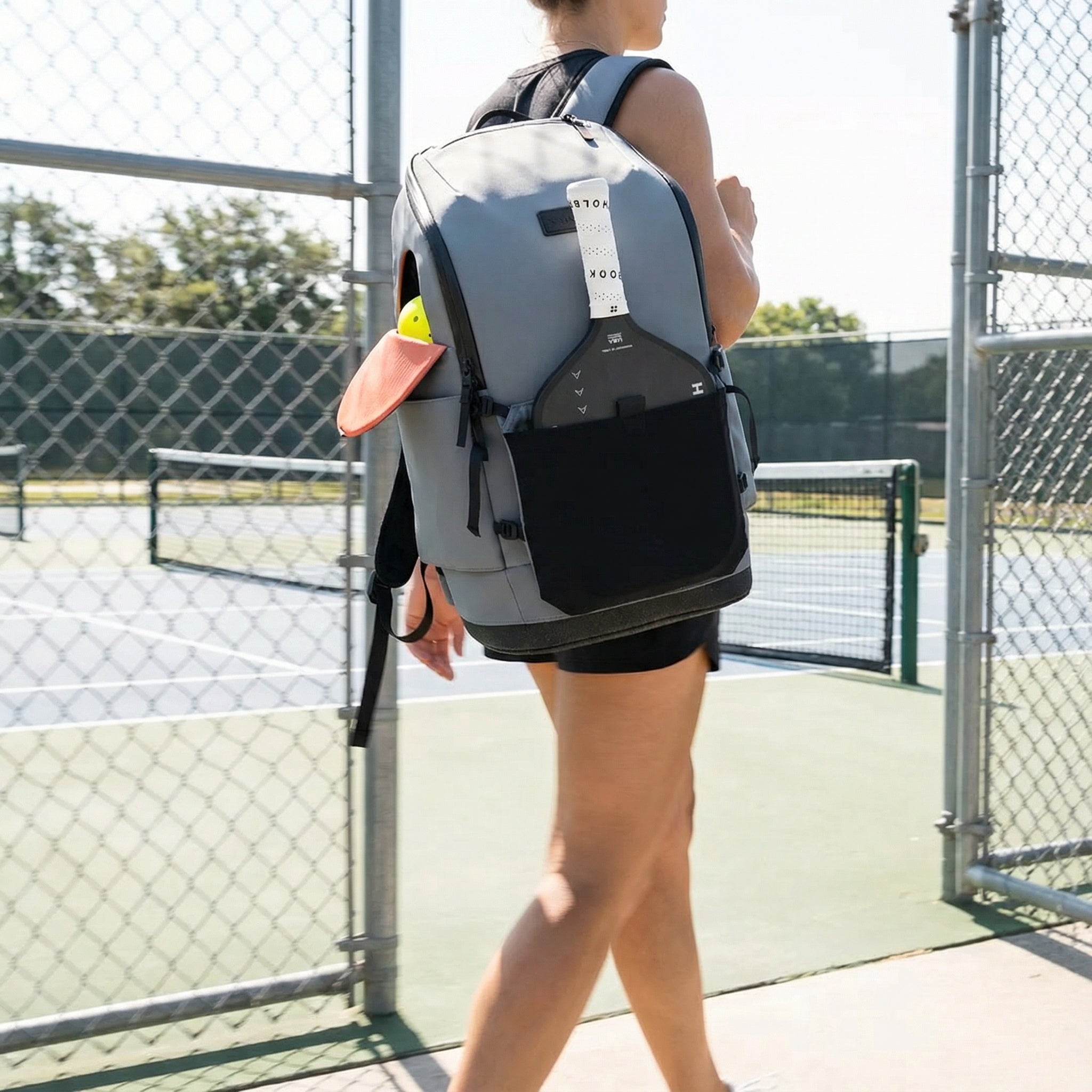
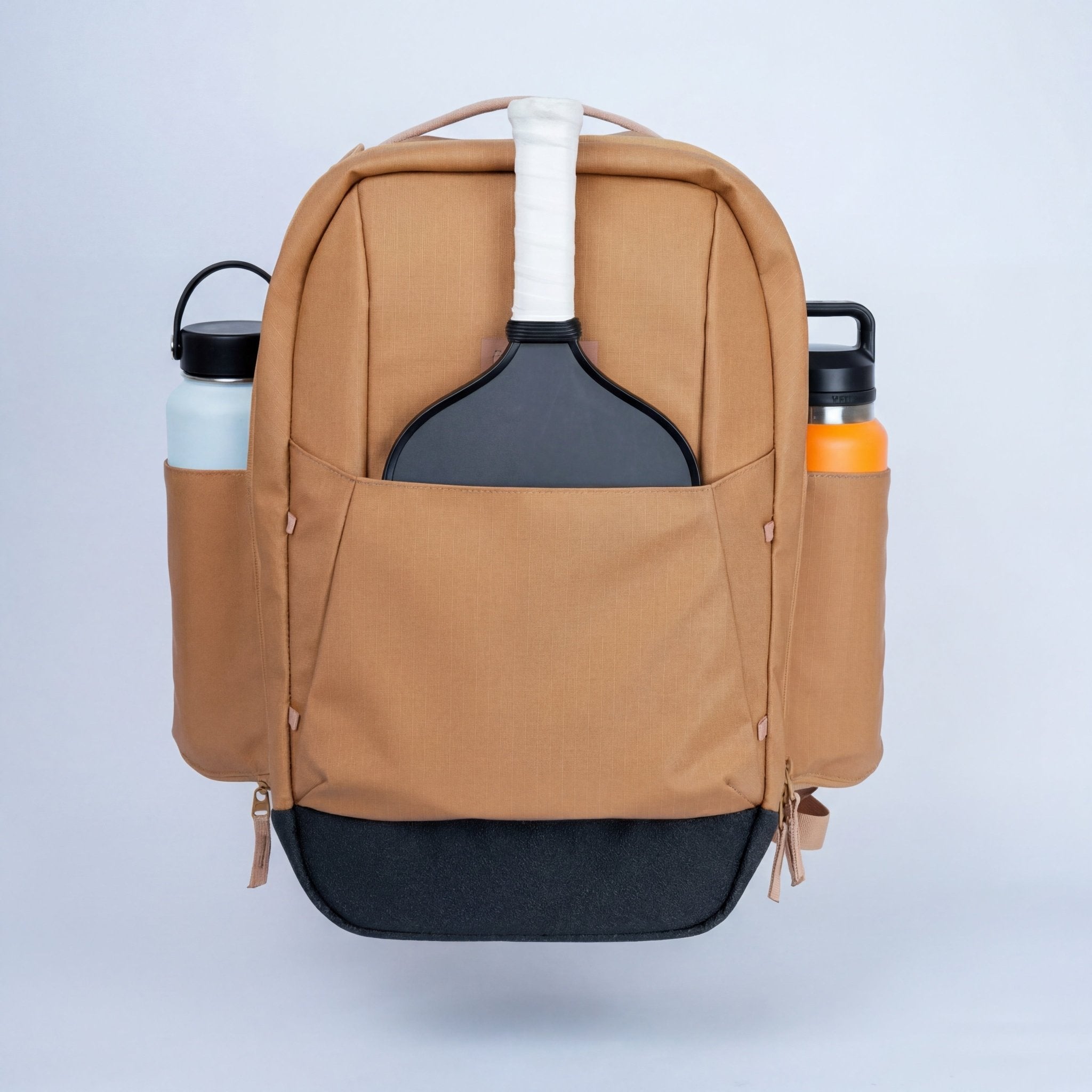
Got your paddle sorted? The next thing most beginners underestimate is where to carry it — along with shoes, balls, a water bottle, and the overgrip tape you'll start bringing once you know better. The Court Ranger V2 Backpack fits two paddles in its dedicated modular sleeve with a 16" padded laptop compartment and YKK AquaGuard weatherproof zippers. At $195, it's built for players who get out there 3+ times a week and need their gear organized without thinking about it.
FAQ: Common Beginner Pickleball Paddle Questions
What paddle should a beginner buy?
A wide-body paddle with a 16mm polymer core, weighing 7.5–8.2 oz, with a grip sized to your hand measurement (palm crease to ring fingertip). Budget: $60–$100. Those specs prioritize control and forgiveness — which accelerates skill development in your first 6–12 months more than any other paddle feature.
Is weight or power more important in a pickleball paddle?
For beginners, weight is more important than power. A lighter paddle (7.5–8.2 oz) gives you faster reaction time at the kitchen line and less arm fatigue over a long session. A heavy "power" paddle amplifies beginner errors — shots sail long, placement gets inconsistent. Control beats power for new players every time.
What is a sweet spot and why does it matter?
The sweet spot is the area on the paddle face that produces clean, predictable contact. Hit outside it and the ball wobbles, dies short, or sails. Wide-body paddles have larger sweet spots. Beginners who frequently miss center contact benefit most from the extra margin a forgiving wide-body shape provides — more usable hits, faster skill development.
Are wide-body paddles better for beginners?
Yes, for most beginners. Wide-body paddles have a larger sweet spot and are easier to control on soft shots at the kitchen line. Elongated paddles offer more reach and spin potential but have a narrower hitting zone — off-center contact costs you more on an elongated paddle, and that's a penalty beginners pay far more often than experienced players.
How much should a beginner spend on a pickleball paddle?
$60–$100 is the right starting tier. You get proper polymer core construction, a genuine wide-body shape, and USA Pickleball approval. Under $40 gets you low-quality construction you'll replace within a season. Over $150 buys premium features — spin optimization, swing-weight tuning — that your mechanics can't take advantage of yet.
What grip size is right for me?
Measure from the middle crease of your palm to the tip of your ring finger in inches. Under 4.0" = small grip. 4.0–4.25" = standard. 4.25–4.5" = medium-large. When in doubt, size down and add an overgrip — you can always build up with a wrap, but you can't shrink a handle that's already too large for your hand.

Leave a comment
This site is protected by hCaptcha and the hCaptcha Privacy Policy and Terms of Service apply.