

Last updated: June 2026
The first thing nobody tells you about a pickleball tournament is how much waiting you'll do. Between check-in, warm-up, pool play gaps, and the transition to bracket play, a typical local tournament fills six to eight hours — and only about half of that is you actually on the court.
Most first-tournament guides are checklists. This one is different: it walks you through the day in real time, from the parking lot at 6:30 AM to the drive home. Read it the week before. Skim it on the morning of. Your first tournament will make a lot more sense with this map in your head.
This article is part of our complete pickleball tournament guide for 2026.
Table of Contents
- What Actually Happens on Tournament Day (The Real Timeline)
- Check-In, Warm-Up, and the Wait That Surprises Every First-Timer
- How Pool Play Works (and Why Your First Match Is Also Data Collection)
- Bracket Play: The Switch From Round Robin to Single Elimination
- Between Matches: How to Use the Downtime Productively
- Etiquette First-Timers Get Wrong (and Don't Want to Learn the Hard Way)
- What to Pack for a Full Tournament Day (the Non-Obvious List)
- FAQ: First Pickleball Tournament Questions
What Actually Happens on Tournament Day (The Real Timeline)
Here's what a typical local or regional tournament looks like, hour by hour:
6:30 AM — Arrive. Even if your first match is at 8:00, arrive now. Parking at outdoor recreation complexes is confusing. Courts are spread out. The check-in table is usually not where the main entrance is. Give yourself 30 minutes just to find your bearings.
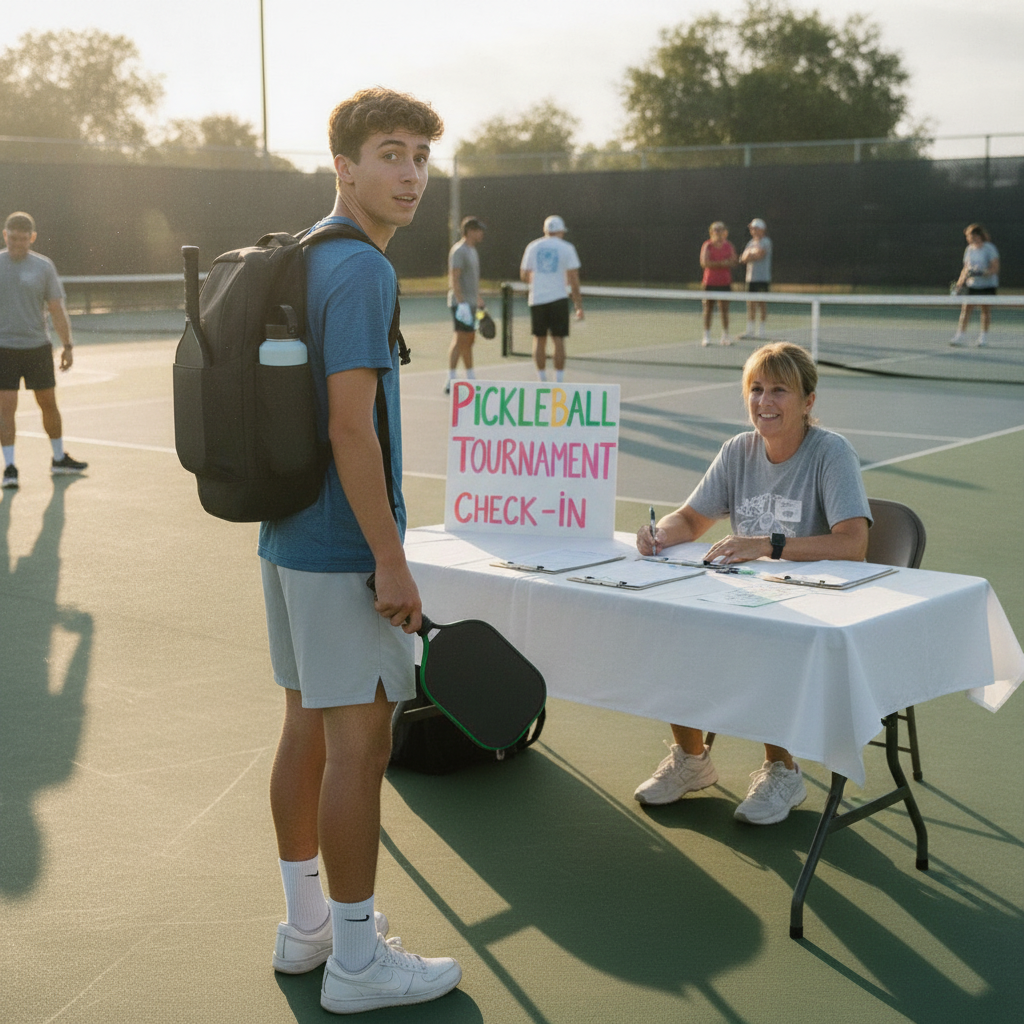
7:00 AM — Check-in. Find the registration table, confirm your name in the bracket, pick up your colored wristband or player card, and get your court assignment for pool play. This is also when you'll see the full bracket sheet for the first time. Scan it. Know who you're playing in round one.
7:15–7:45 AM — Warm-up window. Courts are open for warmup but not always your specific court. Hit with your partner, work through serve and return patterns, get your overhead working. This is not the time for full drilling — it's calibration. Get 15–20 minutes on the ball before you compete.
8:00 AM — First pool play match. Your pool plays round-robin, so you play every other team in your group. Match format is usually first to 11 (win by 2) or first to 15. The referee or tournament director calls courts. Pay attention to the timing board or app notifications — being late to a court can cost you a forfeit.
8:45 AM — The gap. Your first match ends. Your next one isn't for 45 minutes. This surprises virtually every first-timer. The schedule doesn't run back-to-back. Courts need to flip, scores get recorded, the next round gets organized. This is the gap you plan for. Hydrate, eat something small, stay warm, don't cool down completely.
9:30 AM and 10:30 AM — Rounds 2 and 3 of pool play. By now you've adapted to the pace. You know how the scoring calls work, you've read your pool, and you have a sense of which opponents are the toughest draws in bracket play.
11:00–11:30 AM — Results and seeding. Pool play ends. Scores get entered, seeds get posted for the elimination bracket. Find out your seed and your first bracket opponent. This is also when most first-timers discover they're playing someone from a different pool they haven't seen yet — that's normal.
12:00–12:30 PM — Lunch gap. In most local tournaments, there's a genuine 30–60 minute break between pool play finishing and bracket play starting. Plan for a real meal. Not a vending machine granola bar. Actual food.
1:00 PM onward — Bracket play. Single elimination. Lose once and you're done (unless it's double elimination — check your event format). The stakes shift. Take it seriously, but don't tighten up.
Deep runs in bracket play can take you through 3–4 more matches, potentially into late afternoon. If you make the finals, plan for an all-day commitment. Bring enough snacks, sunscreen, and water for 8–10 hours outdoors.
Check-In, Warm-Up, and the Wait That Surprises Every First-Timer
Check-in is handled by the tournament director or a volunteer team. You'll confirm your name, team, and division, and receive your player materials. In most modern tournaments, this is partially digital — your registration confirmation email (usually from Tourney Machine) acts as your ticket, and you check in by showing the QR code or your name.
A few check-in realities nobody mentions:
- Have your DUPR ID ready if the event required a verified rating. Some events check this at the table.
- Know your partner's name and confirm they've also checked in before you separate. Partners who check in independently sometimes end up with different bracket sheets.
- Get the tournament director's number or the event app notification settings before you leave the table. Court assignments change. You need to get those updates.
The warmup situation is genuinely chaotic at most local events. Courts are usually shared across pools in the early warmup window. Don't expect dedicated court time with your partner — find an open wall or a half-court and work through your fundamentals. The goal is to have touched a real ball 20+ times before your first match, not to run full court drills.
How Pool Play Works (and Why Your First Match Is Also Data Collection)
Pool play (round-robin) means everyone in your group of 3–6 teams plays everyone else. You're guaranteed a minimum number of matches — usually 3 to 5 — before the single-elimination bracket begins. This is the best feature of pool play for first-timers: you will play multiple matches no matter what happens.
Here's the mindset shift that separates players who improve from players who just survive their first event: treat pool play like data collection. Every match tells you something:
- Which of your shots holds up under pressure and which breaks down
- Where your serve tends to go when you're nervous
- How your body responds to the competitive environment after 30–40 minutes of play
- What your opponents are doing that you haven't seen in rec play
Winning pool play matters — it determines your seed for the bracket. But first-timers who fixate entirely on winning the first round and don't observe anything end up repeating the same mistakes all day. Watch. Adjust. The players who improve fastest from their first tournament are the ones who left with specific observations, not just a win-loss record.
Score-calling etiquette: in most local events, players call their own score before serving. The server calls the score as "server score – receiver score" (in doubles, it's "server score – receiver score – server number"). Call it loud enough to be heard. If you didn't hear the score, ask. This is expected and normal, not embarrassing.
Bracket Play: The Switch From Round Robin to Single Elimination
Once pool play ends and seeds are posted, the format shifts. In single elimination, one loss ends your day. In double elimination (less common at local events), one loss drops you to a consolation bracket where you can still win the event — but you need to win every match from that point forward.
The mental adjustment is real. Pool play has a built-in cushion — one bad match doesn't eliminate you. Bracket play doesn't. The tension is different. Players who haven't competed before often get tighter in bracket play than they did in pool play, even if they're technically warmed up and familiar with their opponents.
For the competitive side of this: our tournament strategy guide covers how to scout opponents in warm-up, manage momentum swings, and adjust between games. Worth reading before your first event.
"The switch from pool play to bracket play is where first-timers either find their competitive edge or let the pressure take over. The difference is almost never about skill level — it's about whether you've decided why you're there. Play to win the next point. That's the whole job." — Grub
Between Matches: How to Use the Downtime Productively
You have 30–60 minutes between most matches. Most first-timers either walk around watching other courts or sit on their phone. Neither is wrong, but there's a better use of the gap:
First 10 minutes: Walk off the adrenaline from the last match. Don't immediately analyze every mistake — you'll spiral. Get water, eat something, let your heart rate settle.
Middle 20 minutes: If you know your next opponent, watch them play if they're on a nearby court. One specific pattern to look for: where does their return of serve go when they're under pressure? Do they dink cross-court or middle? Do they speed up off predictable backhand returns? One adjustment you make before the next match is worth more than ten mental reps of your last match's errors.
Last 10 minutes: Light hitting, a few serves, get the ball on your paddle. Don't launch into a full warmup — your body is already warm from pool play. The goal is re-calibration, not re-warming.
Nutrition timing matters more than most first-timers realize. A hard tournament match burns 300–600 calories. If you're playing 6+ matches across 8 hours, you need to fuel between rounds — not just at lunch. Bring food that digests fast: bananas, rice cakes, electrolyte packets, protein bars without a lot of fiber. Avoid anything that sits heavy. The tournament venue food (if any) is usually concession-stand quality. Pack your own.
Etiquette First-Timers Get Wrong (and Don't Want to Learn the Hard Way)
Tournament etiquette isn't complicated, but first-timers who show up without knowing it draw attention they don't want.
Line calls: In local and regional events without line referees, players call their own lines. The ball is out only if you're clearly sure. When in doubt, it's in. Calling everything close as "out" makes you a target for disputes and reputation damage that follows you in a local pickleball community. Err on the side of giving the benefit of the doubt.
Score calling: Call the score before every serve. Every time. Even if you both know what it is. It's a USA Pickleball rule, it prevents disputes, and skipping it annoys experienced players.
Kitchen faults: If you step into the kitchen on a volley, call it on yourself immediately. Don't wait for your opponent to catch it. Calling your own faults is standard at all levels below professional.
Time between points: Players have up to 10 seconds between points. Don't rush your opponents, but don't extend the gap unnecessarily to throw off their rhythm either. Both are bad form.
Post-match: Tap paddles (or shake hands) after every match — win or lose, including the rounds you lose badly. It's the universal close-out ritual. Skipping it is noticed.
What to Pack for a Full Tournament Day (the Non-Obvious List)
Everyone will tell you to bring paddles, water, and sunscreen. Here's what they don't mention:
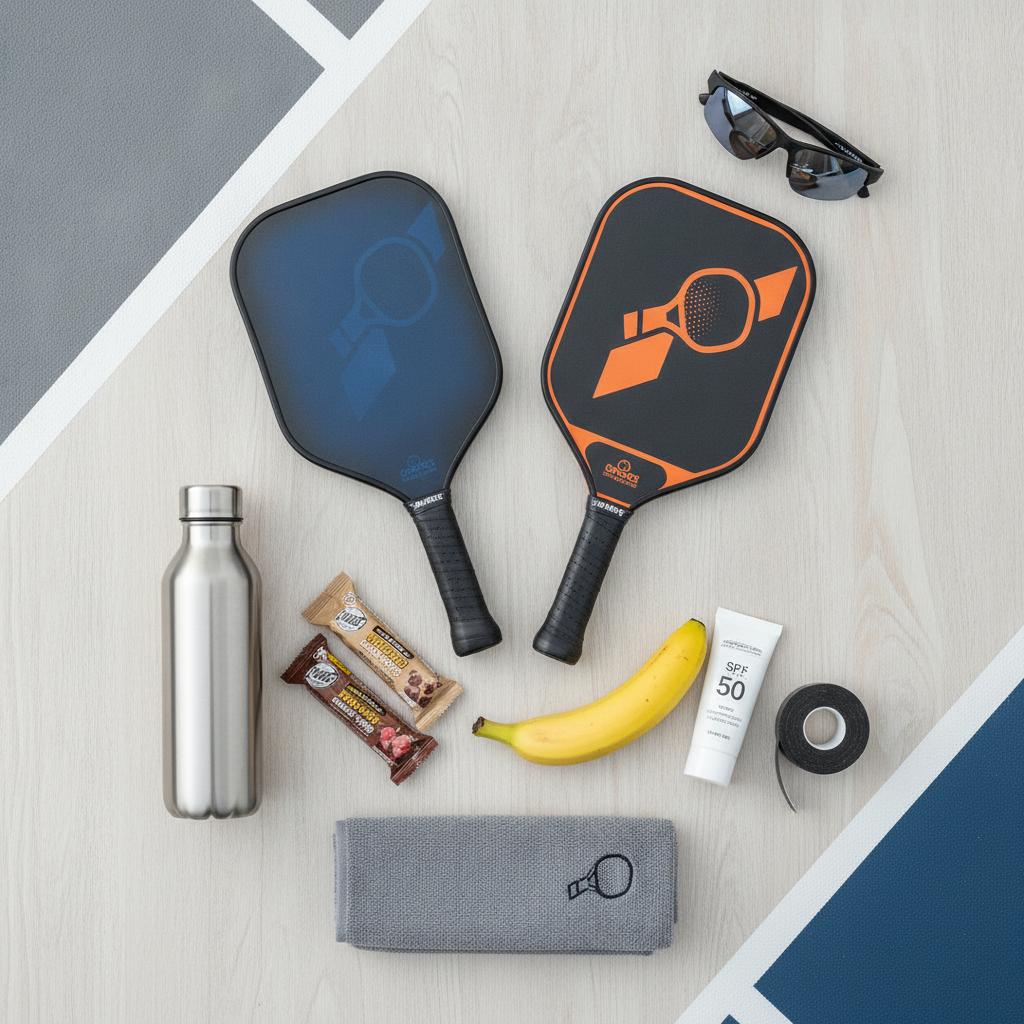
- A backup paddle. If you're playing 6+ hours and your primary paddle's grip degrades, your third-shot drop degrades with it. A backup isn't paranoia — it's preparation.
- Extra overgrip. Sweaty hands in rounds 3 and 4 are real. Keep a fresh grip in your bag. Takes 3 minutes to replace between matches.
- A change of shoes. Outdoor concrete courts eat shoe cushioning. If you're playing 4+ hours on hard courts, your feet will notice by late afternoon. A second pair — even the same model — gives fresh cushioning for bracket play.
- Electrolytes. Not just water. Cramping in a semifinal because you've been sweating for six hours and only drank water is a brutal way to end your tournament.
- A small first-aid kit. Blister tape, ibuprofen, a compression wrap. Tournaments don't have medical tents at the local level.
- A printed or downloaded bracket. Cell signal at outdoor rec facilities is often poor. Screenshot your pool draw and bracket before you leave home.
- Cash. Some venues are cash-only for food, parking, or last-minute equipment. Don't get caught without it.
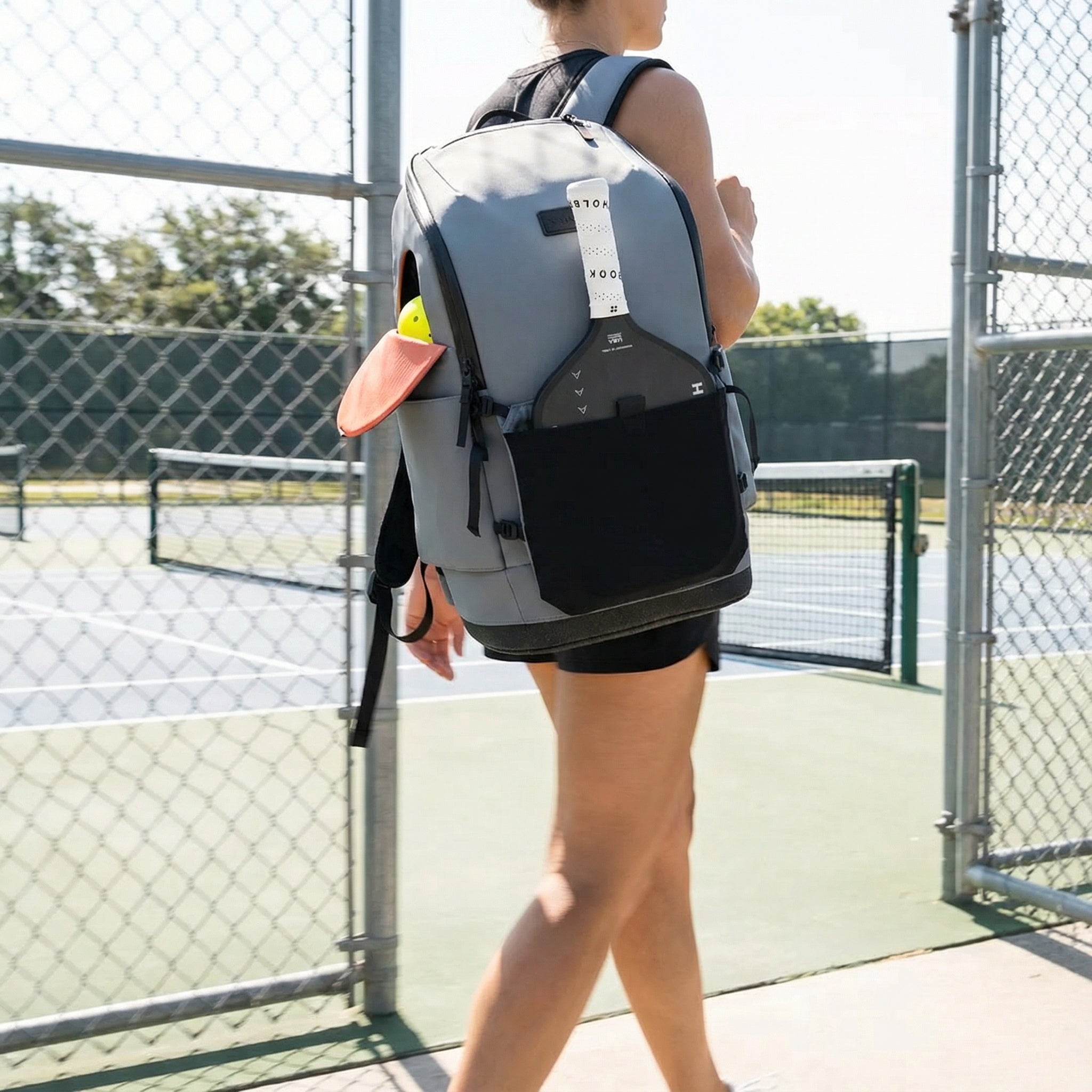
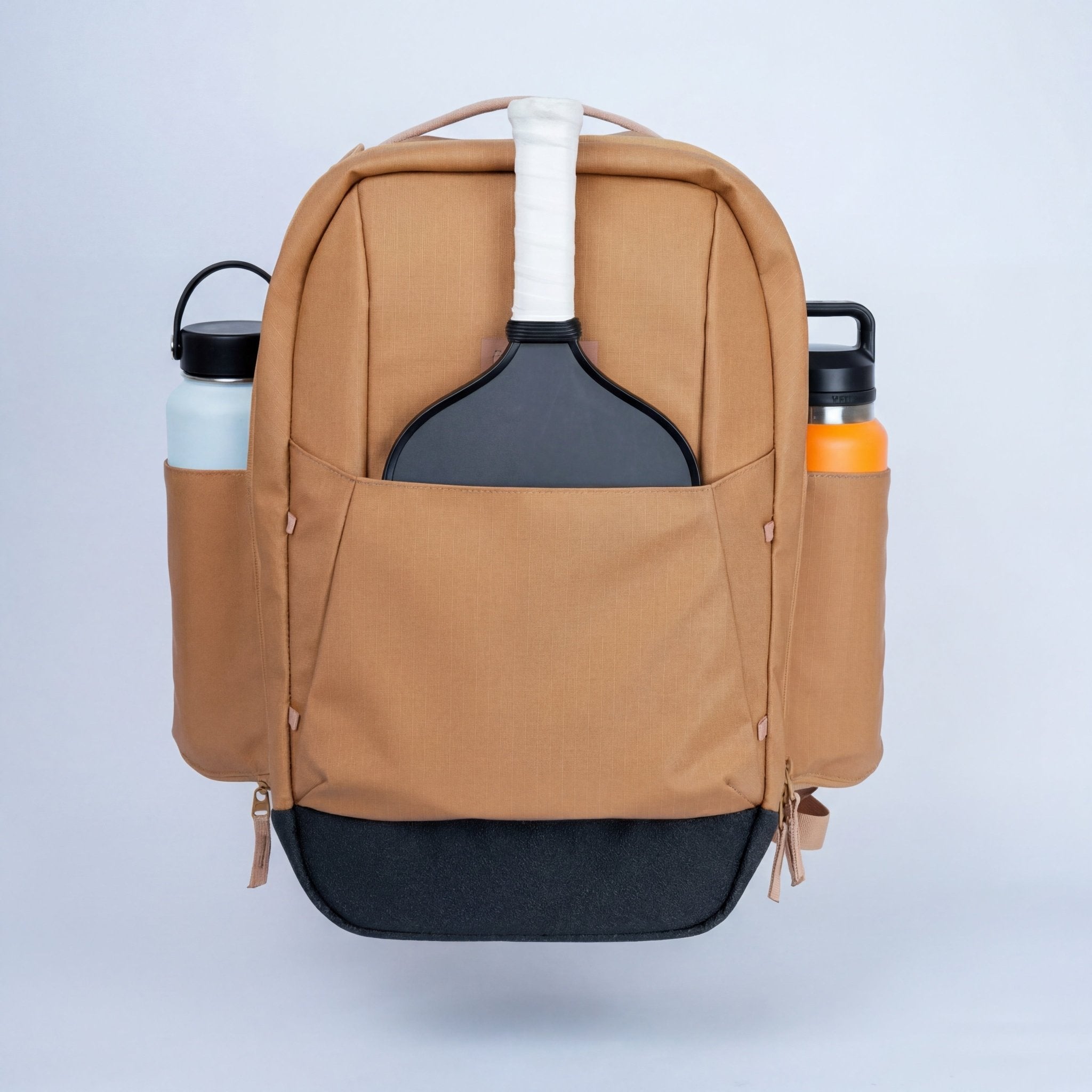
The bag you carry all this in matters more than it sounds. Digging through a disorganized gym bag between matches — when you have 8 minutes before you're due on court — adds stress to a day that already has plenty. You want compartments that work.

The Court Caddy ($325) was built specifically for tournament days like this — modular paddle sleeve fits up to 4 paddles, separate compartments for nutrition, recovery gear, and electronics, YKK AquaGuard zippers that hold up in outdoor heat all day. For first-timers not yet sure how deep they'll go on tournaments: the Court Ranger V2 at $195 gives you the same organizational system at a lower investment. Both carry everything on this list without the dig-and-search problem.
For a comprehensive gear breakdown: see our complete tournament packing list.
FAQ: First Pickleball Tournament Questions
What should I bring to my first pickleball tournament?
Two paddles (one backup), water bottle, electrolyte packets, energy bars, extra overgrip, sunscreen, a hat, a change of shoes if playing outdoors for 4+ hours, cash, and a tournament bag with enough compartments to keep it all accessible between matches. See our full packing list for the complete breakdown.
How long does a pickleball tournament last?
Most local and regional tournaments run 6–8 hours for players who make the bracket rounds. Pool play alone typically runs 3–4 hours. If you reach the finals, plan for a full day commitment. Arrive expecting to stay all day and leave early if things go differently.
How are pickleball tournaments structured?
Most local events use pool play (round-robin) to guarantee minimum matches, followed by single or double elimination bracket play. Pool play determines your seed going into the bracket. In pool play, you play every other team in your group — usually 3 to 5 matches guaranteed before the elimination phase begins.
Are pickleball tournaments intimidating for beginners?
Yes, for the first 30 minutes. Then no. The most surprising thing most first-timers report: the environment is much friendlier than expected. Even competitive players call their own faults, congratulate good shots, and tap paddles after every match. The etiquette culture in pickleball is generally warm — you're competing, not fighting.
What do I wear to a pickleball tournament?
Court shoes (not running shoes — lateral support matters for 6+ hours of play), moisture-wicking athletic wear, a hat for outdoor events. USA Pickleball doesn't enforce dress codes at local events. Dress for the weather and comfort, not for how it looks.
Can you enter a pickleball tournament as a beginner?
Yes. Most events have 3.0 or 2.5 divisions specifically for newer players. Register one half-level below your honest self-assessment if you're unsure. The goal of the first tournament is to learn what competitive play feels like — winning is secondary to finishing with a clear picture of what to work on next.

Leave a comment
This site is protected by hCaptcha and the hCaptcha Privacy Policy and Terms of Service apply.