

Last updated: July 2026
For three months, my third shot drops landed in the kitchen every single time. Trajectory was fine. Placement was right. Opponents kept attacking them anyway. I couldn't figure it out until a 4.0 player watched me drill for five minutes and said something I hadn't considered: "Your drops are flat. There's no spin on them. A flat drop that lands in the kitchen is still easy to attack." That was the whole problem — I'd been solving placement when the real issue was contact mechanics. This guide covers what most third-shot-drop tutorials skip entirely: the physics of spin at contact, and why backspin and topspin turn an attackable ball into one that dies at your opponent's feet.
Disclosure: This post contains affiliate links to Pickleball Central. If you purchase through our links, FORWRD earns a small commission at no extra cost to you. We only link to products we'd recommend regardless.
Table of Contents
- Why Your Drop Isn't Sinking
- Topspin vs Backspin: Which One Actually Works
- The Mechanics: Grip, Paddle Angle, Motion
- The Soft Hands Concept
- Progression Drills
- FAQ: Third Shot Drop Spin
Why Your Third Shot Drop Isn't Sinking (It's Usually the Spin)
A third shot drop that sits up isn't missing its target — it's missing its spin. When a ball has zero rotation, it bounces to a predictable height and your opponent reads it immediately, steps into the kitchen, and attacks from shoulder height. That's not a shot selection failure. It's a contact mechanics failure.
Two types of rotation matter for drops: topspin (forward rotation that pulls the ball down during flight and kicks forward on the bounce) and backspin (backward rotation that makes the ball die on landing and stay low). A flat drop — no spin at all — gives opponents the most comfortable attack ball you can hand them. It bounces predictably. They wind up. You lose the point before you've even reached the kitchen.
Quick self-diagnostic: If your opponent consistently attacks your drops from above net height, your paddle face is either too open at contact (floating ball) or your swing is completely flat. Both mean you're generating no rotation.
Most rec players don't realize the spin problem is invisible from the rally. You're watching WHERE the ball lands, not what it does after landing. But a ball that sinks vs. a ball that sits up at the exact same landing spot are completely different shots. One forces your opponent to hit upward at net height. The other lets them wind up from shoulder height. That difference is entirely about contact.
"At 3.0, most players are trying to land the drop in the right spot. At 3.5 and above, they're trying to make it behave in a way no one can attack. That shift — from placement to ball behavior — is where the third shot drop actually becomes a weapon." — Grub, FORWRD co-founder
Topspin vs Backspin for Third Shot Drops: Which One Actually Works
Both work. They work differently. And here's what almost nobody says out loud: backspin (slice) is easier to learn for most recreational players than topspin.
Topspin on a third shot drop requires a controlled low-to-high brushing motion at extremely low swing speed — a finesse version of a stroke more commonly associated with driving the ball. Get the speed slightly wrong and your drop becomes a drive. Backspin requires a simpler high-to-low cut with an open paddle face, which is more intuitive at low pace and more forgiving of timing errors.
Here's the critical distinction almost every guide misses: drop-shot spin and serve spin are not the same technique, even for the same spin type. Players watch serve technique videos, learn to apply a big low-to-high brushing motion for topspin, then apply that same motion to drops — and they end up with a full-pace groundstroke. Drop topspin is a whispered version of serve topspin. Same contact angle, dramatically different swing speed.
| Shot Type | Contact Point | Paddle Angle | Swing Direction | What It Does |
|---|---|---|---|---|
| Serve topspin | High on ball face | Closed, aggressive | Low-to-high, fast | Fast kicking bounce, power-driven |
| Drop topspin | Center of ball | Neutral to slightly closed | Low-to-high, slow | Pulls ball down during flight, lands soft |
| Drop backspin (slice) | Center-to-bottom | Open face (30–45°) | High-to-low brush | Dies on bounce, skids low, hard to attack |
| Flat drop | Center of ball | Square face | Horizontal swing | Predictable bounce — sits up, easy to attack |
For recreational players drilling once or twice a week: start with backspin. Once your slice drop lands in the kitchen 8 out of 10 times with a consistent low bounce, layer in topspin as a variation. The progression matters — topspin drops require more precise timing and swing control that builds on the mechanical awareness you develop with slice first.
When to use each in a real point: backspin drops work particularly well on low balls and when you need maximum control. Topspin drops are more useful when you have extra time to set up and want slightly more net clearance (topspin brings the ball down faster on the far side). Against hard net-rushers, topspin gives you more margin. Against patient kitchen players, a dying slice drop forces the more difficult pickup.
The Mechanics: Grip, Paddle Angle, Shoulder Motion, Follow-Through
These steps apply to the backspin/slice drop — the recommended starting point. Topspin adjustments are noted in the table above.
Step 1: Grip Pressure
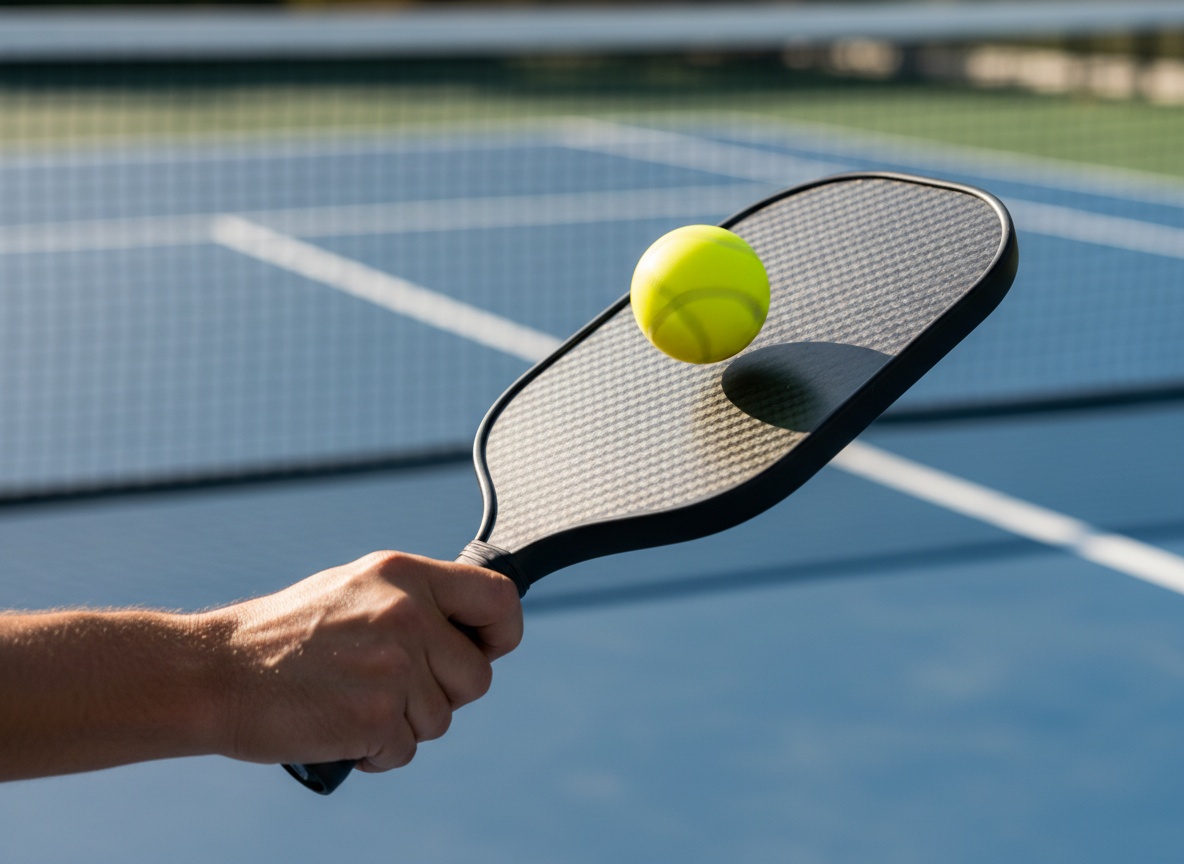
Hold the paddle at 4–5 out of 10 pressure. Not loose enough to wobble at contact, not tight enough to lock up your forearm. Tight grips kill spin — they remove the paddle head freedom that lets you brush across the ball. If you're gripping the paddle the way you'd hold a hammer swinging at a nail, you're gripping too hard for drop mechanics.
Step 2: Paddle Face Angle
For backspin: open the paddle face to roughly 30–45 degrees at the starting position — the paddle pointing slightly skyward before the swing begins. At contact, the face brushes across and under the ball. Not full open (that skies the ball) but enough angle to cut underneath and create backward rotation. Think about the leading edge of the paddle face cutting under the ball rather than the face pushing square through it.
Step 3: Shoulder-First Motion
The swing initiates from the shoulder, not the wrist. Your arm stays relatively straight — no elbow break mid-swing. Think of swinging a gate on a hinge: the shoulder is the hinge, the paddle sweeps through the contact zone. A wrist flick adds unwanted pace and disrupts your angle consistency. Keep the wrist firm (not stiff — firm) throughout the stroke.
Step 4: Contact Point
Contact happens slightly in front of your body. Not off to the side, not behind the hip. Being in front is where you have maximum control over paddle angle — you can see the face, you can adjust through the swing zone. "Chasing the ball" with the paddle (letting the ball come to you, then swinging through) is better than reaching out and stabbing laterally.
Step 5: Follow-Through Low
After contact, the paddle follows through low and forward — not skyward. A low follow-through keeps the spin tight and controls trajectory. If your follow-through finishes above shoulder height, you've transitioned into a lifting motion that flattens out the spin and adds unwanted loft to the shot.
For a deeper breakdown of when to use drops vs. drives, see our Pickleball Shot Selection Strategy guide.
The "Soft Hands" Concept — Why Wrist Firmness Controls Your Spin More Than Stroke Speed
Soft hands doesn't mean loose hands. That's the part most coaching cues get wrong.
Soft hands means the muscles up your forearm are relaxed during the stroke — not limp, but not tensed. When your forearm is tight, you're swinging with your whole arm as a rigid unit. Contact becomes stiff. You get less paddle head velocity at the contact zone, which means less spin. The paddle pushes the ball instead of brushing it.
The mental image that actually works: You want the paddle head to brush across the ball, not push through it. A brush requires the paddle head to move slightly faster than your arm at the contact point — that small differential creates rotation. A push transfers force in a straight line without rotating the ball at all.
Firm hands at the moment of contact, relaxed forearm throughout the stroke. Your shoulder and arm handle movement; the paddle head generates spin. Think whip, not hammer.
One drill that teaches this in about five minutes: hold the paddle loosely, toss a ball in the air yourself, and try to cut underneath it with a slow high-to-low motion. If the ball backspins back toward you after contact, you've got the right feel. If it goes forward with no spin, you're pushing. Run 15–20 reps until you can reliably produce backward rotation on a self-toss before moving to full drop mechanics.
Progression Drills: Wall Solo → Partner Court → Match Scenario
Drill 1: Wall Backspin Feed (Solo, 5 minutes)
Stand 8–10 feet from a wall. Self-feed the ball and practice the slice contact: open face, high-to-low brush, follow through low. Target: the ball bounces back toward you off the floor with backspin. If it bounces away from you, you're pushing. If it doesn't come back far enough, your face is too closed at contact. Run 20 reps per session before moving to live drops.
Drill 2: Cross-Court Feed Drops (Partner, 10–15 minutes)
Partner stands at the kitchen line. You're at the baseline. Partner tosses soft balls from their side; you practice full slice drops into the kitchen. Score only drops that land in the kitchen AND don't bounce above net height on your partner's side. Most players hit 4 out of 10 on day one. Target 8 out of 10 before adding topspin variation. This drill reveals your actual control rate faster than anything else.
Drill 3: Live Third Shot Scenarios (Match Practice)
Play points from 0-0-2. Serve, then you're automatically in third-shot decision mode. Constraint: if your third shot gets attacked from above net height, the point is considered lost — regardless of what happens after. This trains you to care about spin quality, not just getting the ball over the net and into the kitchen area.
For when to go with a speed-up instead of the drop: see our guide on the Pickleball Speed Up Shot. And if you're drilling to prevent overhead attacks off pop-up drops, our Pickleball Overhead Smash Strategy shows exactly what your opponent is reading when your drop sits up.
External resource: USA Pickleball's guide to mastering topspin drops covers foundational technique from an official perspective.
FAQ: Third Shot Drop Spin Questions
How do you add topspin to a third shot drop?
Use a low-to-high brushing motion at the center of the ball with a neutral-to-slightly-closed paddle face — and cut your swing speed by roughly 40% compared to a serve. Drop topspin is a whispered brushing motion. Most players overtrain stroke speed and end up with a drive instead of a drop. The contact angle is the same; the pace is almost nothing.
What's the difference between backspin and topspin in a drop shot?
Topspin pulls the ball down during flight and causes a forward-kicking bounce after landing. Backspin makes the ball die on contact with the court, staying low and skidding rather than sitting up. Both are harder to attack than a flat drop. Backspin is generally easier for recreational players to learn first; topspin requires more precise swing timing but gives slightly more net clearance margin.
Why doesn't my third shot drop sink like the pros?
Usually one of two causes: flat contact with no spin, or too much swing pace. Pro drops sink because topspin is actively pulling the ball down during flight. Without spin, a ball travels flat and floats to an attackable height. Reduce your swing speed significantly, focus on brushing the paddle face across the ball, and prioritize rotation over placement at first.
What grip should I use for a spinning drop shot?
A continental grip — roughly the same hand position as a hammer grip — gives you the most natural ability to adjust paddle angle for both topspin and backspin drops. Eastern grips favor topspin; continental is the most versatile for mixing spin types during a rally and is what most players settle into for third shot work specifically.
Does a textured paddle help with third shot drop spin?
Yes, meaningfully. Raw-carbon and gritty-faced paddles generate significantly more spin than smooth polymer faces because there's more friction at contact. A textured face makes spin technique noticeably easier to execute — especially for backspin slice where that surface grip on the ball does a lot of work. Selkirk's raw carbon paddles and JOOLA thermoformed models at Pickleball Central are solid options if you're looking to upgrade specifically for spin performance.
How do soft hands affect drop shot spin?
Relaxed forearms let the paddle head brush across the ball rather than push through it — and that brush is what creates rotation. Tight forearms, gripping at 7–8 out of 10, stiffen the swing and produce a push instead of a brush. Hold at 4–5 out of 10 throughout the stroke, with firm paddle contact at the moment of impact, not a death grip on the handle the whole time.

Leave a comment
This site is protected by hCaptcha and the hCaptcha Privacy Policy and Terms of Service apply.